
Military Art: WWII
Online information about American military art from sources other than Resource Library
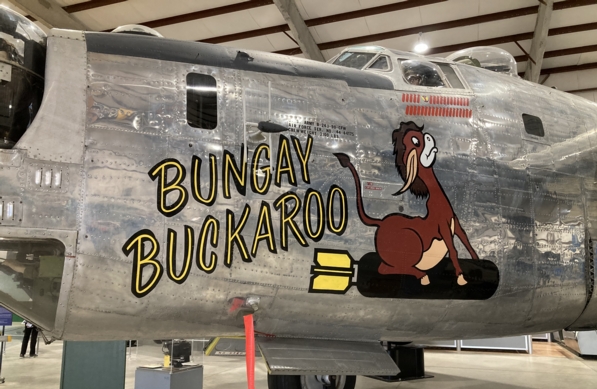
(above: unidentified artist, WW II U.S warplane, Pima Air & Space Museum, Tucson, AZ. Photo, 2022, Barbara Hazeltine)
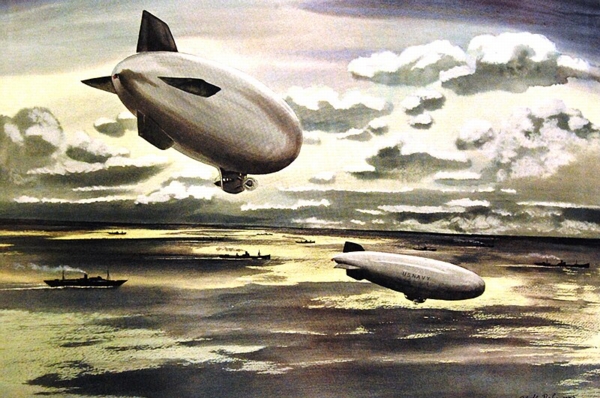
(above: Adolf Dehn, The Convoy Brook, Lot 3124-7: Paintings of Naval Aviation during World War I. Abbott Collection. #59: National Museum of the U.S. Navy. Public domain via Wikimedia Commons*)
American Artists in Uniform, World War II Experience from Brown University. Accessed August, 2015.
Ansel Adams's Photographs of Japanese-American Internment at Manzanar is a collection from the Library of Congress, which says:" Although a majority of the more than 200 photographs are portraits, the images also include views of daily life, agricultural scenes, and sports and leisure activities... When offering the collection to the Library in 1965, Adams said in a letter, "The purpose of my work was to show how these people, suffering under a great injustice, and loss of property, businesses and professions, had overcome the sense of defeat and dispair [sic] by building for themselves a vital community in an arid (but magnificent) environment...." Accessed 11/16
Arthur Beaumont: Art of the Sea is a 2019 exhibit at the Bowers Museum of Cultural Art which says: "His body of work includes numerous portraits of specific vessels, including mighty aircraft carriers and destroyers as well as personal yachts of presidents and celebrities. Beaumont aimed to portray not only admirals but also common sailors and soldiers." Also see biography at official website of Arthur Beaumont. Accessed 6/20
Arthur Szyk: Soldier in Art is a 2017 exhibit at the New-York Historical Society which says: "Arthur Szyk, the great 20th-century activist in art, confronted the turbulent, hate-filled period with forceful artistic depictions caricaturing Hitler, Mussolini, and Hirohito as the evil architects of their regimes' destructive and inhumane policies." Accessed 11/17
"A bold brush beyond battles: as part of the World War II Art Unit in Latin America -- Frank Mechau captured unusual aspects of the conflict, yet his true passion was rooted in the spirit of the West" by Caleb Bach, is a 2004 online article from the Organization of American States . In the online article Caleb Bach says: "The frenzied splendor of wild horses in full gallop, weary ranch hands coming to town on a Saturday night, the Rockies' peaceful majesty. This was the world Frank Mechau knew best. But for a few years during World War II, this Colorado artist so rooted in the western landscape joined others of his generation across the U.S. to witness firsthand and illustrate Allied war efforts for readers at home." Accessed 7/23
Camouflage Rhythms: Artwork by Juliette May Fraser is a 2017 exhibit at the Honolulu Museum of Art which says: "Camouflage Rhythms: Artwork by Juliette May Fraser features oil and watercolor paintings created by Fraser during World War II when she worked side-by-side with lei sellers making camouflage nets for the Army Corps of Engineers. Artists such as Fraser were recruited for their acumen with color, composition, and the painting and dyeing process." Also see Wikipedia entry. Accessed 5/17
Combat Artists of World War II from PBS. Accessed August, 2015.
Ghost Army: The Combat Con Artists of World War II is a 2023 exhibit at the Nevada Museum of Art https://www.nevadaart.org which says: "Activated on January 20, 1944, the 23rd Headquarters Special Troops, known as the "Ghost Army," was the first mobile, multimedia, tactical deception unit in US Army history. Consisting of an authorized strength of 82 officers and 1,023 men under the command of Army veteran Colonel Harry L. Reeder, this unique and top-secret unit was capable of simulating two whole divisions -- approximately 30,000 men -- and used visual, sonic, and radio deception to fool German forces during World War II's final year." Accessed 7/23
HOW TO KILL: WORLD WAR II WATERCOLORS BY ROBERT ANDREW PARKER is a 2015 exhibit at the Arkansas Arts Center which says: "In the war images violence is stranded in vast landscapes, gun scopes isolate men out, and empty space surrounds post-battle debris. Death is the final coda on disconnection, the ultimate severance of man from the world. The effect is bleak but not cold. Parker's color dims but is not harsh, his line wavers at its most agitated but never turns jagged. His refusal to grate has the effect of gentleness, a remembrance that is both tender and clear eyed." Accessed 2/17
Lima Company Memorial at Ohio Statehouse. Accessed August, 2015.
Military Aircraft Nose Art from University of Arizona and Dr. James S. Griffith. Accessed August, 2015.
Naval Art of Thomas Hart Benton from the Navy Art Collection (WWII) Accessed August, 2015.
Philip Guston and Iowa is a 2017 exhibit at the University of Iowa Museum of Art which says: "This special presentation of 12 works by Philip Guston in the UIMA collection emphasizes the renowned artist's production during the three and a half year period he was a (State) University of Iowa painting and drawing instructor and visiting artist (Fall 1941-Spring 1945)." Accessed 9/17
Posters and Patriotism: Selling World War I in New York is a 2017 exhibit at the Museum of the City of New York which says: "When the United States entered World War I in April 1917, New York City's artists and illustrators were enlisted in the war effort. Many of them worked for the federal government's new Division of Pictorial Publicity. Posters and Patriotism: Selling World War I in New York examines the outpouring of posters, flyers, magazine art, sheet music covers, and other mass-produced images created by these New Yorkers to stir the American public to wartime loyalty, duty, and sacrifice." Also see 4/6/17 Reuters article. Accessed 5/17
Thomas Hart Benton and the Navy is a 2017 exhibit at the Chrysler Museum of Art which says: "A heroic period in American history as captured by one of the quintessential American painters of the era: That's the story with Thomas Hart Benton and the Navy, an exhibition of steel, smoke, saltwater, and sinew all captured in a signature style." Accessed 6/17
Thomas Hart Benton and the Navy is a 2018 exhibit at the Cummer Museum of Art & Gardens which says: "Thomas Hart Benton and the Navy presents an important series of 24 paintings and drawings that capture the heroic actions and moments of respite that made up life aboard submarines and around shipyards during World War II." Accessed 3/18
U.S. Naval Art of Arthur Beaumont from Arthur Beaumont Naval Art Website. Accessed August, 2015.
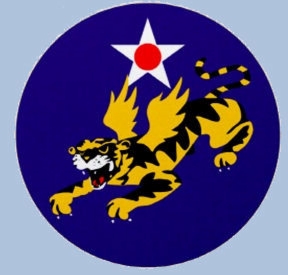
(above: Emblem of the USAAF 14th Air Force,1945, United States Army Air Force via National Archives, USGOV-PD. Public domain, via Wikimedia Commons*)

(above: Jon Whitcomb, I'm Proud of YOU FOLKS too!, c. 1944, produced for the US Government, National Archives at College Park, Still Picture Records Section, Special Media Archives Services Division (NWCS-S). Public domain via Wikimedia Commons*)
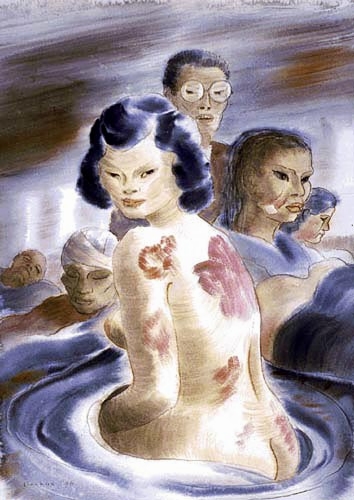
(above: Standish Backus, At the
Red Cross Hospital Hiroshima, c. 1946, Naval History and Heritage
Command. Public domain via Wikimedia Commons*)
 Return to Military and Wartime Art or
Topics in American Representational Art
Return to Military and Wartime Art or
Topics in American Representational Art
*Tag for expired US copyright of object image:

Links to sources of information outside of our web site are provided only as referrals for your further consideration. Please use due diligence in judging the quality of information contained in these and all other web sites. Information from linked sources may be inaccurate or out of date. TFAO neither recommends or endorses these referenced organizations. Although TFAO includes links to other web sites, it takes no responsibility for the content or information contained on those other sites, nor exerts any editorial or other control over them. For more information on evaluating web pages see TFAO's General Resources section in Online Resources for Collectors and Students of Art History.
 Search Resource Library
Copyright 2024 Traditional Fine Arts Organization, Inc., an Arizona nonprofit corporation. All rights reserved.