
Military Art: Other
Online information about American military art from sources other than Resource Library

(above: John Trumbull, Surrender of Lord Cornwallis, 1820, oil on canvas, Rotunda of the US Capitol. Public domain, via Wikimedia Commons)

(above: Charles Willson Peale, George Washington, c. 1780-1782, oil on canvas, 50 x 40 inches, Crystal Bridges Museum of American Art. Public domain, via Wikimedia Commons*)
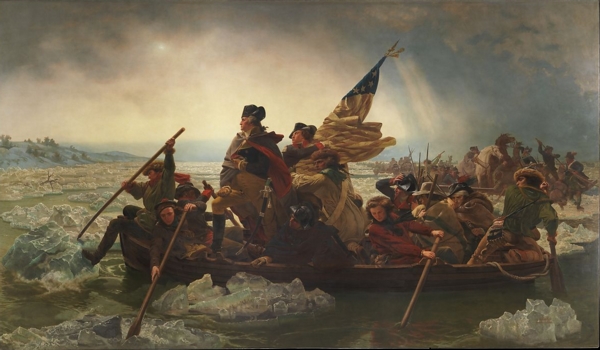
(above: Emanuel Leutze (American, 1816-1868). Washington Crossing the Delaware, 1851. Oil on canvas, 149 x 255 inches. The Metropolitan Museum of Art, New York, Gift of John Stewart Kennedy, 1897 (97.34). Public domain, via Wikimedia Commons*
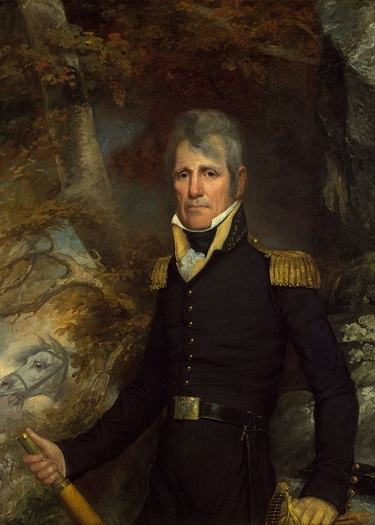
(above: John Wesley Jarvis (American [born England], 1780-1840). General Andrew Jackson, ca. 1819. Oil on canvas, 48 1/2 x 36 inches. The Metropolitan Museum of Art, New York, Purchase, Harris Brisbane Dick Fund, 1964 (64.8). Public domain, via Wikimedia Commons*)
Angels and Demons: Works on Paper by David Schirm is a 2017 exhibit at the Burchfield - Penney Art Center which says: "Angels and Demons: Works on Paper by David Schirm is an exhibition about violence.... This exhibition focuses on work by the artist from the decades that followed his experience in Vietnam." Accessed 1/18
Apocalypse: Then and Now is a 2019 exhibit at the Anya and Andrew Shiva Gallery which says: "All the artists in this exhibition have produced works on the subject of nuclear war in the hopes of preserving future generations and preventing a holocaust." Accessed 3/19
Artists Respond: American Art and the Vietnam War, 1965-1975 is a 2019 exhibit at the Smithsonian American Art Museum which says: "Artists Respond is the most comprehensive exhibition to examine the contemporary impact of the Vietnam War on American art. The exhibition is unprecedented in its historical scale and depth. It brings together nearly 100 works by fifty-eight of the most visionary and provocative artists of the period.' Accessed 5/20
Black Bodies in Propaganda: The Art of the War Poster is a 2017 exhibit at the Gilcrease Museum which says: "Propaganda has long been used to mobilize societies during times of war. The posters presented in the Black Bodies exhibition are visually captivating works of art created with the objective of mobilizing people of color. These appeals for support were presented even as the very populations they targeted faced oppression and injustice in the United States, Europe and Africa." Accessed 5/17
Cartoons of the Spanish-American War, an E-book from Archive.org. Accessed August, 2015.
Darger + War: Violence and Loss in Self-Taught Art is a 2017 exhibit at Intuit: The Center for Intuitive and Outsider Art which says: "Darger + War: Violence and Loss in Self-Taught Art explores the complex intersection of art and war through the lens of self-taught art, and investigates war as a narrative, as experience, and as a state of mind." Accessed 11/17
Dear Dearest Mother: Leslie Starobin's Wartime Still Life Montages was a 2015 exhibit at the Danforth Museum of Art, which says: "Starobin's work spans military conflict from the Civil War to today, and brings text and image together in skillful still-life montages that emphasize the significance of objects as signifiers of both narrative and memory." Viewers may view the 34-page gallery book online. Accessed 11/16
Dr. Seuss Went to War: A Catalog of Political Cartoons, from University of California San Diego. Accessed August, 2015.
Femininity in Propaganda blog page by Ariana H. posted in May, 2011 discussing wartime propaganda posters. Accessed November, 2015.
Gardner's Photographic Sketchbook of War E-book (via Archice.org) from Cornell University Library. Accessed August, 2015.
Jane Irish: War Is Not What You Think was a 2012 exhibit at the La Salle University Art Museum. "The contemporary fascination with the past, and its relevance for the present, inspires the work of Philadelphia-based artist Jane Irish, who has spent the past ten years sifting through the Connelly Library's special collection, Imaginative Representations of the Vietnam War. Through her paintings and ceramic vessels decorated with pastoral landscapes, people and poetry, Irish explores the enduring impact of the Vietnam War, highlighting the heroism of the soldiers as well the Vietnam Veterans Against the War, both of whom fought valiantly for freedom and peace." -- quote from exhibit Introduction by Klare Scarborough, Ph.D., Director and Chief Curator, La Salle University Art Museum. Accessed 1/17
John Rogers: American Stories, an exhibit held November 09, 2012 - February 18, 2013 at the New-York Historical Society. Includes video by curator. Accessed April, 2015.
Love a Vet: Honoring Our Veterans is a 2015 exhibit at the Norman Rockwell Museum which says: "This new exhibition offers artist commentary on the military, patriotism, and the struggles that many veterans face upon their re-entry into civilian life." Accessed 8/18
Artists Respond: American Art and the Vietnam War, 1965-1975 is a 2019 exhibit at the Smithsonian American Art Museum which says: "Artists Respond is the most comprehensive exhibition to examine the contemporary impact of the Vietnam War on American art. The exhibition is unprecedented in its historical scale and depth." Accessed 12/19
Military/War Art and Artists from John Gilinsky. Accessed August, 2015.
Navy Art Collection from U.S. Navy. Accessed August, 2015.
National Veterans Art Museum website. Accessed August, 2015.
Stephen Scott Young: Veterans is a 2017 exhibit at the Greenville County Museum of Art which says: "Highlighting paintings whose subjects connect to three wars, Stephen Scott Young: Veterans features watercolors and sketches from the Museum's permanent collection of works inspired by the artist's visits to Greenville." Accessed 12/17
Steve Mumford's War Journals, 2003-2013 is a 2014 exhibit held at The Frist Center for the Visual Arts. Includes video and gallery guide. Accessed August, 2015.
U.S. Army Vietnam Combat Art Program by Jim Pollock. Accessed August, 2015.
United States Air Force Art Collection from University of Iowa Libraries. Accessed August, 2015.
War as a topic in Art & Social Issues in American Culture, a presentation of Columbus Museum of Art. Accessed August, 2015.
Online videos:
 Art and Democracy gallery tour [14:47]
from Meridian Gallery. [Link found to be expired as of 2015 audit.
TFAO is saving the citation for use by researchers.]
Art and Democracy gallery tour [14:47]
from Meridian Gallery. [Link found to be expired as of 2015 audit.
TFAO is saving the citation for use by researchers.]
Art of Democracy: A Talk and Tour
with Art Hazelwood , 2008, -- a conversation with artist Art Hazelwood
held at Meridian Gallery in San Francisco, CA about art, politics, and the
nationwide exhibition of The Art of Democracy. part
1 [10:41], part
2 [9:30], part
3 [5:07], from Meridian Gallery. Accessed August, 2015.
Art from the Battlegrounds of Iraq,
February 19th, 2008, [01:19:19] thirteeen.org says: "Panelists include
five artists who have had first-hand experience of the Iraq War - embedded
painter Steve Mumford; embedded photographer and filmmaker Brian Palmer;
performance artist and Army Sergeant Aaron Hughes; sculptor and Army Staff
Sergeant Ryan Roa; and Chief Warrant Officer-2 Michael Fay, one of two official
combat artists currently serving in the U.S. Marine Corps. They discuss
their experiences in Iraq and how the war has affected their art. This panel,
moderated by Leonard Lopate of WNYC, was presented by the School of Visual
Arts (SVA) in conjunction with the exhibition "Testimony to War: Art
from the Battlegrounds of Iraq," on view until March 8, 2008. Accessed
August, 2015.
Combat Artists in the Vietnam War 1967
US Army [02:46] 9/5/14, source unknown. Accessed August, 2015.
Hidden Treasures -- The Official
Art Collection of the United States Army [6:52] 2009, from CBS Sunday
Morning. U.S Army art collection from Washington DC federal collection
is featured. Accessed August, 2015.
Testimony
to War: Art from the Battlegrounds of Iraq, [21:48] relates to exhibit
curated by Francis Di Tommaso, at the SVA Gallery February 4 - March 8,
2008, from School of Visual Arts Gallery. Accessed August, 2015.
The Chicago Humanities Festival presents a Terra Foundation for American Art lecture series with art history lectures online, including an illustrated audio "Art for War's Sake" November 11, 2006, by David Lubin. Accessed August, 2015.

 Return to Military and Wartime Art or
Topics in American Representational Art
Return to Military and Wartime Art or
Topics in American Representational Art
TFAO's Distinguished Artists catalogue provides online access to biographical information for artists associated with this state. Also, Search Resource Library for online articles and essays concerning both individual artists associated with this state's history and the history of art centers and museums in this state. Resource Library articles and essays devoted to individual artists and institutions are not listed on this page.
*Tag for expired US copyright of object image:

Links to sources of information outside of our web site are provided only as referrals for your further consideration. Please use due diligence in judging the quality of information contained in these and all other web sites. Information from linked sources may be inaccurate or out of date. TFAO neither recommends or endorses these referenced organizations. Although TFAO includes links to other web sites, it takes no responsibility for the content or information contained on those other sites, nor exerts any editorial or other control over them. For more information on evaluating web pages see TFAO's General Resources section in Online Resources for Collectors and Students of Art History.
 Search Resource Library
Copyright 2022 Traditional Fine Arts Organization, Inc., an Arizona nonprofit corporation. All rights reserved.