
American Religious Art: 1700-2000
by ChatGPT
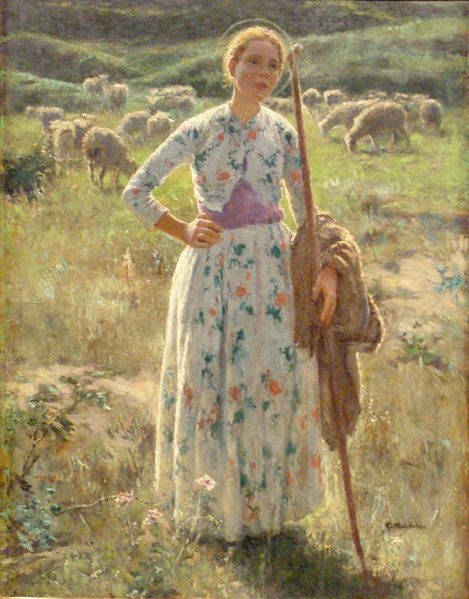
(above, Gari Melchers, Joan of Arc, oil on canvas, 30 x 23 inches, Indianapolis Museum of Art. Public domain, via Wikimedia Commons*)
1700-1750
Introduction:
American religious art from 1700 to 1750 AD offers a captivating glimpse into the spiritual and cultural landscape of early colonial America. As the New World underwent profound changes, religious beliefs played a vital role in shaping the artistic expressions of the time. This essay explores the evolution and significance of American religious art during this period, highlighting its themes, influences, and contributions to the emerging American identity.
Religious Art as a Reflection of Faith:
Religious art during the 18th century was predominantly Christian in nature, reflecting the prevailing religious beliefs of the colonial population. These artworks were deeply rooted in the Protestant tradition and sought to communicate and reinforce the central tenets of Christianity. Paintings, sculptures, and other visual forms of artistic expression served as powerful tools for conveying religious narratives, evoking devotion, and fostering a sense of spiritual unity.
Influences on American Religious Art:
The artistic traditions of the Old World, particularly those of Europe, heavily influenced American religious art during this period. European art movements such as the Renaissance and the Baroque had a lasting impact on the style and subject matter of American artworks. Artists drew inspiration from biblical stories, saints, and Christian iconography, translating them into a distinctly American context.
Themes and Motifs in American Religious Art:
The themes explored in American religious art of the 18th century often revolved around narratives from the Bible, emphasizing key events in the life of Jesus Christ and the saints. Paintings depicted scenes from the Old and New Testaments, including the Nativity, Crucifixion, and Resurrection. These works aimed to inspire piety and convey moral messages to the viewers, encouraging them to lead virtuous lives. One prominent motif seen in American religious art was the use of allegory. Artists employed symbolic imagery to convey religious concepts and moral lessons. For example, the depiction of a lamb represents innocence and the sacrifice of Christ, while a serpent symbolizes temptation and evil. These symbolic elements served as visual aids to aid religious contemplation and deepen spiritual understanding.
Artistic Techniques and Mediums:
The techniques and mediums employed in American religious art during this era varied. Painting was the most prevalent medium, with artists employing oils on canvas or wood panels. The influence of European masters can be observed in the meticulous attention to detail, use of chiaroscuro, and skillful rendering of emotions. Sculpture, though less common, was also employed to create three-dimensional representations of religious figures and saints, often crafted from wood or stone.
The Role of American Religious Art in Shaping Identity:
Religious art of the 18th century played a vital role in shaping the emerging American identity. As colonists sought to establish their own cultural and religious identities, artistic expressions of faith became a way to assert their distinctiveness. Through religious art, early Americans emphasized their commitment to Christianity and used it as a unifying force within their communities. These artworks also served as a reminder of their European heritage while adapting to the unique experiences of life in the New World.
1750-1800
Introduction:
American religious art from 1750 to 1800 AD reflects a transformative period in the nation's history, marked by the Enlightenment and the Great Awakening. This era witnessed a shift in religious thought and artistic expression, as new ideas and movements influenced the creation of religious artworks. In this essay, we will explore the themes, influences, and significance of American religious art during this period, highlighting its contribution to the evolving American identity.
The Enlightenment and its Impact on American Religious Art:
The Enlightenment, with its emphasis on reason, science, and individualism, had a profound impact on American religious art during the late 18th century. As the colonies sought to break free from traditional religious dogma, artistic expressions began to reflect a more rational and humanistic approach to spirituality. Artists sought to convey moral messages through accessible and relatable imagery, aligning with the ideals of the Enlightenment.
Themes and Motifs in American Religious Art:
The themes of American religious art during this period expanded beyond the traditional biblical narratives. Artists explored concepts such as virtue, morality, and the importance of personal religious experience. Portraits of prominent religious figures, such as preachers and revivalists, gained prominence, reflecting the growing influence of charismatic leaders during the Great Awakening. These artworks aimed to inspire and evoke a personal connection to faith in the viewer. Another prevalent motif during this time was the celebration of nature as a reflection of God's creation. Landscape paintings often incorporated religious symbolism, with scenes of picturesque landscapes evoking a sense of awe and reverence. These works conveyed the belief in a divine presence in the natural world and encouraged viewers to seek spiritual solace in nature.
Influences on American Religious Art:
The Great Awakening, a religious revival movement that swept across the American colonies, significantly influenced the artistic expressions of the time. Artists sought to capture the fervor and emotional intensity of religious gatherings and revivals through their artworks. These depictions often conveyed a sense of movement, dynamism, and spiritual ecstasy, reflecting the experiential nature of the Great Awakening. The artistic traditions of Europe continued to inspire American religious art, particularly the Neoclassical style. Artists adopted a more restrained and idealized approach, focusing on balance, symmetry, and order. Influenced by the classical antiquity of ancient Greece and Rome, artworks often featured architectural elements and classical motifs, representing a departure from the more elaborate Baroque style of the previous century.
Artistic Techniques and Mediums:
Painting remained the primary medium for American religious art during this period. Artists utilized oil on canvas or wood panels to create their works. The Neoclassical style favored clean lines, smooth surfaces, and a focus on accurate proportions. Sculpture, though less prevalent, was also employed, particularly for the creation of religious figures and monuments. Artists experimented with various techniques to convey depth, light, and texture, reflecting the evolving technical mastery of American artists.
The Role of American Religious Art in Shaping Identity:
American religious art from 1750 to 1800 AD played a crucial role in shaping the evolving American identity. The artworks reflected the changing religious landscape of the colonies, highlighting the influence of the Enlightenment and the Great Awakening. They provided a visual representation of the newfound emphasis on individual spiritual experience, moral virtues, and the connection between nature and the divine. By embracing new ideas and artistic styles, American religious art contributed to the development of a distinctively American visual culture.
1800-1900
Introduction:
American religious art from 1800 to 1900 AD bears witness to a dynamic period in American history, marked by political, social, and technological changes. During this era, the nation underwent significant transformations, and religious art reflected these shifts in belief systems, artistic styles, and cultural expressions. This essay explores the themes, influences, and contributions of American religious art from the 19th century, shedding light on its role in shaping the nation's evolving religious identity.
The Expansion of Religious Diversity:
The 19th century in America saw the expansion of religious diversity as new religious movements emerged and immigrant populations arrived, bringing their own faith traditions. American religious art during this period reflected a broader range of beliefs, encompassing Christianity in its various denominations, Judaism, Islam, and Eastern spiritual practices. Artists explored these diverse religious landscapes and captured the essence of different faith traditions in their works.
Themes and Motifs in American Religious Art:
American religious art of the 19th century encompassed a wide array of themes, reflecting the multifaceted religious and social milieu of the time. Artists depicted biblical scenes, religious figures, and narratives, as well as the lives of saints and martyrs. They also explored themes of piety, moral instruction, and the importance of social justice. The abolitionist movement, in particular, inspired artists to create powerful visual narratives condemning slavery and promoting equality. Nature continued to play a significant role in American religious art during this period. Artists depicted landscapes as a reflection of the divine, emphasizing the beauty and spirituality found in the natural world. These artworks celebrated the transcendentalist ideas popularized by writers such as Ralph Waldo Emerson and Henry David Thoreau, who emphasized the spiritual connection between humanity and nature.
Influences on American Religious Art:
The 19th century brought a shift in artistic styles and influences. The Romantic movement, with its focus on emotion, imagination, and individual expression, greatly impacted American religious art. Artists embraced more expressive and subjective approaches, using vivid colors, dramatic lighting, and heightened emotional states to convey spiritual experiences. They also drew inspiration from European artistic movements such as the Pre-Raphaelites and Symbolism, which emphasized symbolism and spiritual allegory. The Industrial Revolution and technological advancements had a profound influence on American religious art as well. The availability of photography and printing technologies allowed for the mass reproduction of religious images, making them more accessible to the general public. This led to the widespread distribution of religious prints, engravings, and illustrated Bibles, which played a vital role in shaping religious iconography and visual narratives.
Artistic Techniques and Mediums:
Painting continued to be the dominant medium in American religious art during the 19th century. Artists utilized oil on canvas, watercolors, and tempera to create their works. Advancements in materials and techniques allowed for more experimentation with color, texture, and composition. Sculpture, particularly in the form of religious statues and memorials, also played a significant role in religious art, serving as devotional objects and symbols of faith.
The Role of American Religious Art in Shaping Identity:
American religious art of the 19th century played a crucial role in shaping the nation's religious and cultural identity. It reflected the religious pluralism and social concerns of the time, providing visual narratives that resonated with diverse audiences. The artworks fostered a sense of community, shared values, and moral instruction within religious congregations. Moreover, they served as tools for evangelization and expressions of faith in an increasingly secularized society.
1900-2000
Introduction:
American religious art from 1900 to 2000 AD reflects a century of profound social, cultural, and artistic transformation. During this period, the United States experienced significant shifts in religious beliefs, artistic movements, and technological advancements. This essay explores the themes, influences, and contributions of American religious art throughout the 20th century, highlighting its role in capturing the evolving spiritual and cultural expressions of the nation.
The Pluralism of American Religious Art:
The 20th century marked a period of increased religious diversity in America, with the presence of various faith traditions and spiritual movements. American religious art during this era reflected this pluralism, encompassing Christianity, Judaism, Islam, Eastern philosophies, and indigenous spiritual practices. Artists explored the intersections of different religions, engaging in interfaith dialogues and creating artworks that celebrated religious unity and shared values.
Themes and Motifs in American Religious Art:
American religious art of the 20th century explored a wide range of themes, reflecting the changing social, political, and cultural climate of the nation. Artists delved into topics such as social justice, human rights, peace, and environmentalism. Artworks became platforms for addressing pressing issues and promoting spiritual values as a means of social transformation. The Civil Rights Movement, feminist movements, and ecological concerns influenced the subject matter and messages conveyed in religious art. Symbolism continued to play a significant role in American religious art during this period. Artists employed allegorical imagery, metaphors, and visual symbols to communicate deeper spiritual meanings. The use of religious icons, sacred geometry, and archetypal imagery became prevalent, inviting viewers to contemplate the universal truths and mysteries of existence.
Influences on American Religious Art:
The 20th century witnessed the rise of several artistic movements that impacted American religious art. The modernist and postmodernist movements challenged traditional artistic conventions and norms, encouraging artists to experiment with new styles, materials, and conceptual approaches. This led to the exploration of abstract and avant-garde forms of religious expression, reflecting the changing attitudes towards spirituality and a departure from literal representations. Furthermore, global artistic influences began to shape American religious art. The study of non-Western art, such as African, Asian, and Native American artistic traditions, influenced the stylistic and thematic choices of American artists. These cross-cultural encounters inspired a fusion of diverse visual languages, resulting in a rich tapestry of religious art that reflected the multicultural fabric of the nation.
Artistic Techniques and Mediums:
The 20th century brought forth new artistic techniques and mediums that influenced American religious art. Advancements in photography, film, and digital media allowed artists to experiment with new forms of visual storytelling and incorporate religious themes in innovative ways. Mixed media, installations, and performance art emerged as vehicles for exploring spiritual experiences and religious rituals. Moreover, artists incorporated non-traditional materials into their artworks, embracing found objects, industrial materials, and everyday items. This approach reflected the broader artistic trend of incorporating elements of the ordinary into sacred contexts, blurring the boundaries between the sacred and the secular.
The Role of American Religious Art in Shaping Identity:
American religious art of the 20th century played a significant role in shaping the nation's religious and cultural identity. It reflected the changing religious landscape and social dynamics of the time, providing a platform for diverse voices, perspectives, and spiritual expressions. Artists engaged in the exploration of spirituality, social justice, and the human experience, addressing issues of inequality, peace, and environmental stewardship. By challenging conventional narratives and engaging with contemporary concerns, religious art became a catalyst for dialogue, introspection, and spiritual growth.
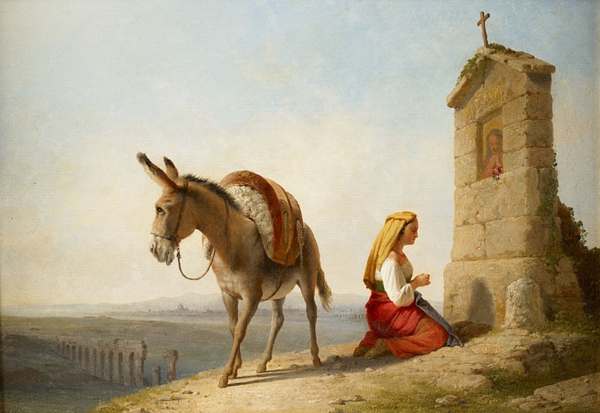
(above: John Gadsby Chapman, Woman and Donkey by a Roadside Shrine, 1870, oil on cardboard (artist board), 10 x 14 inches, Birmingham Museum of Art, museum purchase by the Friends of American Art with funds donated by Mr. and Mrs. Ehney A. Camp, III; Mr. and Mrs. Hubert Goings, Jr.; Mr. and Mrs. William C. Hulsey; and Mr. and Mrs. Lathrop W. Smith, Jr., 2008.17, Public domain, via Wikimedia Commons*)
The above 6/4/23 ChatGPT-generated text was generated in additive sections based on our prompts using selected time periods. The conclusion paragraphs for each time period section were deleted. Three typos in the texts were corrected.
Accompanying the text are examples of representational artworks not specific to it. Images were obtained via Wikimedia Commons, which believes the images to be freely available for presentation here.
Readers may also enjoy articles and essays in our American Representational Art topic Religion in American Art
*Tag for expired US copyright of object image:

Our catalogues:
American Representational Art links to over 200 topics in American Representational Art
Audio Online a catalogue of online streaming audio recordings
Collections of Historic American Art notable private collections
Distinguished Artists a national registry of historic artists
Geographic Tour of American Representational Art History a catalogue of articles and essays that describe the evolution of American art from the inception of the United States to WWII.
Illustrated Audio Online streaming online narrated slide shows
Articles and Essays Online substantive texts published outside of Resource Library
Videos Online a comprehensive catalogue of online full motion videos streamed free to viewers
Videos an authoritative guide to videos in VHS and DVD format
Books general reference books published on paper
Interactive media media in CD-ROM format
Magazines paper-published magazines and journals
Links to sources of information outside of our web site are provided only as referrals for your further consideration. Please use due diligence in judging the quality of information contained in these and all other web sites. Information from linked sources may be inaccurate or out of date. TFAO neither recommends or endorses these referenced organizations. Although TFAO includes links to other web sites, it takes no responsibility for the content or information contained on those other sites, nor exerts any editorial or other control over them. For more information on evaluating web pages see TFAO's General Resources section in Online Resources for Collectors and Students of Art History.
 Search Resource Library
Copyright 2023 Traditional Fine Arts Organization, Inc., an Arizona nonprofit corporation. All rights reserved.