
America's Distinguished Artists
a national registry of historic artists
More paintings by Thomas Hart Benton - page 2
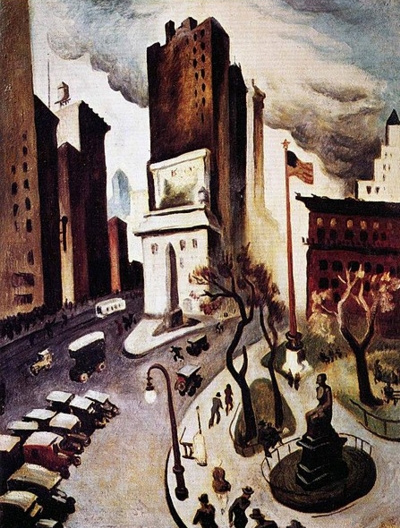
(above: Thomas Hart Benton, Madison Square Park in New York City, 1920, 34 x 25 inches. Photo: Mathew Baigell. Public domain, via Wikimedia Commons*)
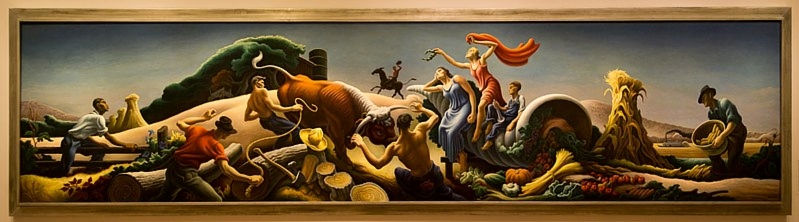
(above: Thomas Hart Benton, Achelous and Hercules, 1947, tempera and oil on canvas mounted on plywood, 62.8 x 159.7 inches, Smithsonian American Art Museum, Gift of Allied Stores Corporation, and museum purchase through the Smithsonian Institution Collections Acquisition Program, 1985.2. Public domain, via Wikimedia Commons*)
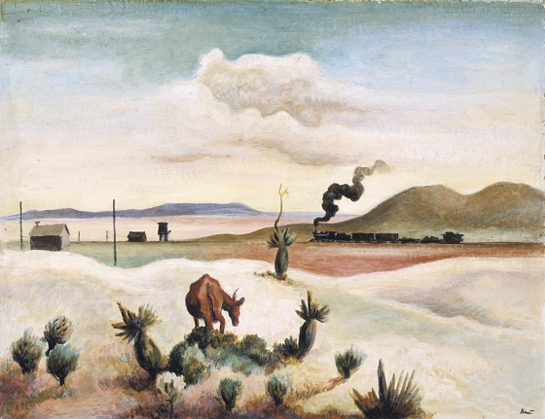
(above: Thomas Hart Benton, New Mexico (Landscape), 1926, oil and tempera on panel, 20 x 26 inches, Denver Art Museum: Funds from Helen Dill bequest, 1937.2)
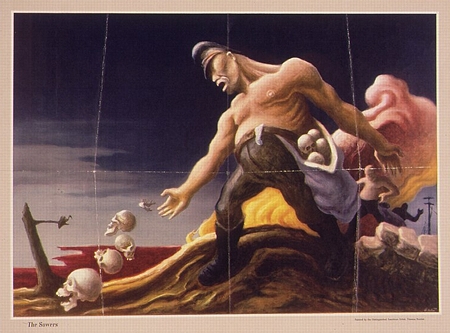
(above: Thomas Hart Benton, The Sowers, c. 1944-45. Record group: Record Group 44: Records of the Office of Government Reports, 1932 - 1947 (National Archives Identifier: 373). Series: World War II Posters, compiled 1942 - 1945 (National Archives Identifier: 513498). NAIL Control Number: NWDNS-44-PA-123. Public domain, via Wikimedia Commons*)

(above: Missouri statehood's 150th anniversary was commemorated with an 8-cent stamp on May 8, 1971. The vignette by Thomas Hart Benton shows a Native American offering a pipe to settlers in a camp with a wagon train cresting a ridge in the background. Bureau of Printing and Engraving - U.S. Post Office. Public domain, via Wikimedia Commons*)
We poked around some AI resources asking about the painting style of Thomas Hart Benton and heard back that his use of sinuous, flowing forms and exaggerated figures was a deliberate choice influenced by his artistic philosophy, training, and goals.
He sought to infuse his paintings with a sense of motion and vitality. The flowing lines and exaggerated forms created dynamic, rhythmic compositions that conveyed the energy and emotional intensity of his scenes. was heavily influenced by mural painting, a medium that often requires storytelling on a large scale. The undulating forms helped guide the viewer's eye across the composition, emphasizing narrative continuity and creating visual drama.
The exaggerated figures allowed Benton to emphasize the physicality and emotional depth of his subjects. These distortions were not meant to be literal but symbolic, reflecting the struggles, strength, and determination of ordinary people.
Benton studied under Stanton Macdonald-Wright, a leader in the Synchromism movement, which focused on color and rhythm in composition. This training may have contributed to Benton's understanding of how form and movement could evoke a sense of harmony and dynamism.
By stylizing his figures and landscapes, Benton aimed to transcend simple realism, turning his depictions of rural America into mythic representations of national identity. His approach made the ordinary seem monumental and timeless.
Benton used bold, vibrant colors to enhance the emotional and narrative impact of his work. He frequently depicted scenes from American history, folklore, and rural life, often with a focus on the struggles and resilience of ordinary people.
While rooted in realism, his works often included symbolic elements that commented on societal and economic issues.
These choices helped Benton communicate
a deeper emotional and cultural narrative, making his works both visually
compelling and ideologically rich.
See paintings by Thomas Hart Benton from our 1999 article about the artist
*Tag for expired US copyright of object image:

Links to sources of information outside of our web site are provided only as referrals for your further consideration. Please use due diligence in judging the quality of information contained in these and all other web sites. Information from linked sources may be inaccurate or out of date. TFAO neither recommends or endorses these referenced organizations. Although TFAO includes links to other web sites, it takes no responsibility for the content or information contained on those other sites, nor exerts any editorial or other control over them. For more information on evaluating web pages see TFAO's General Resources section in Online Resources for Collectors and Students of Art History.
 Search Resource Library
Copyright 2024 Traditional Fine Arts Organization, Inc., an Arizona nonprofit corporation. All rights reserved.