
America's Distinguished
Artists
a national registry of
historic artists
Artwork by Arthur Putnam
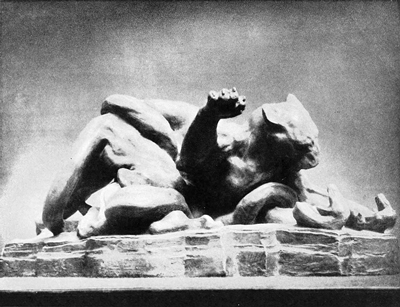
(above: Arthur Putnam, Puma
and Snake, c. 1906, bronze with brown patina, Hood Museum of Art. Public
domain via Wikimedia Commons**)
- Hanson Puthuff (1875-1972) was a distinguished
American painter known for his evocative landscapes, particularly those
depicting the majestic vistas of California. His work reflects a profound
appreciation for nature and a commitment to capturing its ephemeral beauty.
Puthuff's artistic journey and motivations were shaped by his deep connection
to the landscapes he painted, his dedication to the plein air painting
tradition, and his desire to share the sublime beauty of the natural world
with others.
-
- Puthuff was born in Missouri but moved to Colorado
during his childhood, where he developed a love for the outdoors and began
sketching the rugged Rocky Mountains. His early exposure to such breathtaking
landscapes undoubtedly influenced his artistic direction. After studying
at the University of Denver and later at the Art Institute of Chicago,
Puthuff relocated to Los Angeles in 1903, where he would find his true
muse in the diverse and picturesque landscapes of California.
-
- In Los Angeles, Puthuff initially worked as a
commercial artist, painting billboards and other advertisements. However,
his true passion lay in landscape painting. The burgeoning art community
in Southern California, along with its rich and varied natural scenery,
provided the perfect environment for Puthuff to pursue this passion. He
became a prominent member of the California Art Club and was associated
with the Impressionist movement, which emphasized painting outdoors to
capture natural light and color accurately.
-
- Puthuff's work is characterized by its vibrant
use of color, dynamic compositions, and a keen eye for atmospheric effects.
He primarily painted the mountains, deserts, and coastal regions of California,
seeking to portray the state's vast and diverse beauty. His landscapes
often feature the San Gabriel Mountains, the Mojave Desert, and the coastal
cliffs and beaches, all rendered with a sensitivity to the changing light
and moods of the environment.
-
- One of the key reasons Puthuff painted these
landscapes was his profound emotional and spiritual connection to nature.
He believed that the natural world possessed an inherent beauty and serenity
that could provide solace and inspiration to those who experienced it.
Through his paintings, Puthuff sought to convey this sense of wonder and
tranquility, inviting viewers to appreciate the sublime beauty of the landscapes
he so deeply admired.
-
- Moreover, Puthuff was motivated by a desire to
preserve the fleeting moments of beauty he observed in nature. The transient
effects of light and atmosphere were central to his work, and he often
painted en plein air to capture these ephemeral qualities firsthand. This
method allowed him to imbue his paintings with a sense of immediacy and
authenticity, making his depictions of nature both vivid and evocative.
-
- Puthuff's dedication to his craft extended beyond
his own work. As an influential figure in the California art scene, he
played a significant role in promoting the plein air painting tradition
and supporting fellow artists. He taught at the Otis Art Institute and
was actively involved in the California Art Club, helping to foster a community
of artists who shared his passion for capturing the natural beauty of the
region.
-
- In conclusion, Hanson Puthuff's paintings are
a testament to his deep reverence for nature and his commitment to capturing
its transient beauty. His evocative landscapes, characterized by their
vibrant colors and dynamic compositions, reflect his profound connection
to the California scenery he so admired. Through his work, Puthuff sought
to share the sublime beauty of the natural world, inspiring others to appreciate
and preserve the landscapes that brought him such joy. His legacy endures
not only in his stunning depictions of nature but also in his contributions
to the artistic community and the plein air painting tradition.
-
- The above brief essay was generated by AI and
edited in July, 2024.
 Return to America's
Distinguished Artists, referencing
biographical information on historic artists, and richly illustrated with
hundreds of artwork images.
Return to America's
Distinguished Artists, referencing
biographical information on historic artists, and richly illustrated with
hundreds of artwork images.
We wish to extend appreciation to Khanh
Quy Ho for generously volunteering to research
content for this page.
*Tag for expired US copyright of object
image:

and
**Tag for some rights reserved:

Links to sources of information outside
of our web site are provided only as referrals for your further consideration.
Please use due diligence in judging the quality of information contained
in these and all other web sites. Information from linked sources may be
inaccurate or out of date. TFAO neither recommends or endorses these referenced
organizations. Although TFAO includes links to other web sites, it takes
no responsibility for the content or information contained on those other
sites, nor exerts any editorial or other control over them. For more information
on evaluating web pages see TFAO's General
Resources section in Online
Resources for Collectors and Students of Art History.
 Search Resource Library
Copyright 2024 Traditional Fine Arts Organization, Inc., an Arizona nonprofit corporation. All rights
reserved.