
Welcome room - east wall - first view
We've glided to the end of the welcome room's north wall and have just turned right to see the first view along the east wall. Here's how an east wall might look like in a physical museum. We can imagine ours looks just as good.
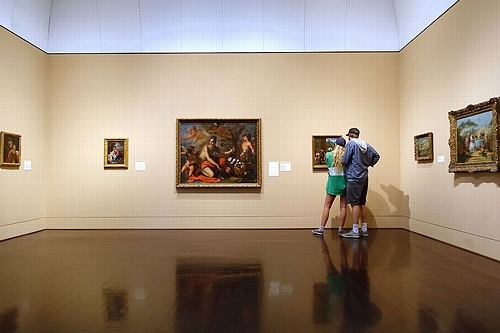
(above: Photo: Daderot, Interior view - Blanton Museum of Art - Austin, Texas, 2015. Public domain, via Wikimedia Commons*)
Where the museum sources images, texts and references
The museum's main source of images is Wikipedia Commons, an online collection of copyright-free images covering a vast number of topics, including American art. There are thousands of images of American paintings and sculptures, indexed in a myriad of ways. The museum's sponsor selected way over a thousand Wikipedia Commons images indexed by artist name to place in's America's Distinguished Artists catalog. Some of the best were selected for this museum. Here's one of them by a historic American artist depicting two Japanese figures in the late part of the 18th century.

(above: Henry Alexander, Scene from "The Mikado" with Louise Paullin, 1886, oil on panel, De Young Museum. Public domain, via Wikimedia Commons*)
This beautiful painting is in a terrific museum in San Francisco, California.
As noted earlier, the director, who is also the curator of the introductory exhibits, needed to fool around with a lot of phrases and words to make prompts that get an ok response from ChatGPT's mysterious brain.
A prompt may say something like this: "Write a 500 word essay about California Impressionist art and artists." Wham, bang. In a few seconds there's some fairly good remarks. They usually need editing. The curator tinkers with the text and shazsam! There's some pretty good text. Or, for an artist. "Write a 500 word essay describing historic California artist (artist name) and why he/she created his/her art." For more action, Chat is happy with a follow up questions that provide new twists.
The folks involved in this museum are more curious about why artists created their works the way they did rather than when and where.
A key source for further information after occasional remarks is Resource Library, published through 2016. Some images in the museum are from pages of Resource Library. For people craving deep dives into American art history, there's a huge mound of information within the sponsor's American Representational Art catalog.

(above: Thomas Hart Benton, Self-Portrait with Rita, 1922, oil on canvas, National Portrait Gallery, Washington. Public domain, via Wikimedia Commons*)
Above is an imaginary likeness of the museum's director from a few years ago at the beach with Rita. Haha! We'll see what he actually looks like in the next view.
TFAO Museum of American Art is proudly sponsored by Traditional Fine Arts Organization, Inc., an Arizona nonprofit corporation. All rights reserved. © 2024
