
America's Distinguished
Artists
a national registry of
historic artists
Additional paintings by Granville
Redmond and brief remarks
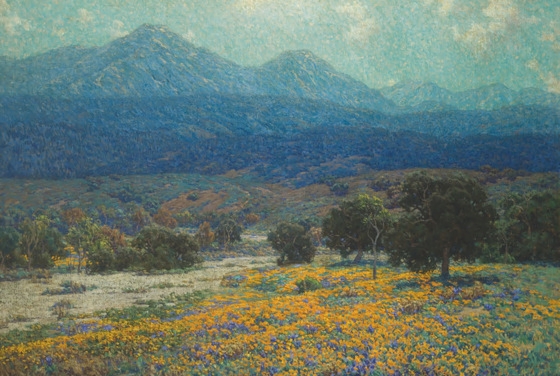
(above: Granville Redmond, California
Poppy Field, c. 1926, oil on canvas, 40 1/4 x 60 1/4 inches. Gift of
Raymond Griffith (40.7). Public domain, courtesy of Los Angeles County Museum
of Art)
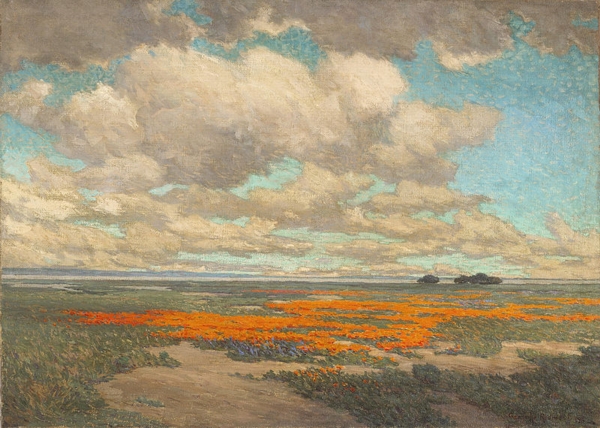
(above: Granville Richard Seymor Redmond,
A Field of California Poppies, 1911, oil on canvas, 26
x 36 inches, Private Collection, Northern California (by family descent
to present owner), Bonhams. Public domain, via Wikimedia Commons*)
-
- Granville Redmond, a celebrated American Impressionist
painter, left an enduring mark on the art world through his captivating
landscapes and floral still lifes. Born in Philadelphia in 1871, Redmond's
artistic talents blossomed despite being deaf from a young age due to scarlet
fever. His family relocated to California in 1874, where Redmond developed
a deep affinity for the natural beauty of the state, particularly its wildflowers
and expansive landscapes.
-
- Redmond's choice of subject matter centered predominantly
on the serene landscapes of California, which he painted with a distinctive
Impressionist style. His works often depicted the rolling hills of the
California countryside, the majestic coastal vistas, and the tranquil meadows
adorned with poppies and lupines. He was particularly drawn to the vibrant
colors and the play of light and shadow in these natural settings.
-
- One of the defining characteristics of Redmond's
art was his ability to capture the essence of California's natural environment.
Influenced by the Impressionist movement, he employed a soft and harmonious
palette, utilizing delicate brushstrokes to convey the ephemeral qualities
of light and atmosphere. His paintings radiated with a sense of tranquility
and a deep appreciation for the fleeting beauty of nature.
-
- Redmond's passion for painting was driven by
a profound connection to the landscapes and flora of California. He believed
that art had the power to convey emotional depth and spiritual resonance,
and he sought to evoke a sense of reverence for the natural world through
his paintings. His works often celebrated the inherent beauty of California's
wilderness, inviting viewers to experience a sense of harmony and serenity
in the presence of nature.
-
- Beyond his technical skill and artistic vision,
Redmond's paintings were also a reflection of his personal experiences
and observations. He spent much of his life exploring and sketching the
landscapes around California, developing an intimate knowledge of its diverse
terrain and botanical diversity. This firsthand experience informed his
paintings and imbued them with a sense of authenticity and emotional resonance.
-
- Throughout his career, Redmond's dedication to
capturing the essence of California's landscapes and wildflowers earned
him critical acclaim and recognition within the artistic community. His
works were exhibited widely across the United States and received numerous
awards and honors. Today, Redmond's paintings continue to captivate viewers
for their poetic beauty, technical proficiency, and profound connection
to the natural world.
-
- In conclusion, Granville Redmond's decision to
paint California's landscapes and floral still lifes was driven by a deep-seated
passion for the beauty and tranquility of nature. His paintings serve as
a testament to his artistic vision, technical skill, and enduring legacy
as a masterful Impressionist painter whose works continue to inspire and
evoke a sense of wonder in viewers around the world.
-
-
- The preceding brief remarks were generated by
AI, based from our online materials, and edited in Auguat 2024.
 Return to America's Distinguished
Artists, Rba-Rgz, referencing biographical information on historic artists,
and richly illustrated with hundreds of artwork images.
Return to America's Distinguished
Artists, Rba-Rgz, referencing biographical information on historic artists,
and richly illustrated with hundreds of artwork images.
We wish to extend appreciation to Khanh
Quy Ho for generously volunteering to research
content for this page.
*Tag for expired US copyright of object
image:

and
**Tag for some rights reserved:

Links to sources of information outside
of our web site are provided only as referrals for your further consideration.
Please use due diligence in judging the quality of information contained
in these and all other web sites. Information from linked sources may be
inaccurate or out of date. TFAO neither recommends or endorses these referenced
organizations. Although TFAO includes links to other web sites, it takes
no responsibility for the content or information contained on those other
sites, nor exerts any editorial or other control over them. For more information
on evaluating web pages see TFAO's General
Resources section in Online
Resources for Collectors and Students of Art History.
 Search Resource Library
Copyright 2024 Traditional Fine Arts Organization, Inc., an Arizona nonprofit corporation. All rights
reserved.