
William Wilson Corcoran
Gallery - east wall - eighth view
Mary Stevenson Cassatt
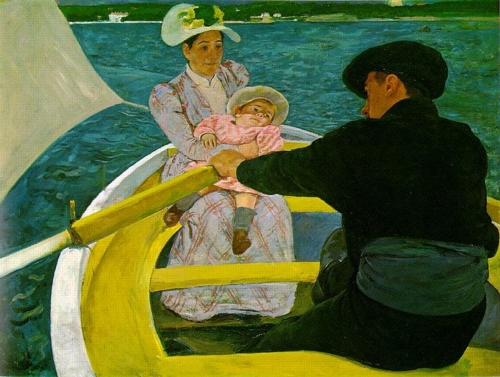
(above: Mary Stevenson
Cassatt, The Boating Party, c. 1893-1894, oil on canvas, 46.2 ? 37
inches, National Gallery of Art, Washington DC, 1963.10.94. Public domain,
via Wikimedia Commons*)
In the Distinguished Artists
page citing Mary Cassatt, there's 14 paintings to see in all.
- Mary Cassatt, an influential American
artist, is celebrated for her unique contributions to the Impressionist movement and her distinct focus on the lives of women and children.
Born into a well-to-do Pittsburgh family in 1844, Cassatt's early exposure
to European art through extensive travel fostered her admiration for artists
like Rubens and Velázquez, and contemporaries such as Manet and
Degas.
-
- Cassatt's artistic journey began in earnest
after settling in Paris in 1875. Invited by Edgar Degas, she participated
in the Fourth Impressionist Exhibition in 1879, becoming the only American
artist to exhibit with the Impressionists. Her work was characterized by
a high-key color palette, rapid brushstrokes, and the optical mixing of
colors, a hallmark of the Impressionist style.
-
- Cassatt's oeuvre is renowned for its
depiction of intimate, everyday moments in the lives of women and children.
Her focus on this theme was not merely a reflection of her personal life,
as she was unmarried and childless, but rather a deliberate artistic choice.
This subject matter resonated with the Impressionists' interest in contemporary
life and paralleled the revered tradition of Madonna and Child imagery
in European art. Works like "Mother and Child" (1889) and "Breakfast
in Bed" (c. 1897) showcase her tender yet unsentimental portrayal
of maternal bonds.
-
- In addition to her paintings, Cassatt
made significant contributions as a printmaker. Encouraged by Degas, she created exquisite prints
that demonstrated her technical prowess and innovative use of line and
color. Her series of drypoint and color aquatint prints from 1891, inspired
by Japanese art, remain celebrated for their compositional beauty and technical
complexity.
-
- Cassatt's later works, including her
mural "Modern Woman" for the 1893 World's
Columbian Exposition in Chicago, further illustrate her commitment to portraying
women's evolving roles in society. This mural, though lost after the exposition,
was foundational for many of her subsequent paintings, highlighting her
ability to merge allegorical content with contemporary themes.
-
- Her impact extended beyond her artistic
output. As a consultant to American art collectiors, Cassatt played a crucial role in shaping American
tastes and bringing Impressionist art to the United States. Her works continue
to be celebrated for their insightful portrayal of women's lives and their
contributions to the Impressionist movement.
-
- The preceding remarks were generated
by GhatGPT, sourced mainly from TFAO texts published online over many years,
and edited by the exhibit's curator in July 2024.
-
Let's turn the corner to the South
wall 
Glide Path
TFAO Museum of American Art is proudly sponsored by Traditional Fine Arts Organization, Inc., an Arizona nonprofit corporation. All rights
reserved. © 2024