
America's Distinguished
Artists
a national registry of
historic artists
additonal Jules Tavernier
paintings

(above: Jules Tavernier, Yosemite
Valley from Inspiration Point, 1882, oil on canvas, 27 x 44 inches,
Private collection. Public domain, via Wikimedia Commons*)
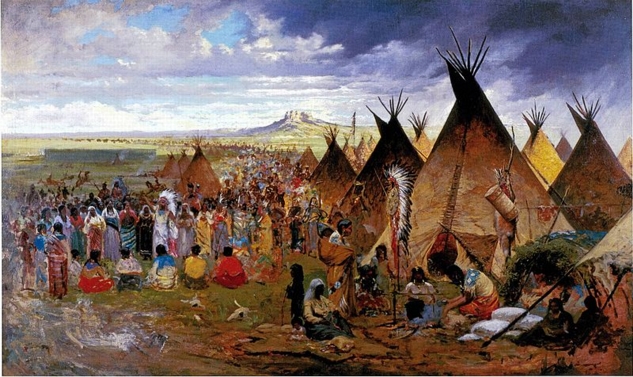
(above: Jules Tavernier, Sioux
Encampment, n.d., oil on canvas, 41 x 69 inches, Oakland Museum of
California. Source: Jules Tavernier, Artist & Adventurer by
Claudine Chalmers, Scott A. Shields, and Alfred C. Harrison Jr., Pomegranate
Communications, Portland, Oregon, 2014. Public domain, via Wikimedia Commons*)
- Jules Tavernier, a French-born painter, is renowned
for his captivating works that span diverse themes and geographies. Tavernier's
art reflects his eclectic journey across continents, capturing landscapes,
indigenous cultures, and dramatic scenes with a unique blend of realism
and romanticism. His motivation for painting was deeply intertwined with
his adventurous spirit and a keen desire to document and celebrate the
world's natural beauty and cultural richness.
-
- Born in Paris in 1844, Tavernier began his artistic
career studying under prominent French artists and exhibiting his works
at the Paris Salon. However, his adventurous nature soon led him to the
United States, where he became a member of the Bohemian Club in San Francisco.
This period marked a significant shift in his artistic focus, as he began
to explore the rugged and diverse landscapes of the American West. Tavernier's
works from this era, such as "Dance of the Flute Players" and
"The Last Stand," depict Native American life and the majestic
scenery of the Western frontier. These paintings are characterized by their
meticulous attention to detail and a deep sense of respect for the subjects
he portrayed.
-
- Tavernier's journey did not end in the American
West. He continued to travel, eventually reaching Hawaii, where he created some of his most iconic works. The
Hawaiian period of Tavernier's career is perhaps the most celebrated, as
it showcases his ability to blend ethnographic detail with dramatic landscapes.
One of his most famous paintings, "Volcano at Night," depicts
the eruption of Kilauea volcano. This painting is a masterful representation
of nature's raw power, with vivid colors and dynamic composition capturing
the volcanic eruption's intensity and grandeur. Tavernier's fascination
with volcanic activity was not merely for its dramatic visual potential
but also stemmed from a scientific curiosity and a desire to convey the
sublime beauty of natural phenomena.
-
- Tavernier's Hawaiian paintings often included
scenes of traditional Hawaiian life, providing a window into the island's
rich cultural heritage. Works such as "A Hawaiian Fisherman"
and "Hula Dancers" are infused with a sense of authenticity and
admiration for the indigenous people and their customs. These paintings
are more than mere representations; they are celebrations of a way of life
that was rapidly changing due to increased Western influence. Tavernier's
choice to depict these scenes reflects his recognition of the importance
of preserving and honoring cultural traditions.
-
- The motivations behind Tavernier's work were
multifaceted. At the core, his paintings were driven by a deep-seated wanderlust
and an insatiable curiosity about the world. Tavernier's art was a means
of exploring and documenting the diverse landscapes and cultures he encountered
on his travels. His works serve as visual narratives that communicate the
beauty, drama, and richness of the natural world and its inhabitants.
-
- Additionally, Tavernier was motivated by a desire
to bridge cultural divides. By painting scenes of indigenous life and natural
phenomena, he sought to foster a greater appreciation and understanding
among his audiences. His paintings encouraged viewers to see beyond their
own experiences and appreciate the diversity of the world around them.
-
- In conclusion, Jules Tavernier's paintings are
a testament to his adventurous spirit, artistic skill, and deep appreciation
for the world's natural and cultural diversity. His works not only capture
the beauty and drama of the landscapes he encountered but also serve as
valuable records of the cultural richness of the regions he visited. Tavernier's
legacy as an artist is one of exploration, documentation, and celebration
of the world's myriad wonders.
-
- The above brief essay was generated by
AI and edited in July, 2024.
Return to Toa-Tzz
Links to sources of information outside
of our web site are provided only as referrals for your further consideration.
Please use due diligence in judging the quality of information contained
in these and all other web sites. Information from linked sources may be
inaccurate or out of date. TFAO neither recommends or endorses these referenced
organizations. Although TFAO includes links to other web sites, it takes
no responsibility for the content or information contained on those other
sites, nor exerts any editorial or other control over them. For more information
on evaluating web pages see TFAO's General
Resources section in Online
Resources for Collectors and Students of Art History.
*Tag for expired US copyright of object
image:

 Search Resource Library
Copyright 2024 Traditional Fine Arts Organization, Inc., an Arizona nonprofit corporation. All rights
reserved.