
America's Distinguished
Artists
a national registry of
historic artists
Aditional paintings by
Winslow Homer
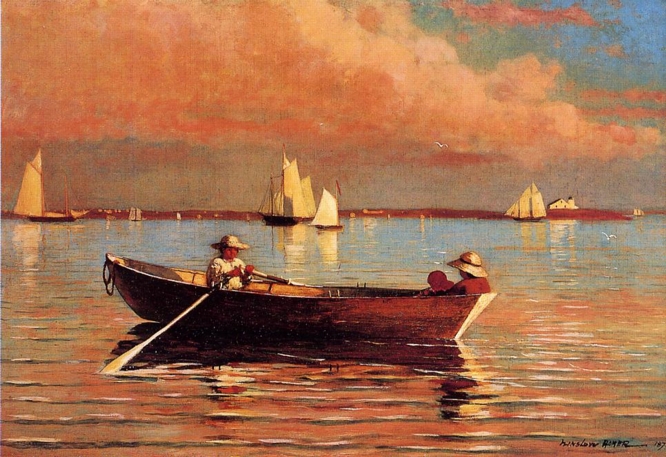
(above: Winslow Homer (1836-1910),
Gloucester Harbor, 1873, oil on canvas, 15.5 x 22.3 in.
The Nelson-Atkins Museum of Art, Gift of the Enid and Crosby Kemper
Foundation. Public domain, via Wikimedia Commons)
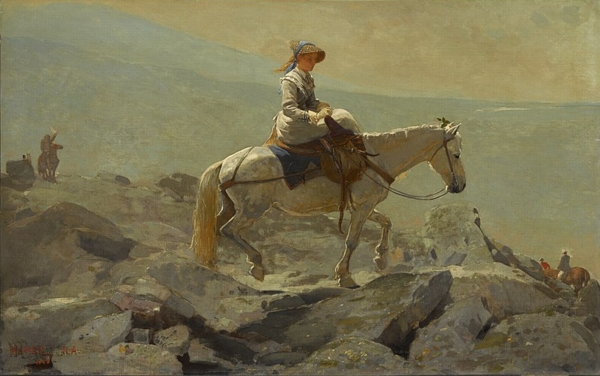
(above: Winslow Homer, The Bridle
Path, White Mountains, 1868, oil on canvas, 24.1 x 37.9 inches, Sterling
and Francine Clark Art Institute, Williamstown, Massachusetts. Public domain,
via Wikimedia Commons*)
- Winslow Homer (1836-1910) is celebrated as one
of America's foremost Realist painters and illustrators, known for his evocative depictions of American life
and the natural world. His works span a variety of themes, from the serene
landscapes of rural life to the dramatic scenes of maritime struggle, capturing
the essence of American spirit and resilience.
-
- Homer's career began in illustration, providing
detailed and narrative-rich engravings for popular publications like Harper's
Weekly. His early works, such as "The Army of the Potomac - A
Sharpshooter on Picket Duty," documented the Civil
War not through the lens of battlefield carnage
but through the everyday experiences of soldiers, emphasizing moments of
quiet and introspection amidst the chaos of war.
-
- Transitioning to painting, Homer continued to
explore themes of American life. His genre paintings of the 1870s, including "Snap-the-Whip"
and "Peach Blossoms," often focused on rural scenes and childhood
innocence, evoking nostalgia and a sense of community. These works are
characterized by their narrative quality and attention to the relationships
within these communities.
-
- Homer's fascination with the sea and
the rugged life of fishermen became a prominent theme in his later works.
After his stay in the fishing village of Cullercoats, England, in 1881,
he produced numerous watercolors and paintings depicting the harsh and
often perilous lives of the villagers. Works like "The Life Line"
and "Undertow" highlight the drama of human struggle against
the formidable forces of nature, reflecting both the physical and emotional
challenges faced by those who live by the sea.
-
- Homer's artistic evolution from illustrator to
painter allowed him to delve deeper into the human condition, using his
keen observational skills and his ability to capture light and movement
to create powerful and emotive works. His paintings not only tell stories
but also evoke strong emotional responses, whether through the tranquil
beauty of a summer day or the intense drama of a rescue at sea.
-
- Homer's dedication to realism and his ability
to convey the spirit of his subjects made him a pivotal figure in American
art. His works continue to be celebrated for their technical mastery and
their ability to capture the essence of the American experience, from the
innocence of childhood to the relentless battle against the forces of nature.
-
- The preceding brief essay was generated by AI
mainly from our texts published online and edited by us in July 2024.
Return to Hia-Hoz
*Tag for expired US copyright of object image:

Links to sources of information outside
of our web site are provided only as referrals for your further consideration.
Please use due diligence in judging the quality of information contained
in these and all other web sites. Information from linked sources may be
inaccurate or out of date. TFAO neither recommends or endorses these referenced
organizations. Although TFAO includes links to other web sites, it takes
no responsibility for the content or information contained on those other
sites, nor exerts any editorial or other control over them. For more information
on evaluating web pages see TFAO's General
Resources section in Online
Resources for Collectors and Students of Art History.
 Search Resource Library
Copyright 2023 Traditional Fine Arts Organization, Inc., an Arizona nonprofit corporation. All rights
reserved.