
America's Distinguished
Artists
a national registry of
historic artists
Page 2 of paintings by
Thomas Hill
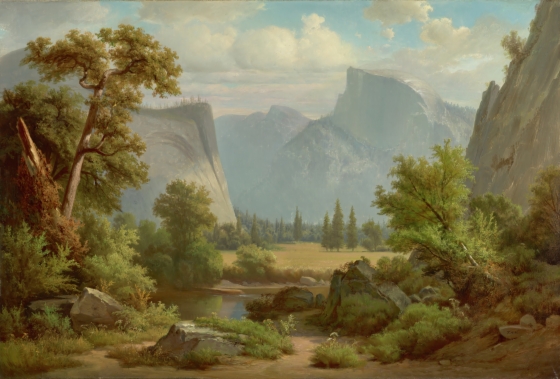
(above: Thomas Hill, Yosemite,
1865. oil on canvas, 30 x 44 inches, Denver Art Museum, Funds from Henry
Roath, 2019.539)
- Thomas Hill was a prominent American 19th
Century landscape painter known for his evocative depictions of
the American West, particularly Yosemite Valley and the White
Mountains of New Hampshire. His work
captures the grandeur and sublime beauty of the natural world, resonating
with the spirit of exploration and the romanticism of the 19th century.
-
- Hill's fascination with Yosemite began during his first
trip there in 1865. The valley's majestic vistas provided endless inspiration,
and he quickly became one of the foremost painters to capture its dramatic
landscapes. His works, such as "El Capitan and Bridal Veil Falls,
Yosemite Valley," highlight the awe-inspiring scale and natural beauty
of these iconic landmarks. Hill's ability to portray the interplay of light
and shadow, as well as his meticulous attention to detail, made his Yosemite
scenes particularly compelling and evocative.
-
- In addition to Yosemite, Hill painted various locations
in New Hampshire's White Mountains, such as Franconia Notch and Crawford
Notch. These works, including "Eagle Cliff from Profile Lake"
and his view of Crawford Notch from 1872, illustrate his versatility and
his ability to convey the unique character of different landscapes. These
paintings were significant not only for their artistic merit but also for
their role in promoting these natural sites as destinations for tourism
and exploration.
-
- Hill's paintings were more than just depictions of beautiful
scenery; they were expressions of the broader cultural and artistic movements
of his time. The Hudson River School
with its emphasis on romanticism and the sublime, greatly influenced Hill.
His works reflect a deep appreciation for the beauty and majesty of the
natural world, a characteristic trait of the school. Moreover, his art
was part of a broader narrative that included artists like Albert
Bierstadt and Thomas Moran,
who also sought to capture the vast and unspoiled beauty of the American
landscape.
-
- Hill's choice of subjects and his painting style were
influenced by both personal and cultural factors. The post-Civil War era
in the United States was a time of expansion and exploration. Hill's landscapes
celebrated the natural beauty of the country, reinforcing a sense of national
pride and identity. His works provided viewers with a visual escape into
the sublime beauty of nature, offering a sense of solace and inspiration
during a time of rapid change and modernization.
-
- Furthermore, Hill's art was driven by a personal passion
for nature and a desire to capture its fleeting beauty on canvas. His meticulous
attention to detail and his ability to capture the atmospheric qualities
of different landscapes demonstrate his deep connection to his subjects.
Through his paintings, Hill not only documented the natural beauty of places
like Yosemite and the White Mountains but also conveyed his own emotional
response to these magnificent environments.
-
- In summary, Thomas Hill painted the American West and the White Mountains
to capture and celebrate the sublime beauty of these landscapes. His works
reflect both the artistic trends of his time and his personal passion for
nature. Through his paintings, Hill played a crucial role in shaping the
visual identity of America's natural wonders, leaving a lasting legacy
in the world of American art. His works continue to inspire and captivate
viewers, offering a glimpse into the majestic beauty of the natural world
as seen through the eyes of one of its most dedicated interpreters.
-
- The preceding brief essay was generated by AI mainly
from our texts published online and edited in July, 2024
Links to sources of information outside
of our web site are provided only as referrals for your further consideration.
Please use due diligence in judging the quality of information contained
in these and all other web sites. Information from linked sources may be
inaccurate or out of date. TFAO neither recommends or endorses these referenced
organizations. Although TFAO includes links to other web sites, it takes
no responsibility for the content or information contained on those other
sites, nor exerts any editorial or other control over them. For more information
on evaluating web pages see TFAO's General
Resources section in Online
Resources for Collectors and Students of Art History.
*Tag for expired US copyright of object
image:

 Search Resource Library
Copyright 2024 Traditional Fine Arts Organization, Inc., an Arizona nonprofit corporation. All rights
reserved.