
America's Distinguished
Artists
a national registry of
historic artists
Artworks by Thomas Moran
plus brief remarks

(above: Thomas Moran, Grand
Canyon with Rainbow. 1912. Oil on canvas. de Young Art Museum. Gift
of Mr. and Mrs. Robert F. Gill through the Patrons of Art and Music. 1981.89.
License: Scuttlebutte,
CC BY-SA 4.0 Scuttlebutte, CC BY-SA 4.0.
via Wikimedia Commons**)

(above: Thomas Moran, Zoroaster
Temple at Sunset, oil on canvas, Phoenix Art Museum. Public domain,
via Wikimedia Commons*)

(above: Thomas Moran, A Snowy Mountain
Range (Path of Souls, Idaho), 1896, oil on canvas, 14 x 27 inches, Denver
Art Museum, The Roath Collection. Public domain, via Wikimedia Commons*)
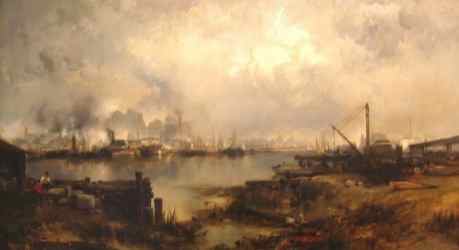
(above: Thomas Moran (1837-1926),
"Lower Manhattan from Communipaw, New Jersey", 1880, oil, Collection
of the Washington County Museum of Fine Arts, Hagerstown, Maryland, Museum
Purchase, 1940, A303) Excerpted from The
Moran Family of Painters: Edward, Leon, Thomas, Mary & Peter Moran
See page 2 of more
artworks by Thomas Moran
- Thomas Moran, a pivotal figure in American art,
is best known for his breathtaking landscape paintings of the American
West. Born in England in 1837, Moran immigrated to the United States with
his family as a child. He would go on to become one of the foremost landscape
painters of his time, significantly contributing to the nation's appreciation
and preservation of its natural wonders. Moran's paintings not only captured
the beauty of the American wilderness but also played a crucial role in
the development of the national park system. Understanding what Moran painted
and why he did it involves examining his influences, motivations, and the
broader cultural context of his work.
-
- Early Life and Artistic Influences
-
- Thomas Moran began his artistic career as an
apprentice to a wood engraver, but his true passion lay in painting. He was inspired
by the works of British artist J.M.W. Turner, whose dramatic use of light
and color greatly influenced Moran's style. Moran's early works primarily
consisted of illustratons and smaller landscape paintings, but his career took a defining turn when he
became involved with the geological surveys of the American West.
-
- The Yellowstone Expedition and Beyond
-
- In 1871, Moran joined the United States Geological
Survey of the Yellowstone region led by Ferdinand V. Hayden. This expedition
proved to be a turning point in Moran's career. Captivated by the stunning
and untamed beauty of Yellowstone, Moran created a series of sketches and
paintings that would later become some of his most famous works. Paintings
like "The Grand Canyon of the Yellowstone" and "The Hot
Springs of Gardiner's River" are celebrated for their vivid colors,
dramatic compositions, and meticulous attention to detail.
-
- Motivations and Impact
-
- Moran's motivations for painting the American
West were multifaceted. Firstly, he was driven by a deep appreciation for
nature's beauty and a desire to capture its grandeur on canvas. His paintings
are characterized by a sense of awe and reverence, reflecting his personal
connection to the landscapes he depicted. Moran's use of light, color,
and scale conveyed the sublime and often overwhelming majesty of the natural
world, inviting viewers to experience these places as he did.
-
- Secondly, Moran was motivated by a sense of national
pride and a desire to contribute to the cultural and environmental preservation
of the United States. His paintings of Yellowstone and other western landscapes
played a pivotal role in convincing Congress to establish Yellowstone as
the first national park in 1872. Moran's works were used to promote the
idea of preserving America's natural wonders for future generations, highlighting
the intrinsic value of these landscapes beyond their economic potential.
-
- Artistic Legacy and Cultural Significance
-
- Thomas Moran's legacy extends far beyond his
artistic achievements. His paintings not only captured the beauty of the
American West but also helped shape the nation's cultural and environmental
consciousness. By portraying the grandeur and uniqueness of places like
Yellowstone, the Grand Canyon, and the Rocky Mountains, Moran's work inspired
a sense of pride and stewardship for America's natural heritage.
-
- Moran's influence is also evident in the broader
American art scene. His ability to blend realism with romanticism set a precedent for landscape painting,
and his works remain a benchmark for artists depicting the natural world.
Moreover, his involvement in the national park movement underscores the
power of art to effect social and environmental change.
-
- Conclusion
-
- In conclusion, Thomas Moran painted the American
West to capture its unparalleled beauty, to inspire a sense of national
pride, and to advocate for the preservation of its natural wonders. His
vivid and dramatic landscapes serve as both artistic masterpieces and historical
documents, highlighting the transformative power of art in shaping public
perception and policy. Moran's work continues to resonate today, reminding
us of the timeless beauty of the natural world and the importance of preserving
it for future generations. Through his paintings, Moran not only celebrated
the splendor of the American landscape but also helped ensure its protection
and appreciation for years to come.
-
- The above text was generated by AI and edited
in July, 2024.
Links to sources of information outside
of our web site are provided only as referrals for your further consideration.
Please use due diligence in judging the quality of information contained
in these and all other web sites. Information from linked sources may be
inaccurate or out of date. TFAO neither recommends or endorses these referenced
organizations. Although TFAO includes links to other web sites, it takes
no responsibility for the content or information contained on those other
sites, nor exerts any editorial or other control over them. For more information
on evaluating web pages see TFAO's General
Resources section in Online
Resources for Collectors and Students of Art History.
*Tag for expired US copyright of object
image:

 Search Resource Library
Copyright 2024 Traditional Fine Arts Organization, Inc., an Arizona nonprofit corporation. All rights
reserved.