
Evolution of American Western Art: 1850-1900
a 2025 article by Gemini AI
Romantic Beginnings (1850s1860s)
In the mid-19th century, American artists first ventured into Western subjects with a romanticized eye. Painters like Albert Bierstadt portrayed grand landscapes with Indians and wildlife as idyllic and "Edenic" scenes. For example, Bierstadt's Indian Encampment, Late Afternoon (1862) shows a Plains village at sunset, tipis and riders bathed in golden light. This scene exemplifies the sweeping, luminous vistas favored by early Western artists, who often framed Native American camps and buffalo herds within majestic mountain scenery.
Indian Encampment, Late Afternoon (1862) by Albert Bierstadt depicts a peaceful Plains village at dusk in the Hudson River School's romantic style. Early Western paintings like this emphasized beauty and grandeur over Realism.
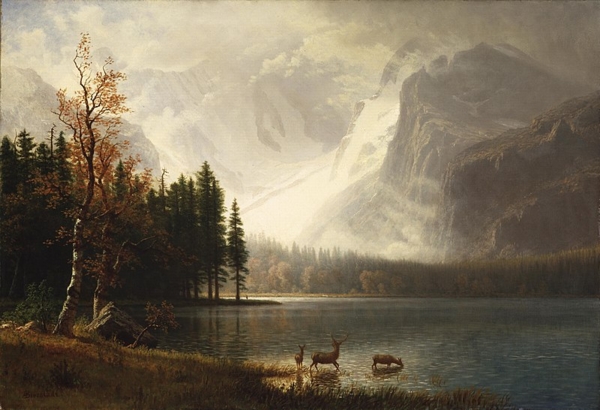
(above: Albert Bierstadt, Estes Park, Colorado, Whyte's Lake, circa 1877, oil on canvas, 30 x 43.7 inches, Buffalo Bill Center of the West. Public domain, via Wikimedia Commons*)
Additional artwork by Albert Bierstadt
Another pioneer was Alfred Jacob Miller, an artist from Baltimore who became "best known for his paintings of trappers and Native Americans in the fur trade"en.. His watercolors (often done on tinted paper for an atmospheric effect) show fur trappers amid Indian families, trading goods or courting. In The Trapper's Bride (c.1859) a mountain man accepts a marriage dowry while buffalo graze nearby. These scenes combined adventure with a touch of narrative humor. Miller's work -- the "trapper and prey" theme -- set a template: European-style attention to composition and detail, but featuring frontier characters and animals.
Alfred Jacob Miller's The Trapper's Bride (c. 185860) shows a fur trapper negotiating with a Native family. Miller's figures are finely detailed, reflecting the artist's romantic yet ethnographic approach.

(above: Alfred Jacob Miller, Indian Boy, watercolor, gouache, ink and pencil on tissue paper laid down on paper, Christies. Public domain, via Wikimedia Commons*)
More paintings by Alfred Jacob Miller
During these decades artists treated horses, buffalo, and Indians in an idealized manner. Bierstadt's The Buffalo Trail(c.1861), for example, displays bison at their zenith under a golden sky -- the buffalo are "shown here in great numbers [with] threats of hunters and railway lines nowhere to be seen." This emphasis on abundance and light contrasts sharply with later realist works. Still, these romantic landscapes and genre scenes established the chief Western motifs horse and rider, cowboys (mountain men) and Indians -- that would dominate American art through 1900.
Toward Realism (1870s-1880s)
By the 1870s some Western artists began to introduce grittier detail and narrative drama. Bierstadt himself painted more contentious scenes: his The Last of the Buffalo (1888) was described as an "ode to an earlier era." In that and related canvases a Native hunter confronts a massive bison bull, foreshadowing the herds' decline. As one critic noted, these later paintings "gave voice to contemporary concerns" about the fate of wildlife. In general, artists started to blend their romantic style with ethnographic accuracy: clothing, gear, and animal anatomy became more faithfully depicted.
Other painters of this period, like Karl Bodmer (Europeans who traveled West) and Henry Farny (American, b.1847), depicted Plains Indians hunting or living in camp with realistic textures and lighting. The "horse and rider" image remained central: cavalry patrols and Indian horsemen appear in many scenes. At the same time, the older "trapper and prey" motif gave way to buffalo-hunt action scenes and confrontations. For example, Bierstadt's Buffalo Trail still shows peaceful abundance, but by 1888 his buffalo-centric paintings dramatized the hunt. This shift from scenic reverence to narrative action set the stage for the next generation of Western artists.
The Cowboy Artists (1880s-1900)
The 1880s and 1890s saw the emergence of explicitly Western genre painters who lived part-time on the frontier. Foremost were Frederic Remington and Charles Marion Russell. Remington (1861-1909) traveled to Montana and Indian Territory in the 1880s, making thousands of sketches of cowboys, cavalry, settlers, and Plains Indians. His paintings (and later bronzes) combined precise detail with dramatic action. An early Remington canvas was the seven-foot-wide A Dash for the Timber (1889), showing fleeing stagecoach riders pursued by Indian horsemen -- the ultimate "cowboys and Indians" spectacle. As Theodore Roosevelt noted, Remington portrayed "the cowboy and rancher, the Indian, the horses and the cattle of the plains" as living figures, preserving this "vanishing" frontier life for posterity. Stylistically, Remington's work had "tight handling and strong lighting" influenced by French academic artmetmuseum.org, giving even wild action a crisp realism.
Paintings by Frederic Remington
Theeodore Roosevelt's words remain telling: "He has portrayed a most characteristic and yet vanishing type of American life. The soldier, the cowboy and rancher, the Indian, the horses and the cattle of the plains, will live in his pictures and bronzes for all time." In this way Remington and his peers cemented the iconic imagery of the Old West.
Frederic Remington's bronze Broncho Buster (modeled 1895) -- "the first sculpture of a cowboy cast in bronze" -- shows a cowboy rearing back on a bucking horse. Remington adapted it from a published sketch; it exemplifies his dynamic, realistic style.
Starting in the 1890s Remington also moved into sculpture (after learning modeling from Frederick Ruckstull). His Broncho Buster (1895) was an instant success as a small bronze. In all, Remington modeled about 21 Western sculpture groups, almost all small bronzes, many derived from his paintings. These statues -- depicting cowboys roping steers, Indians hunting buffalo, or cavalry horses -- were praised as "some of the finest American small bronzes of the time."
Charles M. "Charlie" Russell (1864-1926) was dubbed "the Cowboy Artist" for his hundreds of paintings of frontier life. By 1900 he had produced scenes of rendezvous camps, buffalo hunts, and colorful Indian ceremonies, often with wry humor. Russell's canvases, richly colored and narrative, reinforced the popular Western language even as they grew increasingly accurate in ethnographic detail. Although he did little sculpture before 1900, he would soon follow Remington into bronze work (inspired partly by seeing Western bronzes on display at the 1904 St. Louis Exposition.
Other painters like Henry Farny, Frederic Remington's contemporary Joseph Henry Sharp, and the artists of the Taos Society (e.g. E. Irving Couse) joined this realist trend around 1890, focusing on Native Americans and cowboys in everyday or action-packed situations. The "horse and rider" motif remained ubiquitous: Indian trackers on galloping ponies, cavalry officers charging, cowboys herding cattle -- all in faithfully observed light and anatomy. The mythic West was now rendered with the brush of a field-naturalist.
Paintings by Joseph Henry Sharp
Western Sculpture: Drama in Bronze
Beyond painting, sculptors also embraced Western themes. Edward Kemeys (1843-1907) became America's first devoted animal sculptor -- an "animalier" -- and set early standards. His famous Buffalo and Wolves (1876) is a dynamic bronze group showing a buffalo locking horns with attacking wolves. This violent "trapper and prey" scene captures raw frontier drama without human presence. Kemeys later created other Western animal bronzes (buffalo, bears, wolves) for public monuments.
From the 1890s on, Western subjects flourished in sculpture as well. Remington's transition to modeling led to dozens of bronzes of Western life. Solon Borglum (1868-1922), brother of Gutzon Borglum of Mount Rushmore fame, produced acclaimed works of horses and riders in motion. In Paris and New York around 1898-1900 Borglum exhibited pieces like Lassoing Wild Horses and The Stampede of Wild Horses at the Paris Salon. (He also later sculpted Native American figures and cowboys, contributing to both "horse and rider" and "cowboys and Indians" iconography.) By 1900 even utilitarian objects bore Western motifs: Remington and Russell models appear as decorative bookends and statuettes.

(above: Gutzon Borglum and Lincoln Borglum, Mount Rushmore National Memorial, 1927 to 1941. Photo courtesy of National Park Service Image Gallery)
As evidence of the genre's maturity, the 1904 St. Louis World's Fair displayed hundreds of Western-themed sculptures. Contemporary reports note that the fairgrounds featured "more than a thousand outdoor sculptures" on westward themes, including small bronzes by nearly every notable artistcmrussell.org. Visitors saw Remington bronzes of cowboys and bronco-busters, Edward Kemeys's buffalo groups, Solon Borglum's horse-studies, and many others. Russell himself was inspired by these displays to model his own bronzes afterwards.
Thus by the end of the century Western subjects had fully entered American sculpture. Small bronze groups by Remington, Kemeys, Borglum, and later Russell portrayed the same trappers, riders, and Indian hunters familiar from paintings, but with the added immediacy of three dimensions. Public monuments (e.g. pioneer equestrians, Native American leaders) were also commissioned in this era, but it was the vivid little bronzes that brought Western action into art collections.
Conclusion
Between 1850 and 1900 the Western genre evolved from Romantic fantasy to grounded realism, but its core themes remained constant. Early on, artists painted trappers and prey, vast landscapes, and peaceful scenes of native life in idealized tones. By 1900, painters and sculptors foregrounded the action -- rodeos, hunts, cavalry charges -- in sharp, naturalistic detail. Throughout, horses, riders, cowboys, and Indians dominated the imagery. Indeed, as Roosevelt and others noted, this body of art ensured that "the cowboy and rancher, the Indian, the horses and the cattle of the plains" would be immortalizedmetmuseum.org. The major figures -- Bierstadt, Miller, Remington, Russell and their peers -- each contributed to that enduring legacy, bridging the romantic West of legend and the hard-edged reality of the frontier.
Please don't rely on this AI-generated text for accuracy. It has been lightly edited, yet may be laden with inaccurate information. Consider it a base for further inquiry.
 Return to Western Genre Art, 19th-21st Century
Return to Topics in American Representational Art
*Tag for expired US copyright of object image:

Links to sources of information outside of our web site are provided only as referrals for your further consideration. Please use due diligence in judging the quality of information contained in these and all other web sites. Information from linked sources may be inaccurate or out of date. TFAO neither recommends or endorses these referenced organizations. Although TFAO includes links to other web sites, it takes no responsibility for the content or information contained on those other sites, nor exerts any editorial or other control over them. For more information on evaluating web pages see TFAO's General Resources section in Online Resources for Collectors and Students of Art History.
 Search Resource Library
Copyright 2025 Traditional Fine Arts Organization, Inc., an Arizona nonprofit corporation. All rights reserved.