
Evolution of American Western Art: 1900 To the Present
by ChatGPT, 2025
At the turn of the 20th century, Western genre art was dominated by the legacy of Frederic Remington and Charles M. Russell. Remington (1861-1909) -- was "considered to be one of the most representative artists of Western subjects." He produced thousands of action-packed paintings and bronzes (for example, The Mountain Man of 1903) that "capture[d] a scene of frontier life" -- a buckskinned trapper and his horse descending a rugged pass. His subjects focused on horses, cowboys, cavalry and Native Americans in dramatic, high-action compositions. Remington deliberately kept his figures in motion and full of tension, narrating "hard riding and hard fighting" with maximum impact.

(above: Frederic Remington, On the Southern Plains, 1907, Oil on canvas, 30 1/8 x 51 1/8in. (76.5 x 129.9cm), The Metropolitan Museum of Art, Gift of Several Gentlemen, 1911)

(above: C.M. Russell, Lassoing A Steer, 1897, oil on board 18.5 x 24.5 inches, Private collection. Public domain, via Wikimedia Commons*)
Russell (1864-1926) picked up this mantle of frontier storytelling with his own paintings and bronzes. A former cowhand, he painted thousands of images of ranch life, hunting parties and skirmishes. His intimate knowledge of the West gave "a distinctive realism" to his work -- he was celebrated as a precise documentary artist who often depicted Native Americans from the indigenous point of view. In sum, Remington and Russell together forged a romantic yet naturalistic vision of the Old West: one that memorialized trappers and hunters, horse and rider action, and the epic clash of cowboys and Indians.
Paintings by Frederic Remington
Key Early Western Artists and Their Contributions
Frederic Remington (1861-1909): Painter and sculptor of energetic Western scenes. Known for bronzes like The Mountain Man (a trapper descending with his horsemetmuseum.org) and Bronco Buster, and for narratives of soldiers, cowboys and Indians.
Charles M. Russell (1864-1926): "Cowboy artist" and author who created over 2,000 paintings and sculptures of range life. His work is noted for "distinctive realism" and for humanizing Native Americans, often with humor or poignant drama.
Solon Borglum (1868-1922): A sculptor "noted for his depiction of frontier life, especially cowboys and Native Americans." His bronzes show riders, hunters and frontier scenes drawn from his days as a Nebraska rancher.
Cyrus E. Dallin (1861-1944): Sculptor of idealized Native subjects. His equestrian statue Appeal to the Great Spirit (1909) portrays a Plains Indian on horseback with arms uplifted, a romanticized vision of an Indian speaking to the sky.
James Earle Fraser (1876-1953): Sculptor of End of the Trail (1915), depicting a dejected Indian slumped on a spent horse. This iconic statue symbolizes the defeated Native American; it came to "symbolize the genocide of Native American peoples."
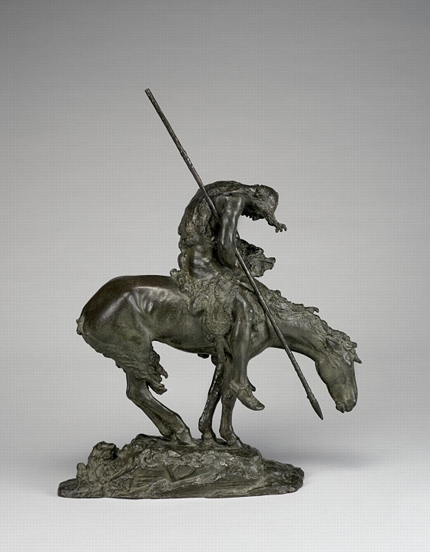
(above: James Earle Fraser, The End of the Trail, 1918, bronze, 33 1/2 x 26 x 8 3/4 inches, Denver Art Museum, Gift of Henry Roath. 2019.22.)
Alexander Phimister Proctor (1860-1950): Called "America's premier sculptor of western animals and heroes." In 1900 he produced The Cowboy (and its companion The Indian), the first-ever statues to depict a Western cowboy and an Indian on horse. Proctor excelled at dynamic animalier bronzes of horses, bison and riders (exhibiting French Romantic naturalism).
Sculptures by Alexander Phimister Proctor
Frank Tenney Johnson (1874-1939): Painter known for "moody and romantic" night scenes. He pioneered moonlit images of tied horses outside saloons, bathing the scene in silvery light -- a style so distinctive that his "night piecesserve as the archetype" for later Western art nightscapes.

(above, Frank Tenney Johnson, P. 45 - illustration from book "The Boss of Wind River" (1911) by A. M. Chisholm. Illustrator Frank Tennyson Johnson; publishers: Doubleday, Page & Co., New York [Caption: Miss Crooks came down the walk to meet him ..."I'm so glad to see you, Joe. I've been looking for you for days"]. Public domain, via Wikimedia Commons*)
Paintings by Frank Tenney Johnson
Edward Borein (1872-1945): Etcher and painter famous for authentic cowboy pictures. A contemporary of Russell's, Borein insisted on accuracy: "I will leave only an accurate picture of the West, nothing else but that," he said. His drawings and watercolors of cowboys, vaqueros and cattle ranch life are detailed, unsentimental studies of Old West life.
Maynard Dixon (1875-1946): Painter of the Southwest, whose work focused on Native American and Hispanic-American subjects and landscapes. Starting with Tonalism and later Precisionism, Dixon blended realism with modernist composition to portray the high desert and its people.
Trapper and Prey Imagery, Horse-and-Rider Iconography
In early Western art, scenes of trappers and hunters stalking game across the landscape were common. Remington's bronzes like The Mountain Man (embedded above) explicitly show the hunter and his horse allied against the wilderness. The Metropolitan Museum of Art notes that the statuette captures "a dramatic moment in the daily life of a buckskin-clad trapper" descending a cliff with his mount. This emphasizes cooperation between man and horse on perilous territory. Russell also painted fur-trappers and buffalo hunts in his grand outdoor scenes. These works tend to be realistic in detail (fur clothing, rifles, horses) yet composed with sweeping drama. Even as the 19th-century frontier was vanishing, artists like Remington dramatized the trapper vs. prey encounter as part of a heroic "vanishing West."
Similarly, the horse-and-rider motif became a defining visual of the West. Many sculptors and painters focused on dynamic equestrian figures. Cyrus Dallin's 1909 Appeal to the Great Spirit shows a shirtless Native American on a rearing horse, arms raised to the sky -- a sublime, romantic image of the Indian rider in communion with nature. Alexander Proctor's early statues of The Cowboy and The Indian (both ca. 1900) were the first sculptures in American art to portray these Western types. Proctor, trained in the Beaux-Arts style, sculpted lithe horses and muscular riders with lifelike immediacy. For example, his cowboy and Indian pairs show men and horses in mid-motion, reflecting both realism and heroic classicism. James Fraser's End of the Trail (1915) again uses horse-and-rider symbolism, depicting a Native American man and horse utterly spent at journey's end. This tragic composition, bronze-cast from 1909, became a potent emblem of Indigenous suffering on the frontier.
In painting, equestrian scenes also thrived. Early illustrators like W.H.D. Koerner and later artists such as Joe De Yong and Philip Goodwin created dynamic paintings of mounted cowboys and Indians. After midcentury, members of the Cowboy Artists of America (founded 1965) painted countless realist portraits of riders in action -- roping calves or loping across deserts. These works continued the tradition of faithfully rendering gear, anatomy and movement, influenced by the earlier emphasis on authenticity.
Paintings by William H. D. Koerner
Cowboys, Indians, and the Move to Realism
The theme of "cowboys and Indians" itself dominated Western art through 1975. Early artists often portrayed battles or encounters (as in Remington's or Russell's narrative scenes). Russell was unusual in sometimes portraying Native Americans sympathetically, even making them protagonists in his stories. Over time, a shift toward authenticity and everyday life emerged. Frank Tenney Johnson and others moved away from pitched battles to quieter genre scenes (horses at night, campfire gatherings), yet legends persisted in public taste.
By the 1930s-'60s, the prevailing style in Western art was representational and nostalgic, though subject matter ranged from mythic to mundane. During this period a generation of painters and sculptors continued both romantic and realistic threads. Illustrators like N.C. Wyeth and John Clymer created heroic cowboy-and-Indian images for magazines. Southwestern fine artists (the Taos and Santa Fe schools) such as Joseph Henry Sharp, Eanger Irving Couse and Walter Ufer depicted Indians and cowboys with a mix of ethnographic detail and painterly color. They often presented Native Americans in a dignified, often idealized manner, and emphasized the brilliant New Mexico light and landscapes in their figures. Meanwhile, humorists like Frederic Remington's friend George "Wolf" Lamm made satirical drawings of Western life.
Paintings by Joseph Henry Sharp
After World War II, Western art saw a conscious turn toward naturalism and authenticity. The Cowboy Artists of America (CAA) was formed in 1965 by a group of cowboy painters determined to "preserve traditional western culture through representational art, as inspired by Charles M. Russell and Frederic Remington.". Founders Joe Beeler, Charlie Dye and others organized annual shows and demanded technical precision in anatomy, gear, and historical accuracy. Their legacy was a resurgence of Western realism: The art produced by [CAA] members set the standard for contemporary Western realism.. Throughout midcentury and into the 1970s, Western artists -- both CAA-affiliated and others -- painted cattle drives, Native ceremonies, rodeo scenes and wide-open ranges in lush yet meticulous detail. Some were national figures (e.g. Maynard Dixon, whose tonalist-to-precisionist canvases of desert mesas and pueblo ruins blended realism with modern composition. Others remained regionally known, but together they kept the Western myth alive in art without resorting to abstraction.
1975 to the present
Since 1975, American Western genre art has undergone a dynamic evolution, with artists reinterpreting traditional themes such as "trapper and prey," "horse and rider," and "cowboys and Indians." This period has seen a blend of romanticized and realistic portrayals, as well as innovative approaches that challenge and expand upon established motifs.
One notable artist is Scott Myers, a Texas-based painter and sculptor born in 1958. With a background in veterinary medicine, Myers brings anatomical precision to his depictions of ranch life, horses, and cowboys. His paintings are characterized by bold colors and layered textures, offering a unique perspective within the Western art genre.
Veryl Goodnight, born in 1947, is renowned for her realistic equine sculptures that often capture the spirit of the American West. Her works, such as The Day the Wall Came Down, showcase her ability to convey motion and emotion through bronze, solidifying her status in the realm of Western art.
In the realm of painting, Kim Douglas Wiggins, born in 1959, offers expressionist landscapes and historical imagery of the American West. Raised on a ranch in New Mexico, Wiggins combines elements of Postimpressionism and American Regionalism to create vivid scenes that reflect both history and imagination.
Bob Coronato, born in 1970, focuses on contemporary Western Americana, painting scenes that depict modern-day cowboys and Native American life. His work aims to bridge the past and present, highlighting the ongoing narratives within Western culture.
Artists like Fritz Scholder have challenged traditional representations of Native Americans in art. Scholder's work, such as Seated Indian with Rifle (After Remington), utilizes bold colors and abstract elements to provoke thought and reinterpret historical depictions.
Delmas Howe, born in 1935, brings a neoclassical approach to Western themes, often incorporating homoerotic elements into his paintings. His Rodeo Pantheon Series reimagines classical mythological figures as cowboys, blending Renaissance influences with Southwestern motifs.
Felice House, an American figurative painter, reinterprets classic Western characters by portraying them as women. Her oil paintings challenge traditional gender roles within the genre, offering a feminist perspective on iconic cowboy imagery.
In sculpture, Curt Mattson brings firsthand ranching experience to his works, capturing the raw energy of cattle drives and rodeos. His pieces, like Bawlin' Broncs and Clatterin' Horns, reflect a deep understanding of animal behavior and movement.
Kevin Red Star, born in 1943, offers a contemporary, expressionistic sensibility in his paintings, celebrating his Crow Indian cultural heritage. His work, such as Crow Indian Parade Rider, uses exaggerated color and simplified form to provide a brilliant glimpse into Crow life.
These artists, among others, have contributed to the rich tapestry of American Western art since 1975, each bringing their unique perspectives and techniques to traditional themes. Through their work, the genre continues to evolve, reflecting both the enduring allure and the complex realities of the American West.
Please don't rely on this AI-generated text for accuracy. It has been lightly edited, yet may be laden with inaccurate information. Consider it a base for further inquiry.
 Return to Western Genre Art, 19th-21st Century
Return to Topics in American Representational Art
*Tag for expired US copyright of object image:

Links to sources of information outside of our web site are provided only as referrals for your further consideration. Please use due diligence in judging the quality of information contained in these and all other web sites. Information from linked sources may be inaccurate or out of date. TFAO neither recommends or endorses these referenced organizations. Although TFAO includes links to other web sites, it takes no responsibility for the content or information contained on those other sites, nor exerts any editorial or other control over them. For more information on evaluating web pages see TFAO's General Resources section in Online Resources for Collectors and Students of Art History.
 Search Resource Library
Copyright 2025 Traditional Fine Arts Organization, Inc., an Arizona nonprofit corporation. All rights reserved.