
South Carolina Art History: A Century of Light and Spirit, 1845-1945
by Gemeni 2.5 Pro
Page 1
Introduction: The Soul of the Palmetto State on Canvas
In 1845, South Carolina was a land of profound contrasts, a society defined by a wealthy planter class and deep-rooted cultural traditions, set against a landscape that stretched from the foothills of the Blue Ridge Mountains to the subtropical marshes of the Lowcountry. This unique sense of place became a powerful muse for artists over the next century, a period of immense social upheaval and artistic revolution.
The story of painting in South Carolina from 1845 to 1945 is a narrative of how this specific landscape and its culture were captured, interpreted, and transformed through the successive lenses of America's great artistic movements. It is a journey from the idealized visions of Romanticism to the radical new languages of Modernism, a story anchored in the state's enduring natural beauty and the quiet virtues of its people.
A pivotal moment in this journey occurred in 1858 with the founding of the Carolina Art Association in Charleston. This act by prominent citizens signified a formal, lasting commitment to cultivating the arts in South Carolina, establishing a cultural anchor that would, in 1905, become the Gibbes Museum of Art. The history of this institution serves as a throughline for the state's artistic development, providing a stage where the grand drama of American art would unfold.
From its galleries, one can trace the evolution from the sublime emotions of the antebellum era to the atmospheric moods of Tonalism the light-drenched canvases of Impressionism the fervent cultural preservation of the Charleston Renaissance, and finally, the startling innovations of Modernism that heralded a new age. This century of expression reveals a continuous dialogue between a cherished regional identity and the inexorable forces of national and international change, all captured on canvas.
The Romantic Spirit: Idealized Nature and Antebellum Virtue (1845-1880)
The international Romantic movement, with its profound emphasis on emotion, individualism, and the sublime power of nature, found fertile ground in the cultural climate of the antebellum South. Southern Romanticism was less about wild, untamed wilderness and more about an idealized chivalric code, the heroic individual, and a deep, often spiritual, connection to a cultivated but majestic landscape. This sensibility permeated the art of the period, which was dominated by a rich tradition of portraiture.
No artist better exemplifies the romantic portrait than Thomas Sully (1783-1872). Having spent his youth in Charleston, Sully frequently returned to the city for commissions, becoming the preferred portraitist of the Southern elite. His style, described as "warm, lush," and deeply influenced by the English romantic school of Sir Thomas Lawrence, was perfectly attuned to the tastes of his patrons.
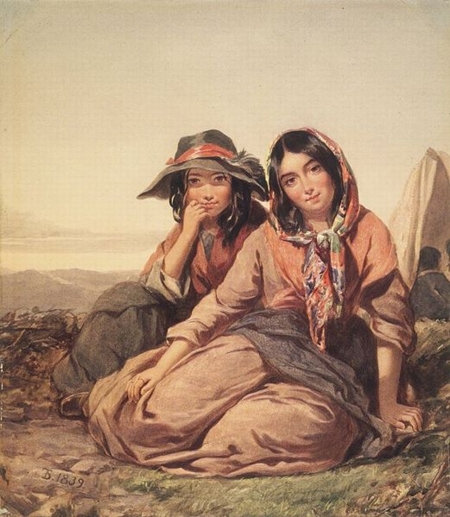
(above: Thomas Sully, Gypsy Maidens, c. 1839, watercolor on paper, 16 1/2 x 14 1/2 inches, Purchased with funds given by Mr. and Mrs. Leonard L.Milberg, Brooklyn Museum. Public domain, via Wikimedia Commons*)
Sully famously advised that "one can never flatter a subject too much," and his portraits reflect this philosophy. They are not stark, realistic documents but rather idealized likenesses that convey social grace, gentle character, and an air of effortless gentility. This preference for a flattering, romantic style was a conscious cultural choice. In a society that valued an "idealized chivalric code of personal honor," these portraits served as visual affirmations of those virtues, projecting an image of a refined and ordered world.
While portraiture reigned, the romantic reverence for nature also found expression. South Carolina-born Washington Allston (1779-1843), though active before our period, was a towering figure in Romanticism whose influence lingered, shaping the perception of the Southern landscape as a place of sublime beauty. Itinerant artists like Alvan Fisher (1792-1863) also traveled through the state, drawn to its scenic grandeur. Between 1817 and 1826, Fisher journeyed from Vermont to South Carolina, producing a diverse body of romantic images that expanded the repertoire of 18-19th Century landscape art and reflected a growing national interest in the majestic and varied scenery of the South.

(above: Washington Allston (American, Georgetown, South Carolina 1779-1843 Cambridgeport, Massachusetts), The Spanish Girl in Reverie, 1831, Oil on canvas, 30 x 25 inches. The Metropolitan Museum of Art, Gift of Lyman G. Bloomingdale, 1901. Public domain, via Wikimedia Commons*)
More paintings by Washington Allston
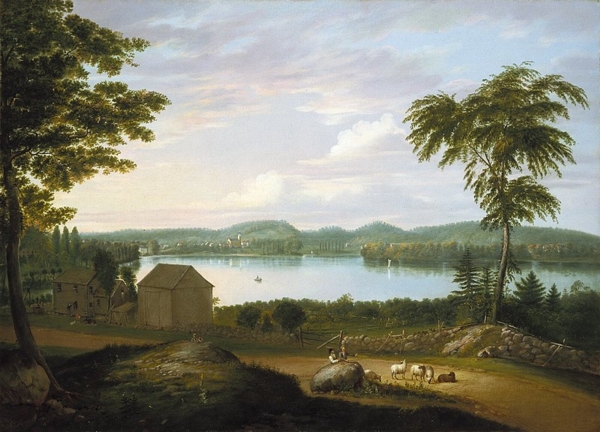
(above: Alvan Fisher, View of Springfield
on the Connecticut River, c. 1819,oil on canvas, 31.6 x 43.7 inches, Dick
S. Ramsay Fund, Brooklyn Museum. Public domain, via Wikimedia Commons*)
A Poetic Vision: The Rise of Tonalism and the Lowcountry Atmosphere (1880-1915)
In the decades following the Civil War, a new artistic sensibility emerged in America. Tonalism was a quiet, introspective movement, characterized by "soft, blurred lines, gentle use of colors in the mid-range of tones," and an overarching focus on mood, memory, and atmosphere rather than literal description. Emerging from the trauma of conflict, it offered a contemplative, spiritualized vision of the landscape, a tranquil escape into a world of memory and feeling. The unique climate of the South Carolina Lowcountry. -- with its humid, hazy air, its soft, diffused light filtering through Spanish moss, and its mysterious, silent swamps -- proved to be a perfect subject for the Tonalist aesthetic. The landscape itself seemed to embody the movement's core principles.
Alice Ravenel Huger Smith (1876-1958) stands as the quintessential artist of the Lowcountry Tonalist vision. A Charleston native and a leading figure of the later Charleston Renaissance, Smith was largely self-taught, developing a lyrical, fluid watercolor style to portray the "creeks, marshes, and swamps" of her home. Her methods were deeply Tonalist; influenced by the painter Birge Harrison and by Japanese art, she often composed her works in the studio from memory sketches, seeking a "more poetic and imaginative vision" that captured the essence and emotion of a scene rather than its precise details. Her works, with their delicate washes and subtle harmonies, transform the Lowcountry into an ethereal, almost spiritual realm, a landscape of the soul.
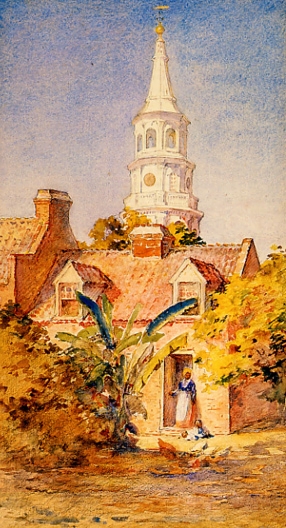
(above: Alice Ravenel Huger Smith, The Rector's Kitchen and View of St. Michael's, c. 1910-15, watercolor on board, 22 x 28 inches, Greenville County Museum of Art. Smithsonian American Art Museum says: "Back the rector's home at St. Michael's Church in Charleston, South Carolina showing the small kitchen building with church spire rising behind it. Standing just outside the doorway of the kitchen is an African-American woman tending to a baby that is seated on the ground in front of her." Public domain, via Wikimedia Commons*)
Another key figure in Southern Tonalism was Elliott Daingerfield (1859-1932). While more closely associated with North Carolina, his work was profoundly influential throughout the South and is held in important South Carolina collections. His direct link to the movement comes from his mentorship under George Inness, one of the fathers of American Tonalism.
Please click here to view artwork by George Inness

(above: Elliott Daingerfield, The Grand Canyon, c.1912, oil on canvas, 36.2 x 48.2 inches, North Carolina Museum of Art, purchased with funds from the State of North Carolina. Public domain, via Wikimedia Commons*)
Inness taught Daingerfield the technique of layering paint and varnish to create luminous, atmospheric effects of light, which became a hallmark of his moody, evocative style. Daingerfield believed in a powerful link between nature and spirituality, stating that the artist's role was to express "the beautiful" by imparting a "spiritual vision" to the observer. His goal was to capture the "mood and feeling of a place," the very definition of the Tonalist impulse.
The rise of Tonalism in South Carolina was more than a stylistic shift; it was a response to a profound historical moment. In the post-Reconstruction era, the style's hazy, dreamlike, and nostalgic qualities provided a visual language to process the loss of the "Old South," transforming a landscape freighted with memory into a timeless sanctuary of poetic beauty.
Note: Tables within AI reports formatted
in a manner incompatible with functionality of our page editing software
have been deleted. Please don't
rely on this AI-generated text for accuracy. It has been lightly edited,
yet may be laden with inaccurate information. Consider it a base for further
inquiry
 Return to South
Carolina Art History
Return to South
Carolina Art History
Return to Individual States Art History Project
*Tag for expired US copyright of object image:

Links to sources of information outside of our web site are provided only as referrals for your further consideration. Please use due diligence in judging the quality of information contained in these and all other web sites. Information from linked sources may be inaccurate or out of date. TFAO neither recommends or endorses these referenced organizations. Although TFAO includes links to other web sites, it takes no responsibility for the content or information contained on those other sites, nor exerts any editorial or other control over them. For more information on evaluating web pages see TFAO's General Resources section in Online Resources for Collectors and Students of Art History.
 Search Resource Library
Copyright 2025 Traditional Fine Arts Organization, Inc., an Arizona nonprofit corporation. All rights reserved.