
Indiana Art History: 1840-1940
by Claude AI
In the rolling hills and fertile farmlands of Indiana, a remarkable artistic awakening unfolded across the nineteenth and early twentieth centuries. From the modest beginnings of frontier portraiture to the internationally recognized Brown County Art Colony, Indiana's artists created a distinctive voice that celebrated the natural beauty of their homeland while embodying the highest ideals of American virtue and spiritual uplift. This century-long journey transformed the Hoosier State into one of America's most significant regional art centers, nurturing painters and sculptors whose works continue to inspire with their devotion to beauty, nature, and the ennobling power of art.
The Foundation Years (1840-1880)
Indiana's artistic heritage began in the 1840s when the state was still defining its cultural identity amidst rapid westward expansion. Elizabeth Flower Ronalds, whose brother founded the town of Albion near the Indiana border, opened an art school during this formative period. The early emphasis on art education reflected a broader cultural belief in art's moral and educational value, particularly for women who were considered their families' cultural guardians.
During these pioneer decades, itinerant artists traveled throughout Indiana, creating portraits that preserved the dignity and aspirations of frontier families. These early works, while modest in technique, carried profound emotional weight as they documented the faces of those building new lives in the American heartland. The paintings from this era emphasized character and virtue, presenting their subjects as embodiments of the pioneering spirit that was transforming the wilderness into civilized communities.
As Indiana's towns grew and prospered, local artists began expanding beyond 18-19th Century portraiture to capture the natural beauty of their surroundings. The state's diverse landscape -- from the sand dunes of Lake Michigan to the limestone caves of the south, from prairie grasslands to dense forests -- provided endless inspiration for artists seeking to document the splendor of their native region.
The Emergence of the Hoosier Group (1880-1900)
The 1880s marked a pivotal moment in Indiana's artistic development with the emergence of what would become known as the Hoosier Group. Theodore Clement Steele is perhaps the most famous of the "Hoosier Group" of American impressionist painters. Other painters in the group included William Forsyth, J. Ottis Adams, Richard B. Gruelle and Otto Stark. These five artists trained abroad but returned to Indiana and developed a distinctive style of landscape painting.
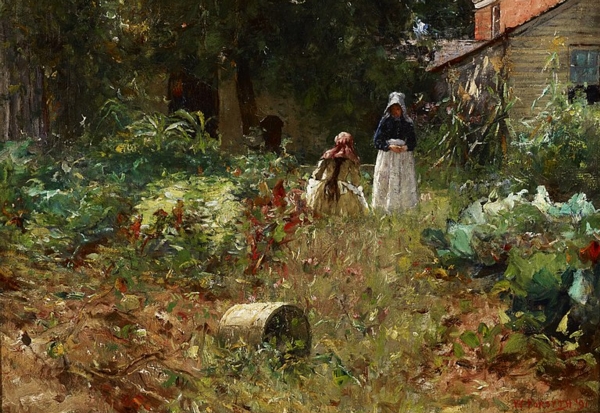
(above: William J. Forsyth, In the Garden, c. 1891, oil on canvas, 26 3/4 x 20 3/4 inches, Indianapolis Museum of Art, Gift from the Estate of Charlotte Hofmann Bose, 2014.7. Public domain, via Wikimedia Commons*)

(above: Otto Stark, Marie Stark (Mrs. Otto Stark), 1887, oil on board, 20.5 x 17.5 in. Indianapolis Museum of Art, Gift of Miss Gretchen Stark. Public domain, via Wikimedia Commons*)
Theodore Clement Steele (1847-1926) stands as the towering figure of Indiana art during this period. Born in Owen County, Steele's journey from humble beginnings to international recognition embodied the American dream of artistic achievement through dedication and talent. After studying in Munich, where he absorbed European techniques while maintaining his distinctly American sensibility, Steele returned to Indiana with a mission to capture the unique character of Hoosier landscapes. His paintings celebrated the changing seasons of Indiana with a luminous quality that transformed ordinary rural scenes into sublime expressions of natural beauty. Steele found particular inspiration in the golden light of Indiana autumns, the fresh greens of spring meadows, and the serene snow-covered landscapes of winter. His work consistently emphasized the spiritual dimension of nature, presenting the Indiana countryside as a source of moral and aesthetic renewal.
William Forsyth (1854-1935) complemented Steele's vision with his own distinctive approach to Indiana landscape painting. Forsyth's works often featured the intimate details of rural life -- farmhouses nestled among trees, gardens bursting with flowers, and quiet country lanes that invited contemplation. His paintings embodied a gentle optimism about rural American life, presenting the countryside as a refuge from the increasing industrialization of the late nineteenth century. Forsyth's dedication to art education at the Herron School of Art ensured that his aesthetic philosophy of beauty and virtue would influence generations of Indiana artists.
J. Ottis Adams (1851-1927) brought a particular sensitivity to the relationship between light and landscape that distinguished his contributions to the Hoosier Group. John Ottis Adams was best known as a nature-loving artist. A landscape painter who was a key member of the Hoosier Group of Indiana painters, Adams, along with William Forsyth and Theodore Steele, was committed to depicting his own native region. Adams found his greatest inspiration along the Muscatatuck and Whitewater Rivers, where he created luminous paintings that captured the interplay of water, light, and foliage. His works often depicted quiet moments in nature -- cattle drinking at stream's edge, wildflowers blooming along riverbanks, and the soft light of dawn breaking over pastoral scenes. These paintings conveyed a sense of peace and spiritual communion with the natural world that resonated deeply with viewers seeking respite from the complexities of modern life.
The Brown County Renaissance (1900-1920)
The establishment of the Brown County Art Colony marked the golden age of Indiana painting. Though artists such as William McKendree Snyder had been coming to Brown County as early as 1870, the colony is considered to have been firmly established in 1907 when the noted Impressionist painter Theodore Clement Steele (1847-1926) moved there. Steele became the first major artist to make a home in Brown County, Indiana, building his home and studio called "House of the Singing Winds" on a large plot of land west of Nashville.
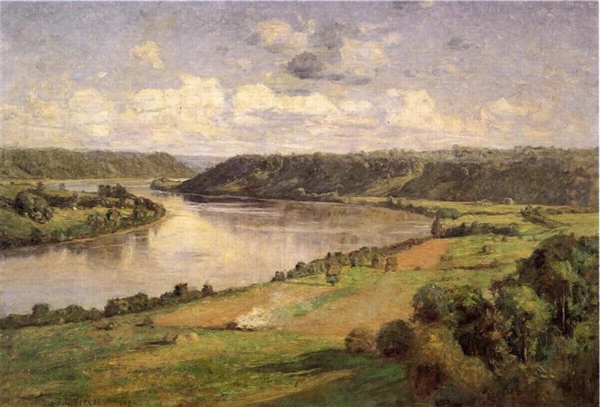
(above: T. C. Steele, The
Ohio river from the College Campus, Hanover, 1892, oil, canvas, 66 x
97 cm). Friends of T.C. Steele*)
The Brown County landscape provided Indiana artists with an ideal subject matter that combined natural beauty with symbolic meaning. The rolling hills, covered in hardwood forests that blazed with color each autumn, offered a distinctly American alternative to European landscape traditions. Artists found in Brown County's scenery a perfect expression of the American pastoral ideal -- unspoiled nature that suggested both divine providence and national promise.
Adolph Shulz played a crucial role as the colony's founder and organizer, encouraging artists from across the region to discover the inspirational qualities of Brown County's landscape. His own paintings celebrated the area's seasonal transformations, particularly the spectacular autumn colors that became the colony's signature subject. Shulz's work emphasized the spiritual dimensions of landscape painting, presenting nature as a source of both aesthetic pleasure and moral instruction.
The colony attracted numerous artists who contributed to its reputation as a center of Regionalist painting. These artists shared a common commitment to finding beauty in their immediate surroundings rather than seeking exotic or foreign subjects. Their work collectively created a visual celebration of Indiana's distinctive character, emphasizing the state's role as the heartland of American values and natural beauty.
The Sculpture Tradition (1900-1940)
While painting dominated Indiana's artistic landscape, the state also produced notable sculptors who contributed to the 19-20th Century sculptural tradition. Indiana sculptors of this period were particularly drawn to subjects that celebrated heroic virtue, historical memory, and the dignity of human achievement. Many worked on public commissions that adorned courthouse squares, university campuses, and civic buildings throughout the state.
Indiana sculptors found inspiration in both classical traditions and contemporary American themes. Their works often commemorated significant figures from Indiana history, celebrating the pioneering spirit and civic virtues that had shaped the state's development. These sculptures served not merely as decorative elements but as moral exemplars, reminding viewers of the values and achievements that defined Indiana's contribution to American civilization.
The sculpture produced in Indiana during this period emphasized themes of heroism, sacrifice, and community service. War memorials, in particular, provided opportunities for sculptors to create works that honored military service while celebrating the broader values of patriotism and civic duty. These monuments served as focal points for community gatherings and civic ceremonies, reinforcing the social bonds that held Indiana communities together.
The Mature Period (1920-1940)
The period between the world wars represented the culmination of Indiana's artistic development during this century-long evolution. The Brown County Art Colony continued to flourish, attracting artists from across the Midwest who sought to participate in its unique artistic community. Founded in 1926, the Brown County Art Gallery has supported Indiana artists, past, present, and future for nearly 100 years, providing a permanent venue for displaying and selling the work of colony artists.
During these decades, Indiana artists achieved national recognition for their contributions to regional art. The first Hoosier Salon was open to painters who had lived in Indiana for at least a year. Entries for the juried exhibition were submitted from across the United States. The selections featured 253 works of art from 132 artists. The Hoosier Salon, established during this period, provided a prestigious platform for Indiana artists to display their work and compete for recognition at the national level.
The art produced in Indiana during the 1920s and 1930s continued to emphasize themes of natural beauty, rural virtue, and spiritual uplift. Artists created works that served as visual antidotes to the increasing urbanization and mechanization of American life. Their paintings presented Indiana's landscape and rural communities as repositories of enduring American values, places where traditional virtues of hard work, family loyalty, and community cooperation continued to flourish.
Richard Gruelle (1851-1914) and Otto Stark (1859-1926), the remaining members of the original Hoosier Group, continued to influence Indiana art through their teaching and example. Their commitment to plein air painting and their emphasis on capturing the unique qualities of Indiana light and atmosphere helped establish a distinctive regional style that influenced countless younger artists.
Legacy of Beauty and Virtue
By 1940, Indiana had established itself as one of America's most significant regional art centers, with a distinctive tradition that celebrated natural beauty, rural virtue, and spiritual uplift. The state's artists had created a body of work that served not merely as aesthetic decoration but as a visual celebration of American values and the enduring appeal of the pastoral ideal.
The paintings and sculptures created in Indiana during this century-long period continue to inspire viewers with their commitment to beauty, their celebration of virtue, and their faith in art's power to elevate the human spirit. During Steele's time here, he built studios and guest houses for friends and clients and is credited with founding the Brown County Art Colony, creating a lasting legacy that transformed Indiana into what became known as the "Art Colony of the Midwest."
The artists of Indiana during this golden century understood that art served a higher purpose than mere personal expression. They believed that beauty had the power to inspire virtue, that landscape painting could reconnect viewers with the divine presence in nature, and that art could serve as a unifying force in American culture. Their legacy reminds us that regional art, rooted in specific places and traditions, can achieve universal significance by celebrating the values and aspirations that unite all humanity in the quest for beauty, meaning, and spiritual fulfillment.
Through their devotion to their craft and their commitment
to uplifting themes, Indiana's artists from 1840 to 1940 created a distinctive
contribution to American culture that continues to inspire and ennoble all
who encounter their work. Their paintings and sculptures stand as testament
to the transformative power of art and the enduring appeal of beauty as
a guide to the highest human aspirations.
Note: Tables within AI reports formatted
in a manner incompatible with functionality of our page editing software
have been deleted. Please don't
rely on this AI-generated text for accuracy. It has been lightly edited,
yet may be laden with inaccurate information. Consider it a base for further
inquiry
 Return to Indiana
Art History
Return to Indiana
Art History
Return to Individual States Art History Project
*Tag for expired US copyright of object image:

Links to sources of information outside of our web site are provided only as referrals for your further consideration. Please use due diligence in judging the quality of information contained in these and all other web sites. Information from linked sources may be inaccurate or out of date. TFAO neither recommends or endorses these referenced organizations. Although TFAO includes links to other web sites, it takes no responsibility for the content or information contained on those other sites, nor exerts any editorial or other control over them. For more information on evaluating web pages see TFAO's General Resources section in Online Resources for Collectors and Students of Art History.
 Search Resource Library
Copyright 2025 Traditional Fine Arts Organization, Inc., an Arizona nonprofit corporation. All rights reserved.