
North Carolina Art History:
A Narrative of Painting, 1840-1940
by Gemini 2.5 Pro
The Tar Heel Muse and the
Progressive Paradox
In the century spanning from 1840 to 1940, North
Carolina presented a landscape of profound contrasts, a place of both
untamed natural grandeur and burgeoning cultural ambition. The state's artistic
evolution during this period is a compelling narrative, shaped by the dramatic
topography of its mountains and coastline and driven by a unique societal
dynamic. This era in North Carolina was defined by what has been termed
a "progressive paradox," a delicate and often tense coexistence
of deeply conservative traditions alongside remarkable, state-supported
"progressive impulses." This inherent duality is the key
to understanding how a largely rural, agrarian state could become a vital
crucible for American art, nurturing movements that ranged from the spiritually
charged landscapes of Romanticism to the radical, world-changing experiments
of the European avant-garde.
The story of painting in the Tar Heel State is one of successive
waves of influence meeting the bedrock of a powerful sense of place. It
begins with artists drawn to the sublime wilderness of the Appalachian Mountains,
seeking to capture not just the scenery but its spiritual resonance. This
impulse, rooted in 19th-century Romanticism, found its most potent expression
in the moody, atmospheric style of Tonalism.
As the century turned, new light and new ideas arrived with Impressionism
and the homegrown focus of Regionalism,
brought by artists who saw in North Carolina landscapes and people a subject
worthy of national attention. Finally, in a development that defied all
expectations, the state became a sanctuary for Modernism,
hosting groundbreaking art colonies that would challenge the very definition
of art. This report traces that remarkable journey, exploring the key genres,
the essential art colonies, and the pivotal artists who transformed the
state into an enduring canvas for American expression.
Part I: The Spirit of the
Landscape: Romanticism and Tonalism in the Highlands
The 19th-century American artistic consciousness was profoundly
shaped by a desire to capture the sublime, a concept that intertwined awe,
terror, and wonder in the face of nature's raw power. While the Hudson River School painters found their muse
in the Catskills and the Rockies, a parallel movement was stirring in the
South. The ancient, mist-shrouded peaks of North Carolina's Appalachian
Mountains offered a different kind of wilderness -- less about the crisp,
documentary grandeur of national expansion and more about an intimate, spiritual
connection to the land. This environment proved to be the ideal crucible
for Tonalism, a style that moved beyond Romanticism's overt drama to explore
the landscape's more subtle, poetic, and emotional moods through a limited
palette and soft, atmospheric effects. North Carolina's most significant
contribution to late 19th-century American art was therefore not a reflection
of Manifest Destiny, but a deeply personal and mystical meditation on place,
championed by artists who saw the mountains as a conduit for the divine.
-
-
- Elliott Daingerfield (1859-1932) -- The Mystic of Blowing
Rock
-
- No artist is more central to this narrative than Elliott
Daingerfield. Though born in Harpers Ferry, Virginia, he was raised in
Fayetteville, North Carolina, his identity forged in the crucible of the
post-Civil War South. Seeking a formal arts education unavailable
in his hometown, he moved to New York City in 1880 at the age of 21, studying
at the National Academy and the Art Students League. This move placed
him in the orbit of the era's most important artistic currents.
-
- Daingerfield's artistic soul was awakened not by the
reigning academic traditions but by his discovery of the French Barbizon
painters and, most critically, by his friendship with the great American
Tonalist George Inness. Their influence steered him away from precise
representation and toward a more evocative, spiritual interpretation of
nature. This resonated with his own mystical inclinations; Daingerfield
claimed to have had a vision of Jesus as an adolescent and firmly believed
that art was primarily a "spiritual rather than an aesthetic medium." His
later discovery of European Symbolism further solidified his conviction
that art should express an inner world of ideas and emotions.
-
- His technical prowess was perfectly suited to this vision.
Daingerfield became a master of creating "vivid, beautifully painted,
symbolic landscapes" defined by "monumental forms and smoky,
turbulent light." He achieved this through a meticulous process
of layering thin glazes of color, building up a deep, resonant atmosphere
that seemed to emanate from within the canvas. His goal was not to paint
a specific view but to create an "enhanced" reality, a "deeply
personal meditation on the landscape" that conveyed a universal spiritual
truth. His primary cultural inspiration was the rugged terrain around
his beloved summer home in Blowing Rock, which he purchased in 1886. The
stunning vistas of Grandfather Mountain became his most profound muse,
a physical manifestation of the sublime through which he sought to capture
"the good which he felt was inherent in all mankind."
-
- Artworks by Daingerfield that exemplify his vision include:
-
- Grandfather Mountain, NC (c. 1910):
This watercolor is a powerful distillation of his lifelong subject. It
captures the monumental and spiritual presence of the mountain, focusing
on its form and the atmospheric effects of light and mist, embodying the
core principles of Tonalism and his personal, romantic vision of nature.
-
- Field and Sky: An oil sketch held
by the North Carolina Museum of Art, this work demonstrates his ability
to reduce a landscape to its essential spiritual components. The painting
is a dialogue between the terrestrial and the celestial, rendered with
the moody palette and soft edges characteristic of Tonalism.
-
- The Grand Canyon (c. 1912): Though
not a North Carolina scene, this painting is a crucial part of his legacy
within the state, as it is held in the collection of the North Carolina
Museum of Art. Commissioned by the Santa Fe Railroad, the work shows how
Daingerfield applied the Tonalist and Symbolist vocabulary he honed in
the Appalachians to another of America's iconic landscapes, creating a
"thought amid the everlasting calm" that was more a vision than
a view.
-
-

(above: Elliott Daingerfield,
The Grand Canyon, c.1912, oil on canvas, 36.2 x 48.2 inches, North
Carolina Museum of Art, purchased with funds from the State of North Carolina.
Public domain, via Wikimedia Commons*)
-
- Constance Cochrane (1888-1962) -- A Legacy of Light and
Atmosphere
-
- The influence of Daingerfield's vision extended to the
next generation of artists, establishing a distinct school of thought.
Constance Cochrane, born in Pensacola, Florida, to a naval family, became
a key figure in this lineage. As an original member of the Philadelphia
Ten, a pioneering group of women artists who exhibited together for decades,
she was a significant force in American art. Her connection to North
Carolina's artistic heritage was forged through her education under Elliott
Daingerfield himself at the Philadelphia School of Design for Women (now
Moore College of Art), where Henry B. Snell was also an influential teacher.
-
- This direct tutelage firmly places Cochrane within the
Tonalist and Impressionist traditions that Daingerfield championed. Known
for her versatile style and accomplished seascapes, her work depicting
North Carolina reflects the atmospheric concerns and spiritual undertones
of her mentor.
- An acclaimed artwork by Cochrane that highlights this
connection is Clouds on Grandfather Mountain (c. 1917):
Part of the esteemed Jonathan P. Alcott Collection, this painting is a
direct homage to the landscapes of her teacher. The work focuses entirely
on the sublime interplay of clouds, light, and the iconic mountain's form.
It perfectly fulfills the criteria of depicting pure, unadulterated natural
beauty, free of any human intervention, while echoing the mystical mood
of Daingerfield's canvases.
Part II: New Light, New
Soil: Impressionism and Regionalism Take Root
As the 20th century dawned, the artistic winds shifted.
The introspective, spiritual haze of Tonalism began to give way to new languages
of expression that emphasized observation, local character, and the fleeting
effects of light and color. Impressionism, with its bright palette and broken
brushwork, and Regionalism, with its heartfelt celebration of specific American
places and people, found fertile ground in North Carolina. This period
marked a significant transition from the mystical to the tangible and from
the universal to the deeply local. This evolution was not solely an indigenous
development; it was powerfully catalyzed by an influx of professionally
trained artists from major national and international art centers like Chicago
and Paris. Drawn by the state's sublime natural beauty and its growing reputation
for creative community, these artists brought with them the techniques and
philosophies that would connect North Carolina to the broader conversations
shaping American art.
-
- Rudolph Frank Ingerle (1879-1950) -- The Painter of the
Smokies
-
- Rudolph Frank Ingerle embodies the artist as both an
admirer and a steward of the landscape. Born in Vienna, Austria, he immigrated
to the United States as a child, eventually settling in Chicago where he
trained at the prestigious Art Institute of Chicago. His
early association with the Indiana School of Painting signaled an interest
in regional landscape, but his true muse was found around 1920, during
his first visit to the Great Smoky Mountains of North Carolina. He
was immediately captivated, and his love for the mountains, perhaps rooted
in childhood memories of his native Moravia, compelled him to return for
several months each year. He became so identified with the area that he
was affectionately dubbed the "Painter of the Smokies."
-
- Ingerle's technical prowess lay in his ability to blend
an Impressionist's sensitivity to light with a Regionalist's deep affection
for a specific place. His cultural inspiration was twofold: he was drawn
to the "untamed and beautiful views of the region" as well as
the "rural, isolated, hard-working lifestyle of the mountain people,"
whom he considered "the finest Americans in the country." His
work was not merely an aesthetic exercise; it was an act of profound civic
virtue. In the 1920s and 1930s, as logging interests threatened to devastate
the forests, Ingerle joined a coalition of artists, writers, and local
citizens to campaign for their protection. His paintings, which celebrated
the unspoiled beauty of the Smokies, served as powerful visual arguments
for preservation. These efforts contributed directly to the establishment
of the Great Smoky Mountains National Park in 1934, demonstrating a remarkable
fusion of artistic expression and social action. His art became a
tool for advocacy, ensuring the protection of the very landscapes that
inspired it.
-
- Artworks by Ingerle that reflect his devotion to the
region include:
-
- October in the Smokies: Featured
in the Jonathan P. Alcott Collection, this painting captures the specific
seasonal beauty of the mountains, a hallmark of the Regionalist focus on
time and place.
-
- Dawn, Bryson City, North Carolina:
This work showcases his Impressionistic interest in the transient effects
of light, capturing the precise moment of sunrise over a specific North
Carolina town.
-
- Nantahala: Named for the dramatic
river gorge in the heart of the Smokies, this painting underscores his
deep geographical and emotional connection to Western North Carolina.
-
-
- Childe Hassam (1859-1935) - An Impressionist's Touch
in the State's Collections
-
- While not a resident painter in North Carolina, the presence
and influence of Childe Hassam, a leading figure of American Impressionism,
is deeply felt within the state's major art institutions. His connection
is cemented by the North Carolina Museum of Art's significant collection
of his works, particularly a group of paintings from the Isles of Shoals,
off the coast of New England, which are considered undisputed masterpieces
of the genre. Trained at the Académie Julian in Paris, Hassam mastered
the Impressionist technique of capturing fleeting moments of light and
atmosphere with vibrant color and energetic brushwork.
-
- Artworks by Hassam held in North Carolina collections
that depict pure, natural beauty include:
-
- The Laurel in the Ledges, Appledore
(1906): Promised to the North Carolina Museum
of Art, this painting is a quintessential Impressionist landscape. It offers
a "rapturous sense of place," focusing entirely on the natural
elements of "dense thickets of laurel wedged in granite crags"
and the shimmering "silvered northern light," completely devoid
of human intervention.
-
- Isles of Shoals (1907): Also promised
to the NCMA, this dynamic seascape captures the "blue Atlantic breaking
against rocks and swirling in tidal pools". It is a pure celebration
of the elemental power and beauty of the sea, rendered with the immediacy
and vibrancy that define American Impressionism.
-
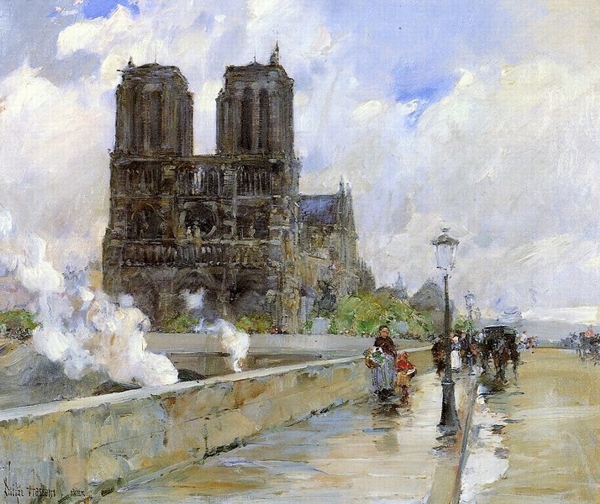
(above: Childe Hassam, Notre Dame
Cathedral, Paris, 1888, oil on canvas, 43.82 x 54.93 cm, Detroit
Institute of Arts. Public domain, via Wikimedia Commons*)
Additional paintings by
Childe Hassam
Part III: The Avant-Garde
in Appalachia: The Rise of Modernism
The most remarkable and unexpected chapter in North Carolina's
artistic story is its emergence as a vital center for American and international
Modernism. This development stands as the starkest illustration of the state's
"Progressive Paradox," where the most advanced ideas of the European
avant-garde found a sanctuary in the rural Appalachian mountains. This
was not a single, monolithic movement but a multifaceted engagement with
new forms of expression that occurred on parallel tracks. It included an
organic, nature-based modernism pioneered by artists who distilled the Southern
landscape into its spiritual essence; a design-oriented modernism that grew
out of established art colonies; and a radical, pedagogy-focused European
Modernism imported directly from the Bauhaus. Together, these currents transformed
North Carolina into a dynamic and complex environment for artistic innovation.
-
- Will Henry Stevens (1881-1949) -- A Pioneer of Southern
Modernism
-
- Will Henry Stevens was a pivotal figure in the development
of a distinctly Southern Modernism. Although born in Indiana and holding
a long-term teaching position at Sophie Newcomb College in New Orleans,
Stevens spent his summers in the mountains of North Carolina, a region
that became a primary source of his artistic inspiration. He was a
popular and influential teacher at several Southern art colonies, most
notably the legendary Black Mountain College, which placed him at
the very heart of the state's modernist milieu.
-
- While his early training was with respected American
Impressionists like Frank Duveneck and William Merritt Chase, Stevens's
mature work was shaped by a profound and expansive intellectual curiosity. He
drew inspiration from a diverse range of sources: the Transcendentalist
writings of Ralph Waldo Emerson and Henry David Thoreau; the spiritual
and theoretical work of European modernists Wassily Kandinsky and Paul
Klee; and the minimalist elegance of Chinese Sung Dynasty landscape painting. This
unique synthesis of influences drove his artistic evolution.
-
-

(above: Frank Duveneck, Siesta,
1886, oil on canvas, 25.5 in x 37.9 in. Cincinnati Art Museum.
Bequest of Mary O'Brien Gibson in memory of her parents, Cornelius and Anna
Cook O'Brien. Public domain, via Wikimedia Commons)
Additional artwork by
Frank Duveneck
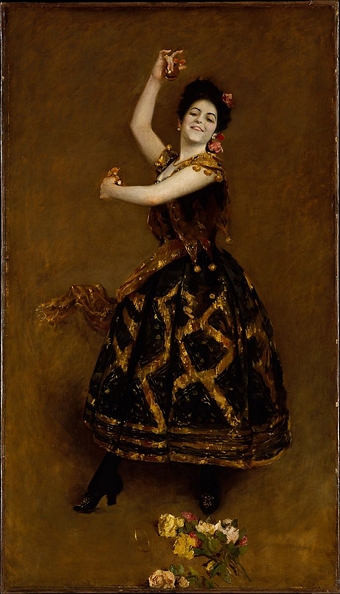
(above: William Merritt Chase, Carmencita,
c. 1890, oil on canvas, 69 7/8 x 40 7/8 inches, Metropolitan Museum of Art
(NYC). Gift of Sir William Van Horne, 1906. Public domain, via Wikimedia
Commons*)
Additional paintings by William
Merritt Chase
-
- Stevens was a master of duality, working simultaneously
and without contradiction in both representational and abstract styles. He
was a tireless experimentalist, even mixing his own pastel pigments to
achieve specific lyrical effects. His genius lay in his ability to
perceive and render the essential "design" in nature, distilling
the Southern landscape into non-objective compositions of color, line,
and form that he termed "semi-abstract."
-
- Artworks by Stevens that illustrate this modernist vision
include:
-
- Smoky Mountain Landscape: This work
demonstrates his ability to evoke the feeling and structure of the North
Carolina mountains while moving beyond literal depiction, using simplified
forms and a poetic color palette to capture their essence.
-
- The High Tops: While the title suggests
a specific location, the work is an abstract interpretation, focusing on
the rhythmic interplay of form and color harmony rather than on topographical
accuracy.
-
- Wooded Landscape in the Great Smoky Mountains: This piece further underscores the deep connection to the specific
North Carolina region that fueled his most innovative and modernist explorations.
-
-
- Homer Ellertson (1892-1935) -- Modernism in Tryon
-
- Homer Ellertson represents the emergence of modernism
from within one of North Carolina's more traditional art colonies. After
studying at the Pratt Institute and working as a successful textile designer
in New York, Ellertson made a decisive move in 1920 to the Tryon artists'
colony to dedicate himself to painting. From the moment of his arrival,
he was motivated to discover "new forms of expression" and was
uninterested in conventional painting. He found a kindred spirit in Augustus
Vincent Tack, another important painter exploring modernism who wintered
in Tryon. Ellertson's work shows a keen awareness of European movements,
and he enthusiastically experimented with "form and perspective alluding
to Cubism" and deployed "radical perspective and deconstruction"
in his landscapes.
-
- A modernist work by Ellertson is Construction
of El Taarn (1923): This gouache study for a large textile wall
hanging, now in the collection of the Asheville Art Museum, is a key modernist
work to emerge from the Tryon colony. It showcases his roots in design
and his bold move toward abstract, geometric composition, demonstrating
that avant-garde ideas were taking hold even outside of explicitly modernist
institutions.
-
-
- Other Key Figures
-
- Thomas Hart Benton (1889-1975): As one of the triumvirate
of Regionalist painters, Benton's connection to North Carolina is primarily
through his influence and the inclusion of his work in significant state
collections, such as the Jonathan P. Alcott Collection. His focus on the
character and dignity of rural American life resonated deeply with the
state's own identity and artistic sensibilities. He trained at the Art
Institute of Chicago.
-
Paintings by Thomas Hart
Benton
-
- Mary Anne Keel Jenkins (1929-2017): A lifelong North
Carolina artist and educator, Jenkins serves as a bridge from the pre-war
era to the post-war modernist landscape. Born in Stokes, NC, she studied
at the Ferree School of Art in Raleigh, and her early work in the years
just after the 1940 cutoff consisted of realistic still lifes, portraits,
and figure paintings. Her later career saw a full embrace of modernism,
with color field paintings inspired by artists like Helen Frankenthaler,
demonstrating the continued evolution of artistic styles within the state.
Part IV: Crucibles of Creation:
North Carolina's Art Colonies
The remarkable evolution of art in North Carolina between
1840 and 1940 was not a series of isolated events but was actively fostered
within dynamic communities of creativity. These art colonies -- some formal
and institutional, others informal and geographically defined -- were the
essential engines of the state's artistic development. They provided infrastructure,
fostered collaboration, and attracted talent from across the nation and
the world. The chronological emergence and distinct character of these colonies
map perfectly onto the progression of artistic styles in North Carolina,
demonstrating that they were not merely passive locations but active catalysts
for change, driving the journey from Tonalism to Modernism.
- The Tryon Artists' Colony (est. 1890s): A Pastoral Haven
for Cosmopolitan Tastes
-
- Beginning in the late 1880s, the small mountain community
of Tryon in the Carolina foothills began to establish itself as a destination
for artists, writers, and intellectuals seeking a temperate climate and
a supportive environment. By the turn of the century, it had blossomed
into a full-fledged artists' colony. It attracted a sophisticated, often
European-trained clientele, including painter and etcher George Charles
Aid, who was drawn specifically by the promise of both a "vineyard
and an artistic colony," hoping to replicate a congenial European
lifestyle. The colony also became home to ambitious modernists like Homer
Ellertson and Gladys Milligan, who found in Tryon a place to pursue new
forms of expression. Tryon thus functioned as a crucial transitional space,
a pastoral haven where artists could work outside the pressures of a major
metropolis while remaining part of a stimulating and worldly creative exchange.
-
- The Penland School of Crafts (est. 1929): Art, Craft,
and Community Empowerment
-
- Born from a different impulse, the Penland School of
Crafts was founded in 1929 in the remote mountains of Mitchell County by
the visionary educator Lucy Morgan. Its mission was rooted in the
philosophy of the Arts and Crafts movement, which valued handmade objects
and believed in the dignity of manual labor. Morgan's initial goal was
profoundly practical and benevolent: to revive the traditional craft of
hand-weaving and provide a source of income for local women in an economically
challenged region. The school began as a cottage industry, but its
reputation grew exponentially after a 1928 article in the Handicrafter magazine
brought national attention. Soon, Penland was attracting students
from across the country and around the world, evolving into a national
center for education in traditional handicrafts like pottery, basketry,
and metalworking. Within the 1929-1940 period, Penland embodied the Regionalist
ethos, celebrating local tradition and fostering a spirit of "the
joy of creative occupation and a certain togetherness."
-
-
- Black Mountain College (1933-1957): A Bastion of the
International Avant-Garde
-
- The most radical and globally significant of North Carolina's
creative communities was Black Mountain College. Founded in 1933, it became
a sanctuary for some of Europe's leading artistic minds fleeing the rise
of Fascism. When Josef and Anni Albers emigrated from Germany, they left
the shuttered Bauhaus school behind but brought its revolutionary "modern
aesthetic and design prowess" directly to the North Carolina mountains.
The college was a legendary experiment in education and interdisciplinary
creativity, breaking down the barriers between painting, sculpture, design,
architecture, music, and dance. It served as the primary conduit for infusing
the rigorous, theoretical principles of European Modernism into American
culture. The college attracted a stellar roster of faculty and students
who would go on to define post-war art, including Ruth Asawa, Robert Rauschenberg,
and Kenneth Noland, making its legacy a major focus of the Asheville
Art Museum's collection today. Black Mountain College was the undeniable
epicenter of the state's "progressive" cultural identity.
-
-
- The Great Smoky Mountains: An Informal Colony of the
Sublime
-
- While not a formal institution with a director and curriculum,
the Great Smoky Mountains region stretching between Asheville, North Carolina,
and Knoxville, Tennessee, functioned as a powerful de facto art colony.
The sheer magnetic pull of its "picturesque locations" and "untamed
and beautiful views" drew a steady stream of artists, writers, and
photographers who formed a cohesive community bound by a shared muse. Landscape
painters like Rudolph Ingerle were inspired not only by the sublime scenery
but also by the resilient character of the mountain people. This informal
colony was so unified by its love for the region that its members successfully
organized and campaigned alongside local citizens to advocate for the creation
of the Great Smoky Mountains National Park, demonstrating a collective
purpose that transcended mere art-making and achieved a lasting civic good.
-
-
Part V: The Iconography
of Virtue in Portrait and Figure Painting
-
-
- A close examination of art from 1840 to 1940 reveals
a purpose that is often secondary in contemporary analysis: its role as
a moral and didactic tool. Art was not created solely for aesthetic pleasure;
it was often intended to reinforce and celebrate societal values. While
virtues are not typically listed in artwork titles, an iconographic and
contextual interpretation of key figurative works found in North Carolina's
collections reveals a rich tapestry of art meant to exemplify qualities
such as benevolence, wisdom, fortitude, courage, and humility. The clearest
examples of this are found not in avant-garde experiments but in the more
traditional and publicly-facing genres of maternal portraiture and civic
historical painting. This highlights a fascinating duality in the art world
of the period, where the personal, spiritual, and formalist concerns of
modernism coexisted with a powerful tradition of morally instructive art.
-
- Benevolence, Wisdom, and Humility in Maternal Portraiture
-
- Mary Cassatt (1844-1926) Baby
Charles Looking Over His Mother's Shoulder (No. 3) (c. 1900) This
stunning masterpiece of American Impressionism, on long-term loan to Charlotte's
Mint Museum, is a profound study in virtue. The subject itself --
the intimate, protective embrace of a mother and child -- is a universal
symbol of nurturing love Cassatt's "unique composition, with the mother's
back to the viewer," is a masterful artistic choice that deepens the
work's meaning. By obscuring the mother's face and identity, Cassatt
elevates her from an individual to an archetype of motherhood. This act
of turning away from the viewer can be read as a powerful expression of motherhood.
Her role as protector and caregiver supersedes her own individuality. The
solid, supportive posture required to hold the child is a quiet yet clear
depiction of maternal fortitude. Cassatt's Impressionist technique,
with its soft, feathery brushwork and gentle play of light, enhances the
atmosphere of tenderness and intimacy, reinforcing the painting's overarching
theme of benevolent love.
-
-
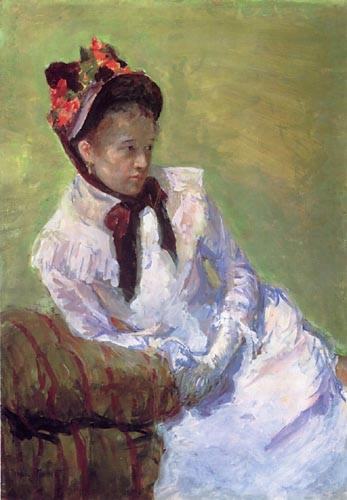
(above: Mary Stevenson Cassatt,
Self Portrait, c. 1878, guache on paper, 23.6 x 16.1 inches, Metropolitan
Museum of Art. Public domain, via Wikimedia Commons*)
Additional paintings by
Mary Cassatt
-
- Courage and Fortitude in Historical and Civic Art
-
- George Charles Aid (1872-1938) At the Baptism of Virginia
Dare. This historical tableau, commissioned for its civic importance
and later donated to the Mint Museum, is an explicit celebration of foundational
virtues. The painting commemorates the christening of the first English
child in the New World, an event that symbolizes the establishment of community
and faith in a new, unknown, and often hostile environment. The very act
of the colonists is a testament to their courage and fortitude. The painting
was created to inspire these same virtues in its viewers by honoring them
as cornerstones of the state's identity. The decision to commission such
a work reflects a societal desire to anchor its cultural narrative in these
enduring strengths.Wisdom and Dignity in Portraiture
-
The collections of the North
Carolina Museum of Art and the Mint
Museum contain significant holdings of 18th and 19th-century American
portraiture. While specific works are not detailed with an analysis
of virtue, the genre itself was culturally coded to convey such qualities.
Formal portraiture of this era, especially of civic leaders, judges, scholars,
and family elders, was rarely just about capturing a likeness. Artists like
John Singleton Copley, whose magnificent portraits are a cornerstone of
the NCMA's collection, were masters at using composition, lighting, attire,
and expression to project the sitter's gravitas, sobriety, and intellectual
authority -- qualities that collectively define wisdom. The stoic
expressions, the formal poses, and the often-included symbols of learning
or office were all part of a visual language designed to communicate the
dignity and esteemed character of the individual for posterity.
The Enduring Canvas
The century of artistic expression in North Carolina from
1840 to 1940 is a narrative of dynamic interplay between a sublime, powerful
landscape and the successive waves of artists and ideas that washed over
it. The state was far from a passive backdrop for the currents of American
art; it was an active crucible where national and international styles were
tested, adapted, and imbued with a unique regional character. The journey
from the spiritual Tonalism of Elliott Daingerfield in the misty highlands
to the revolutionary Modernism of Josef Albers at Black Mountain College
is a testament to the state's remarkable capacity for artistic evolution.
This vibrant history was animated by the state's "Progressive
Paradox," a foundational tension between a conservative bedrock and
forward-looking cultural ambition. This duality proved to be not a
contradiction but a source of profound creative vitality. It created an
environment where the deeply traditional and the radically avant-garde could
not only coexist but flourish. It allowed the state to nurture the romantic,
spiritual landscapes of the 19th century while simultaneously becoming a
world-renowned sanctuary for the 20th century's most advanced artistic thinkers.
The art colonies at Tryon, Penland, and Black Mountain, along with the informal
community of artists in the Great Smoky Mountains, served as the essential
engines for this progress, attracting talent and fostering the exchange
of ideas that kept North Carolina connected to the wider art world.
Today, this rich and complex legacy is preserved, studied,
and celebrated by the state's premier institutions. The collections of the
North Carolina Museum of Art, the Asheville Art Museum, and the Mint Museum
stand as enduring testaments to a century of extraordinary creativity, ensuring
that the story of the Tar Heel muse continues to inspire and inform generations
to come.
Note: Tables within AI reports formatted
in a manner incompatible with functionality of our page editing software
have been deleted. Please don't
rely on this AI-generated text for accuracy. It has been lightly edited,
yet may be laden with inaccurate information. Consider it a base for further
inquiry.
 Return to North
Carolina Art History
Return to North
Carolina Art History
Return to Individual States Art History Project
*Tag for expired US copyright of object
image:

Links to sources of information outside
of our web site are provided only as referrals for your further consideration.
Please use due diligence in judging the quality of information contained
in these and all other web sites. Information from linked sources may be
inaccurate or out of date. TFAO neither recommends or endorses these referenced
organizations. Although TFAO includes links to other web sites, it takes
no responsibility for the content or information contained on those other
sites, nor exerts any editorial or other control over them. For more information
on evaluating web pages see TFAO's General
Resources section in Online
Resources for Collectors and Students of Art History.
 Search Resource Library
Copyright 2025 Traditional Fine Arts Organization, Inc., an Arizona nonprofit corporation. All rights
reserved.