
Pennsylvania Art Colonies: A Comparative History of Landscape, Craft, and Community
by Gemini 2.5 Pro
Page Two
Notable Artists of the Brandywine School
Pyle's greatest legacy was the incredible stable of talent he nurtured. Over his teaching career, he mentored more than 150 artists who went on to dominate the field of illustration.

(above: Howard Pyle, The Mermaid, 1910, oil on canvas, 57.8 x 40.1 inches, 1940: given to Delaware Art Museum by the children of Howard Pyle in memory of their mother, Anne Poole Pyle. Public domain, via Wikimedia Commons*)
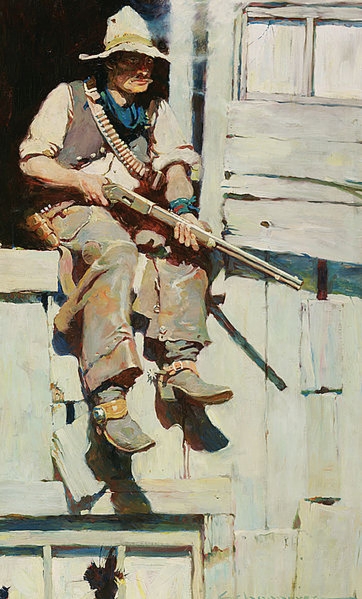
(above: Frank Schoonover, Hopalong
Takes Command, 1905, oil on canvas, 30 x 20 inches, Delaware
Art Museum, 1942: bequeathed to Delaware Art Museum by Joseph Bancroft.
Public domain, via Wikimedia Commons*)
The Enduring Legacy: An End as a Beginning
The Howard Pyle School of Art formally ceased operations in 1910, and Pyle himself died in Italy the following year. However, this was not a decline in the traditional sense; it was a successful dispersal. The colony did not fade away; it multiplied. Pyle's goal was to launch the careers of his students, and in this, he was astoundingly successful. The "end" of his school was the successful launch of its "product": a generation of Brandywine illustrators who dominated the field.
The Brandywine tradition was carried on directly by his pupils. Philanthropist Samuel Bancroft constructed studios for four of Pyle's top students -- Wyeth, Schoonover, Harvey Dunn, and Clifford Ashley -- in 1905. Frank Schoonover and Stanley Arthurs continued teaching in Wilmington for decades, with Arthurs even taking over Pyle's original studio. N.C. Wyeth established his own family compound in Chadds Ford, becoming a mentor to his own artistic children and creating a multi-generational enterprise. The school's legacy was ultimately institutionalized with the founding of the Brandywine River Museum in 1971, which is centered on the work of Pyle and the Wyeth family, ensuring the school's profound and lasting influence on American art and culture.
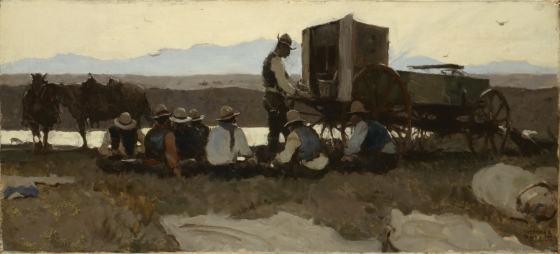
(above: Harvey Dunn, The Chuckwagon, 1915. oil on canvas; 15 3/8 x 35 7/8 inches, Denver Art Museum, William Sr. and Dorothy Harmsen Collection, 2001.1144)
Chapter 3: Rose Valley: An Arts and Crafts Utopia on Ridley Creek
In stark contrast to the organic artist gatherings at New Hope and Scalp Level, the Rose Valley colony in Delaware County was a meticulously planned, intentional community. Founded in 1901, it was the tangible expression of the utopian social and artistic ideals of its visionary founder, Philadelphia architect William Lightfoot Price. It was not merely a place for artists to work, but an attempt to create a new way of life.
William Price's Socialist Dream
William Lightfoot Price (1861-1916) was a nationally known architect deeply influenced by the English Arts and Crafts movement and the romantic, anti-industrial, socialist philosophies of its leader, William Morris. Inspired by Morris's utopian novel News from Nowhere, Price sought to create a community that would reject the alienation of industrial mass production and embrace what he called "the art that is life" through communal living, honest labor, and the beauty of handcrafted objects.
To realize this dream, Price, with the financial backing of wealthy, liberal-minded Philadelphians, purchased an 80-acre tract of land near Moylan in 1901. The property was a "tumble-down decrepit hamlet," the site of a former textile mill village that had been largely abandoned after a fire destroyed the main mill in 1885. Price saw this as the perfect canvas. He formed the Rose Valley Association and set about renovating the existing mill workers' houses and ruined mills, transforming them into workshops, studios, a community hall, and homes for the artisans he hoped to attract.
The "Banded Workshops" and Their Wares
The artistic and economic engine of Rose Valley was intended to be its "banded workshops," a term borrowed from Morris for small groups of artisans working together in a personal, collaborative manner. The Rose Valley Association did not produce crafts itself; rather, it rented workshop space to artisans and granted the use of its official trademark -- a wild rose with a "V" for Valley, encircled by a buckled belt symbolizing fellowship -- to work that met its high standards of design and craftsmanship.
Three main workshops were established:
Notable Figures of Rose Valley
The community was defined by its founder and the key artists and thinkers he attracted to his experiment.
The Unraveling of an Ideal and Its Lasting Imprint
The commercial aspect of the Rose Valley experiment was ultimately a failure. The colony was plagued by financial problems from the beginning. The handcrafted nature of its products made them extremely expensive. A hand-carved Rose Valley dining table, for example, cost $150 in 1904, more than double the price of a high-quality, mass-produced Gustav Stickley table at $66. This placed its "democratic" goods far beyond the reach of the average person, creating a central contradiction: the utopian, socialist experiment was sustained by wealthy backers and produced luxury goods for an elite clientele.
By 1907, the furniture and pottery shops had closed, and The Artsman had ceased publication, undone by precarious finances and a shortage of skilled artisans willing to work under the communal model. By 1910, the Rose Valley Association had sold off most of its assets, and the land was developed into a picturesque, "artistic" suburb, with many of the new homes designed by Price himself.
Though the craft workshops failed, the colony's legacy endured in other forms. Its most important and lasting contribution is its architecture. The homes and renovated mills designed by Price represent a major achievement of the American Arts and Crafts movement, and the borough of Rose Valley is now on the National Register of Historic Places. The social and artistic spirit of the community also survived. In 1923, the Hedgerow Theatre was founded in the old mill building (Artsman's Hall), becoming America's oldest continuously operating resident repertory theatre and a direct inheritor of the colony's communal, creative ethos. Rose Valley's story is the ultimate irony of the Arts and Crafts movement: its idealistic, anti-industrial dream failed commercially, but its beautiful, handcrafted shell survived to become a highly desirable and affluent residential community.
Chapter 4: The Scalp Level School: Düsseldorf Realism in the Allegheny Mountains
In the rugged, forested terrain of southwestern Pennsylvania, far from the genteel landscapes of Bucks and Delaware counties, another, very different kind of art colony took root. The Scalp Level School was the most informal of Pennsylvania's historic artist colonies, originating not from a planned utopian vision or the arrival of famous painters, but as a rustic summer retreat for a group of Pittsburgh artists seeking refuge and inspiration in the wilderness.
An Informal Retreat from Industrial Soot
The school's origins can be traced to a fishing trip in 1866. George Hetzel (1826-1899), a prominent Pittsburgh artist and teacher, was invited to the area of Scalp Level, a small village near Johnstown at the confluence of Paint Creek and Little Paint Creek. He was so struck by the sublime beauty of the mountain streams and deep green hills that he began encouraging his colleagues and students from the Pittsburgh School of Design for Women to join him there for summer excursions.
The primary motivation for these trips was escape. In the last third of the 19th century, Pittsburgh was rapidly becoming one of the nation's most heavily industrialized cities, its air thick with factory smoke and soot. Scalp Level offered a dramatic contrast: a seemingly pristine, untouched natural world. The artists hauled their canvases, paints, and fishing tackle by train and wagon, renting cottages or boarding with local families for months at a time to sketch and paint the landscape en plein air. This loose-knit group, united by their shared teacher and their love for this specific landscape, became known as the Scalp Level School.
An Older Tradition: The Düsseldorf and Hudson River Legacy
Stylistically, the painters of Scalp Level stood apart from the Impressionists of New Hope. Their work was not concerned with capturing the fleeting effects of light with broken color but was firmly rooted in older, more traditional European and American artistic modes. The school's leader, George Hetzel, had studied at the prestigious Düsseldorf Academy in Germany, and his work, along with that of his followers, reflects the tenets of that school.
Their paintings are characterized by a sober realism, a darker, earth-toned palette, and a dramatic use of light and shadow (chiaroscuro) to create powerful compositions. Like the painters of the Hudson River School with whom they are often compared, the Scalp Level artists sought to convey a sense of the sublime, an almost religious awe in the face of an untouched, majestic 18-19th Century and 9-20th Century American landscape. They were romantic realists, documenting a vision of nature that they felt was being lost to the forces of industrialization.
Notable Artists of the Scalp Level School
The school was defined by its founder and the circle of Pittsburgh-based artists who accompanied him on his summer sojourns.

(above: Albert Francis King, Late Night Snack, c. 1900, oil on canvas, 16.1 x 22 inches, Carnegie Museum of Art, gift of R. K. Mellon Family Foundation. Public domain, via Wikimedia Commons*)
Dissolution by Encroachment
A Legacy of Landscape, Craft, and Community
The histories of Pennsylvania's four major art colonies -- New Hope, Brandywine, Rose Valley, and Scalp Level -- present a rich and varied tapestry of American artistic life at the turn of the twentieth century. Though they shared a common impulse to create art outside the confines of the city, their foundational philosophies, organizational structures, and ultimate fates were profoundly different. Together, they offer a compelling narrative of the ambitions, triumphs, and failures that defined a pivotal era in the nation's cultural development.
A synthesis of their divergent paths reveals a spectrum of outcomes. The Brandywine School stands as a model of successful dissemination. Founded by Howard Pyle with the explicit goal of training commercially successful illustrators, its "end" was a triumphant beginning, launching the careers of dozens of artists who defined the Golden Age of Illustration and established a multi-generational artistic dynasty. Its legacy was not one of decline but of successful transformation, institutionalized in the enduring influence of its artists and the establishment of the Brandywine River Museum of Art.
At the other end of the spectrum lies Rose Valley, a story of idealistic failure and ironic preservation. William Price's utopian Arts and Crafts experiment, grounded in socialist principles of handmade craft for the people, collapsed under the weight of its own economic contradictions. Its beautiful but expensive goods could only be afforded by the elite, and the commercial venture failed within a decade. Yet, its legacy survives not in its crafts but in its remarkable architecture and the enduring community spirit embodied by the Hedgerow Theatre, leaving behind an artistic suburb of great historical and aesthetic importance.
The New Hope School charts a middle course, evolving from an organic creative hub into a celebrated artistic "brand." The Pennsylvania Impressionists achieved immense national success, defining a powerful and popular style of American landscape painting. However, this very success led to a certain creative ossification, and as artistic tastes shifted toward Modernism, the school's influence as an avant-garde movement faded. The colony transformed from a working community of artists into a commercialized center for art and tourism, its legacy now carefully managed by institutions like the Michener Art Museum and the Phillips' Mill Community Association, which the artists themselves founded.
Finally, the story of the Scalp Level School offers the most poignant conclusion. This informal retreat of Pittsburgh realists was not undone by shifting tastes or financial woes, but by the physical destruction of its muse. The artists who fled the soot of industry to paint the "untouched landscape" of the Alleghenies ultimately watched that landscape be consumed by the very forces of logging and mining they opposed. Its dissolution was not a transformation but an erasure, a testament to the fragile relationship between art and the natural environment that inspires it.
Despite these varied fates, the legacies of these colonies are far from lost. They are actively preserved, studied, and celebrated by the major regional museums they helped inspire. The Michener Art Museum, the Brandywine River Museum of Art, and the Westmoreland Museum of American Art all stand as vital repositories of this history. The communities themselves, in the preserved architecture of Rose Valley and the bustling galleries of New Hope, continue to shape the cultural identity of Pennsylvania. These colonies, born from a desire to capture a particular vision of America, have become an inseparable part of the American story they once sought to paint.
Note: Tables within AI reports formatted
in a manner incompatible with functionality of our page editing software
have been deleted. Please don't
rely on this AI-generated text for accuracy. It has been lightly edited,
yet may be laden with inaccurate information. Consider it a base for further
inquiry.
 Return to Pennsylvania
Art History
Return to Pennsylvania
Art History
Return to Individual States Art History Project
*Tag for expired US copyright of object image:

Links to sources of information outside of our web site are provided only as referrals for your further consideration. Please use due diligence in judging the quality of information contained in these and all other web sites. Information from linked sources may be inaccurate or out of date. TFAO neither recommends or endorses these referenced organizations. Although TFAO includes links to other web sites, it takes no responsibility for the content or information contained on those other sites, nor exerts any editorial or other control over them. For more information on evaluating web pages see TFAO's General Resources section in Online Resources for Collectors and Students of Art History.
 Search Resource Library
Copyright 2025 Traditional Fine Arts Organization, Inc., an Arizona nonprofit corporation. All rights reserved.