
America's Distinguished Artists
a national registry of historic artists
Paintings by Willard Nash

(above: Willard Nash, Untitled (Santa Fe Landscape), c. 1925, oil on canvas, Phoenix Art Museum. Public domain, via Wikimedia Commons*)
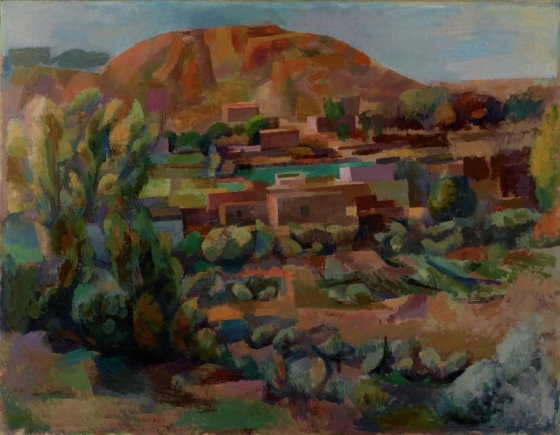
(above: Willard Nash, Santa Fe Hillside, c. 1925, oil on canvas; 28 1/4 x 36 1/8 inches, Denver Art Museum: The Roath Collection by exchange, 2017.70)
Out of curiosity, we asked ChatGPT about Nash's connection with the Santa Fe. We got this in return:
He was closely connected to the Santa Fe art colony, a hub of creative activity in the early 20th century, through his work, residence, and influence on the region's artistic culture. Here are key aspects of his connection:
Nash moved to Santa Fe, New Mexico, in the early 1920s. Like many artists of the time, he was drawn to the area's dramatic landscapes, unique quality of light, and rich cultural heritage. He became an active participant in the colony, which was known for fostering modernist and regional art.
When much of the Santa Fe art colony was associated with Regionalism and traditional depictions of Southwestern life, Nash stood out as a modernist. His works often combined elements of Cubism and Post-Impressionism, incorporating bold colors and geometric abstraction to interpret the landscapes and architecture of New Mexico.
Nash worked alongside and interacted with other members of the Santa Fe art colony, such as John Sloan and members of the Taos Society of Artists. Though his style was more avant-garde, his works contributed to the growing diversity of artistic expression in the region.
Despite his modernist leanings, Nash embraced the local subjects that fascinated the colony's artists, including Pueblo architecture, the New Mexican landscape, and Native American culture. His ability to bridge modernist techniques with regional themes made him a distinctive voice in the colony.
Nash's work helped expand the artistic vocabulary of the Santa Fe art colony, demonstrating that contemporary art movements could be harmonized with regional subject matter. His paintings remain part of the legacy of New Mexico's rich art history.
Through his innovative style and dedication to depicting
the Southwestern environment, Nash made a lasting impact on the Santa Fe
art scene and its broader reputation as a center for American modernism.
Links to sources of information outside of our web site are provided only as referrals for your further consideration. Please use due diligence in judging the quality of information contained in these and all other web sites. Information from linked sources may be inaccurate or out of date. TFAO neither recommends or endorses these referenced organizations. Although TFAO includes links to other web sites, it takes no responsibility for the content or information contained on those other sites, nor exerts any editorial or other control over them. For more information on evaluating web pages see TFAO's General Resources section in Online Resources for Collectors and Students of Art History.
*Tag for expired US copyright of object image:

 Search Resource Library
Copyright 2024 Traditional Fine Arts Organization, Inc., an Arizona nonprofit corporation. All rights reserved.