
AI Curiosities
The Washington Landscape
School: Capturing America's Natural Splendor
by Grok 3
In the 19th century, as the United States grappled with
its identity as a burgeoning nation, a group of artists emerged to immortalize
the raw beauty of its landscapes. Among these were the painters sometimes
referred to as the "Washington Landscape School," a loosely defined
group centered in Washington, D.C., who shared a passion for depicting the
region's natural scenery with a blend of romanticism and realism. Though
less celebrated than their contemporaries in the Hudson
River School, these artists played a pivotal role in shaping the visual
narrative of the American landscape, particularly in the mid-Atlantic region.
This feature article explores the essence of the Washington Landscape School,
its cultural significance, and the contributions of four of its most prominent
artists, drawing primarily from the resources of the Traditional Fine Arts
Organization (TFAO) and other nonprofit sources.
The Washington Landscape
School: A Regional Vision
The term "Washington Landscape School" is not
as formally recognized as the Hudson River School, but it describes a group
of 19th-century artists who focused on the landscapes of the Washington,
D.C., area, including the Potomac River, the Chesapeake Bay, and the surrounding
countryside. These painters, active primarily from the 1820s to the 1870s,
were inspired by the dramatic vistas of the region, which offered a mix
of pastoral tranquility and rugged wilderness. Their work reflected the
broader American fascination with nature as a symbol of divine beauty and
national promise, echoing the sentiments of transcendentalists like Ralph
Waldo Emerson and Henry David Thoreau. As noted by TFAO, American landscape
painting during this period was a celebration of the nation's "Edenic"
qualities, and the Washington Landscape School contributed to this narrative
by capturing the unique character of the mid-Atlantic terrain.
Unlike the Hudson River School, which emphasized the sublime
grandeur of New York's wilderness, the Washington Landscape School often
portrayed more intimate, localized scenes. These works blended topographical
accuracy with romantic idealism, reflecting the influence of European traditions
while asserting a distinctly American identity. The artists were shaped
by the cultural currents of Manifest Destiny, which celebrated the expansion
of the American frontier, and by a growing appreciation for the natural
world as a source of spiritual and aesthetic inspiration. Their paintings
often served as both artistic expressions and documents of a landscape in
transition, as urbanization and industrialization began to encroach on rural
areas.
The Washington Landscape School was not a formal institution
but rather a collective of artists who shared geographic proximity and a
commitment to plein air sketching and detailed observation of nature. Their
work was exhibited in local venues, such as the Washington Art Association,
and occasionally at the Pennsylvania Academy of the Fine Arts, though they
received less patronage than their New York counterparts. Despite this,
their contributions were significant, offering a regional counterpoint to
the national narrative of landscape art. Below, we delve into the lives
and works of four key figures associated with this group: Thomas Doughty,
William Trost Richards, Max Weyl, and James Peale.


Left photo by David Graham,
Center photo by Nathan Benn. Please click on images to enlarge them. Images
courtesy of Pennsylvania Academy of the Fine Arts.)
Thomas Doughty (1793-1856)

(above: Thomas Doughty, Lake of
the Mountains, 1829, oil on canvas, De Young Museum. Public domain,
via Wikimedia Commons*)
- Style and Inspiration: Thomas Doughty, often considered
a pioneer of American landscape painting, is closely associated with the
Washington Landscape School due to his depictions of the mid-Atlantic region.
His style combined meticulous realism with a romantic sensibility, emphasizing
the serene beauty of rivers, forests, and rolling hills. Doughty's internal
inspiration stemmed from his belief in nature as a divine creation, a view
shared by many of his contemporaries. His paintings often evoke a sense
of calm and contemplation, inviting viewers to connect spiritually with
the landscape.
-
- Cultural Influence and Teachers: Doughty was largely
self-taught, though he was influenced by English landscape traditions,
particularly the works of Claude Lorrain and Thomas Gainsborough. His paintings
resonated with the American public's growing pride in their nation's natural
beauty, aligning with the cultural ethos of the early 19th century. As
noted by TFAO, Doughty's work was popular among Philadelphia collectors,
reflecting his role in establishing landscape painting as a respected genre
in America.
-
- Key Artworks:
-
- · View on the Schuylkill River (c. 1820s): This painting captures the pastoral charm of
the Schuylkill River near Philadelphia, a region closely tied to Washington,
D.C.'s aesthetic sphere. Its detailed rendering of foliage and water, combined
with a soft, glowing light, exemplifies Doughty's ability to blend realism
with romantic idealism. The work is significant for its early contribution
to the American landscape tradition, showcasing a distinctly regional identity.
-
- · In Nature's Wonderland (1830s):
This piece depicts a tranquil valley scene, likely inspired by the Potomac
region. Its importance lies in its reflection of the romantic ideal of
nature as a sacred space, a theme central to the Washington Landscape School's
ethos.
-
William Trost Richards (1833-1905)

(above: William Trost Richards,
Recruiting Station (Bethlehem), before 1862, oil on canvas, Pennsylvania
Academy of the Fine Arts. Public domain, via Wikimedia Commons*)
- Style and Inspiration: William Trost Richards was a master
of marine and landscape painting, known for his luminous depictions of
coastal and inland scenes. His style evolved from the detailed realism
of the Hudson River School to a more impressionistic approach later in
his career. Richards drew inspiration from his deep reverence for nature's
beauty, often sketching en plein air to capture the fleeting effects of
light and atmosphere. His work reflects a spiritual connection to the landscape,
influenced by the writings of John Ruskin.
-
- Cultural Influence and Teachers: Richards was influenced
by the Pre-Raphaelite movement and the teachings of Ruskin, who emphasized
truth to nature. He studied under German artist Paul Weber in Philadelphia,
which honed his technical precision. His paintings, exhibited at institutions
like the Pennsylvania Academy, contributed to the growing appreciation
for American landscapes as symbols of national identity.
-
- Key Artworks:
-
- · South-West
Point, Conanicut (1878/1879) : This
watercolor, part of the Corcoran Collection, showcases Richards's ability
to capture the power of the sea with vibrant, translucent hues. Its significance
lies in its demonstration of watercolor's potential as a fine art medium,
elevating the status of the Washington Landscape School.
-
- · June
Woods (1860s): This oil painting depicts
a lush forest scene, likely inspired by the mid-Atlantic countryside. Its
meticulous detail and vibrant colors reflect Richards's commitment to capturing
nature's beauty, making it a quintessential example of the school's aesthetic.
-
-
Max Weyl (1837-1914)
- Style and Inspiration: Max Weyl, a lesser-known but significant
figure in the Washington Landscape School, specialized in intimate, light-filled
landscapes of the District of Columbia
area. His style was characterized by loose brushwork and a focus on atmospheric
effects, foreshadowing impressionism. Weyl's internal inspiration came
from his love for the local landscape, particularly the Potomac River and
Rock Creek Park, which he painted with a sense of personal connection and
tranquility.
-
- Cultural Influence and Teachers: Weyl was largely self-taught,
though he was influenced by the Barbizon School's emphasis on naturalism.
His work resonated with Washington's growing art community, contributing
to the city's emerging identity as a cultural hub. His paintings were exhibited
locally, fostering a sense of regional pride in the capital's natural surroundings.
-
- Key Artworks:
-
- · Rock Creek Park (1880s):
This painting captures the serene beauty of Washington's iconic park, with
soft light filtering through trees. Its importance lies in its documentation
of a beloved local landmark, reflecting the Washington Landscape School's
focus on regional identity.
-
- · Potomac
River Scene (1890s): This work showcases
Weyl's ability to convey atmospheric effects, with delicate shifts in light
and color. It is significant for its proto-impressionistic style, bridging
the gap between 19th-century realism and later modernist trends.
James Peale (1749-1831)
- Style and Inspiration: James Peale, the younger brother
of Charles Willson Peale, is better known for his miniatures but also produced
significant landscapes associated with the Washington Landscape School.
His style was precise and topographical, reflecting his training as a miniaturist.
Peale's inspiration came from his fascination with the American countryside,
particularly the areas around Washington, D.C., where he painted scenes
of pastoral beauty.
-
- Cultural Influence and Teachers: Peale was trained by
his brother Charles, a prominent portraitist, which influenced his meticulous
attention to detail. His landscapes contributed to the early 19th-century
American desire to document the nation's scenery, aligning with the cultural
push for a national artistic identity.
-
-
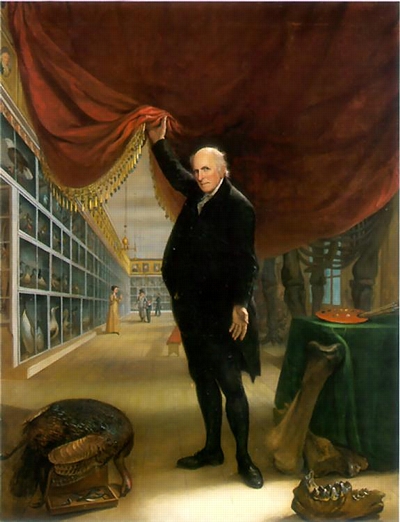
(above: Charles Willson Peale
(1741-1827), The Artist in His Museum, 1822, oil on canvas, 103.7
x 79.8 inches. Pennsylvania Academy of the Fine Arts. Public
domain, via Wikimedia Commons*)
-
- Key Artworks:
-
- · View of Georgetown (c.
1810): This painting captures the early urban landscape of Georgetown,
blending natural and architectural elements. Its importance lies in its
historical value as a record of Washington's early development.
-
- · Landscape
with a Waterfall (1820s): This work depicts
a romanticized natural scene, likely inspired by the Potomac region. Its
significance lies in its contribution to the emerging American landscape
tradition, emphasizing the beauty of the local environment.
-
Legacy and Impact
The Washington Landscape School, though less prominent
than its New York counterpart, left an indelible mark on American art. Its
artists captured the essence of the mid-Atlantic landscape, blending romanticism
with a growing sense of national identity. Their works, as documented by
TFAO and other nonprofit sources, reflect a pivotal moment in American history
when the land itself became a canvas for cultural and spiritual expression.
Through their paintings, Thomas Doughty, William Trost Richards, Max Weyl,
and James Peale not only preserved the beauty of the Washington region but
also contributed to the broader narrative of American landscape painting,
celebrating the nation's natural heritage in a time of transformation.
Please don't rely on this AI-generated
text for accuracy. It has been edited, yet may have inaccurate information.
Links are ours. Nonessential parts of the report were deleted.
 Return to Virginia Art History
Return to AI Curiosities
*Tag for expired US copyright of object
image:

Links to sources of information outside
of our web site are provided only as referrals for your further consideration.
Please use due diligence in judging the quality of information contained
in these and all other web sites. Information from linked sources may be
inaccurate or out of date. TFAO neither recommends or endorses these referenced
organizations. Although TFAO includes links to other web sites, it takes
no responsibility for the content or information contained on those other
sites, nor exerts any editorial or other control over them. For more information
on evaluating web pages see TFAO's General
Resources section in Online
Resources for Collectors and Students of Art History.
 Search Resource Library
Copyright 2025 Traditional Fine Arts Organization, Inc., an Arizona nonprofit corporation. All rights
reserved.

