

with an emphasis on representational art
The Teton Range - Aspiring to the Summit
by Gemini 2.5 Pro 2025
If the Grand Canyon's allure is its "incomprehensible" depth, the Teton Range's allure is its perfect, "ideal" verticality. The range is compositionally unique: the peaks "jut to the sky" and are "void of foothills, creating an abrupt and dramatic silhouette. This visual immediacy is why Thomas Moran, upon first seeing them in 1879, immediately journaled, "The Tetons have loomed up grandly against the sky. From this point it is perhaps the finest pictorial range in the United States or even [North] America".
The technical challenge for painters is managing the "sheer mountain heights" and the extreme "dynamic range" of light and shadow. A common solution is to use foreground trees to "give a sense of scale" and add a "metaphorical [sense of] struggle and power".
This vertical composition is inherently symbolic of aspiration. In art, a vertical orientation evokes "height, grandeur and aspiration," "upward motion or growth," and "spirituality". The act of ascending a mountain is a classic "journey from the surface to the sky", a spiritual metaphor found in cultures worldwide. For 19th-century Americans, this was critical. As interest grew in finding American landscapes that could "rival the European Alps", the Tetons became America's national Alps, a potent symbol of its own "lofty" aspirations.
Albert Bierstadt was the definitive master of the "grandiose" Teton and Rocky Mountain painting. For Bierstadt, the allure of the peaks was their capacity for drama. His method involved combining plein air sketches and photography to construct enormous studio canvases that were often "conjectural" and "exaggerated". He was not painting a place so much as his feelings about it.
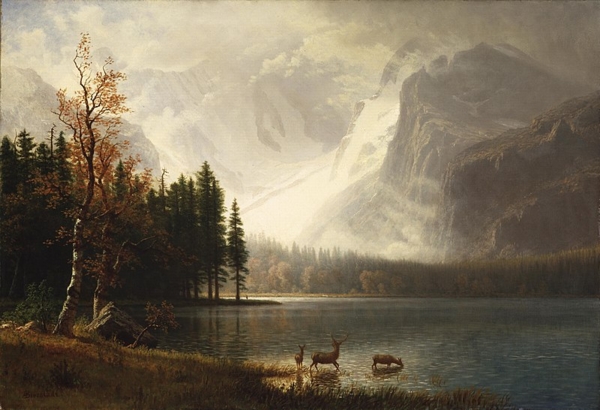
(above: Albert Bierstadt, Estes Park, Colorado, Whyte's Lake, circa 1877, oil on canvas, 30 x 43.7 inches, Buffalo Bill Center of the West. Public domain, via Wikimedia Commons*)
His signature style is defined by "the juxtaposition of water and sheer mountain heights and the theatrical deployment of storm clouds and slanting light". This masterful use of chiaroscuro (the contrast of light and dark) was designed to create a "heightened" emotional experience.Bierstadt was, in essence, a showman, and the Tetons were his stage. His paintings are not quiet landscapes; they are events. The "theatrical" light and "garish" storms are calculated to overwhelm the viewer, plunging them directly into the "delightful horror" of the Sublime.
The Teton's allure as a national symbol was arguably codified not by a painter, but by photographer Ansel Adams. His 1942 photograph, The Tetons and the Snake River, is widely considered the "climax vision" of the park. The historical and symbolic significance of this image lies in its sharp contrast with the 19th-century art that preceded it.
Where 19th-century images like Thomas Moran's Mount of the Holy Cross symbolized America's "holy mission" and Manifest Destiny, Adams's 20th-century photograph "does not stand for a mission of conquest". Instead, it denotes the "pristine grandeur of nature... untouched by human presence," and, as a symbol, it "begs that they be left alone". This image, created for the Department of the Interior, marks the crucial pivot in the American landscape's allure. The emotional appeal shifts from the 19th-century's "awe at what we are destined to possess" to the 20th-century's "awe at what we must protect." The art still serves a national purpose , but that purpose has evolved from settlement to conservation.
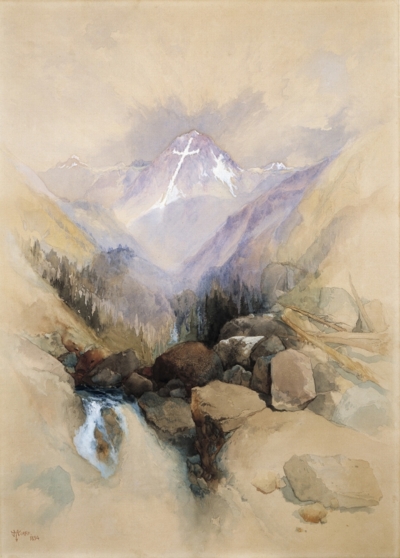
(above: Thomas Moran, Mount
of the Holy Cross, 1894, watercolor on paper, 18 1/2 x 16 1/2
inches, Denver Art Museum, Anonymous Gift, 1981.16)
For contemporary painters, the "allure" of the Tetons is described in deeply personal and spiritual terms, echoing the original Transcendentalist impulse but stripped of its 19th-century political baggage. The nationalistic project of Manifest Destiny has faded, replaced by a more intimate connection.
Artist Kathryn Turner, who grew up on a ranch in their shadow, describes this connection as a "spell." "The mountains have a spell on me," she states. "They are always calling to me and my paintings are an answer to that call". She jokes that there are "sirens in the mountains" , and their allure is their "dynamic" and ever-changing moods. For plein air painters like Stefan Baumann or those trekking into the Wind River Range, the allure is the physical and spiritual act of "finding God at the end of a paintbrush" while painting "America's spectacular western landscape" outdoors. The 19th-century "allure" of forging a national identity has been replaced by a 21st-century "allure" of forging a personal one.
The allure of America's highest mountains and deepest canyons endures because these landscapes are symbolically multivalent. They function as vast, open-air arenas for confronting the nation's and the individual's most profound questions.
For painters, the Teton Range and the Grand Canyon remain the ultimate test of both technical skill and spiritual vision. In the 19th century, this allure was a nationalistic quest to capture and define the American Sublime. For contemporary painters, it has become a personal quest for transcendence and connection -- an "answer to that call".
For viewers, these landscapes are theaters of philosophical
confrontation. The Tetons, as the Summit, offer an iconography of aspiration,
"upward motion", and a connection to "divine power".
This article is an excerpt of a larger one discussing towering
mountains and deep canyons. We added images and links to other
materials to this article to make it more interesting and educational for
your benefit. Although AI is rapidly improving its accuracy, this article
may have inaccurate information. It's safest to consider it a base
for further inquiry.
 Return to Wyoming Art History
*Tag for expired US copyright of object image:

and
**Tag for some rights reserved:

Links to sources of information outside of our web site are provided only as referrals for your further consideration. Please use due diligence in judging the quality of information contained in these and all other web sites. Information from linked sources may be inaccurate or out of date. TFAO neither recommends or endorses these referenced organizations. Although TFAO includes links to other web sites, it takes no responsibility for the content or information contained on those other sites, nor exerts any editorial or other control over them. For more information on evaluating web pages see TFAO's General Resources section in Online Resources for Collectors and Students of Art History.
Copyright 2025 Traditional Fine Arts Organization, Inc. an Arizona nonprofit corporation. All rights reserved.