
From the River to the Region: A Story of Missouri Art
by Gemini 2.5 Pro
In seeking to understand and appeciate the story of art in Missouri you need to understand its map. Unlike the painters of the East Coast, who looked to the mountains and forests for a vision of sublime, untouched wilderness, Missouri's early artists looked to the water. The state is a beating heart of commerce and movement, defined by the confluence of the continent's two greatest rivers, the Missouri and the Mississippi. In the 19th century, St. Louis wasn't just called the "Gateway to the West"; it was a chaotic, bustling, and vital fact. A painting from 1846 by Henry Lewis captures the scene: "Steamboats crowd a riverfront lined with warehouses that extend into the distance," a testament to the "bustling economy" of the 19th century. This geography is the single most important differentiator of Missouri's art. The rivers were the highways, the subject, and the muse, and they produced an art not of quiet contemplation, but of human activity: of commerce, exploration, westward expansion, settlement, and conflict.
The evolution of Missouri's art, from its frontier days to the cusp of the modern era in 1945, is a story that unfolds in three distinct acts. First came the documentation, as explorer-artists used St. Louis as a base camp to chronicle the lands and peoples of the new West. Second came the mythologizing, as the state's first native-born genius, a man who was both politician and painter, translated that frontier life into a sophisticated, iconic, and truly American art. And third, in the 20th century, came the re-examination, as a prodigal son of Missouri, a sophisticated modernist, returned home to strip away the romanticism and paint a new, grittier, and more complex social history.
Chroniclers of the Frontier
St. Louis, in the 1830s and 1840s, was the launching pad for a generation of "artist-explorers". These men were a unique breed, part-artist and part-ethnographer, who traveled up the Missouri River to document a world few Euro-Americans had ever seen. The first and most important of these was Karl Bodmer. Bodmer was a Swiss artist hired by a German naturalist, Prince Maximilian of Wied, to accompany a scientific expedition that started up the Missouri from St. Louis in 1833. Bodmer's significance is immense for a simple reason: "no artist had ever painted the Upper Missouri beyond its great bend before". His mission was scientific, and his works are not romantic fantasies. He produced stunningly meticulous watercolor portraits of individuals from the Omaha, Mandan, Hidatsa, and Blackfoot nations, painted "in situ". His work is "notable for their sensitivity of depiction and subtle, refined brushwork," capturing his sitters with a direct and sensitive precision. Bodmer's paintings are "timeless classics" precisely because they are not myth-making; they are a priceless, unrepeatable historical baseline, an ethnographic record of these cultures captured at the very last moment before the westward expansion originating from his starting point in St. Louis changed their world forever.
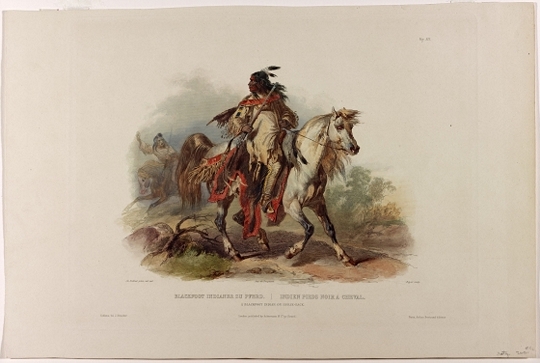
(above: Karl Bodmer, A Blackfoot Indian on Horseback, n.d, Lithograph, 15 x 19 3/4 inches, Denver Art Museum, Gift of the Estate of Frederic H. Douglas, 1956.442)
If Bodmer was the scientific documenter, Carl Wimar was the myth-maker. Wimar was a German immigrant who, unlike Bodmer, settled in St. Louis as a boy. He became the "Chronicler of the Missouri River Frontier," but with a crucial difference: he returned to Germany to study at the Düsseldorf Academy, where he absorbed a taste for grand, dramatic, and often violent historical painting. His work is a fascinating blend of direct frontier observation and European romanticism. One of his key early works, The Abduction of Boone's Daughter by the Indians (1853-56), depicts a 1776 event and is a prime example of a popular "captivity narrative". It contrasts the "civil" Jemima Boone with the "savage" Natives, exploiting the prejudices of the day for dramatic effect. But his most influential painting was The Attack on an Emigrant Train (1856). This painting, which became the prototype for the entire "cowboys and Indians" genre, was not based on his own observation but was inspired by a fictitious tale. Wimar effectively invented the visual language of the American West. He wasn't just painting history; he was creating the wagon-train-attack mythology that would define the genre for a century, all the way to Hollywood. He cemented these new myths as Missouri's official history in 1861, when he painted massive murals, including Westward the Star of Empire, in the rotunda of the St. Louis Court House.

(above: Karl Ferdinand Wimar, Buffalo Drinking, c. 1861-1862, oil on canvas, Phoenix Art Museum, Museum purchase in memory of Mr. Roy Wayland, 1964.264. Public domain, via Wikimedia Commons*)
While Wimar was creating the drama of the West, his contemporary Henry Lewis was capturing its scale. Lewis, who came to St. Louis in 1836, understood that a static, framed painting couldn't possibly capture the experience of traveling the Mississippi. So, he created a populist spectacle: "Lewis' Mammoth Panorama of the Mississippi". This "Great National Work" was, in essence, a 19th-century movie. It was an enormous, scrolling painting, estimated to be 825 yards long, which was presented as a two-hour show with narration. What made it a hit was its "fidelity" and its innovative format. Lewis had "drawn before you both banks" of the river, creating an immersive experience that mimicked the view from a steamboat. The panorama was the perfect fusion of subject and format -- a massive, linear, time-based artwork for a massive, linear, time-based subject. Today, his work is valued as an "unsurpassed" historical record of the riverfront communities of the 1840s.
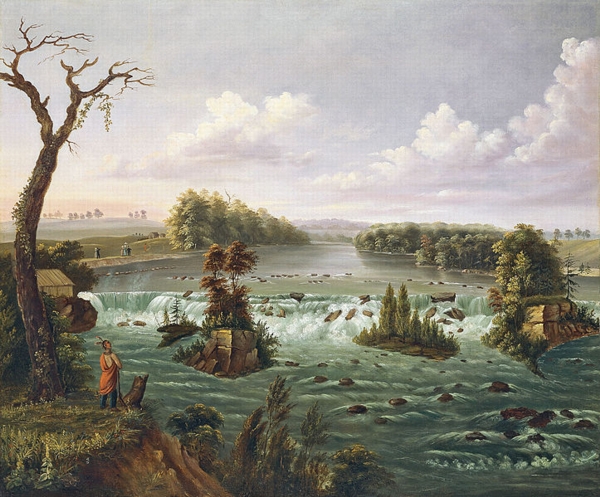
(above: Henry Lewis, Falls of Saint Anthony, Upper Mississippi, oil on canvas, 27 x 32.4 inches, Thyssen-Bornemisza Museum, 646 (1981.52). Public domain, via Wikimedia Commons*)
The Missouri Artist
As this first wave of explorer-artists faded, Missouri's first native-raised genius emerged. George Caleb Bingham was, and is, known simply as "the Missouri Artist". He was the first major American artist to be based west of the Mississippi River. Born in 1811, he moved to Missouri in 1819, settling in the river town of Franklin and later in Arrow Rock. His great works, painted between 1845 and 1860, represent the absolute peak of 19th-century Missouri art. What makes Bingham fundamentally different from the artists who came before is that he was a true insider. His art was an autobiography of his state, and he focused on the two great subjects that defined his own life: the river and politics. He wasn't just an observer; he was an active Whig politician who served in the Missouri state legislature, as state treasurer, and as Missouri's Adjutant-General. He didn't just paint frontier life; he lived it and helped shape its laws.
Bingham's first great theme was the river. His "early masterpiece," Fur Traders Descending the Missouri (1845), was one of the paintings that launched his national career when he sent it to the American Art-Union in New York. The painting depicts a quiet, suspended moment: a French trader and his half-Native son glide downstream in a dugout canoe, a strange, chained bear cub perched on the bow. The subject is captivating, but the painting's true genius is its style. Bingham's work exemplifies the Luminist movement. It has a "remarkable atmospheric quality," perfectly capturing the "soft brilliance of the humid atmosphere which is... characteristic of the Missouri Valley." Bingham's great achievement was to reconcile "formal, academic" European traditions with the "often strikingly unconventional reality" of the West. He applied the sophisticated, light-obsessed techniques of Luminism to the rough-hewn, "folksy" subject of the river, elevating it to the level of high art. His fame faded after his death, but in 1933, the Metropolitan Museum of Art's purchase of this very painting "sparked interest in Bingham's work" and single-handedly revived his reputation.

(above: George Caleb Bingham (American, 1811-1879). Fur Traders Descending the Missouri,1845. Oil on canvas, 29 x 36 1/2 inches. The Metropolitan Museum of Art, New York, Purchase, Morris K. Jesup Fund, 1933 (33.61.). Public domain, via Wikimedia Commons*)
His second great theme was politics, a subject he knew intimately. His "most celebrated painting," The County Election (1852) , is a direct product of his life as a Whig politician. The painting, now a treasure of the Saint Louis Art Museum, is a complex and brilliant narrative scene, a perfect snapshot of messy Jacksonian democracy in action. As an insider, Bingham gives us the full picture. We see the ideal of democracy: "merchants in top hats discuss the issues with laborers in shirtsleeves," a picture of "rational exchange". But he also gives us the flawed reality: politicians "anxiously press their party tickets toward individuals," a "drunken citizen, unable to stand, is nonetheless dragged to cast a vote," and another man nurses his head, "his clarity evidently lost in a brawl". This is a "wry critique," but it is ultimately an affirmation. Bingham, the politician, understood the system's flaws. As the museum's analysis notes, the painting reveals "that the democratic ideal must be embraced even though uniformed votes could prevail". This nuanced, insider's view, capturing both the "virtue" and "vice" of American democracy, is what makes the painting a timeless masterpiece.
Art for the People
As the 19th century closed, Missouri's frontier era gave way to a Gilded Age ambition. The state's art world began to institutionalize. The St. Louis School and Museum of Fine Arts was founded in 1879 as part of Washington University, establishing a permanent home for art education. But the single most important event in Missouri's cultural history was the 1904 St. Louis World's Fair, also known as the Louisiana Purchase Exposition. This monumental fair was designed to announce that St. Louis had officially graduated from a "Gateway" town of frontier commerce to an established, world-class capital of culture. The fair's grand Art Palace, designed by Cass Gilbert, was planned from the start as a permanent structure, and after the fair, it became the new home of the Saint Louis Art Museum.
This same Gilded Age ambition fueled one of the most fascinating, though short-lived, chapters in American craft history, University City Pottery. This enterprise, which flourished from about 1909 to 1914, was not a humble folk-art movement. It was the "top-down" Utopian dream of Edward G. Lewis, a magazine publisher and amateur potter who wanted to create an Arts and Crafts ideal in his new community. To ensure his pottery was the best in the world, he recruited international masters, most notably Taxile Doat, a renowned "French ceramist who was an expert on porcelain and high-fire glazes". The works they produced were not common stoneware; they were the pinnacle of technical achievement, elite luxury goods. The University City Pottery https://tfaoi.org/aa/4aa/4aa484.htm became famous for its true porcelain and its "seductive, often shimmering crystalline glazes". A promotional pamphlet boasted that "no two pieces are alike" and that each was an "exclusive gem". The pottery was a paradox: an attempt to create an American Arts and Crafts community by importing European technical elitism. Like many Gilded Age dreams, it was financially unsustainable and closed in 1914, but the works that survive are considered masterpieces of American art pottery.
This "high-craft" ambition stood in sharp contrast to the "folk-craft" traditions that had existed in Missouri for centuries. The state's earliest pottery and textiles belonged to its Indigenous inhabitants, whose "unbaked... moulded by hand" pottery and "splendid blankets, woven with the most beautiful feathers of the wild turkey" were found in burial mounds. Early settlers, in turn, produced functional items like the "common grey stoneware" drinking cup found in St. Charles County. The history of these functional crafts, particularly textiles, is told less through famous artists and more through the institutions that preserved them. The Missouri Historic Costume and Textile Collection at the University of Missouri, for example, now holds thousands of "apparel and textile artifacts," serving as a repository for the objects of daily life and the clothing of "notable Missourians". This reveals a clear hierarchy in the state's art history: painting was dominant, "high craft" had a brief, shining moment, and the "folk crafts" of daily life were valued as history, preserved by collectors and university archives.
The Modernist as Regionalist
As Missouri's art scene entered the 20th century, its second great artistic giant emerged: Thomas Hart Benton. If Bingham was the "insider," Benton was the "prodigal son." Born in Neosho, Missouri, in 1889, he, like Bingham, came from a prominent political family. But Benton's path was starkly different. He left Missouri, studied in Paris, and lived in New York for over 20 years, where he experimented with modern art styles like Synchromism. He was a true modernist. But in the 1930s, he famously "declared himself an 'enemy of modernism'". Along with Grant Wood and John Steuart Curry, he became a leader of the new Regionalism movement, choosing to paint "everyday people in scenes of life in the United States". His Regionalism was not a naive, provincial style; it was a conscious, intellectual choice by a sophisticated artist to reject European abstraction and forge a new, muscular, and populist American art. In 1935, he completed his prodigal son's return, moving back to Missouri to head the painting department at the Kansas City Art Institute.
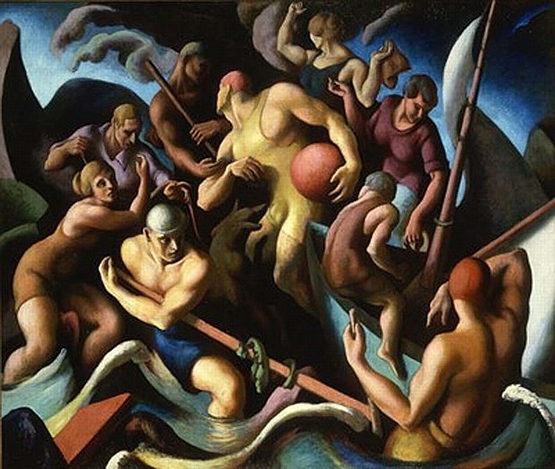
(above: Thomas Hart Benton, People of Chilmark (Figure composition), 1920, oil on canvas, 65.5 x 77.6 inches, Hirshhorn Museum and Sculpture Garden, The Joseph H. Hirshhorn Bequest, 1966, 66.468. Public domain, via Wikimedia Commons*)
Benton's most important and controversial work is A Social History of Missouri, a massive mural completed in 1936 for the State Capitol in Jefferson City. This 16-foot-high mural, which wraps around the House Lounge, is considered by many to be his greatest achievement. It was a populist masterpiece, rejecting the "noble leaders" the politicians who commissioned it had hoped for, and instead celebrating "ordinary men and women, hard at work at a thousand tasks". But it was also deeply confrontational. Benton included the "darker sides" of Missouri's history, painting its uncomfortable truths right onto the capitol walls. The controversy exploded because he included the subjects of slavery, the notorious Missouri outlaw Jesse James, and, most scandalously of all, the currently active Kansas City political boss Tom Pendergast. This was not Bingham's gentle, optimistic critique; this was 20th-century social realism, and it was a direct affront to the romantic myths the state told about itself.
A final painting, Persephone (1938-39), perfectly encapsulates Benton's mature style. This masterpiece, now at the Nelson-Atkins Museum of Art, "recasts a Greek myth in a contemporary, rural guise". It caused what one review called a "sexy scandal". In Benton's hands, the "shamelessly naked" goddess Persephone is a "sunbathing farm girl," and the god Hades who abducts her is a "lustful, aging farmer" with a "rickety cart". This "Peeping Tom" farmer, as some noted, also bears a striking resemblance to Benton himself. The painting was criticized for its "gritty representations" of American culture , but that is precisely its genius. Benton, the Paris-trained modernist, synthesizes his "high art" knowledge (classical myth, Old Master nudes) with a frank, modern, and uniquely Missouri-Ozark sensibility. It is high art, social commentary, and personal expression all at once.
The Enduring Frontier Spirit
The story of representational art in Missouri, from its earliest days to 1945, is a story of wrestling with the frontier. It begins with the objective documentation of that frontier by the scientific eye of Karl Bodmer. It quickly evolves with the romantic mythologizing of Carl Wimar, who created the very visual language of the American West. That frontier experience was then perfected and captured by the great insider-participant, George Caleb Bingham, who translated its unique light into Luminist masterpieces and its political life into complex, enduring narratives. As the frontier closed, the state's ambition was expressed in the "high craft" of University City Pottery, which sought to import European sophistication, and in the founding of its great museums.
Finally, that entire legacy was re-interrogated by Thomas Hart Benton. The 20th-century modernist-turned-regionalist, he returned home to tear down the romantic myths of Wimar and complicate the gentle critiques of Bingham. He painted a new, more "gritty" and confrontational social history. The art of Missouri, in the end, is defined by this "Show-Me" spirit: a constant, creative tension between its raw, "unconventional reality" and its ambitious, sophisticated desire to translate that reality into a great American art.
We lightly edited this article, added images and provided links to other materials to enhance it. AI is rapidly improving in accuracy, yet the article may have inaccurate information.
Our prompt to Gemini 2.5 Pro:
Write 1,500 to 2,000 words in a conversational style about the history of representational art in Missouri through 1945. Use only paragraphs and don't use bullet points or tables. Cover the evolution of artistic styles. Note anything special such as geography, events and other subject matter that differentiated Missouri art from other states. Include painting, pottery and textiles.
Identify those artists deemed most important in the state's history through 1945 and explain why. For each artist, discuss the artist's most important artworks and why each is important. Do not include abstract expressionist artworks. For your research, use only.org and .edu websites Do not research .com websites.
 Return to Missouri Art History
*Tag for expired US copyright of object image:

Links to sources of information outside of our web site are provided only as referrals for your further consideration. Please use due diligence in judging the quality of information contained in these and all other web sites. Information from linked sources may be inaccurate or out of date. TFAO neither recommends or endorses these referenced organizations. Although TFAO includes links to other web sites, it takes no responsibility for the content or information contained on those other sites, nor exerts any editorial or other control over them. For more information on evaluating web pages see TFAO's General Resources section in Online Resources for Collectors and Students of Art History.
Copyright 2025 Traditional Fine Arts Organization, Inc. an Arizona nonprofit corporation. All rights reserved.