
Thomas Hart Benton: Missouri's Native Son and Artistic Giant
by Grok 4
Have you ever heard of Thomas Hart Benton? Not the old-timey senator -- though, fun fact, the artist was named after his great-uncle, that famous Missouri politician. No, I'm talking about the painter, the guy who basically put the American Midwest on the art map during the tough times of the Great Depression. Born in 1889 in Neosho, Missouri, Benton became one of the big shots in what's called the American Scene movement, specifically Regionalism Think of him as the artistic voice shouting, "Hey, America, look at your own backyard!" He painted everyday folks in a way that was bold, twisty, and full of life, sending messages about hard work, social struggles, and what it meant to be American. Let's chat about why he mattered so much, both across the whole country and right there in his home state of Missouri. I'll break it down for you, like we're grabbing coffee and flipping through an old art book.

(above: Thomas Hart Benton, Self-Portrait with Rita, 1922, oil on canvas, National Portrait Gallery, Washington. Public domain, via Wikimedia Commons*)
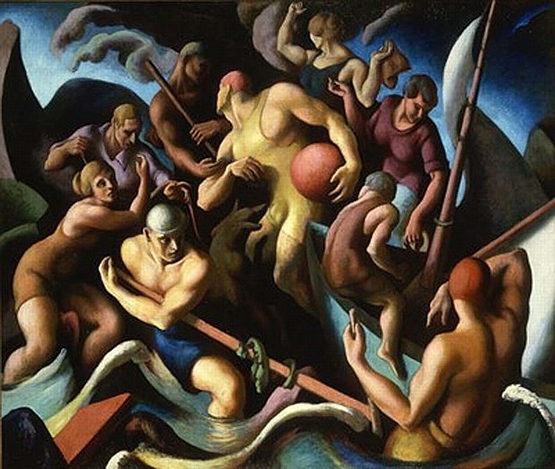
(above: Thomas Hart Benton, People of Chilmark (Figure composition), 1920, oil on canvas, 65.5 x 77.6 inches, Hirshhorn Museum and Sculpture Garden, The Joseph H. Hirshhorn Bequest, 1966, 66.468. Public domain, via Wikimedia Commons*)
First off, nationwide, Benton was a powerhouse in the American Scene painting world. This movement popped up in the 1930s as a reaction to all that fancy European abstract stuff that was dominating the art scene. Artists like Benton, along with his buddies Grant Wood and John Steuart Curry, said, "Nah, let's paint real America -- the farms, the factories, the people hustling through the Depression." Benton led the charge in Regionalism, shifting the spotlight from snooty New York galleries to the heartland. He believed art should be for everyone, not just elites, and his murals were like giant billboards of American life. Take his famous "America Today" series from 1930-31, which he painted for the New School in New York. It's this massive set of panels showing everything from bustling cities to rural labor, with folks from all walks of life -- workers building skyscrapers, farmers threshing wheat, even jazz musicians jamming away. It captured the energy and diversity of the U.S. during a time when people needed hope, and it ended up influencing how Americans saw themselves. The Metropolitan Museum of Art snagged it later, and it's still a big deal because it showed that art could tell the story of a nation in flux.
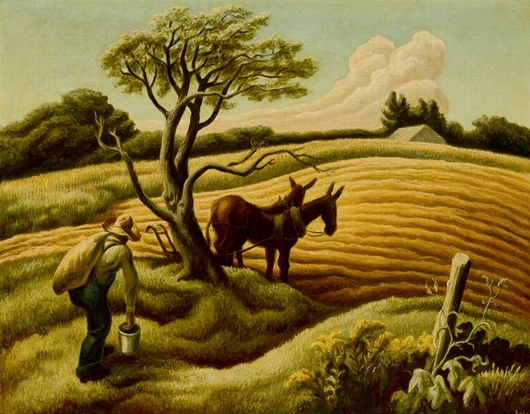
(above: Thomas Hart Benton, Noon, 1939, tempera and oil on board, 22 x 28 inches, Sothebys. Public domain, via Wikimedia Commons*)
What made Benton stand out nationally was his rejection of abstraction. He'd dabbled in modernism early on -- studied in Paris, played with Cubism and Synchromism (that's this color-theory thing that makes paintings feel like music)-but he ditched it for straight-up realism with a twist. He wanted art to have a political punch, like a stump speech from a country politician. His work was everywhere: post offices, state capitols, even influencing government programs during the New Deal. The Treasury Department hired artists like him to paint murals in public buildings, boosting morale. Benton's stuff was in overdrive during World War II too-he did a series called "The Year of Peril" in 1942, showing fascism as this monstrous threat, like in "The Sowers," where a giant skull-tossing figure represents genocide and war. It was propaganda, sure, but it rallied people by tying American values to everyday heroes. And get this: he taught at places like the Art Students League in New York, where he mentored Jackson Pollock. Yeah, the abstract expressionist king started out mimicking Benton's curvy, rhythmic style before going all splattery. Benton expanded what American art could be-more inclusive, more narrative, and way more about the common folk. Without him, the art world might've stayed stuck in Europe-worship mode.
Now, let's zoom in on Missouri, because that's where Benton's heart really was. He was born there, grew up in a political family-his dad was a congressman-and even though he bounced around to Chicago, Paris, and New York, he always came back to his roots. In 1935, he straight-up moved to Kansas City, Missouri, and set up shop in a studio that's now a state historic site. Why Missouri? It was his muse. He drew from the Ozarks, the rivers, the farms-the whole Midwestern vibe. One of his biggest gigs was the mural "A Social History of Missouri" in the state capitol in Jefferson City. Painted in 1936, it's this epic wall-to-wall story of Missouri's past, from Native Americans and pioneers to slavery, outlaws like Jesse James, and modern industry. It wasn't all rosy; he showed the ugly sides too, like lynchings and exploitation, which stirred up controversy. Some folks called him a Communist for painting workers and strikers, but Benton was just holding up a mirror to Missouri's complex history.
In Missouri, he taught at the Kansas City Art Institute, inspiring a new generation of artists to look locally for subjects. His home and studio in KC became a hub for creativity, and he kept painting there until he died in 1975, working on his last mural, "The Sources of Country Music," for the Country Music Hall of Fame. That piece celebrates folk tunes, blues, and gospel -- stuff rooted in Missouri's cultural soil. Benton put Missouri on the national art map by making its stories universal. He showed that a small-town boy from Neosho could capture the soul of America, and in turn, Missouri honors him with museums, historic sites, and even naming stuff after him. His work boosted state pride during tough economic times, reminding folks of their resilience and heritage. Without Benton, Missouri's art scene might not have that gritty, storytelling edge it's known for.
Okay, so how did he paint people? That's where Benton's style gets really fun and unique. He didn't go for straight realism like a photo; nah, he twisted things up. His figures are all exaggerated -- muscular, sinewy, with these fluid, curving lines that make them look like they're dancing or straining against the wind. Influenced by old masters like El Greco and Michelangelo, he'd elongate bodies, give them dynamic poses, and pack them with energy. Think caricature meets heroism: farmers look like Greek gods threshing wheat, workers in factories have these powerful, almost rubbery limbs bending in rhythm. In "City Building" from "America Today," you see a multi-racial crew of laborers -- Black, white, all hustling together on a skyscraper. Their bodies twist and overlap, creating this sense of movement, like the painting's alive. He used bold colors too-vibrant reds, greens, blues-to make everything pop, and he'd throw in abstract elements, like Cubist rainbows, to add a musical feel.
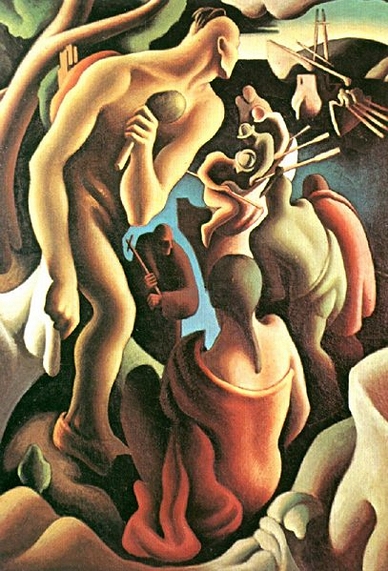
(above: Thomas Hart Benton, American Discovery Viewed by Native Americans, 1922. Public domain, via Wikimedia Commons*)
Benton depicted all kinds of people: rural folks, urban workers, African Americans, Native Americans, women, kids -- you name it. But he wasn't always PC by today's standards. In his "American Historical Epic" series, Native Americans are shown as strong, bronzed figures in battle or losing their land, often stereotyped as "noble savages" or frozen in time. He'd exaggerate scales -- making settlers tiny next to towering Natives -- to flip power dynamics and question colonialism. African Americans appear in jazz scenes or as enslaved people, with muscular bodies emphasizing their strength amid oppression. Women might be dancing in speakeasies or working fields, shown as vital parts of society, not just background. His people weren't idealized; they were raw, sometimes ugly, but always human -- sweating, laughing, fighting. He sketched from life during road trips across the South and Midwest, observing steel mills, cotton fields, and logging camps, then turned those into clay models before painting. It was his way of saying, "These are the real Americans, in all their glory and grit."
Benton was all about messaging. His art was like a visual sermon, celebrating the "voice of the people" while calling out society's ills. He wanted viewers to see the strength in ordinary workers -- the farmers, miners, musicians-who built America. During the Depression, his paintings said, "Hey, we've got vitality; we can overcome this." But he didn't sugarcoat: he protested against big business, the KKK, lynchings, and fascism. In murals like "The Arts of Life in America," he showed folks from different regions engaging in creative stuff -- dancing, singing, playing sports -- as a way to unite the country through shared imagination. He blended folk songs and dialogue into his work, making it feel like a ballad come to life, urging people to value their cultural roots.
For Native Americans and history, his messages were trickier -- he recast myths of the frontier to highlight inequality and violence, like in "The Lost Hunting Ground," where he questions who really "won" the West. It wasn't always triumphant; sometimes it ended on a sad note, pushing viewers to rethink American progress. Politically, Benton was a populist -- scorned elites, championed the little guy. His art assessed success by audience appeal: if it didn't connect with regular folks, what was the point? Even in biblical retellings, like "Susanna and the Elders" set in rural America, he made ancient stories relevant, commenting on morality and everyday life.
In the end, Thomas Hart Benton was important because he
made art democratic. Nationally, he redefined American painting as something
homegrown and narrative-driven. In Missouri, he immortalized the state's
spirit, from its history to its people. His twisty, vibrant depictions turned
ordinary folks into icons, and his messages -- about resilience, injustice,
and cultural pride -- still resonate today. Next time you're in a museum
or driving through the Midwest, think of Benton; he painted the America
we often overlook.
We lightly edited this article, added images and provided
links to other materials to enhance it. AI is rapidly improving
in accuracy, yet the article may have inaccurate information.
 Return to Missouri Art History
*Tag for expired US copyright of object image:

Links to sources of information outside of our web site are provided only as referrals for your further consideration. Please use due diligence in judging the quality of information contained in these and all other web sites. Information from linked sources may be inaccurate or out of date. TFAO neither recommends or endorses these referenced organizations. Although TFAO includes links to other web sites, it takes no responsibility for the content or information contained on those other sites, nor exerts any editorial or other control over them. For more information on evaluating web pages see TFAO's General Resources section in Online Resources for Collectors and Students of Art History.
Copyright 2025 Traditional Fine Arts Organization, Inc. an Arizona nonprofit corporation. All rights reserved.