
Missouri's Fascinating Art History
by Grok 4
If you want to understand the story of American art, you can't just stay on the East Coast. You have to go west, and in the 19th and early 20th centuries, the gateway to that West was Missouri. The art that emerged from this state between 1845 and 1945 is a fascinating tale, not just of pretty pictures, but of a nation figuring out its own identity.
This hundred-year span is framed by two absolute giants of American art, both Missourians, who, in their own unique ways, defined what it meant to paint America. The story of Missouri art is the story of George Caleb Bingham and Thomas Hart Benton, with a fascinating, glittering, and transformative chapter in between.
George Caleb Bingham: Painting the Frontier's Last Quiet Moment
The story for our period begins in 1845, and it begins with a painting that is so quiet, so still, it almost feels like a dream. The artist is George Caleb Bingham, known simply as "The Missouri Artist." He was not just a painter; he was a politician, a self-taught frontiersman who captured the soul of his state at a pivotal moment. His style was a unique blend of Romanticism and an American style we now call Luminism, marked by an almost spiritual treatment of light. But what makes Bingham so important is that he was one of the very first major American artists to come from west of the Mississippi. He turned his gaze away from European ruins and East Coast parlors and focused on the people and places that defined the American borderland: the river boatmen, the fur traders, and the rowdy, messy process of frontier democracy.
The painting that launches our era is "Fur Traders Descending the Missouri" (1845). It is, without exaggeration, one of the most important artworks in American history. It depicts a man, a French trapper, and his son, who is of mixed Native American heritage, in a dugout canoe. On the bow sits a small, chained bear cub. The Missouri River is a sheet of glass, the morning light is hazy and ethereal, and the entire scene is bathed in a profound, unsettling silence. What makes it so important is its ambiguity. Bingham originally titled it "French Trader & Half breed Son," a specific and telling title that the American Art-Union in New York later changed to the more generic and "palatable" name we know today. The painting is an elegy. It captures the end of an era. This is not a wild, untamed wilderness; it's a river already tamed by commerce, a moment of transition. The stillness of the water and the soft light give the scene a timeless, romantic quality, idealizing the frontier life for an Eastern audience that was hungry for images of the West. It put Missouri, and Bingham, on the national map.

(above: George Caleb Bingham (American, 1811-1879). Fur Traders Descending the Missouri,1845. Oil on canvas, 29 x 36 1/2 inches. The Metropolitan Museum of Art, New York, Purchase, Morris K. Jesup Fund, 1933 (33.61.). Public domain, via Wikimedia Commons*)
Bingham wasn't just about quiet rivers, though. He was deeply political, and his most famous series of paintings chronicles the vibrant, chaotic, and uniquely American spectacle of elections. The most celebrated of these is "The County Election" (1852). This is the complete opposite of "Fur Traders." It's a complex, bustling scene crowded with dozens of figures, each a specific character study. You see men lining up to vote (which was done by voice, not a secret ballot), politicians earnestly persuading, drunkards being offered more liquor, and citizens arguing. It's a "warts and all" depiction of democracy in action. Its importance lies in its honesty. It's not a sanitized, heroic painting of founding fathers. It is a genre painting -- a scene of everyday life -- that captures the messy, populist, and very human reality of self-governance on the frontier. Bingham knew these scenes intimately, and he painted them with a detail and character that made them profoundly American. For decades, George Caleb Bingham was Missouri art.
The Gilded Age: St. Louis Looks to Europe
After Bingham's death in 1879, the artistic winds shifted. Missouri, particularly St. Louis, was no longer a rugged frontier outpost. It was a booming, wealthy, and industrial city, a "gateway" that had become a destination. Like the rest of America in the Gilded Age, its cultural aspirations turned toward Europe. Artists from Missouri, like Richard E. Miller, became expatriates, moving to Giverny, France, to paint alongside the Impressionists. Back home, the dominant styles became more academic, polished, and cosmopolitan. Artists like Frederick Oakes Sylvester painted the Mississippi River, but not with Bingham's focus on the human narrative. Instead, he painted it in a Tonalist style, full of mood, poetic light, and atmospheric effects, closer to the work of James McNeill Whistler than a frontier genre painter.
The single most important event that defines this era for Missouri art was the 1904 Louisiana Purchase Exposition, better known as the St. Louis World's Fair. This event was a cultural earthquake. It was a "visual encyclopedia" for the millions who attended. The fair's magnificent Palace of Fine Arts, designed by architect Cass Gilbert, was the only major structure built to be permanent; today, it is the home of the Saint Louis Art Museum. For seven months, this building and its sprawling temporary wings presented one of the largest art exhibitions the world had ever seen, with works from France, Japan, Germany, and beyond.
What made this event so different, and so crucial to Missouri's art history, was its groundbreaking curatorial vision. For the first time at any international exposition, the fair's organizers officially included decorative arts (like furniture and textiles) and Native American arts within the "Fine Arts" category. This was a radical act that broke down the old, stuffy European hierarchies. Missourians didn't have to go to Paris or Rome to see the latest in Impressionism, Symbolism, or Japanese design; the world had come to them. This massive influx of global art exposed a generation of Missouri artists and patrons to new ideas, new colors, and new ways of seeing, setting the stage for the next great rebellion.
Thomas Hart Benton: The Return to the Soil
That rebellion came in the 1920s and 30s, and its leader was Missouri's second great artistic son, Thomas Hart Benton. Born in Neosho, Missouri, into a powerful political family (just like Bingham), Benton was the quintessential American rebel. He went to Paris, studied modern art, and experimented with abstract styles like Synchromism. Then, in a famous and very public reversal, he rejected it all. He declared European modernism a "disease" and an effete, foreign import. He believed that true American art had to come from its own soil, its own people, and its own "backyard." He returned to Missouri and became the fiery, outspoken leader of the Regionalism movement, also known as American Scene painting.
Benton's style is unmistakable. Where Bingham's art is still, Benton's is explosive. His figures are not realistic; they are muscular, sculptural, and writhing with energy, as if carved from gnarled wood. His compositions are dynamic and restless, his colors vivid and earthy. He was, in many ways, a modernist in disguise, using the tools of abstraction to create a powerful representational art. He was a populist who wanted his art to be seen by everyone, not just elite collectors, which is why he championed the public mural.

(above: Thomas Hart Benton, Self-Portrait with Rita, 1922, oil on canvas, National Portrait Gallery, Washington. Public domain, via Wikimedia Commons*)
His most important and controversial work is "A Social History of the State of Missouri" (1936), a massive mural cycle that covers the walls of a lounge in the Missouri State Capitol in Jefferson City. When it was unveiled, it caused an uproar. The legislature that commissioned it was expecting a heroic, glorified pageant of state history. Benton gave them the opposite. He gave them a "warts and all" social history, a "crude realism" that he felt was more honest. Alongside scenes of pioneers and farmers, Benton included the darker side of Missouri's past: a slave auction, a lynching, and the political corruption of the Pendergast machine in Kansas City. He populated his history with Missouri's folk heroes and outlaws, from Huck Finn and Jesse James to the saloon singer Frankie (of "Frankie and Johnny" fame). It was loud, chaotic, and uncompromising.
Benton believed he was painting the truth of the state's character, and in doing so, he created a masterpiece of the American Scene movement. If the Capitol mural was his public thesis, a painting like "Persephone" (c. 1938-39) shows his mature style at its most potent. This work, now in the Nelson-Atkins Museum of Art in Kansas City, is a modern retelling of the classical Greek myth of the abduction of Persephone by Hades, the god of the underworld. But Benton sets the scene in the Missouri Ozarks. Persephone is a sensual, sunbathing nude, and "Hades" is a grizzled, muscular, overall-clad farmer (a self-portrait of Benton, some say) leering at her from behind a gnarled tree. The painting is a brilliant blend of classical mythology and earthy regionalism. It's about the cycle of the seasons, the fertility of the land, and a raw, primal sensuality. It perfectly captures Benton's belief that the timeless, epic stories of humanity were playing out right there in the hills and hollows of his home state.
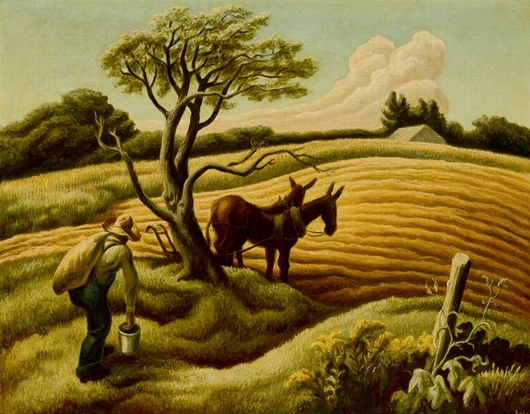
(above: Thomas Hart Benton, Noon, 1939, tempera and oil on board, 22 x 28 inches, Sothebys. Public domain, via Wikimedia Commons*)
The century of art from 1845 to 1945 in Missouri is a perfect mirror of America's own journey. It begins with Bingham, the romantic chronicler, capturing the last quiet moments of the river frontier with a luminous, gentle light. It passes through the ambitious, cosmopolitan Gilded Age, where St. Louis and its great World's Fair looked to the rest of the world for inspiration. And it ends with Benton, the fiery populist, who ripped art away from the coasts and Europe, bringing it back to the soil, painting the history and folk culture of his state with a brash, muscular, and unforgettable energy. These two men, Bingham and Benton, bookend the era, both products of Missouri political families, and both convinced that the most American stories of all were the ones unfolding right in front of them, on the bluffs of the Mississippi and in the hills of the Ozarks.
We lightly edited this article, added images and provided
links to other materials to enhance it. AI is rapidly improving
in accuracy, yet the article may have inaccurate information.
 Return to Missouri Art History
*Tag for expired US copyright of object image:

Links to sources of information outside of our web site are provided only as referrals for your further consideration. Please use due diligence in judging the quality of information contained in these and all other web sites. Information from linked sources may be inaccurate or out of date. TFAO neither recommends or endorses these referenced organizations. Although TFAO includes links to other web sites, it takes no responsibility for the content or information contained on those other sites, nor exerts any editorial or other control over them. For more information on evaluating web pages see TFAO's General Resources section in Online Resources for Collectors and Students of Art History.
Copyright 2025 Traditional Fine Arts Organization, Inc. an Arizona nonprofit corporation. All rights reserved.