
Horizons of Clay and Canvas: A Narrative History of Nebraska Art
a Gemini 3 Deep Research Report
January, 2025
When you look at the history of art in Nebraska between 1850 and 1950, you aren't just looking at a timeline of paintings and sculptures. You are looking at a story of human resilience against a landscape that was, for a long time, overwhelming. In the mid-19th century, Nebraska wasn't dotted with galleries or supply stores; it was a vast, open horizon that demanded a specific kind of creativity. The art that emerged here wasn't born in salons; it was born in sod houses, on reservations, and in the minds of people who had to be incredibly resourceful just to survive. It is a story about how geography dictated the medium -- how the lack of trees led to buildings made of earth and furniture made of horn, and how the endless sky influenced a style of painting that was unique to the Plains.
To really understand this, we have to start with the people who were here first. In the mid-1800s, the artistic traditions of the Omaha, Pawnee, Ponca, and Lakota nations were undergoing a massive shift. For generations, the primary way to decorate clothing and ceremonial objects was quillwork. This involved the painstaking process of harvesting porcupine quills, dyeing them with natural pigments, and stitching them onto hide. It was a sacred craft, often restricted to guilds of women who had purchased the right to perform it. But as settlers moved in and game patterns were disrupted, harvesting porcupines and finding quality hides became increasingly difficult.
At the same time, trade routes were flooding the region with glass beads from Venice and Bohemia. You might think this was just a simple swap of materials, but it actually sparked a whole new artistic explosion. Beads were durable and came in colors that quills simply couldn't match. Indigenous artists adapted quickly. The Lakota, living on the high plains, developed bold geometric designs -- triangles and diamonds that could be read from a distance, speaking of mountains and buffalo tracks. Meanwhile, the Omaha and Winnebago tribes, settled in the wooded river valleys of the east, created floral patterns that mirrored the plants they saw along the Missouri River. This transition from quill to bead wasn't just about fashion; it was a survival strategy, a way to maintain cultural identity in the face of immense pressure.
One of the most remarkable figures to bridge the gap between these traditional forms and the Western art world was Angel De Cora. Born on the Winnebago Reservation in 1871, she was part of a generation that was often forcibly removed from their families to be educated in Eastern boarding schools. Yet, De Cora didn't let that erase her identity. She went on to study at Smith College and under the famous illustrator Howard Pyle. Pyle encouraged her to paint the life she knew, and she did so with a style that was moody and atmospheric, often called Tonalist. She became a fierce advocate for the value of Native American art, arguing that Indigenous design was not primitive but a sophisticated form of abstraction that deserved the same respect as Greek or Roman art. She was arguably Nebraska's first Modernist designer, using her position to validate the artistic heritage of her people on a national stage.
While Indigenous artists were adapting their traditions, the new settlers arriving in the 1860s and 70s were facing their own artistic crisis: a lack of materials. If you were a pioneer living in a sod house, you couldn't exactly order a mahogany dining set. This scarcity gave birth to a fascinating "pioneer aesthetic" defined by making do with what was at hand. A prime example of this is the furniture of Dr. John Dorwart. Living in Friend, Nebraska, Dorwart looked at the piles of discarded cattle horns from local slaughterhouses and saw potential. He spent hours matching, polishing, and interlocking these horns to create elaborate chairs and settees upholstered in velvet. These weren't just crude seats; they were complex pieces of engineering that turned a dangerous part of a beast into a symbol of domestic comfort.
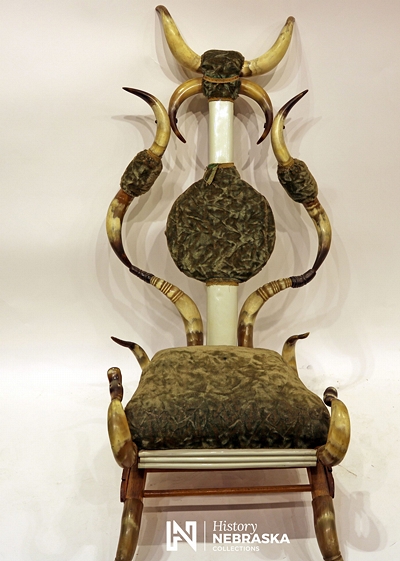
(above: Dr. John Dorwart, Chair. Photo courtesy of Nebraska State Historical Society)
Textiles also became a major form of expression during this time. In the isolation of the Sandhills, quilting was more than a hobby; it was a mental lifeline. Grace Snyder, a ranch wife who lived a life of hard labor, created quilts that are essentially mathematical masterpieces. Her most famous work, the "Flower Basket Petit Point" quilt, is mind-boggling. Inspired by a design on a china plate, she cut over 87,000 tiny triangular pieces of fabric to recreate the image in cloth. It is considered one of the finest American quilts of the 20th century. Snyder proved that you didn't need a studio in Paris to create high art; you could do it with a needle and thread in a ranch house, organizing thousands of scraps into a perfect, ordered whole.

(above:Detail of Grace Snyder's "Flower Basket Petit Pointe" quilt, one of her two designs designated among the 100 best 20th-century quilts by Quilters Newsletter Magazine in 1999. She made the quilt in 1943. (Image No. 7828-8). Image courtesy of Nebraska State Historical Society)
Simultaneously, the Lakota people were developing their own textile tradition: the Star Quilt. As the buffalo herds vanished, the traditional painted buffalo robes used in ceremonies could no longer be made. In their place, Lakota women adopted the quilt, but they made it their own. They developed the "Morning Star" pattern, an eight-pointed star that represents the direction from which spirits travel to earth. These quilts replaced the buffalo robes in funerary rights and became essential gifts for honoring ceremonies. It is a profound example of how art in Nebraska was often about spiritual survival, using new materials to preserve ancient meanings.
As towns began to stabilize in the late 19th century, there was a strong push to prove that Nebraska was "civilized." This led to the creation of institutions that would nurture the arts for decades. In 1888, a group of citizens in Lincoln formed the Haydon Art Club, which would eventually become the Nebraska Art Association and lead to the founding of the Sheldon Museum of Art. It was driven largely by women like Sarah Wool Moore, who believed that a collection of fine art was necessary for the education of the state's youth. They didn't have a museum building yet, so they held exhibitions in libraries and rented halls, shipping paintings in from New York to show locals that culture could thrive on the plains.
This desire for cultural recognition culminated in the Trans-Mississippi and International Exposition of 1898 in Omaha. It was a surreal event. In a city that was still paving its streets, civic leaders built a temporary "Grand Court" of plaster palaces that looked like ancient Rome, complete with a lagoon and gondolas. The Expo's Fine Arts Building displayed hundreds of paintings from Europe and America, exposing millions of visitors to high art. However, the Expo also highlighted the era's racial tensions, contrasting the "civilized" white art with an "Indian Congress" that displayed Native Americans as living artifacts. Despite its flaws, the Expo was a watershed moment. It proved that the region had a hunger for beauty and laid the groundwork for future philanthropists to build permanent museums like the Joslyn.
Nebraska didn't have traditional "art colonies" like Taos, New Mexico, or Provincetown, where artists lived in clusters of studios. Instead, the University of Nebraska and local guilds served that function. The Omaha Art Guild and the Lincoln Artists' Guild became the social glue for artists who were otherwise isolated by the vast geography. These groups provided a place to critique work, share models, and exhibit together. The university, in particular, was a magnet, drawing in teachers and students who would define the state's artistic future.
This brings us to the "Golden Age" of Nebraska art, the period between the World Wars. While the rest of the art world was flirting with abstraction, Nebraska artists largely embraced Regionalism. But Nebraska Regionalism was different from the famous Iowa brand of Grant Wood. It was less satirical and more focused on the sheer scale of the land.
Three painters really define this era. First, there is Dale Nichols. You might know him from his "Red Barn" paintings that appeared on everything from calendar pages to postage stamps. It is easy to write him off as nostalgic, but Nichols was actually doing something quite sophisticated. He called it "magical realism." His paintings are geometric and precise, with snow that looks pristine and shadows that are perfectly blue. He wasn't painting the dirty, dusty reality of the 1930s farm; he was painting a psychological ideal, a memory of order in a chaotic world. He believed that specific shapes like pyramids and spheres created a "psychic" harmony, and he used his farm scenes to explore those theories.

(above:Dale Nichols, January, 1935, Collection of Williams College Museum of Art. Image courtesy of Bone Creek Art Museum)
Then there is Terence Duren from Shelby. If Nichols painted the ideal, Duren painted the drama. After surviving polio as a child, which turned him toward art, he studied in Europe but returned to his hometown. His style was Gothic and narrative, capturing the eccentricities of small-town life. His murals and illustrations often featured local history and folklore, and he believed deeply that art should be understandable to the people it depicted. He didn't shy away from the odd or the dramatic, giving his work a storytelling quality that Nichols lacked.

(above:Terence Duren, Apple Picking, 22.5" X 27.5", Image courtesy of Kiechel Fine Art, Lincoln Nebraska)
The third key figure is Dwight Kirsch. As a professor and director at the University galleries, he was a mentor to many, but his own art was equally important. He realized that the Nebraska Sandhills -- those rolling dunes of grass -- were naturally abstract. You couldn't paint them like a European landscape because they had no focal point. Kirsch treated the dunes as studies in light, shadow, and form, bridging the gap between Regionalism and Modernism.
We also have to mention Augustus Dunbierr, who brought Impressionism to the state. He was a classic plein air painter, meaning he painted outdoors, directly from nature. He would strap his easel to his back and paint the Missouri River valley in all weathers, capturing the shifting light with thick, bold brushstrokes. He was also one of the first Nebraska artists to paint regularly in the Southwest, establishing a link between the Omaha art scene and the colony in Taos.
Perhaps the single greatest artistic achievement in the state is the Nebraska State Capitol, built between 1922 and 1932. It is a masterpiece of collaboration. The architect, Bertram Goodhue, rejected the traditional dome and built a "skyscraper of the plains" that mimicked the flat geometry of the landscape. But it was the art that made it speak. The sculptor Lee Lawrie created what is known as "architectural sculpture," where the figures aren't just stuck on the building but seem to grow out of the stone itself. His "Sower," a 19-foot bronze figure atop the dome, revolutionized public art by placing an agricultural worker, rather than a general or a Greek god, at the pinnacle of government.
Inside the Capitol, Elizabeth Dolan painted "The Spirit of the Prairie," a mural that is heartbreakingly beautiful. It depicts a pioneer mother looking out over the empty land with her children. Unlike the triumphant war memorials common in other states, Dolan's work acknowledges the loneliness and endurance of the women who settled the West. The entire thematic program of the Capitol was guided by Hartley Burr Alexander, a philosophy professor who ensured that the art incorporated not just Western history but also Indigenous symbolism, weaving the two into a unified story of the state.
Sculpture also found a place in the public parks. Ellis Burman, working during the Depression, created the "Smoke Signal" in Pioneers Park. It is a massive concrete sculpture dedicated to the Native American tribes of Nebraska. Burman's work was populist and rougher than the refined stone of the Capitol, but it represented a democratization of art, moving it out of galleries and into the spaces where people lived and played.
Finally, we shouldn't overlook the earth itself. The clay of southeastern Nebraska gave rise to the Lincoln Pottery Works in the 1880s. While they started by making practical jugs and crocks, they eventually employed skilled artisans to create decorative vases and urns. This abundance of clay also meant that Nebraska developed a distinct red-brick architecture. Towns like Hastings and Lincoln were built from local brick, giving them a visual warmth and permanence that stood in contrast to the wooden shacks of the early frontier.
By 1950, Nebraska had developed a distinct artistic voice. It wasn't an imitation of the East Coast; it was something homegrown. From the beaded moccasins of the Omaha to the bronze Sower casting seeds over Lincoln, the art of this century was defined by a deep relationship with the land. It was an art of necessity, born from the need to make sense of the horizon, and it left a legacy of resilience that continues to define the state's culture today.

(above:Dwight Kirsch, Nebraska
Sandhills, 1936, watercolor, 18 3/4 x 15", Museum of
Nebraska Art, Gift of Mrs. Terry Townsend. Image courtesy of Museum
of Nebraska Art)
Prompt:
In about 2,000 to 2,500 words, using a conversational,
informal, style of writing, write a narrative about the history of artistic
expression in Nebraska from 1850 through 1950. Don't use bullet points
or tables. Cover types of art including paintings, sculpture, pottery, and
textiles. Do not research abstract expressionist art. Note anything special
such as geography, events and other things that differentiated Nebraska
art from other states. Identify the most highly regarded artists in the
state during that time period and say what is unique and special about their
art that makes them so important. If you identify early art colonies
in the state, discuss why they developed and their importance. Research
only .edu and .org sites. Include tfaoi.org as a source if that site has
relevant information.
We lightly edited this article, added images and provided
links to other materials to enhance it. AI is rapidly improving
in accuracy, yet the article may have inaccurate information.
 Return to Nebraska Art History
*Tag for expired US copyright of object image:

Links to sources of information outside of our web site are provided only as referrals for your further consideration. Please use due diligence in judging the quality of information contained in these and all other web sites. Information from linked sources may be inaccurate or out of date. TFAO neither recommends or endorses these referenced organizations. Although TFAO includes links to other web sites, it takes no responsibility for the content or information contained on those other sites, nor exerts any editorial or other control over them. For more information on evaluating web pages see TFAO's General Resources section in Online Resources for Collectors and Students of Art History.
Copyright 2025 Traditional Fine Arts Organization, Inc. an Arizona nonprofit corporation. All rights reserved.