
Swedish-American Art In Minnesota: 1850-1945
a Gemini 3 Conversational Deep Research Report
February, 2026
The migration of over 1.25 million Swedes to the United States between 1850 and 1930 represents a pivotal chapter in the cultural synthesis of the American Midwest, particularly within the state of Minnesota. This demographic shift was catalyzed by a confluence of factors, including the devastating famines of the 1860s in regions like Småland and a rigid social hierarchy that offered limited mobility to the peasant class. Upon arrival in Minnesota, these immigrants encountered a landscape that bore a haunting resemblance to their homeland -- a terrain of undulating uplands, dense hardwood forests, and a vast network of lakes that mirrored the lacustrine beauty of Sweden. Between 1850 and 1945, the artistic expression of these settlers evolved from the rudimentary, utilitarian crafts required for frontier survival into a sophisticated body of fine art that bridged the gap between Swedish peasant traditions and American modernism. This evolution was not merely an aesthetic journey but a profound social mechanism used by the Swedish-American community to negotiate their identity, facilitate assimilation, and assert their cultural sophistication in a frequently hostile nativist environment.
The Genesis of Material Culture on the Minnesota Frontier
In the initial decades of settlement, spanning from 1850 to roughly 1880, the Swedish immigrant experience was defined by the harsh realities of the frontier. The concept of "art" during this period was inextricably linked to the Slöjd tradition -- a Swedish philosophy of handcraft that emphasizes the integration of the hand, mind, and heart in the creation of functional objects. The earliest Swedish settlers in Minnesota were often specialists in necessity; they were the architects of the log cabins that became the standard of American frontier housing, a construction technique introduced to the continent by Swedes and Finns in the seventeenth century.
As these pioneers moved into the remote regions of the Minnesota wilderness, they brought with them a rich heritage of craftsmanship in wood, leather, wool, and birch bark. However, the transition to the American Midwest necessitated a "sea-change" in their material culture. In Sweden, the peasant family existed within a largely self-sufficient, diversified economy, crafting their own furniture, utensils, and clothing. In the American market economy, the Swedish immigrant became a specialist -- typically a farmer -- who converted produce into cash to purchase manufactured necessities. This economic shift initially threatened traditional handicrafts, as the time required for decorative carving or intricate weaving became an expensive luxury in the face of survival.
Despite these pressures, fragments of Swedish material culture survived and eventually flourished. The domestic environment of the early Swedish-American home was a repository for these traditions. Items such as the bonader -- painted wall hangings on linen or paper -- were brought from Sweden or recreated in Minnesota to decorate the dark interiors of log cabins during Christmas and other festivities. These paintings, often depicting biblical scenes or folk tales using vegetable and mineral pigments, provided a vibrant link to the ancestral past and served as a form of cultural inheritance passed down through generations.
Monumental Sculpture: Carl Milles and the Vision of Peace
The culmination of the Swedish sculptural tradition in Minnesota is best exemplified by the work of Carl Milles (1875-1955), an internationally renowned Swedish sculptor whose impact on the state's public art is unparalleled. Milles, who lived and worked at the Cranbrook Academy of Art in Michigan for much of his American career, was commissioned to create a centerpiece for the St. Paul City Hall and Ramsey County Courthouse.

(above: Carl Milles, The Dancer's Skirt (Danserskorna), Göteborg, Sweden. Photo: Rolf Broberg. Public domain, via Wikimedia Commons**)
The resulting work, Vision of Peace (originally titled Indian God of Peace), is a monumental achievement of Swedish-American art. Unveiled in 1936, the statue stands 38 feet tall and was carved from creamy white Mexican onyx, a material chosen for its translucent and luminous qualities. The sculpture depicts a stylized Native American figure rising from the smoke of peace pipes, representing a vision of global harmony that Milles claimed inspired him after witnessing a ceremony in Oklahoma. The Vision of Peace is unique not only for its scale and material but also for its integration into the Art Deco architecture of the building, which features 23 different varieties of wood and blue Belge marble. The statue receives significant attention in contemporary museum exhibits, architectural books, and digital media, serving as a primary example of how Swedish-American artistic vision could define the civic identity of a major American city.
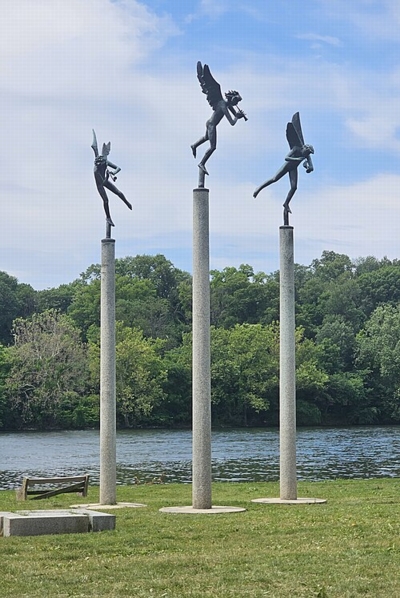
(above: Carl Milles, Playing Angels, Fairmount Park, Philadelphia. Photo: JJonahJackalope. Public domain, via Wikimedia Commons**)
The Professionalization of Swedish-American Fine Art
As the Swedish population in Minnesota grew and became more established, a class of professional artists emerged. These individuals were often well-educated, having trained in the elite art academies of Europe or at prestigious American institutions like the Art Students League of New York or the Art Institute of Chicago.Unlike the earlier folk artists, these professional painters and sculptors sought to engage with the mainstream American art world while maintaining their ethnic identity.
Between 1905 and 1964, the Swedish-American community organized a series of ethnic exhibitions that were among the most enduring in American history. These shows were strategically designed to showcase the cultural sophistication of Swedish-Americans, countering prevalent stereotypes of the "cloddish" immigrant.The patronage system that supported these artists was remarkably vigorous; wealthy Swedish-American businessmen and community leaders purchased their works and facilitated their entry into major museums and galleries.
John F. Carlson and the Transcendental Forest
John Fabian Carlson (1874-1945) is perhaps the most celebrated Swedish-born painter associated with the American landscape tradition of the early twentieth century. Although much of his career was spent in the Woodstock art colony in New York, Carlson's roots in the "somber pine forests" of Småland, Sweden, provided the fundamental aesthetic framework for his work. Carlson immigrated to the United States as a child in 1887, eventually becoming a director of the Art Students League's summer program and a nationally acclaimed teacher.
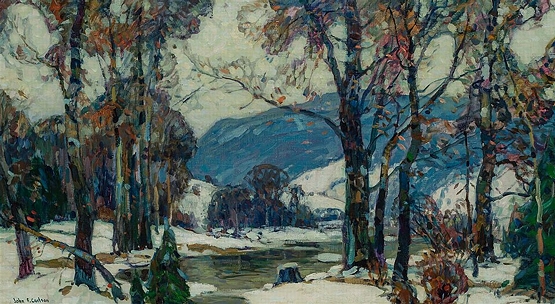
(above: John Fabian Carlson, Highland Snows, oil on canvas, 20 x 36 inches, Shannon's Fine Art Auctioneers. Public domain, via Wikimedia Commons*)
Carlson's style was characterized by a refined Impressionism that focused on the atmospheric qualities of the forest. He was particularly famous for his depictions of "thawing snow" and the intricate patterns of sunlight filtering through barren winter trees. His work Thawing Snow is a hallmark of his style, demonstrating a mastery of muted tones and geometric composition. Critics often noted a "Swedish" quality in his work -- a certain melancholy and deep reverence for the solitude of the woods -- that aligned with both his heritage and the broader American Regionalism movement. Carlson's influence was magnified by his writing; his theories on landscape painting became standard texts for generations of American artists.
Dewey Albinson: The Modernist Chronicler of nature
Ernest Dewey Albinson (1898-1971) was a pivotal figure in the "Minnesota Modern" movement. Born in Minneapolis to Swedish immigrant parents, Albinson was introduced to art during a childhood recuperation from a shooting accident. He studied at the Minneapolis School of Art and later in Paris under cubist masters, this training profoundly influenced his style. Albinson's work is characterized by "art tones and pastels" and strong, expressionist brushstrokes that emphasize the geometric forms of the landscape. He was deeply committed to capturing the "vanishing way of life" along Lake Superior's North Shore and within the St. Croix Valley. His most famous series involves the "Spirit Little Cedar Tree" (the "Witch Tree") at Grand Portage, a subject he painted repeatedly to document its "haunting beauty." Albinson saw himself as a "descendant of the independent Vikings," and his art was often a weapon in his personal battle against the industrial "progress" that threatened the wilderness he loved. His work is extensively represented in the Minneapolis Institute of Arts and the Smithsonian American Art Museum and he receives frequent mention in historical surveys of Minnesota art.
Knute Heldner: From Lumber Camps to Southern Tranquility
Knute Heldner (1877-1952) was an artist of "savage grandeur," a term French critics coined to describe the forthright, powerful quality of his paintings. Born in Småland, Heldner worked as a lumber camp cook and Northwoods guide in Minnesota before winning the gold medal at the 1915 Minnesota State Fair. His early work was deeply concerned with the "social realism" of the working man, depicting the harsh conditions of mining and logging camps.
Heldner eventually divided his time between Duluth and New Orleans, creating a unique body of work that blended Swedish expressionism with the subtropical colors of the American South. His "post-impressionist" style utilized heavy impasto and a rich palette to create "dreamy" landscapes and poignant portraits of the poor and homeless during the Great Depression. Heldner's importance is signaled by his presence in the Smithsonian American Art Museum and his friendship with cultural figures like Tennessee Williams.
B.J.O. Nordfeldt: The Technical Innovator
Bror Julius Olsson Nordfeldt (1878-1955) was a modernist of international reputation who significantly influenced the Minnesota art scene through his teaching at the Minneapolis School of Art in the 1930s and 40s. Born in Tullstorp, Sweden, Nordfeldt was a master of diverse media, including etching, lithography, and oil painting.
Nordfeldt's most notable contribution to the technical world of art was the "Provincetown print," a white-line woodblock technique that allowed for multiple colors to be printed from a single block. His style focused on the "flattening of form and distortion of space," creating stylized, emotionally powerful images of nature and religious themes. During his time in Minnesota, he influenced a generation of students, including his second wife, Emily Abbott Nordfeldt, and his work is a cornerstone of the Frederick R. Weisman Museum of Art collection.
Paintings by Bror Julius Olsson Nordfeldt
The American Swedish Institute and the Infrastructure of Patronage
The success of Swedish-American artists in Minnesota was not an accident of talent alone but the result of a deliberate and robust infrastructure of patronage. The American Swedish Institute, founded in 1929 by the newspaper publisher Swan Turnblad, served as the epicenter of this activity. Turnblad, himself a Swedish immigrant who lived a "rags-to-riches" success story, donated his magnificent mansion to establish a cultural center dedicated to preserving the historic role of Sweden and Swedish Americans in US history. The ASI provided a platform for both established and emerging artists, hosting regular exhibitions that bridged the interests of local craftsmen with the elite practitioners of the Nordic countries. This institutional support extended to the creation of the Hillstrom Museum of Art at Gustavus Adolphus College, which holds one of the most significant collections of Swedish-American art in the country. The Reverend Richard L. Hillstrom, a key benefactor, specifically focused on acquiring works by Carlson, Nordfeldt, and others to ensure their importance remained in the broader narrative of American art history.
The Enduring Vision of Swedish-American Art
By 1945, the landscape of Swedish-American art in Minnesota had undergone a total transformation. The utilitarian Slöjd of the frontier had evolved into a body of work that was represented in the nation's greatest museums, from the Smithsonian to the Art Institute of Chicago. The artists of this era -- John F. Carlson, Dewey Albinson, Elof Wedin, Knute Heldner, and B.J.O. Nordfeldt -- each provided a unique perspective on the immigrant experience, blending the melancholy and mysticism of the North with the rugged reality and modernist ambition of their new home.
What differentiated Swedish-American art from other Minnesota art was this deep-seated "Swedish quality" -- a synthesis of technical discipline, philosophical engagement with nature, and a communal drive toward cultural excellence that served as a beacon for the broader immigrant community. Today, the legacy of these artists is maintained through a vibrant network of museums, folk schools, and digital archives. From the towering onyx of Carl Milles' Vision of Peace to the geometric planes of Elof Wedin's Beaver Bay, the artistic output of Minnesota's Swedish-Americans between 1850 and 1945 remains a vital and luminous part of the state's cultural fabric, testifying to the power of art to bridge worlds and define the human experience.

(above: Entrance, American Swedish
Institute, Minneapolis, Minnesota. Photo: John Hazeltine. © 2012 John
Hazeltine)
Prompt:
In an informal manner without using section headings, tables or bullet points, write an approximately 1,500 word narrative about the history of Swedish-American art in Minnesota between 1850 and 1945. Cover types of art including paintings, sculpture, woodworking and textiles. Note anything special such as culture and styles that differentiated Swedish-American art from other Minnesota art. Discuss four to six of the most highly regarded Swedish-American artists who created artworks in the state during the specified time period. Explain both the evolution of their artistic styles and what is unique and special about their artworks that makes them important. To aid in evaluation of the relative importance of the above mentioned specific artists who created artworks in the state, consider the level of mention they receive in museum exhibits, YouTube videos, books and articles. Research only .org and .edu sites
Research plan:
(1) Search .org and .edu websites for a comprehensive historical overview of Swedish-American art in Minnesota from 1850 to 1945, focusing on how immigration patterns influenced the local art scene. (2) Research specific cultural and stylistic markers that distinguished Swedish-American art from other contemporary Minnesota art, such as the influence of Lutheranism, Swedish folk motifs, and the preservation of heritage in a new environment. (3) Investigate the history of Swedish-American woodworking and textiles in Minnesota during this period, looking for academic papers or museum descriptions of flat-plane figure carving and traditional weaving techniques. (4) Identify four to six highly regarded Swedish-American artists (such as painters, sculptors, or master carvers) who were active in Minnesota between 1850 and 1945. (5) For each identified artist, use university archives and museum sites to detail the evolution of their style from their early career to their peak, and pinpoint the unique characteristics that define their contribution to American art. (6) Evaluate the legacy and prominence of these artists by searching .org and .edu domains for their presence in permanent museum collections, retrospective exhibitions, scholarly publications, and educational video content. (7) Look for comparative analyses on .org and .edu sites that contrast the Swedish-American aesthetic with the broader Midwestern Regionalist movement or other ethnic art traditions in Minnesota during the same timeframe.
We lightly edited the article, added images and provided
links to other materials to enhance it. AI is rapidly improving in
accuracy, yet the article may have inaccurate information.
 Return to Minnesota Art History
*Tag for expired US copyright of object image:

and
**Tag for some rights reserved:

Links to sources of information outside of our web site are provided only as referrals for your further consideration. Please use due diligence in judging the quality of information contained in these and all other web sites. Information from linked sources may be inaccurate or out of date. TFAO neither recommends or endorses these referenced organizations. Although TFAO includes links to other web sites, it takes no responsibility for the content or information contained on those other sites, nor exerts any editorial or other control over them. For more information on evaluating web pages see TFAO's General Resources section in Online Resources for Collectors and Students of Art History.
Copyright 2026 Traditional Fine Arts Organization, Inc. an Arizona nonprofit corporation. All rights reserved.