
Montana Art History: 1850-1945
a Gemini 3 Deep Research Report
March, 2026
The trajectory of artistic expression in Montana between 1850 and 1945 is a narrative defined by the collision of ancient indigenous traditions with the expansionist fervor of the American frontier and the eventually sophisticated reach of modern industrial patronage. This period witnessed Montana's transition from a vast, unmapped territory of the indigenous "Shining Mountains" into a formalized state whose identity was meticulously crafted through the lenses of painters, sculptors, and material artisans.
The geographic diversity of the region -- spanning the high-alpine ruggedness of the Continental Divide to the sweeping, arid benchlands of the eastern plains -- did more than serve as a backdrop; it dictated the medium, scale, and emotional resonance of the art produced within its borders. During these ninety-five years, Montana became a primary site for the mythologizing of the American West, a development fueled by the tactical interests of transcontinental railways and the arrival of visionary artists who sought to capture a "vanishing" frontier while simultaneously laying the groundwork for Western modernism.
Geographic and Cultural Foundations
The artistic history of Montana is inextricably linked to its physical geography, which acted as a catalyst for specific styles and themes that differentiated it from the more pastoral or coastal traditions of other states. The sheer verticality of the Rocky Mountains and the immense horizons of the Great Plains required an aesthetic that could handle the sublime -- a quality that early European-American artists struggled to encapsulate without resorting to the monumental scale of the Hudson River School or the detailed ethnographic rigor of explorer-artists. Long before the arrival of European settlers, the land was a canvas for indigenous peoples. The earliest artistic records are found in cave paintings and animal carvings, some dating back thousands of years, which established a precedent for a life-based aesthetic that emphasized the relationship between humans and the natural world.
By the mid-19th century, the cultural landscape was dominated by nomadic and semi-nomadic tribes, including the Crow (Apsáalooke), Cheyenne, Salish, and Blackfeet (Niitsitapi). Each of these groups maintained sophisticated traditions of material culture that served as both functional items and social signifiers. The Crow, who arrived in south-central Montana around 1700, were particularly noted for their intricate beadwork and the distinct aesthetic they brought to tribal regalia, which would later be documented by frontier painters as iconic symbols of the Plains. The Cheyenne, residing in the southeastern portion of the state, developed a unique tonal language and a textile tradition that integrated imported materials into ancient patterns.
The period between 1850 and 1880 was marked by the establishment of the first permanent European-American settlements, such as St. Mary's Mission and Fort Owen in the Bitterroot Valley. These early outposts were the sites of the first cross-cultural artistic exchanges in the region. Jesuit missionaries, known as "blackrobes," introduced European religious iconography, while local tribes integrated glass beads and trade cloth into their traditional crafts. This era of the "fur trade aesthetic" was characterized by utility and the blending of styles, where the manufacture and trade of ceramics and textiles were central to the survival and social cohesion of the frontier economy.
The Railway Era and Commercialization of the Landscape
The arrival of the Northern Pacific and Great Northern Railways in the late 19th century fundamentally altered the course of Montana art. No longer was the state's beauty a local secret or a difficult-to-reach subject for only the most intrepid explorers. The railroads acted as the first major corporate patrons of the arts in the West, commissioning works that would serve as the backbone of their marketing campaigns. This commercial interest birthed a specific genre of landscape painting designed to evoke wonder and domesticate the wildness of the frontier for eastern tourists.
The "See America First" campaign, launched by the Great Northern Railway, utilized the dramatic vistas of Glacier National Park as its primary visual currency. This initiative was not merely a tourism drive but a massive artistic undertaking. The railway established the "Swiss Chalet" aesthetic in its park lodges, creating a setting where art was an integral part of the visitor experience. Large-scale panoramic paintings were commissioned for depots, ticket agencies, and hotel lobbies, often housed in heavy, gold-painted frames that bore the railway's slogan. These works were intended to be permanent fixtures of the state's historic architecture, and many still hang in the lodges of Glacier National Park, serving as "precious links to an ephemeral past".
Abby Williams Hill (1861-1943) stands out as one of the most significant figures of this era, not only for her artistic output but for her meticulous documentation of the life of a railway artist. Between 1900 and 1910, Hill received multiple commissions from both the Great Northern and Northern Pacific Railways to paint the scenery along their routes. Her daybooks and journals from 1903 and 1904 detail the grueling conditions of her work, which often required her to travel into remote regions of the North Cascades and the Montana Rockies with her children in tow. Hill's style was a blend of academic Realism and a budding Impressionism, characterized by a vibrant palette and a deep sensitivity to the atmospheric conditions of the high mountains. Her work was featured at the 1904 St. Louis World's Fair, bringing international attention to the landscapes of the Pacific Northwest and Montana.
The Glacier Park Art Colony: A Northern Mecca
The concentrated effort of the railways to promote Glacier National Park led to the development of one of the state's earliest and most influential art colonies. By the second decade of the 20th century, Glacier had become an "Artists' Mecca," attracting landscape painters, expressionists, and even early abstract artists who were drawn to its "peculiar properties as a wild and natural place". This colony was distinct from the more urban artistic circles of Butte or Helena, as it was seasonally tied to the rhythms of the tourism industry and the natural environment.
The colony's development was spurred by the Department of the Interior's National Parks Educational Committee, established in 1919, which sought to "interpret and popularize natural science" through art. This institutional support ensured that Glacier was not just a destination for vacationers but a site of serious artistic and scientific inquiry. The artists of the Glacier colony, such as John Fery, created hundreds of works that documented the park in its early years, functioning like "a window to a past that is quickly slipping away." Fery's work, in particular, was characterized by its massive scale and its ability to capture the grandeur of the glacially carved valleys, a style that became synonymous with the Great Northern Railway's branding.
The importance of the Glacier Park Art Colony lay in its ability to synthesize diverse artistic trends. While many were landscapists in the grand academic manner, others dabbled in expressionism, reflecting the broader modernizing trends in American art. This environment fostered a cross-pollination of ideas that made Montana a significant node in the national art scene, rather than a provincial backwater. (see our coverage of landscape painting: 18-19th Century, 19-20th Century).
Charles Marion Russell: The Cowboy Artist as Cultural Icon
No analysis of Montana's artistic history is complete without a deep examination of Charles Marion Russell (1864-1926). Russell's evolution from a self-taught night herder to the state's most celebrated artist represents the pinnacle of the frontier narrative. His work is characterized by a visceral authenticity that could only come from a man who had lived the life he depicted. Russell was not merely an observer; he was a participant in the cattle boom of the 1880s, an experience that fueled his lifelong commitment to capturing the "Old West" before it was "broken by the plow".
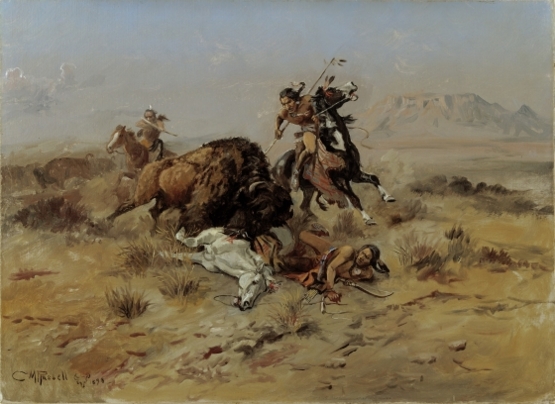
(above: Charles Marion Russell, Buffalo Hunt, 1898, oil on canvas, 18 1/8 x 25 3/8 inches, Denver Art Museum, Gift of Sharon Magness, 1997.517. Photo by Jeff Wells, courtesy Denver Art Museum)
Russell's artistic style was defined by several unique markers that set him apart from his contemporaries. He famously signed his work with a bison skull, a symbol of the vanished herds and the passing of an era. In his compositions, he often utilized a "trademark" white horse in the center to anchor the action and included a small spot of red -- often a scarf or a piece of equipment -- to draw the viewer's eye. His mastery of animal anatomy was unparalleled, a skill he honed during his years on the range. His 1886 watercolor, Waiting for a Chinook (originally Last of the 5,000), became an instant icon of the hardships of the frontier, depicting a starving cow surrounded by wolves during the disastrous "Hard Winter".
The uniqueness of Russell's art lies in its emotional depth. Unlike many of his contemporaries who painted the West as a place of heroic conquest, Russell often depicted it as a place of loss and inevitable change. His transition into bronze sculpture allowed him to explore these themes in three dimensions, creating works like King of the Glaciers and Lone Warrior, that are now centerpieces of major museum collections. The importance of Russell's work is evaluated not just by its artistic merit but by its immense public appeal; the Historical Society of Montana raised $59,000 in 1955 through public donations to acquire the Malcolm S. Mackay collection of his work, ensuring it remained accessible to the people of the state. Today, Russell receives more mentions in books, articles, and media than perhaps any other Western artist, and the annual "Russell" exhibition and sale in Great Falls remains a premier event in the Western art world.
The Historian's Brush: Edgar Samuel Paxson
While Russell was the poet of the range, Edgar Samuel Paxson (1852-1919) was its historian. His masterwork, Custer's Last Stand, involved extensive research, including interviews with both indigenous and military survivors. Paxson's style was more illustrative and meticulously detailed than Russell's, reflecting an ethnographic interest in the clothing, weaponry, and social hierarchies of both the settlers and the tribes. Paxson's evolution as an artist saw him transition from a frontier scout and ranch hand to a sophisticated muralist and painter of historical narratives. Paxson's style was more illustrative and meticulously detailed than Russell's, reflecting an ethnographic interest in the clothing, weaponry, and social hierarchies of both the settlers and the tribes.
Artwork by Edgar Samuel Paxson
Paxson's evolution as an artist saw him transition from a frontier scout and ranch hand to a sophisticated muralist and painter of historical narratives. In 1954, the Historical Society of Montana held the largest public showing of his work ever assembled, valuing the nearly 100 paintings at approximately $100,000. This retrospective highlighted works like A Hunt of ye Olden Times (1901) and his numerous depictions of Montana Indians, which were noted for their characteristic detail and historical accuracy. Paxson's importance lies in his role as a bridge between the oral traditions of the frontier and the written and visual histories of the state. His work is frequently cited in books and articles regarding Montana's formative years, and his murals in the Missoula County Courthouse remain vital public art landmarks.
Winold Reiss and the Modernist Blackfeet Portraits
The 1920s brought a radical shift in the depiction of Montana's indigenous people through the work of Winold Reiss (1886-1953). Reiss's work was a departure from the romanticized, "vanishing Indian" tropes common in earlier frontier art. Instead, he utilized strong graphic lines, bold color blocking, and Art Deco motifs to present his subjects as vibrant, contemporary individuals.
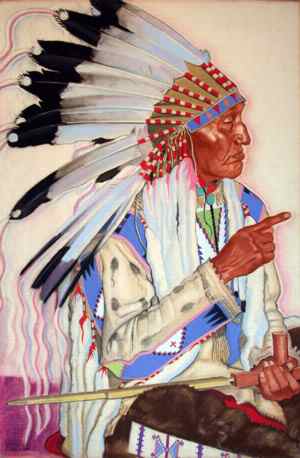
(above: Winold Reiss, Heavy Head, mixed media on Whatman board, 1935, 39 x 26 inches. Private Collection)
Reiss's mission to paint American Indians was sparked by his childhood reading of German adventure novels, but his actual encounters in Montana resulted in a deeply respectful and collaborative body of work. This specific painting highlights the use of "sign talking," a universal language among Plains tribes, and reflects Reiss's architectural background through its geometric tipi motifs. What makes Reiss's work unique is his fusion of fine art with commercial design. This specific painting highlights the use of "sign talking," a universal language among Plains tribes, and reflects Reiss's architectural background through its geometric tipi motifs.
What makes Reiss's work unique is his fusion of fine art with commercial design. Furthermore, Reiss's mentorship of indigenous artists, such as Gerald Tail Feathers at the Saint Mary's Lake Summer Art School, demonstrated a level of cross-cultural engagement that was rare for the time. Reiss's importance is cemented by his murals at Cincinnati Union Terminal and his consistent presence in museum exhibitions that explore the intersection of Modernism and Western art.
Elizabeth Lochrie: The Scrapper's Vision
Among the few women to achieve significant status in the Montana art world during this period was Elizabeth Lochrie (1890-1981). Her artistic evolution was shaped by her studies at the Pratt Institute under Arthur Wesley Dow, a revolutionary who taught that art should be created through the essential elements of composition -- line and color -- rather than mere imitation of nature. Lochrie's style was characterized by its sophisticated modern edge and its rejection of sentimentalism.
Lochrie's style was characterized by its sophisticated modern edge and its rejection of sentimentalism. Her "studio on wheels," a Cadillac that she drove across the state, allowed her to achieve a level of intimacy with her subjects that few other artists could match. Her portraits, such as the 1965 oil on canvas of Chief Dewey Beard (Iron Hail), are celebrated for their strength and their capture of the subject's individual character. Lochrie's importance is reflected in her inclusion in the Montana Institute of the Arts collection and her enduring presence in the permanent collection of the Montana Museum of Art and Culture, which celebrated its 120th anniversary with her work as a focal point. She represents a pioneering female voice that challenged the gender norms of the 1930s and 40s while contributing to the state's modern artistic identity.
Olaf Seltzer and the Continuity of Detail
Olaf Seltzer (1877-1957) was another crucial figure whose work bridged the gap between the era of Russell and the later documentary realists. His watercolors and oils often focused on the history and wildlife of the Montana region, and his precision made him a favorite among collectors and historians alike. Seltzer's evolution as an artist was influenced by the same frontier realities that shaped Russell, but his technique was more refined and focused on the technical accuracy of the gear, animals, and landscapes. His watercolors and oils often focused on the history and wildlife of the Montana region, and his precision made him a favorite among collectors and historians alike.
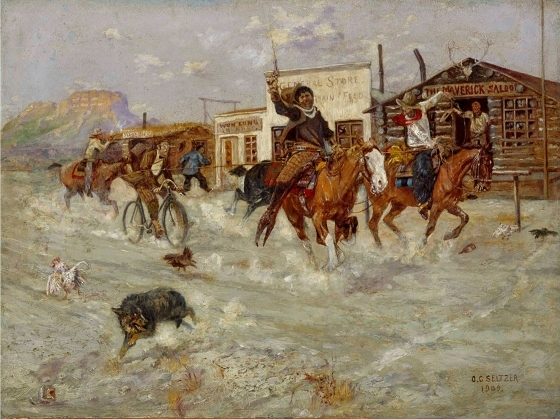
(above: Olaf Carl Seltzer, A Dude's Welcome, 1909, oil on canvas,17 1/4 x 23 1/2 inches, Denver Art Museum, The Roath Collection, 2013.93)
Seltzer's evolution as an artist was influenced by the same frontier realities that shaped Russell, but his technique was more refined and focused on the technical accuracy of the gear, animals, and landscapes. Seltzer's importance lies in his role as a primary documentarian of the Montana experience, providing a visual record that is as much about historical data as it is about artistic expression.
Sculpture and Bronzes
The tradition of sculpture in Montana was heavily influenced by the "action bronzes" of Russell and the later works of Robert Scriver. Scriver, based in Browning, became a master of indigenous peoples. The transition from the delicate carvings of the indigenous peoples to the massive, monumental bronzes found in state capitols and town squares reflects a broader trend of institutionalizing the frontier narrative.
Textiles and Indigenous Modernity
Textiles in Montana served as a primary site of cultural resistance and adaptation. These materials were integrated into traditional garments, creating a form of "indigenous modernity" that allowed tribes to maintain their cultural identity while participating in the global trade economy. Archaeological evidence from Blackfeet boarding schools also shows how children used material culture, including fragments of textiles and traditional items, to assert their identity against the government's assimilation policies.
Pottery and the Industrial Shift
The history of pottery in Montana during this period is a study in the shift from utilitarian domestic ware to decorative and professional ceramics. By the mid-20th century, the technological advancements in firing and the establishment of local kilns allowed for the rise of a more formalized pottery movement, though the period between 1850 and 1945 was dominated by functional objects that were often discarded and now form the basis of the state's material history.
The Legacy of the Big Sky
The history of artistic expression in Montana between 1850
and 1945 is a testament to the power of a landscape to shape human creativity.
From the ancient cave paintings that established the region's first visual
records to the modernist portraits by Reiss and Lochrie that looked toward
a more inclusive future, Montana art has always been deeply rooted in its
geography and its people. The art colonies of Glacier Park and the solitary
travels of artists like Russell and Hill helped forge a state identity that
was both rugged and refined. From the ancient cave paintings that established
the region's first visual records to the modernist portraits of Reiss and
Lochrie that looked toward a more inclusive future, Montana art has always
been deeply rooted in its geography and its people.
Prompt:
Write an approximately 2,500-word narrative about the history of artistic expression in Montana between 1850 and 1945, using an informal style without section headings, tables, or bullet points. Cover types of art including paintings, sculpture, pottery and textiles. Note anything special such as geography, culture, events and styles that differentiated Montana art from other states. Discuss four to six of the most highly regarded artists who created artworks in the state during the specified time period. Explain both the evolution of their artistic styles and what is unique and special about their artworks that makes them important. To aid in evaluation of the relative importance of the above mentioned specific artists who created artworks in the state, consider the level of mention they receive in museum exhibits, YouTube videos, books and articles.
Identify any early art colonies in the state, discuss why they developed and their importance.
Research only .org and .edu sites
Research plan:
(1) Search .org and .edu domains for a comprehensive overview
of Montana's art history from 1850 to 1945, specifically looking for information
on paintings, sculptures, pottery, and textiles. (2) Investigate the unique
influences of Montana's geography (mountains, plains) and its diverse cultural
history (Indigenous traditions and frontier life) on the development of
regional artistic styles. (3) Identify and research four to six highly regarded
artists active in Montana between 1850 and 1945, such as Charles M. Russell
or Elizabeth Lochrie, focusing on their biographical details and stylistic
shifts. (4) For the selected artists, find specific details about what makes
their work unique and how their style evolved over time, using academic
and organizational archives. (5) Evaluate the cultural and historical importance
of these artists by searching .edu and .org sites for their presence in
major museum exhibits, permanent collections, and scholarly publications.
(6) Research the development of early art colonies in Montana, identifying
why specific locations became hubs for artists and what impact these colonies
had on the state's broader artistic landscape. (7) Look for information
regarding the intersection of historical events, like the homesteading boom
or the creation of National Parks, with the evolution of artistic themes
in Montana. (8) Gather specific anecdotes and descriptive details about
the artistic techniques and mediums used during this period to support a
long-form narrative.
We lightly edited the article, added images and provided
links to other materials to enhance it. AI is rapidly improving in
accuracy, yet the article may have inaccurate information.
 Return to Montana Art History
*Tag for expired US copyright of object image:

and
**Tag for some rights reserved:

Links to sources of information outside of our web site are provided only as referrals for your further consideration. Please use due diligence in judging the quality of information contained in these and all other web sites. Information from linked sources may be inaccurate or out of date. TFAO neither recommends or endorses these referenced organizations. Although TFAO includes links to other web sites, it takes no responsibility for the content or information contained on those other sites, nor exerts any editorial or other control over them. For more information on evaluating web pages see TFAO's General Resources section in Online Resources for Collectors and Students of Art History.
Copyright 2026 Traditional Fine Arts Organization, Inc. an Arizona nonprofit corporation. All rights reserved.