
`
Zuni Pottery In the Fred Harvey Era
a Gemini 3 Deep Research Report
March, 2026
The early twentieth century in the American Southwest was defined by a profound collision between ancient sedentary cultures and the rapid expansion of industrial capitalism. At the heart of this transformation was the Zuni Pueblo, or A:shiwi, a community that had occupied the high desert plateaus of western New Mexico for millennia. For the A:shiwi people, the ceramic arts were never merely decorative; they were functional vessels for water and prayer, manifestations of a matrilineal tradition that linked the physical land to the spiritual realm of the ancestors. However, as the Santa Fe Railway and the Fred Harvey Company began to market the "Indian Country" to a burgeoning class of eastern travelers, the Zuni ceramic tradition underwent a strategic and stylistic evolution. This period, roughly spanning from 1895 to 1940, saw the emergence of a characteristic Zuni style that balanced the demands of a new commercial market -- fueled by the luxury "Indian Detours" -- with the internal necessity of cultural preservation.
The rise of the Fred Harvey Company, under the leadership of Fred Harvey and later his sons Ford and Byron, revolutionized the hospitality industry of the Southwest. In partnership with the Santa Fe Railway, the company created an ecosystem of hotels, restaurants, and curio shops that provided a commodified presentation of Indigenous life to white tourists seeking an escape from the industrial grime of the East. Central to this marketing strategy was the "Indian Detour," an all-expense automobile tour launched in 1926 that whisked affluent travelers from rail-side hotels into the remote fastnesses of the Pueblos. As these "Harveycars" arrived at the Zuni Pueblo, the potters faced a unique economic opportunity. The resulting Zuni Polychrome of the early twentieth century became a hybrid form: an art that maintained centuries-old techniques -- such as hand-coiling and mineral painting -- while adapting its scale, motifs, and silhouettes to suit the aesthetic expectations and transport requirements of the modern traveler.
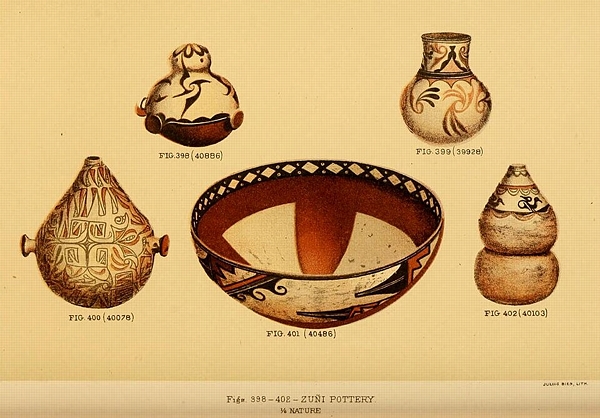
(above: Work in clay by the Zuni people. Smithsonian Institution. Second Annual Report of the Bureau of American Ethnology. 1880-'81. Washington, G.P.O., 1883. Public domain, via Wikimedia Commons.*)
The Harvey Empire and the Construction of the Southwestern Myth
The logistical framework that brought Zuni pottery into the global market was a marvel of early twentieth-century corporate synergy. The Fred Harvey Company did not merely sell food and lodging; it sold an experience of the primitive that was carefully curated to feel both exotic and safe. This curated experience began at major railway hubs and hotels like the Alvarado in Albuquerque and El Navajo in Gallup. Gallup, located just thirty-five miles north of the Zuni Pueblo, served as a primary gateway for travelers embarking on the Native Heritage Trail. The El Navajo hotel, managed by the Fred Harvey system, was a key node in this network, functioning as a high-end basecamp for those wishing to explore the western edges of Indian Country.
The introduction of the Indian Detours in 1926 by Ford Harvey marked a shift from passive rail observation to active, guided exploration. These tours were hostessed by couriers -- often college-educated women who acted as cultural intermediaries, explaining the history and crafts of the Pueblos to the tourists. These couriers were trained using instructional bulletins that detailed the exotic nature of the indigenous landscape, effectively organizing the tourist gaze. When travelers arrived at Zuni in their distinctly marked Harvey cars, they were not seeing the Pueblo through their own eyes, but through a lens of antimodern nostalgia fostered by the company's marketing. This marketing portrayed Native American life as a disappearing relic, an idea that the Harvey family used to create a sense of urgency for collectors.
Mary Jane Colter and the Staging of Authenticity
The physical environment in which tourists encountered Zuni pottery was carefully designed by architect Mary Jane Elizabeth Colter. Colter blended architecture and ethnology to create many of the impressive regional hotels, such as La Fonda in Santa Fe and La Posada in Winslow, Arizona. Her style vocabulary, based on stair-step buttresses, projecting roof-beams, and chimneys made of old pottery, became the trademark of the proto-pueblo style that evolved into the "Santa Fe style". This architectural backdrop served to authenticate the Native American crafts sold within the hotel curio shops, framing them not as mere souvenirs but as artifacts of a grand, albeit constructed, regional history.
At the Grand Canyon, Colter designed the Hopi House, which opened in 1905 to represent the emerging interest in Southwestern Indian arts and crafts. While ostensibly modeled after a Hopi dwelling, the Hopi House served as a dedicated market for all Pueblo crafts, including Zuni pottery. The interior reflected local building styles with small windows, low ceilings, and wall niches that created an atmosphere of intimacy and authenticity. Here, artisans demonstrated their craft for tourists, an activity that the Harvey Company promoted as a way to see a "real live Indian in his feathers and paint". This demonstration of skill fostered cultural pride in the participating craftspeople and allowed artistic careers to emerge, even while placing them within a highly commercialized setting.
A:shiwi Heritage and the Matrilineal Core
The Zuni people, or A:shiwi, have lived in the Southwest for millennia, sustaining themselves primarily through farming. Their traditional life is oriented in a matrilineal clan system, which has profound implications for the production of pottery. In Zuni culture, the knowledge of clay, motifs, and firing techniques was historically passed down from mother to daughter, ensuring a continuity of style that survived the pressures of European contact. The Zuni language, Shiwi'ma, is a unique isolate that bears no similarity to any known language, reflecting a cultural history that emerged about 7,000 years ago. This linguistic and cultural independence provided a foundation for the Zuni to resist total assimilation, even as they engaged with the global market.
According to Zuni creation stories, the ancestors emerged into this Fourth World from the Grand Canyon and eventually found their way to Halona:wa, the "Middle Place". This geographical center is the heart of the Zuni Pueblo, located 35 miles south of Gallup on a reservation that was once the size of Rhode Island before being shrunken by the U.S. government in 1848. This history of displacement and resilience informed the Zuni approach to the tourist trade. While they profit from the market for tourist goods, the Zuni have never given in to selling their ceremonies, setting up barriers of secrecy to limit the primitivist experience of the tourists.
The pottery of the Zuni is thus more than just a commodity; it is a manifestation of this enduring connection to the land and people of the Southwest. Modern Zuni families continue these traditions, blending innovation with cultural continuity. The matrilineal system ensures that even as styles evolve to meet the demands of the Fred Harvey Company, the core techniques and spiritual significance of the craft remain anchored in A:shiwi identity.
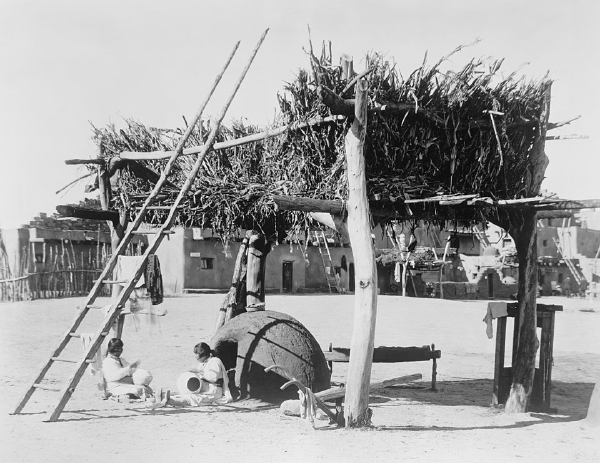
(above: A drying platform of the Zunis. Photograph shows Zuni women making pottery beneath a drying platform. The platform, composed of tree trunks and limbs forming the framework and flooring, holds tall plants and corn. This display is part of an exhibition of the "painted desert" of the Santa Fe at the Panama-California Exposition in San Diego, California, Library of Congress. Public domain, via Wikimedia Commons.*)
The Technical Alchemy of Zuni Polychrome
Zuni pottery in the early twentieth century -- known as Zuni Polychrome (1850-1920) -- was characterized by a specific set of material and technical choices that distinguished it from the wares of neighboring Pueblos. The base material was a locally collected gray or white colored clay, which was mixed with a chunky sherd temper containing rust-colored inclusions. This practice of using ground-up bits of old pottery as temper served both a practical purpose -- preventing the clay from cracking during firing -- and a symbolic one, linking the new vessel to the heritage of the ancestors.
The surface of a Zuni Polychrome vessel was typically covered in a thick white slip, which provided a clean, matte canvas for decoration. Most decorations were executed in a black mineral pigment, with a subtle use of red for filling and smaller areas. A diagnostic feature of this period was the use of a brown mineral pigment on the very top of the rim and the bottom of the vessel, which distinguished Zuni Polychrome from earlier polychrome types that utilized red slip in these areas. This shift in pigmentation represents one of the subtle technical evolutions that occurred as Zuni potters refined their style for the commercial market.
The firing process remained traditional, with vessels shaped by hand using the coiling method without the use of a potter's wheel. The resulting pottery featured visible imperfections that appealed to the Arts and Crafts movement, which celebrated hand-wrought items as a counter to the overwhelming presence of industrial goods. Despite these traditional methods, the quality of pottery produced at Zuni was noted to have gradually declined after 1900 by some observers, likely due to the increased pressure of production for the tourist trade. However, the finer artifacts were often collected by the Harvey Company and either sold or donated to museums, ensuring that the highest levels of Zuni artistry were preserved.
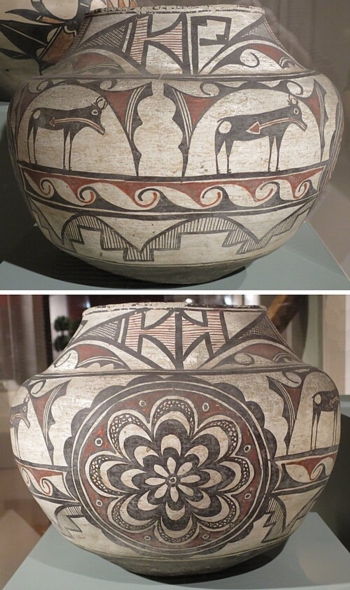
(above: Bowls, Zuni Pueblo people, fired clay, Dayton Art Institute (two views of the same bowl) Photo courtesy of Wmpearl. Public domain, via Wikimedia Commons.**)
The Iconography of the Heart-Line and the Rain Bird
The decorative motifs of Zuni pottery in the early twentieth century were a complex language of symbols that represented the A:shiwi relationship with the natural world, particularly the essential element of water. One of the most famous and repeated motifs was the "heart-line deer," an image of a right-facing animal with a line running from its mouth to a triangular-shaped heart. These deer were often framed by feather motifs interpreted as "houses," creating a visual narrative that resonated with both Zuni tradition and the expectations of the tourist market.
Another central motif was the "rain bird," which symbolized the storm and the life-giving rain. This motif often began with a spiraled beak, the "eye of the storm," and grew into large bands of hachures (crosshatched lines) that signified wind and rain. The Zuni influence on these motifs was so significant that they were frequently adopted by other cultures, such as the Hopi, who utilized Zuni rain bird and feather designs on their own ceramics during the nineteenth and early twentieth centuries. On Zuni jars, these designs were organized into wide decorated areas framed by one or two lines extending from the rim to just above the base.
Water symbolism was further reinforced through depictions of tadpoles, frogs, dragonflies, and butterflies, particularly on specialized cornmeal bowls used for ceremonies. These bowls often featured stepped or terraced sides and strap handles, forms that were adapted for sale as "sacred pottery baskets" to travelers. The combination of these motifs -- the deer, the bird, the rosette, and the water creatures -- conveyed a sense of balance and excellence of line work that became the hallmark of the Zuni style. For the tourist, purchasing a jar with these motifs was a way to capture a piece of the "exotic" Southwest; for the Zuni, it was a way to maintain the visual vocabulary of their culture while participating in a global economy.
Commercial Adaptation and the Role of Herman Schweizer
The evolution of Zuni pottery was not a passive process; it was actively influenced by the demands of the Fred Harvey Company and its savvy merchandisers like Herman Schweizer. Schweizer recognized that the affluent travelers on the Indian Detours were often looking for portable, lightweight items that could be easily transported back to the East Coast or Europe. This led to a significant shift in the scale and form of Zuni pottery. While traditional utilitarian water jars (ollas) were large and heavy, potters began creating smaller, inexpensive pieces like handled bowls in the shape of baskets, pitchers, and cups specifically for the tourist trade.
Schweizer dictated that lighter-weight versions of heavier Native items be made, which ultimately resulted in a flourishing of smaller forms such as miniature bowls and figurines. The transition of Native American pottery from a utilitarian vessel or ceremonial object to a marketable commodity emphasized the production of these "hybrid forms" that balanced tradition with market demand. Artists maintained traditional hand-coiling and mineral painting techniques but adapted the designs and scales to suit tourist tastes, leading to wider recognition and the emergence of artistic careers.
The success of the tourist trade also led to the "aestheticization" of Zuni vessels. While early pieces were primarily made for domestic use, the work produced for the Harvey Company became increasingly focused on visual appeal and collectible art. Potters like those from the Zuni and Acoma Pueblos would barter their art for new clothing, magazines, and other goods, showing that the engagement with the market was a multi-faceted cultural exchange. This commercial adaptability allowed the Zuni to navigate the onslaught of cultural tourism while maintaining their distinct traditions and supplementary family income.
The Rise of the Zuni Clay Owl and the Curio Trade
One of the most characteristic and enduring products of the Zuni tourist trade was the clay owl figurine. These Great Horned Owl effigies, often featuring painted black feathers on a white slip, became a staple of the Zuni "curio trade" beginning as early as 1875 and continuing throughout the mid-twentieth century. Marketed to tourists as "guardians," these figurines provided a whimsical and portable alternative to the larger water jars. The production of these owls became so prevalent that they are now closely associated with the work of several prominent Zuni pottery families, such as the Nahohai lineage.
The curio trade also encouraged the production of miniature baskets and other small clay items, which were identified as being produced specifically for the commercial market. These "tourist trinkets" were not merely decorative; they were a strategic response to the fetishization of all things Indian by the American public.
This transition to the curio market was also facilitated by the Fred Harvey Company's practice of stocking their souvenir stores with Southwestern Indian crafts, making these motifs nationally known. The clay owl, in its various forms and sizes, served as a bridge between the traditional world of Zuni effigy pottery -- such as the duck effigies common among prehistoric groups -- and the modern demands of the leisure economy. Today, many Zuni families carry on these traditions, creating owls and other figurines that blend innovation with cultural continuity, celebrated for their beauty and enduring connection to the A:shiwi people.
Profiles of Resilience: Tsayutitsa and the Nahohai Lineage
The history of Zuni pottery in the early twentieth century is also a history of individual artists who navigated the shifting tides of the commercial market. Tsayutitsa, active during the 1920s and 1930s, is recognized for producing large, well-made jars that emphasized the aestheticization of the vessel. Her work stood in contrast to the more mass-produced items strictly for the tourist trade, demonstrating that high-quality artistry could still flourish within a commodified environment. Similarly, Lawsaiyatesetsa was documented at the Gallup Inter-Tribal Ceremonial in 1937, carrying jars with complex "deer in his house" and "rainbird" motifs that drew inspiration from ancestral designs.
The Nahohai family provides a remarkable example of generational continuity in Zuni pottery. Josephine Nahohai, born around 1912, grew up during this transitional period and later became famous for her owl figurines, which remained a staple of the curio trade after 1940. Her husband, Nat Nahohai, often collaborated by painting the vessels she formed, and their descendants, such as Randy and Milford Nahohai, have continued to revitalize ancestral designs. Randy Nahohai, in particular, has looked back to early ancestral pottery, such as Tularosa Black-on-white wares, to create contemporary rainbird jars that unify ornament and form.
These individual and family histories challenge the declension model proposed by some outside critics who believed that the art form was in decline during the Harvey era. Instead, they reveal a story of adaptation and excellence, where pottery remained a vital source of income and cultural expression as the Zuni population transitioned away from farming and herding. The participation of these potters in events like the Gallup Inter-Tribal Ceremonial and their presence in high-profile collections ensured that Zuni pottery was recognized as a legitimate and thriving art form on a national stage.
The Tourist Gaze and the Shield of Secrecy
The interaction between Zuni potters and the travelers of the Indian Detours was shaped by the "tourist gaze," a particularly intrusive way of viewing indigenous people and their culture as exotic "others". The Fred Harvey Company organized this gaze through its curated tours, staged Indian villages, and educational couriers. To the tourists, the pre-industrial lifestyle of the Pueblo inhabitants was an escape from urbanization, a primitivist pastime that provided an experience of "otherness". However, this romanticized view often clashed with federal assimilation policies, such as those promoted by Indian Commissioner Charles Burke, who feared that catering to the tourist industry would delay Native Americans' integration into society.
The production of tourist pottery was thus a form of strategic engagement. By accepting the advice of traders in matters of style and scale, the Zuni potters were able to create a product that met the market's demand for the primitive without revealing the deeper meanings of their ceremonies. This management of the tourist gaze allowed tourism to become a tool of integration rather than destruction, providing much-needed income for families while elements of the traditional culture survived and flourished. The Zuni potters navigated this onslaught of cultural tourism with remarkable resilience, ensuring that their art remained a vibrant expression of their people's survival.
The Geography of the Trail: From Gallup to the Middle Place
The spatial relationship between the Zuni Pueblo and the infrastructure of the Fred Harvey Company was essential to the development of the early twentieth-century pottery style. Most travelers arrived at the Pueblo via Gallup, a major trading center located along the Santa Fe Railway and the historic Route 66. The El Navajo Hotel in Gallup, part of the Fred Harvey system, served as the primary departure point for the automobile "detours" to Zuni. This route, part of New Mexico's Native Heritage Trail, led travelers through a landscape of multicolored bluffs and ancient lava flows, reinforcing the sense of adventure and discovery that defined the Harvey experience. (See Z.S. Liang, Pueblo Street Market in the 1920s, 2006, oil on canvas. The Hilbert Museum of California Art, gift of John Heckenlively, M.D.)
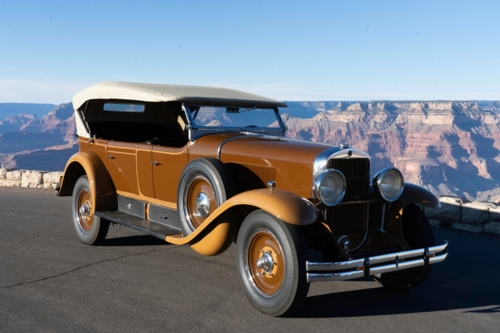
(above: 1929 Cadillac 341-B, the last remaining Harvey Car, on display at the New Mexico History Museum, 2025. Image: Courtesy of the NMHM Photo Archives)
The proximity of Gallup allowed Zuni potters to reach a large and diverse audience throughout the year. The Red Rock Museum in Gallup chronicles this local history, and the city continues to host tribal ceremonial events that attract collectors and tourists alike. The "Indian Detours" themselves were designed to make this landscape more accessible, both literally and figuratively, whisking travelers from the depot in distinctly marked cars to inhabited pueblos and scenic points of interest. This logistical convenience made it possible for Zuni pottery to make its way into many American homes, becoming an emblem of the Southwestern experience.
Geographical landmarks like El Morro National Monument, where centuries of travelers carved their marks into the sandstone bluffs, further connected the Zuni Pueblo to the broader history of the region. The ancestral cliff dwellings and the site of first contact at Hawikuh provided a historical depth that tourists found captivating. By situating Zuni pottery within this rich cultural and natural landscape, the Fred Harvey Company and its partners created a market for an art form that was inextricably linked to the land of the Middle Place.
Cultural Continuity in the Face of Modernity
The development of Zuni pottery in the early twentieth century is a profound example of how a traditional art form can adapt to the pressures of modernity without losing its cultural essence. Through the logistical power of the Fred Harvey Company and the creative marketing of the Indian Detours, Zuni potters found a new audience for their work among the travelers seeking a piece of the "authentic" Southwest. They responded to this market by refining their materials-such as the distinctive white slip and mineral pigments of Zuni Polychrome -- and focusing on motifs like the heart-line deer and the rain bird that became internationally recognized symbols of their people.
The influence of figures like Mary Jane Colter and Herman Schweizer helped shape the aesthetic and scale of these vessels, leading to a flourishing of "hybrid forms" that balanced utilitarian tradition with commercial demand. Yet, despite this commodification, the Zuni potters maintained their matrilineal core and their tactics of refusal, ensuring that the deepest spiritual significance of their craft remained within the Pueblo. Individual artists and families, like Tsayutitsa and the Nahohai lineage, demonstrated a remarkable resilience, producing work of high quality that challenged narratives of cultural decline.
Today, the legacy of this era lives on in the modern Pueblo pottery that remains both a sacred cultural practice and a thriving art form. The objects collected by the Harvey Company and individuals like the Andersons now reside in museums and private collections, serving as a testament to the artistry and endurance of the A:shiwi people. Formed from the land and fired with care, Zuni ceramics embody centuries of tradition passed down through generations, bridging the ancient world of the ancestors with the vibrant reality of the modern Southwest. In the end, the story of Zuni pottery in the early twentieth century is one of integration and survival, a narrative of beauty and craftsmanship that continues to resonate far beyond the trails of the Indian Detours.
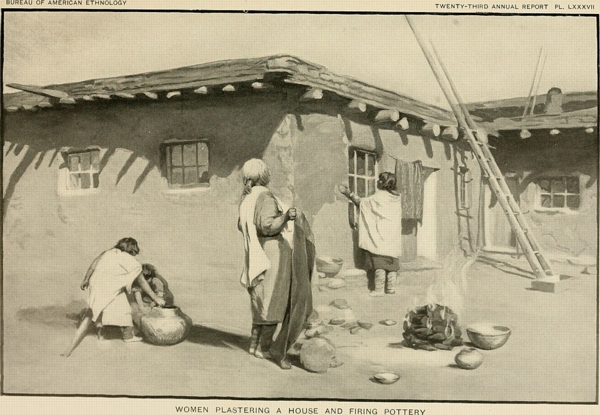
(above: Photo from 1895 annual report of the Bureau of American Ethnology to the Secretary of the Smithsonian Institutin. May be a photo of Zuni Pueblo. Photo courtesy of Wmpearl. Public domain, via Wikimedia Commons.*)
Prompt:
We lightly edited this report, added images and provided links to other materials to enhance it. AI is rapidly improving in accuracy, however, the report may contain inaccurate information. This presentation doesn't meet scholarly standards, yet Gemini 3 AI researched and checked it for accuracy. Sources are footnoted in the raw AI report, yet deleted here for a general audience. Please see An Evaluation Of Gemini 3 Deep Research In Replication Of Academic Peer Review, an April, 2026 Gemini 3 Deep Research Report.
 Return to American Pottery Art
Return to Native American Art
Return to New Mexico Art History
*Tag for expired US copyright of object image:

and
**Tag for some rights reserved:

Links to sources of information outside of our web site are provided only as referrals for your further consideration. Please use due diligence in judging the quality of information contained in these and all other web sites. Information from linked sources may be inaccurate or out of date. TFAO neither recommends or endorses these referenced organizations. Although TFAO includes links to other web sites, it takes no responsibility for the content or information contained on those other sites, nor exerts any editorial or other control over them. For more information on evaluating web pages see TFAO's General Resources section in Online Resources for Collectors and Students of Art History.
Copyright 2026 Traditional Fine Arts Organization, Inc. an Arizona nonprofit corporation. All rights reserved.