
Sky City Crucible: Acoma Pottery in the Era of Fred Harvey Indian Detours
a Gemini 3 Deep Research Report
March, 2026
The high desert plateau of western New Mexico serves as a landscape where the ancient and the modern have engaged in a century-long dialogue, mediated through the tactile medium of clay. At the heart of this cultural intersection lies the Acoma Pueblo, or Sky City, a settlement perched atop a 370-foot sandstone bluff that has remained continuously inhabited for over a millennium.
By the dawn of the twentieth century, this ancestral stronghold
became the focal point of a transformative economic and artistic movement,
driven by the expanding reach of the Atchison, Topeka and Santa Fe Railway
and the sophisticated marketing machinery of the Fred Harvey Company. The
development of Acoma pottery during this period was not merely a continuation
of domestic craft but a deliberate evolution of style, materials, and motifs
designed to meet the expectations of a new class of travelers. These "detourists,"
arriving in the rugged New Mexico interior via luxury "Harveycars,"
sought a tangible connection to a culture they were told was vanishing,
prompting Acoma potters to refine their techniques and visual language into
a form that was both deeply traditional and highly marketable.
Geographical and Historical Foundation of Acoma Artistry
The resilience of Acoma pottery is inseparable from the geography of the Pueblo itself. Situated approximately sixty miles west of Albuquerque, the Acoma Pueblo is built upon a sheer-walled mesa that offered protection from Navajo and Apache raids for centuries. This isolation preserved the core of Acoma cultural practices, even as the outside world underwent radical shifts. For the Acoma people, pottery was historically a utilitarian necessity, providing vessels for the storage of water and seeds, as well as implements for cooking and eating.However, the late nineteenth and early twentieth centuries brought environmental and economic challenges that necessitated a shift in how these objects were valued. As traditional farming began to decline due to the pollution of nearby water sources like the Rio San Jose -- a result of the industrial and population growth in neighboring areas such as Grants -- the production of pottery for trade and tourism emerged as a vital economic lifeline.
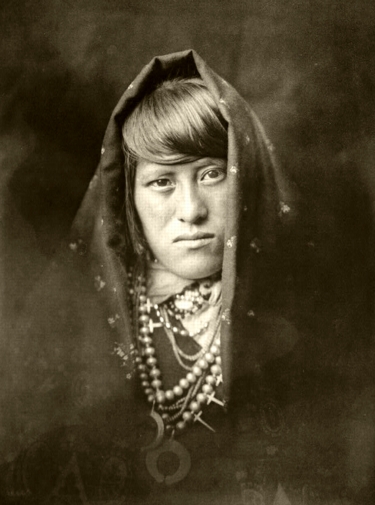
(above: Edward S. Curtis, Girl of Acoma, 1926, photographic print, The North American Indian, U.S. Library of Congress. Public domain, via Wikimedia Commons*)
The physical isolation of Sky City meant that the materials used in its pottery remained locally sourced and distinct. The clay preferred by Acoma potters is a dense, slate-like substance found in specific sites accessible only by foot outside the village. This material, when first extracted, is rocky and must be sun-dried, pulverized, and sifted to remove impurities. The unique properties of this local clay, when combined with specific tempering agents, allow for the creation of vessels with exceptionally thin walls, a hallmark of Acoma craftsmanship that became highly prized by twentieth-century collectors. This thin-walled characteristic was not just an aesthetic choice but a technical achievement, allowing the pots to be lighter for transport and more resonant when struck, a quality often demonstrated to tourists as a proof of authenticity and skill.
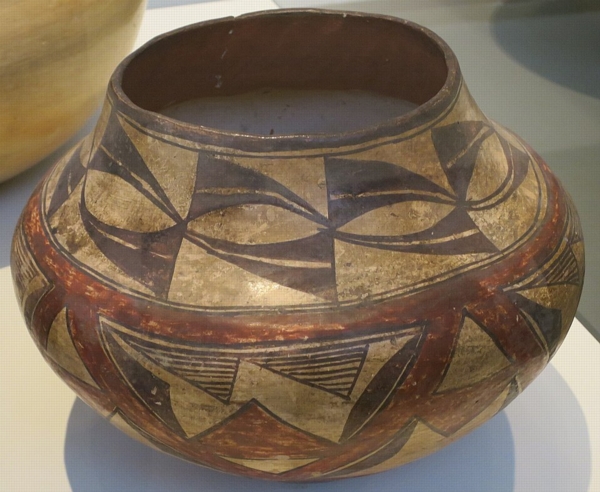
(above: Jar (olla), late 19th-early 20th century, Acoma Pueblo, New Mexico. Hand-built clay with black, white and red pigments. Long-term loan to the Honolulu Museum of Art. Public domain, via Wikimedia Commons. Photo by Hiart**)
Fred Harvey Company and the Invention of the Southwestern Image
The catalyst for the commercialization of Acoma pottery was the Fred Harvey Company, an organization that, alongside the Santa Fe Railway, is credited with "inventing" the romanticized image of the American Southwest for the national imagination. Fred Harvey, a British immigrant who began by opening trackside eating houses in the 1870s, eventually built an empire of hotels, restaurants, and museums that transformed the desert frontier into a tourist destination. Following Fred Harvey's death in 1901, his children, Ford and Minnie, along with her husband John Huckel, expanded the company's focus to include the promotion of Native American arts and culture.
Central to this effort was Herman Schweizer, often referred to as the Fred Harvey anthropologist, though he lacked formal credentials. Based at the Alvarado Hotel in Albuquerque, Schweizer managed the company's Indian Department, established in 1901. Schweizer recognized that the "curio" trade offered immense profit potential and began commissioning Native artists to create works that would appeal to Eastern tastes. He influenced the size and form of traditional crafts, encouraging silversmiths to reduce the weight of jewelry and potters to create smaller, more portable "souvenir" pieces. The Alvarado Hotel's Indian Building became a staging ground for these interactions, featuring "live exhibits" where Navajo weavers and Pueblo potters demonstrated their skills for travelers during train stops.
The Indian Department's strategy was multifaceted. It involved not only the sale of contemporary works but also the curation of museum-quality collections that established the Harvey Company as an authority on Southwestern ethnography. Schweizer formed business associations with legitimate scholars, such as George A. Dorsey of the Field Columbian Museum, to lend an air of academic validity to the Harvey operations. This association ensured that every item purchased by a traveler was perceived not just as a trinket, but as a piece of a "vanishing" heritage, a narrative that significantly increased the market value of the pottery.
Logistics of the Indian Detours
The most direct conduit between Acoma potters and affluent travelers was the Indian Detours program, launched in 1926. As automobile and airplane travel began to threaten the dominance of the railroad, the Harvey Company sought new ways to keep tourists engaged. The Indian Detours were specialized motor excursions that took passengers off the train for one to three days, driving them into the "wilderness panoramas" of northern New Mexico to visit living pueblos and ancient ruins. These tours were high-end affairs, utilizing a fleet of "Harveycars" - luxurious Packards, Cadillacs, and White Motor Company buses.
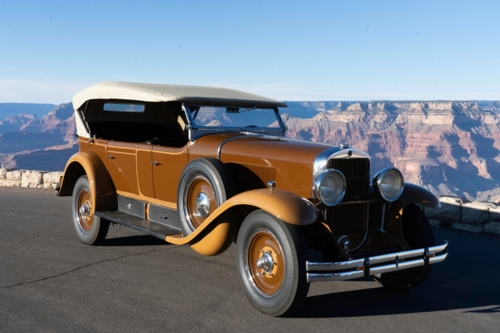
(above: 1929 Cadillac 341-B, the last remaining Harvey Car, on display at the New Mexico History Museum, 2025. Image: Courtesy of the NMHM Photo Archives)
The experience was meticulously curated to provide a sense of adventure without sacrificing the comfort expected by the company's wealthy clientele. The cars were driven by men dressed in Western, cowboy-style attire, who were required to have mechanical training to handle the steep, unpaved roads of the New Mexico interior. The guides, known as "couriers," were college-educated women who wore "Navajo-style" costumes consisting of velveteen skirts, concha belts, and squash blossom necklaces. These couriers underwent months of intensive study on the landscape, history, and local cultures, ensuring they could provide a narrative that emphasized the "romance and mystique" of the Pueblo world.
When these convoys arrived at Acoma, they provided a captive audience for the Pueblo's artisans. Travelers were encouraged to stroll through the village, observe the potters at work, and purchase handmade goods directly from the source. This direct interaction was a departure from the earlier "curio" model, where traders acted as middlemen. At the Pueblo, the traveler could witness the arduous process of creation, which added a layer of "staged authenticity" to the transaction. The potters, in turn, began to tailor their work to this specific encounter, focusing on visual complexity and portability. (See Z.S. Liang, Pueblo Street Market in the 1920s, 2006, oil on canvas. The Hilbert Museum of California Art, gift of John Heckenlively, M.D.)
Technical Alchemy: Materials and the Science of the Thin Wall
The distinctive style of Acoma pottery in the early twentieth century was driven by a sophisticated understanding of material science, passed down through generations. The primary material, the local gray clay, is inherently dense and requires a specific tempering process to become workable and durable. Unlike many other Pueblos that use sand or volcanic ash as temper, Acoma potters utilize ground-up pottery sherds, some of which may be hundreds of years old. This practice is both technical and spiritual; the "ancient ones" are literally incorporated into the new creations, providing a tangible link between the past and the present.
The use of potsherd temper is critical for achieving the thin walls for which Acoma pottery is famous. This temper makes the clay more porous, which prevents the vessel from shrinking too rapidly or cracking during the drying and firing processes. The thinness of the walls was a significant selling point for tourists, as it demonstrated a level of skill and delicacy that set Acoma work apart from the heavier wares of other regions.Potters would often tap the side of a finished jar with a fingernail to produce a high-pitched ring, proving the vessel's density and strength despite its fragile appearance.
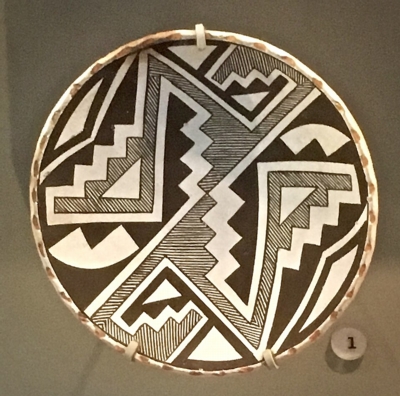
(above: Lucy Lewis, Small decorative plate with a classic Chaco-style design. On display at Museum of Northern Arizona, Flagstaff. Public domain, via Wikimedia Commons*)
Role of Kaolin Slip and Polishing
Another defining characteristic of Acoma pottery is its brilliant white background. While the raw clay is naturally gray, the potter applies several layers of a liquidized slip made from fine kaolin clay. This slip must be carefully strained and applied with a steady hand. Once the layers are dry, the surface is polished to a high sheen with a smooth stone. This polishing process, known as burnishing, is essential not only for aesthetics but also for closing the pores of the clay, making the vessel more watertight.
The resulting surface provides a stark, clean canvas for the intricate polychrome designs that became the signature of the Pueblo. The white backgrounds allow for the creation of crisp, detailed black images, as well as rich polychrome designs incorporating reds and oranges. In the commercial market of the early twentieth century, this high contrast was particularly effective at catching the eye of travelers browsing the Harvey Company's display cases.
(above: Acoma Pueblo, pottery jar, Field Museum. Public domain, via Wikimedia Commons. Transferred from en.wikipedia to Commons by Dmitri Lytov using CommonsHelper. The original uploader was Ancheta Wis at English Wikipedia.**)
Yucca Brush and Mineral Pigments
The pigments used for decoration are derived from natural minerals and plants gathered from the surrounding mesa, reflecting a deep connection to the land. Black paint is often made from a mixture of wild spinach (beeweed) and mineral iron, while red and orange hues are sourced from local ochre-rich clays. These paints are applied with brushes fashioned from the chewed ends of yucca leaves. By stripping the leaf to its essential fibers, the potter can create a brush with a fine, pointed tip that allows for the execution of the incredibly thin lines that became a hallmark of the era.
The exact mixture of binder, water, and pigment is a delicate science; if the mixture is too watery, the colors will be pale and weak after firing; if it is too thick, the paint will flake off the polished surface. This technical precision was a matter of professional pride for Acoma potters, who competed to produce the most intricate and durable designs for the discerning collectors brought to the Pueblo by the Indian Detours.
Evolution of Style and Motif
As the twentieth century progressed, Acoma pottery underwent a stylistic transition from the older Acomita Polychrome to what is now recognized as Acoma Polychrome. This shift was characterized by a move away from simple geometric bands toward "all-over" patterns that covered the entire surface of the vessel with complex, interconnected elements. The demand from the Fred Harvey market for visually striking pieces led potters to refine their motifs, incorporating both ancestral symbols and new, standardized designs that resonated with the expectations of travelers.
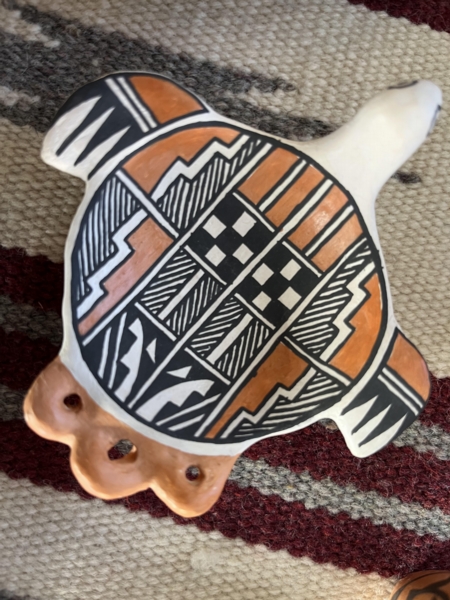
(above: Acoma Pueblo, New Mexico, Decorated Tray. Private Collection)
Semiotics of Water and the Sky
The motifs on Acoma pottery are deeply rooted in the environmental realities of life on a desert mesa. Because water is the most precious resource in the arid Southwest, many of the designs are symbolic prayers for rain. Fine, parallel lines -- often referred to as "fine-line" work -- represent falling rain, while hatching patterns symbolize lightning, thunderclouds, and the steep slopes of the surrounding mountains. Zigzag patterns and step designs further reinforce the connection to weather and the cycle of life.
The color palette also carries significant meaning. The orange bands often found at the top and bottom of Acoma vessels represent the sun and its relationship to Mother Earth. The placement of these bands reflects the traditional belief that the sun rotates around the earth, creating a balanced and harmonious composition that appeals to both the spiritual practitioner and the aesthetic-minded tourist.
Acoma Parrot and the Floral Influence
Among the most iconic and perhaps misunderstood motifs of the early twentieth century is the Acoma parrot. While parrots are not native to the New Mexico high desert, they have been part of the Pueblo's iconographic vocabulary for centuries, likely originating from ancient trade networks with cultures in Mexico. On pottery made for the Indian Detours, the parrot was often depicted in profile with a curved beak and separated tail feathers. This motif was frequently paired with stylized floral elements, creating a lush, organic contrast to the rigid geometric patterns found on earlier wares.
The popularity of the parrot motif was bolstered by its visual appeal to travelers. It represented the exotic and historical elements of the Southwest's trade history, fitting perfectly into the "romance and mystique" marketed by the Harvey Company. Similarly, floral patterns began to appear more frequently, blending traditional stylized plant forms with a more naturalistic approach that suited the decorative preferences of the Victorian and Edwardian eras.
Gender, Labor, and the Transition to a Commercial Economy
The development of the tourist market fundamentally altered the social dynamics of pottery production within the Acoma Pueblo. Historically, pottery was considered "women's work," with techniques and motifs passed down through female lineages -- from grandmother to mother to daughter. However, the economic shift toward the curio trade made pottery making a primary income source for many families, especially as agriculture and other labor forms became less viable.
The transition from utilitarian to commercial pottery resulted in significant changes to the forms of the vessels being produced. Traditional Acoma pottery consisted largely of large ollas (water jars), storage vessels, and bowls used for domestic life. As tourists became the primary buyers, potters began to create smaller pieces -- miniatures, seed pots, and decorative jars -- that were easier for travelers to pack into their trunks or carry onto a train.
Despite the shift in size, the quality of the work often increased. To compete in the Harvey Company's "curio" shops and at demonstrations at the Alvarado Hotel, potters refined their painting techniques to a level of precision that was unnecessary for everyday domestic use. The "fine-line" style, in particular, became a benchmark of excellence. The painting of these lines was so arduous that artists often had to take breaks every fifteen to twenty minutes to rest their eyes. This labor-intensive process increased the value of the pieces and appealed to the Harvey Company's desire to showcase "skilled artisans" as part of their marketing strategy.
The Fred Harvey Company's influence was not limited to the tours themselves; it extended into the very spaces where the pottery was sold. The Indian Building at the Alvarado Hotel and the Hopi House at the Grand Canyon (designed by Mary Jane Colter and opened in 1905) were meticulously constructed to feel like authentic indigenous environments. These buildings served as both retail outlets and museums, housing high-quality ethnographic collections alongside pieces for sale.
By placing Acoma potters in these "staged" settings, the Harvey Company created a sense of urgency for the traveler. The narrative of the "vanishing race" -- the idea that these cultures and their crafts were disappearing -- was a powerful marketing tool. Tourists were led to believe that by purchasing a piece of pottery, they were preserving a piece of American history. This interaction forced Acoma potters to navigate a complex middle ground. They had to produce work that looked traditional and ancient enough to satisfy the tourist's desire for authenticity, while also being innovative enough to stand out in a crowded marketplace where "something new" was constantly demanded to keep the public interested.
Cultural Preservation Through Commercial Innovation
While it is easy to view the commercialization of Acoma pottery as a dilution of tradition, the evidence suggests a more nuanced reality. The demand created by the Fred Harvey Company and the Indian Detours provided the financial resources that allowed Acoma families to maintain their ancestral homes and continue their ceremonial lives. The rigorous standards set by the market -- particularly the emphasis on thin walls and fine-line painting --encouraged potters to master their craft to an extraordinary degree.
The Lewis family, led by the legendary Lucy Lewis, is a prime example of how these traditions were sustained through commercial success. By teaching their children the "fine craft of gathering, preparing, shaping, decorating, and firing the clay," these families ensured that the technical knowledge of the ancestors would not be lost. The motifs used -- the heart-line deer, the stylized parrot, and the lightning patterns -- became a shared language that connected the Acoma people to their past even as they navigated the modern world. The transition to a cash economy through pottery sales provided a buffer against the loss of land and the environmental degradation that threatened traditional Acoma life.
Decline of the Harvey Era and the Birth of Modern Collecting
The golden age of the Fred Harvey Indian Detours began to fade following the onset of the Great Depression in 1929 and the subsequent rise of the transcontinental highway system. The availability of private automobiles and the construction of new highways meant that travelers were no longer dependent on the Santa Fe Railway and the curated experiences of the Harvey Company. Herman Schweizer died in 1943, and by 1946, the Harvey Company's massive ethnographic purchasing power had virtually come to an end.
However, the legacy of this period remains etched in the pottery itself. The styles, materials, and motifs developed for the travelers of the early twentieth century defined the "Acoma look" that persists to this day.The transition from utilitarian objects to works of fine art was complete. Today, Acoma pottery is revered not just as a souvenir of a Southwest journey, but as a testament to a community's ability to adapt, survive, and flourish through its art. The thin-walled vessels, the brilliant white kaolin slip, and the intricate fine-line rain symbols continue to serve as a bridge between the ancient mesa of Sky City and the global stage of contemporary art. The early twentieth-century Acoma potter was a figure of remarkable adaptability, navigating the pressures of a changing environment and the opportunities of a burgeoning tourist economy to ensure the survival of their Sky City story for generations to come.
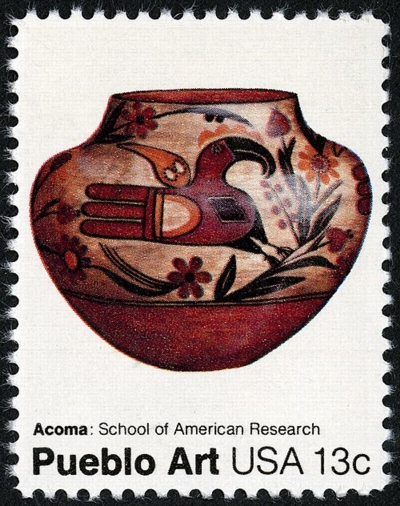
(above: American Folk Art Series:
Pueblo Pottery - Acoma Pot - Acoma: School of American Research - 13-cent
1977 U.S. stamp. Public domain, via Wikimedia Commons.*)
Prompt:
Research Plan:
We lightly edited the article, added images and provided
links to other materials to enhance it. AI is rapidly improving in
accuracy, yet the article may have inaccurate information.
 Return to American Pottery Art
Return to Native American Art
Return to New Mexico Art History
*Tag for expired US copyright of object image:

and
**Tag for some rights reserved:

Links to sources of information outside of our web site are provided only as referrals for your further consideration. Please use due diligence in judging the quality of information contained in these and all other web sites. Information from linked sources may be inaccurate or out of date. TFAO neither recommends or endorses these referenced organizations. Although TFAO includes links to other web sites, it takes no responsibility for the content or information contained on those other sites, nor exerts any editorial or other control over them. For more information on evaluating web pages see TFAO's General Resources section in Online Resources for Collectors and Students of Art History.
Copyright 2026 Traditional Fine Arts Organization, Inc. an Arizona nonprofit corporation. All rights reserved.