
San Ildefanso Pottery in the Early Twentieth Century
a Gemini 3 Deep Research Report
March, 2026
The high desert sun of New Mexico casts long, amber shadows over the adobe walls of San Ildefonso Pueblo, a place where the earth itself has always been the primary medium of expression. In the early years of the twentieth century, this small Tewa-speaking community sat at a quiet crossroads of history. The ancient traditions of pottery making, which had sustained the Pueblo people for a millennium, were facing a slow decline.
For generations, the women of San Ildefonso crafted sturdy, utilitarian vessels -- broad-shouldered ollas for water storage and wide bowls for grain -- but the arrival of inexpensive, mass-produced metal pails and enamelware from the burgeoning American industrial machine began to render these clay tools obsolete. It was during this fragile period of transition that a remarkable convergence of archaeology, tourism, and individual artistic genius would transform San Ildefonso pottery from a fading domestic craft into a world-renowned fine art.
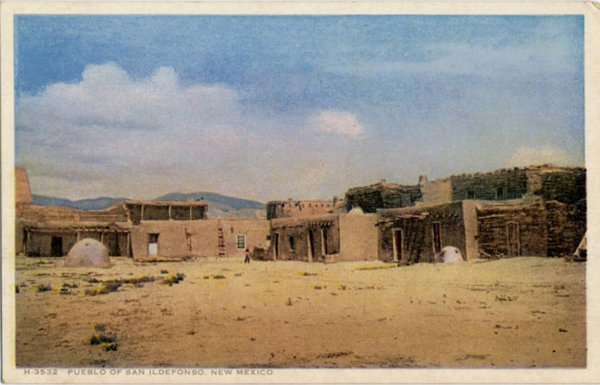
(above: Pueblo Of San Ildefonso, New Mexico, c. 1900s, photographic print, Fred Harvey Postcard Series, the Newberry. Public domain, via Wikimedia Commons*)
At the heart of this transformation was the Fred Harvey Company and its symbiotic relationship with the Atchison, Topeka and Santa Fe Railway. By the late nineteenth century, the railroad had pierced the isolation of the Southwest, bringing with it a new class of travelers eager to experience the "authentic" frontier. Fred Harvey, a visionary entrepreneur, realized that these tourists were not just looking for a place to eat and sleep; they were seeking a curated encounter with the exotic cultures of the high desert. To satisfy this hunger, the Harvey Company established the Indian Department in 1901, led by Herman Schweizer, who worked to professionalize the sale of Native American crafts. The company's influence reached its zenith with the introduction of the "Indian Detours" in 1926, which whisked affluent travelers in "Harveycars" from luxury hotels like Santa Fe's La Fonda directly to the plazas of nearby Pueblos, including San Ildefonso.
The travelers who stepped out of these touring cars were looking for souvenirs that captured the spirit of the land. However, the traditional polychrome pottery of the late 1800s -- often featuring red and black designs on a cream slip -- was frequently too large and fragile for a tourist's trunk. The potters of San Ildefonso, observing the preferences of these new patrons, began to adapt. They refined their techniques to produce smaller, more decorative pieces that functioned as art objects rather than kitchen implements. This shift was not merely a commercial concession; it was a creative rebirth fueled by a rediscovery of the past.
In 1908, a crucial link between the ancient and the modern was forged when Edgar Lee Hewett, director of the Museum of New Mexico, began archaeological excavations at the nearby Pajarito Plateau. Among the ruins of the ancestral Tewa sites, his team unearthed shards of a prehistoric, polished black pottery that had been lost to time. Intrigued by the beauty of these fragments, Hewett sought out the most skilled potter in San Ildefonso to see if the style could be recreated. He found Maria Martinez, a young woman already known for her exceptional ability to shape symmetrical, thin-walled vessels.

(above: Maria Martinez, Pot, approximately 1945, on display at the de Young Museum in San Francisco. Photo by Jim Heaphy. Public domain, via Wikimedia Commons*)
Maria, working alongside her husband Julian, embarked on a decade-long journey of experimentation. While Maria focused on the physical construction of the pots -- a process of hand-coiling and scraping that required immense patience and strength -- Julian took on the role of the decorator. In Pueblo tradition, pottery was almost exclusively a woman's domain, but as the medium moved toward the art market, this partnership between husband and wife became a hallmark of the San Ildefonso style. Together, they sought to unlock the secret of the ancient blackware. They discovered that the black color was not the result of a specific pigment, but rather a chemical reaction during the firing process.
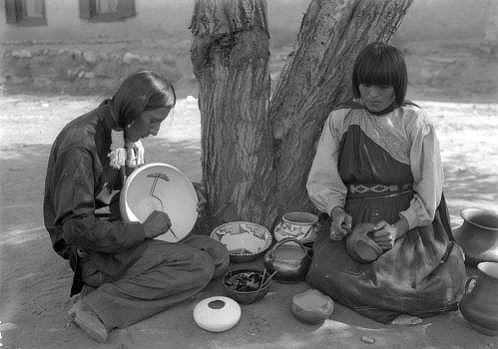
(above: Julian and Maria Martinez decorating pottery, c.1912. Public domain, via Wikimedia Commons*)
The materials they used were gathered from the sacred landscapes surrounding the Pueblo. They harvested a specific type of local clay, which was then mixed with "temper" -- finely ground volcanic ash found in nearby hills. This ash allowed the clay to withstand the thermal shock of an open-air fire without cracking. To achieve the mirror-like finish that would define their work, Maria would apply a thin slip of iron-rich red clay to the dried pot and then burnish it for hours with a smooth, water-worn river stone. This labor-intensive polishing compressed the surface molecules, creating a glossy sheen that felt like silk to the touch.
The breakthrough occurred around 1919 when Julian discovered a way to create a matte-on-polished effect. He found that by painting designs onto the highly polished surface with a liquid slip made of the same red clay (sometimes mixed with the juice of the Rocky Mountain Beeplant, or guaco), the painted areas would remain dull after firing, while the burnished background would retain its luster. The magic happened during the firing itself.
As the fire reached its peak temperature, the potters would "smother" the mound of burning wood and dried cow manure with fine ash and more manure. This process, known as reduction firing, cut off the supply of oxygen, creating a carbon-rich atmosphere. The carbon would penetrate the clay, turning the red pots into a deep, velvety black. The polished areas became a shimmering jet black, while Julian's painted motifs emerged as a subtle, charcoal-colored matte.
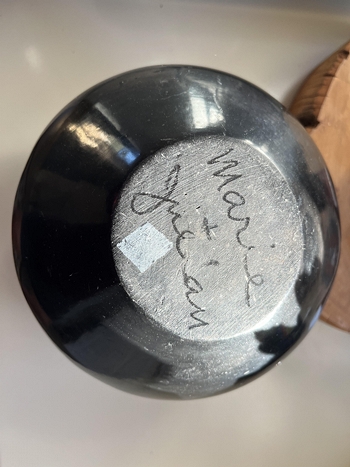
(above: Signatures of Maria and Julian Martinez, Pot (verso), n.d., clay. Private Collection)
This "black-on-black" style was an immediate sensation among the travelers on the Indian Detours. It felt modern and sophisticated, yet it was deeply rooted in the soil of the Southwest. Julian's choice of motifs further bridged this gap. While he drew inspiration from the geometric patterns found on the ancient shards from the Pajarito excavations, he also introduced more fluid, symbolic imagery that resonated with the Pueblo worldview. One of the most iconic motifs he popularized was the Avanyu, the horned water serpent.
The Avanyu was a powerful protector of water and a guardian of the springs -- a vital deity in the arid environment of New Mexico. Julian depicted the serpent with an undulating body that mimicked the flow of a river or the curve of a lightning bolt, often with a feathered crest that suggested the arrival of rain clouds. These motifs were not merely decorative; they were visual prayers for the survival of the community. Other designs included stylized feathers, which represented the breath of life and the connection between the earth and the sky, and stepped patterns that symbolized the mountains and the clouds. By placing these sacred symbols on pottery sold to outsiders, the San Ildefonso artists were asserting their cultural identity even as they integrated into the American economy.
The Fred Harvey Company played a pivotal role in promoting these specific artists and their styles. In the "Indian Rooms" of the Harvey Hotels, such as the Alvarado in Albuquerque, Maria and Julian were often invited to demonstrate their craft. Travelers could watch Maria effortlessly coil a pot and Julian meticulously paint a design with a brush made from a single yucca leaf. This "demonstration" style of marketing gave the pottery a narrative and a face, elevating the individual artist in a way that had never occurred in traditional Pueblo society, where work was generally communal and unsigned. At the urging of museum directors and Harvey scouts, Maria began to sign her name at the bottom of her pots -- a revolutionary act that signaled the birth of the Native American art market.
As the success of the Martinez family grew, other potters in San Ildefonso began to innovate and develop their own characteristic variations. In the 1920s and 30s, artists like Rose Gonzales, who had married into the Pueblo from San Juan, introduced a carved style of pottery. Instead of painting a matte slip, she would deeply incise the clay while it was still "leather-hard," creating a sculptural, cameo-like effect that added a new dimension to the blackware tradition. Others, such as Tonita Peña and Juan Roybal, continued to refine the polychrome tradition, using traditional red, white, and black slips to create intricate scenes of Pueblo life and dance.
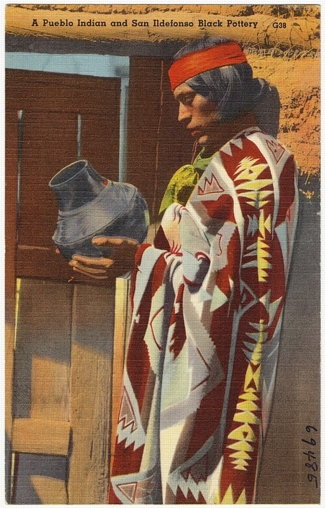
(above: Postcard, "A Pueblo Indian and San Ildefonso Black Pottery." Published by Southwest Arts & Crafts, Santa Fe, New Mexico; Tichnor Bros. Inc., Boston, Mass. Public domain, via Wikimedia Commons*)
The materials remained consistent, tying the community to its ancestral lands. The gathering of clay and volcanic ash was often a family affair, involving rituals and offerings to the earth. The firing process, too, remained a high-stakes gamble against the elements. A sudden gust of wind or a drop of moisture could cause a pot to crack or "fire-cloud" (develop an uneven gray patch), ruining days of work. This reliance on natural processes ensured that every piece remained unique, a point that the Fred Harvey Company emphasized in its marketing brochures. One such brochure famously stated, "Never were two pieces of Indian pottery exactly alike."
The impact of this artistic evolution was profound. The income from pottery sales allowed the people of San Ildefonso to maintain their traditional way of life during a century of intense pressure to assimilate into broader American culture. The Pueblo, which had once been struggling with poverty and land loss, became a hub of artistic excellence. The "Indian Detours" brought thousands of visitors, but more importantly, they brought a valuation of Pueblo culture that, however commercialized, provided a buffer against the erasure of their heritage.
The development of the San Ildefonso style was a complex dance between tradition and adaptation. The potters did not simply "sell out" to the tourist trade; they used the market as a vehicle for cultural survival. They took the materials of their ancestors -- the clay, the ash, and the beeweed -- and the motifs of their spiritual life -- the serpent, the cloud, and the feather -- and translated them into a language that the modern world could understand and admire. The black-on-black pottery, with its elegant balance of light and shadow, became a metaphor for the Pueblo experience itself: a resilient core of tradition polished to a high shine for the outside world to see.
By the time the Fred Harvey Company sold its Indian Detours business in 1930, the course of San Ildefonso pottery had been irrevocably changed. The "curio" had become "fine art." Collectors from the East Coast and Europe were no longer just looking for a souvenir of their desert vacation; they were seeking out signed works by Maria Martinez and her contemporaries to display in museums and private galleries. The collaborative spirit of the early twentieth century, sparked by the partnership of Maria and Julian and the curiosity of travelers stepping off the railroad, had ensured that the voice of the San Ildefonso potter would be heard for generations to come. (See Z.S. Liang, Pueblo Street Market in the 1920s, 2006, oil on canvas. The Hilbert Museum of California Art, gift of John Heckenlively, M.D.)
As the narrative of San Ildefonso pottery continues into
the twenty-first century, it remains a testament to the power of artistic
innovation. The legacy of those early years -- the hours spent burnishing
with a river stone, the careful painting of the Avanyu's curve, and the
tension of the reduction fire -- is still felt in the work of the descendants
of those original masters. The Pueblo remains a place where the earth is
sacred, and the creation of a vessel is, as it has always been, a "visual
prayer."
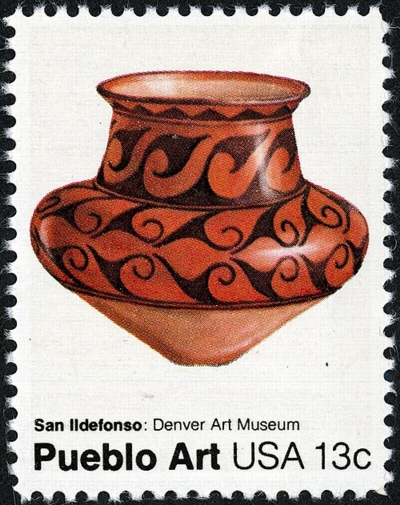
(above: American Folk Art Series: Pueblo Pottery - San Ildefonso Pot - San Ildefonso: Denver Art Museum - 13-cent 1977 U.S. stamp. Public domain, via Wikimedia Commons*)
Prompt:
We lightly edited this report, added images and provided
links to other materials to enhance it. AI is rapidly improving in
accuracy, however, the report may contain inaccurate information. This presentation doesn't meet scholarly standards, yet Gemini
3 AI researched and checked it for accuracy. Sources are footnoted in the
raw AI report, yet deleted here for a general audience. Please
see An Evaluation Of Gemini 3 Deep Research
In Replication Of Academic Peer Review, an April, 2026 Gemini 3 Deep Research
Report.
 Return to American Pottery Art
Return to Native American Art
Return to New Mexico Art History
*Tag for expired US copyright of object image:

and
**Tag for some rights reserved:

Links to sources of information outside of our web site are provided only as referrals for your further consideration. Please use due diligence in judging the quality of information contained in these and all other web sites. Information from linked sources may be inaccurate or out of date. TFAO neither recommends or endorses these referenced organizations. Although TFAO includes links to other web sites, it takes no responsibility for the content or information contained on those other sites, nor exerts any editorial or other control over them. For more information on evaluating web pages see TFAO's General Resources section in Online Resources for Collectors and Students of Art History.
Copyright 2026 Traditional Fine Arts Organization, Inc. an Arizona nonprofit corporation. All rights reserved.