
Santa Clara Pueblo Ceramics in the Fred Harvey Era
a Gemini 3 Deep Research Report
March, 2026
The early twentieth century served as a transformative epoch for the Santa Clara Pueblo, a Tewa-speaking community situated along the Rio Grande in northern New Mexico. During this period, the production of pottery underwent a profound metamorphosis, transitioning from a localized, utilitarian practice rooted in millennia of communal tradition to a sophisticated art form curated for a burgeoning global tourist market.
This shift was catalyzed by the strategic interventions of the Atchison, Topeka and Santa Fe Railway and its hospitality partner, the Fred Harvey Company. Through the establishment of the Indian Department in 1901 and the subsequent launch of the "Indian Detours" in 1926, these corporate entities did not merely facilitate travel; they actively participated in the aesthetic and economic reshaping of Pueblo life.
For the potters of Santa Clara, particularly matriarchs such as Sara Fina Tafoya and her daughter Margaret, this era demanded a delicate negotiation between preserving ancestral techniques -- hand-coiling, stone-polishing, and pit-firing -- and the development of a distinct, marketable style characterized by deep intaglio carving and iconic motifs like the bear paw and the Avanyu.
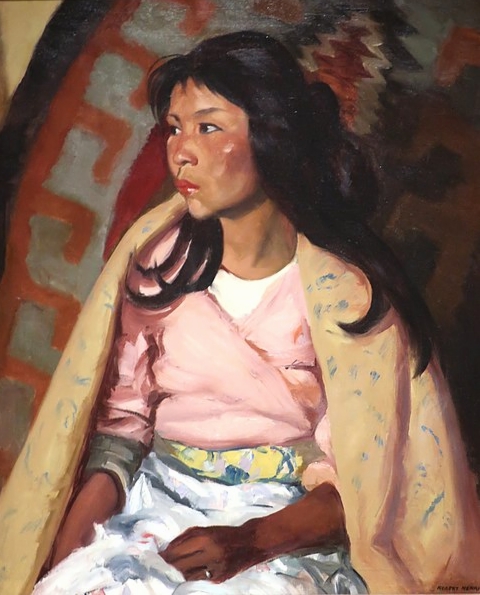
(above: Robert Henri, Indian Girl of Santa Clara, 1917, oil on canvas, Phoenix Art Museum. Public domain, via Wikimedia Commons**)
The Geological and Spiritual Landscape of Tewa Ceramic Arts
To understand the evolution of Santa Clara pottery in the twentieth century, one must first recognize the deep historical and spiritual foundations upon which these innovations were built. Archaeological evidence suggests that Puebloan pottery traditions in the Rio Grande Valley emerged as early as A.D. 500, coinciding with the transition from a migratory hunting-and-gathering lifestyle to a more settled agricultural existence.
In the Tewa worldview, pottery was never an isolated economic activity; it was an extension of the relationship between the people and the earth. The Tewa term *nung* serves as a linguistic bridge, simultaneously signifying "earth," "soil," and "us." This ontological unity implies that the potter and the clay are partners in a process of creation that is both physical and spiritual.
The technical requirements of Santa Clara pottery are inextricably linked to the specific geology of the Pajarito Plateau and the surrounding valley. Traditional potters extract their clay from ancestral deposits, a practice that Margaret Tafoya noted had been maintained by her family "as far back as records exist." The process begins with the careful gathering of raw clay, which is then refined and mixed with a "temper" -- typically fine sand, ground rock, or volcanic tuff -- to provide structural integrity and prevent cracking during the drying and firing phases. This spiritual and material adherence to locality ensured that even as the forms of the pottery changed to suit modern tastes, the substance of the work remained anchored in Tewa land.
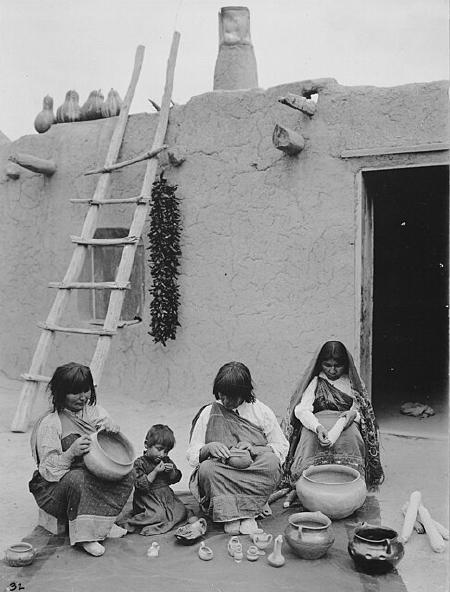
(above: Indians of Santa Clara Pueblo, New Mexico, making pottery, 1916. Department of the Interior. Bureau of Indian Affairs. Information Office. Records of the Bureau of Indian Affairs. Public domain, via Wikimedia Commons*)
The firing process itself is a testament to the sophisticated understanding of chemical reduction. Until the turn of the century, Santa Clara was primarily known for producing undecorated redware and blackware. The color of a vessel is determined by the management of the fire: an open fire where oxygen is plentiful produces red pottery, while a "smothered" fire, achieved by covering the burning fuel (typically dried manure) with powdered manure or ash, creates an oxygen-deprived environment. This reduction process forces carbon into the clay body, turning the entire vessel a deep, permanent black without the need for glazes or artificial pigments.
The Fred Harvey Company and the Architecture of "Authenticity"
The catalyst for the commercialization of these traditions was the vision of Fred Harvey and his successors. By the late nineteenth century, the Atchison, Topeka and Santa Fe Railway had effectively conquered the geography of the Southwest, but the region remained a "wilderness" in the minds of affluent Eastern travelers.
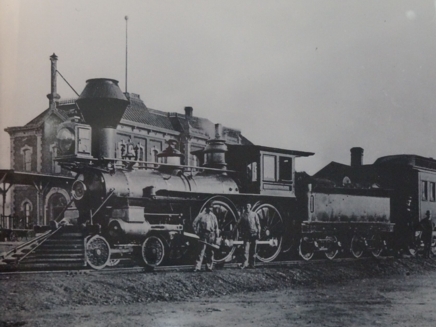
(above: Sherlock locomotive # 5, Topeka, Kansas, c. 1890, Mohave Museum of History and Arts. Public domain, via Wikimedia Commons*)
To transform this landscape into a destination, the Harvey Company created an Indian Department in 1901, spearheaded by Herman Schweizer, who is often described as the "Fred Harvey anthropologist." Schweizer recognized that the value of Native American crafts lay not just in their physical form, but in the "romance and mystique" they projected. The company's strategy involved a systematic branding of the Southwest. They commissioned artists, photographers, and ethnographers to create imagery for brochures, postcards, and menus that emphasized the exoticism and ancient heritage of the Pueblo people.
In Albuquerque, the company established the Indian Building at the Alvarado Hotel, which served as a prototype for modern museum-quality showrooms. Here, travelers could witness Santa Clara and San Ildefonso potters working in "live exhibits," reinforcing the connection between the artist and the "authentic" object. This environment allowed the Harvey Company to set standards for what constituted high-quality "curio" art, subtly nudging potters toward designs that resonated with Western aesthetic sensibilities, such as more symmetrical forms and higher-gloss finishes.
The Indian Detours: Mediating the Pueblo Experience
By 1925, the rise of the automobile and the airplane began to cannibalize rail travel. In response, the Harvey Company and the Santa Fe Railway launched the "Indian Detours" in May 1926. These tours were designed to lure passengers off the trains for one-to-three-day motor excursions into the "wilderness panoramas" of northern New Mexico.
Guests traveled in "Harveycars" -- luxurious Packards, Cadillacs, and Franklins -- driven by male drivers -- and accompanied by female "couriers". The role of the Courier Corps was essential in shaping the traveler's perception of the Santa Clara Pueblo. These women, often college graduates, were subjected to rigorous training programs that included lectures on archaeology, ethnology, and history. Despite their academic training, their presentation was highly stylized; they wore Navajo-style velvet skirts, concha belts, and squash blossom necklaces to embody the "Southwestern" image the company was selling.
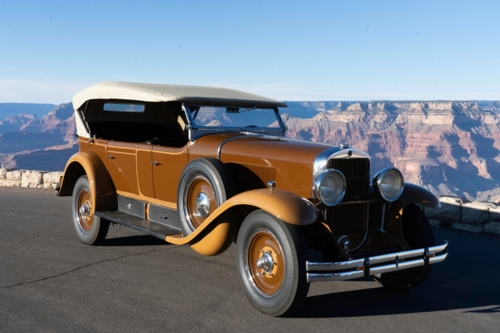
(above: 1929 Cadillac 341-B, the last remaining Harvey Car, on display at the New Mexico History Museum, 2025. Image: Courtesy of the NMHM Photo Archives)
When the Harveycars arrived at Santa Clara, the couriers acted as cultural intermediaries, explaining the "primitive" techniques of the potters while facilitating transactions. This direct access to a wealthy clientele had immediate stylistic consequences. Travelers on these detours were looking for souvenirs that could survive the journey back to the East Coast. This led to a diversification of forms: while large storage jars remained the hallmark of Santa Clara skill, potters began producing smaller "miniatures," ashtrays, candlesticks, and wedding vases that were easier to pack and more suited to Victorian and Edwardian home décor. (See Z.S. Liang, Pueblo Street Market in the 1920s, 2006, oil on canvas. The Hilbert Museum of California Art, gift of John Heckenlively, M.D.)
The Sculptural Revolution: Matriarchs and Innovation
In the early twentieth century, the aesthetic of Santa Clara pottery began to diverge sharply from the painted traditions of other pueblos. While Maria Martinez of San Ildefonso achieved fame through her matte-on-polished black-on-black pottery, the artists of Santa Clara focused on the sculptural qualities of the clay body itself.
This era was dominated by the Tafoya family, specifically Sara Fina Tafoya and her daughter Margaret, who are credited with elevating the village's traditional blackware into a recognized fine art form. Sara Fina Tafoya was a pioneer of form and scale. She was renowned for her ability to build unusually large vessels, some exceeding 30 inches in height, which required exceptional technical mastery to prevent collapse during construction and cracking during the firing process.
Around 1920, a critical stylistic innovation occurred: the transition from undecorated surfaces to deep intaglio carving. Unlike the painted designs seen at Acoma or Cochiti, Santa Clara carving was physical and subtractive. Potters would use tools to cut deeply into the damp clay, creating a play of light and shadow that accentuated the monochrome surface.
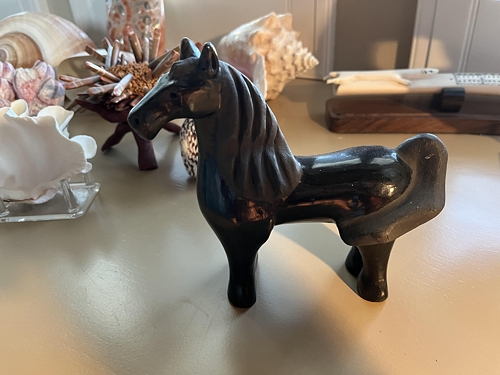
(above: Unidentified Santa Clara Potter, Horse, undated. Private Collection)
Margaret Tafoya further refined this style, making it a signature of the Santa Clara brand. She insisted on maintaining the traditional coiling method, rejecting the potter's wheel as a foreign intrusion that lacked the spiritual connection inherent in hand-building. Her work often featured a "double-shouldered" profile and a mirror-like polish achieved through hours of burnishing with a smooth river stone. For Tafoya, the high polish was not just decorative; it was a manifestation of the "good heart" and virtue of the potter, as she famously stated, "The pottery knows".
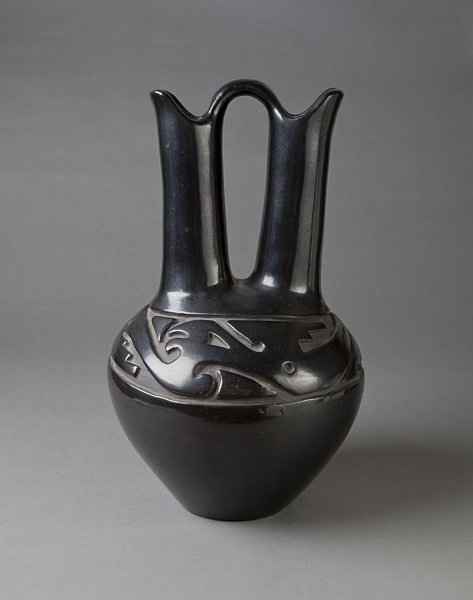
(above: Margaret Tafoya, Wedding Vase, Santa Clara Pueblo, New Mexico, c. 1970, oil on canvas, 22.5 x 42 inches, Bowers Museum, Anonymous Donor. Public domain, via Wikimedia Commons**)
Symbolic Language: The Bear Paw and the Avanyu
The motifs developed during this period were deeply rooted in Tewa cosmology but were presented in a way that spoke to the "mystique" sought by Indian Detour travelers. The two most iconic motifs -- the bear paw and the Avanyu -- illustrate this dual function. The bear paw is more than a design; it is a surrogate for a signature and a narrative of salvation.
According to Tewa legend, a bear led the Santa Clara people to a hidden source of water during a catastrophic drought. In remembrance of this act, potters began placing the bear's track on their work, particularly on vessels meant for water storage. In the early 1900s, this was often a simple impressed design made with the fingers while the clay was still wet. As the market grew, the bear paw became a family trademark; every potter developed their own specific style of "paw," allowing collectors to identify the maker even before the practice of signing the bottom of the pot became standard.
The Avanyu, or water serpent, represents a more complex theological symbol. As the guardian of the waters and a deity associated with lightning and rain, the Avanyu is depicted as a horned serpent with an undulating body that often encircles the entire vessel. On carved Santa Clara pottery, the Avanyu provided a dramatic curvilinear element that broke up the horizontal bands of the pot. For travelers, the Avanyu was an "exotic" and "mystical" figure that satisfied the desire for "authentic" Indian symbolism, while for the potters, it remained a prayer for survival in an arid landscape.
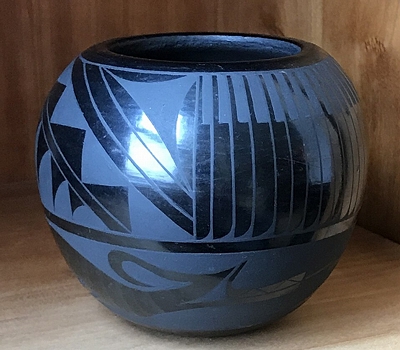
(above: Black-on-black pot crafted by Merton and Linda Sisneros of Santa Clara Pueblo, featuring kiva steps (top left), feathers (top right), and Avanyu, spirit of water (bottom). From a private collection.. Photo courtesy of Kenrossalex. Public domain, via Wikimedia Commons**)
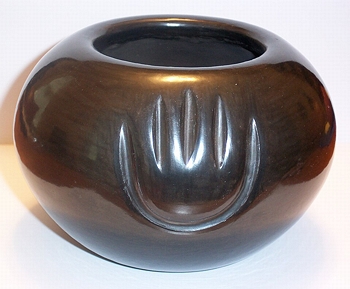
(above: Black stone-polished
bowl with a bear paw design, crafted by Angela Baca, Santa Clara Pueblo,
New Mexico. From a private collection. Photo courtesy of Kenrossalex. Public
domain, via Wikimedia Commons
The success of the Harvey Company's marketing had profound consequences for the social fabric of the Santa Clara Pueblo. Historically, pottery production was a communal and matrilineal endeavor, where skills were passed from mother to daughter and the identity of the individual artist was secondary to the tradition of the village. The Indian Detours and the rise of the "curio" market introduced the concept of the individual artist as a celebrity. Under the influence of white patrons and organizations such as the Indian Arts Fund (established 1925), potters were encouraged to sign their names to their work. This was a fundamental shift from a barter-based economy to a cash-based one.
While the Tewa worldview accepted and even valued the imperfections inherent in the collaboration between human and clay, the tourist market demanded flawless symmetry and "professional" finishes. This led to more intensive preparation of materials, such as the sifting of clay to remove organic matter, which some elders viewed as a loss of the "life" within the material.
Innovation as a Form of Cultural Preservation
One of the most remarkable aspects of Santa Clara pottery in the early twentieth century was the realization that innovation could be a tool for preservation. Potters like Lela and Van Gutierrez demonstrated this by developing a unique matte-polychrome style that utilized earth-toned slips on a tan background, a departure from the dominant blackware. By creating "non-traditional" styles within the traditional framework of hand-coiling and pit-firing, they ensured that Santa Clara pottery remained dynamic and relevant to a changing world.
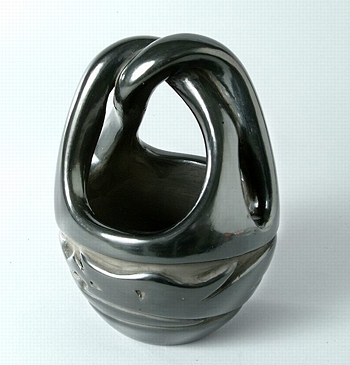
(above: Double Handled Bowl, Santa Clara Pueblo, 1996, Made by Florence Browning. The water serpent [awanyu] design on the sides of the bowl is carved into the clay when the piece has dried to "leather hard." This method is best known from Santa Clara Pueblo. Ceramic. H 16.5, D 11.5 cm [H 6.5, D 4.75 inches] Bandelier National Monument, BAND 22753. Public domain, via Wikimedia Commons*)
The Harvey Company's Indian Detours essentially created a stage upon which the potters of Santa Clara could perform their identity while securing the economic future of their community. By developing a characteristic style that was both visually striking and deeply symbolic, these artists turned "souvenirs" into "fine art." The motifs of the bear paw and the Avanyu, once confined to the functional vessels of the home and the ceremonial vessels of the kiva, became the global ambassadors of Tewa culture.
The Enduring Legacy of the Harvey Era
The evolution of Santa Clara pottery during the era of the Indian Detours represents a rare instance of a traditional culture successfully co-opting a commercial system to ensure its own survival. The Fred Harvey Company provided the infrastructure and the audience, but the potters of Santa Clara provided the creative genius that transformed a domestic craft into a world-renowned art form. Matriarchs like Margaret Tafoya proved that one could satisfy the modern market without sacrificing the "soul" of the clay, maintaining a commitment to ancestral materials and techniques that continues into the twenty-first century.
Today, the "characteristic style" of Santa Clara
- the heavy, carved, and highly polished blackware - is a symbol of cultural
resilience. It stands as a testament to a period when the dusty plazas of
the Pueblo became the center of a global artistic conversation, mediated
by the Harveycars and the couriers, but ultimately defined by the steady
hands and "good hearts" of the Tewa potters who understood that
for their culture to endure, it had to be both ancient and ever-new.
Prompt:
We lightly edited this report, added images and provided
links to other materials to enhance it. AI is rapidly improving in
accuracy, however, the report may contain inaccurate information. This presentation doesn't meet scholarly standards, yet Gemini
3 AI researched and checked it for accuracy. Sources are footnoted in the
raw AI report, yet deleted here for a general audience. Please
see An Evaluation Of Gemini 3 Deep Research
In Replication Of Academic Peer Review, an April, 2026 Gemini 3 Deep Research
Report.
 Return to American Pottery Art
Return to Native American Art
Return to New Mexico Art History
*Tag for expired US copyright of object image:

and
**Tag for some rights reserved:

Links to sources of information outside of our web site are provided only as referrals for your further consideration. Please use due diligence in judging the quality of information contained in these and all other web sites. Information from linked sources may be inaccurate or out of date. TFAO neither recommends or endorses these referenced organizations. Although TFAO includes links to other web sites, it takes no responsibility for the content or information contained on those other sites, nor exerts any editorial or other control over them. For more information on evaluating web pages see TFAO's General Resources section in Online Resources for Collectors and Students of Art History.
Copyright 2026 Traditional Fine Arts Organization, Inc. an Arizona nonprofit corporation. All rights reserved.