
Hopi Pottery in the Early Twentieth Century
a Gemini 3 Deep Research Report
March, 2026
The cultural landscape of the American Southwest underwent a seismic shift at the dawn of the twentieth century, catalyzed by the expansion of the Atchison, Topeka & Santa Fe Railway and the commercial ingenuity of the Fred Harvey Company. Within this period of rapid modernization and burgeoning tourism, the Hopi potters of First Mesa, most notably led by the visionary artist Nampeyo of Hano, developed a distinctive aesthetic and technical style that fundamentally redefined indigenous ceramic traditions. This evolution was not a spontaneous artistic movement but rather a calculated and sophisticated response to the socioeconomic pressures of the era and the specific demands of a new class of travelers arriving on the "Indian Detours." By bridging the gap between the archaeological past and the commercial present, these artisans synthesized ancestral materials and motifs into a characteristic style that appealed to a global market while simultaneously preserving their cultural heritage during a time of profound transition.
The Fred Harvey Company and the Architecture of Southwestern Tourism
The genesis of the modernized Hopi pottery market lies in the logistical and promotional strategies of the Fred Harvey Company. Originally established in 1876 as a provider of high-quality dining services along the railroad, the company evolved into a massive hospitality empire by the time of Fred Harvey's death in 1901.Under the leadership of his son Ford Harvey and daughter Minnie Harvey Huckel, the company recognized that the "romance and mystique" of the Southwest could be leveraged to revitalize waning rail travel. In 1902, the company established its Indian Department, headed by Herman Schweizer, a man whose expertise in Native American arts and crafts and savvy business sense would shape the aesthetic expectations of thousands of tourists.
Schweizer, operating out of the Alvarado Hotel in Albuquerque, acted as a rigorous quality-control agent, ensuring that the Harvey Company sold only the highest-grade textiles, jewelry, and pottery. The Indian Department utilized "artist-demonstrators" in staged settings to attract passengers during their respite from the train. These "live exhibits" featured artisans from various tribes, including Navajo weavers and Hopi potters, who worked in traditional dress to create souvenirs for the travelers. This commercial formula was eventually extended to the "Indian Detours," a program launched in 1926 that offered guided motor tours in "Harveycars" to remote pueblos and ruins. These tours, led by educated female couriers, provided travelers with direct access to the Hopi mesas, creating a lucrative and immediate market for the potters of First Mesa. (See Z.S. Liang, Pueblo Street Market in the 1920s, 2006, oil on canvas. The Hilbert Museum of California Art, gift of John Heckenlively, M.D.)
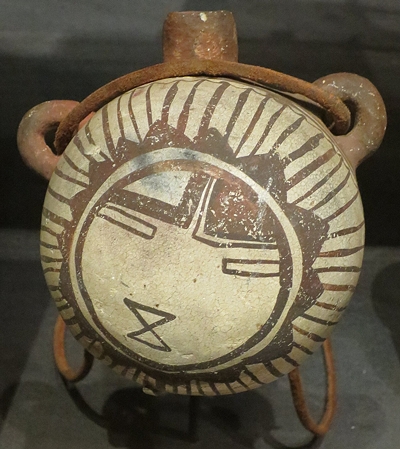
(above: Hopi Pueblo: Ceramic Canteen Decorated With Face of Tawa, the Sun, 1890-1900, Heard Museum. Photo by Wmpearl. Public domain, via Wikimedia Commons**)
The Artistic Vision of Nampeyo of Hano
At the center of the Hopi pottery revolution was Nampeyo of Hano, a Hopi-Tewa woman born around 1858. Nampeyo's heritage was rooted in the village of Hano, settled by Tewa people who had migrated from New Mexico to the Hopi mesas following the Pueblo Revolt of 1680. By the late 1800s, Hopi pottery had entered a period of decline characterized by thick-walled vessels with slips that often crackled during firing. Nampeyo, recognizing the superior quality of ancient fragments found in the ruins of Sikyatki and other ancestral sites, began to experiment with materials and designs that would revive the "glory years" of Hopi ceramics.
Nampeyo's breakthrough was fueled by the archaeological activities of the era. In 1895, Dr. Jesse Walter Fewkes of the Smithsonian Institution excavated the prehistoric village of Sikyatki. Nampeyo's husband, Lesou, was employed on the excavation and provided her with access to countless pottery shards and intact vessels. While some accounts suggest Nampeyo merely copied these ancient designs, the evidence indicates a more sophisticated process of synthesis. She adopted the shallow jar shapes and flattened shoulders of Sikyatki polychrome pottery but integrated her own fluid artistic vision, creating what became known as the Sikyatki Revival or Hano Polychrome style.
The development of the characteristic Hopi style in the early twentieth century was as much a technical achievement as it was an artistic one. Authentic Hopi pottery is distinguished by the fact that it is entirely handmade without the use of a wheel, employing the coil and scrape method passed down through generations. The process began with the gathering of clay from specific geological layers on the Hopi mesas, which was then dried, soaked, washed, and sifted to ensure purity.
One of Nampeyo's most significant discoveries was a superior yellow-firing clay that she found near the ancient ruins. This clay, when fired in an oxidizing atmosphere, produced a range of warm hues from cream to deep orange, which became a hallmark of the revival style. To improve the durability of the vessels and prevent cracking, potters added "temper," often consisting of crushed shards of prehistoric pottery. This practice not only provided structural integrity but also created a literal and symbolic connection to the ancestral past.

(above: Nampeyo (1860-1942), Giara, 1895, Hopi-Tewa. Public domain, via Wikimedia Commons*)
The firing process itself underwent a notable change. While ancient potters had used coal, the post-contact era saw a shift to sheep dung and cedarwood as primary fuel sources. Sheep dung provided a rapid and even heat that was essential for achieving the clear, vibrant colors of the Sikyatki Revival. Some potters, drawing on ancient Tewa traditions, also used sheep bones in the fire to increase the heat or produce whiter surfaces. The final polishing was achieved using smooth stones, creating a dense, reflective surface that served as the canvas for intricate painted designs.
The Alchemy of Pigments and the Yucca Brush
The vibrant decorations of early twentieth-century Hopi pottery were created using entirely natural pigments derived from the local environment. Black paint, known as guaco, was produced by boiling the bee-weed plant (tansy mustard) until it reduced to a thick, dark syrup. This syrup was then dried into cakes, wrapped in corn husks, and stored until needed, at which point it was reconstituted with water or mixed with mineral pigments like hematite. Red and brown tones were created from iron-rich ochres gathered from desert springs and rocky outcrops.
The application of these pigments required a precision that was achieved through the use of brushes made from yucca fibers. Potters would chew the ends of yucca leaves to expose the long, flexible fibers, which were then trimmed to create brushes capable of painting the fine lines and sweeping curves characteristic of the style. The mastery of these tools allowed Nampeyo and her contemporaries to execute designs that were both mathematically precise and artistically fluid, covering the vessels in patterns that seemed to vibrate with movement.
Symbolic Motifs and the Narrative of Migration
The motifs developed for the pottery sold to travelers were deeply symbolic, reflecting the spiritual and historical worldview of the Hopi people. The most iconic of these was the "Migration Pattern," a series of interlocking, abstracted bird wings and tail feathers that represented the journeys of the Hopi clans across the Southwest. This motif emphasized the concept of kukveni, or "footprints," signifying the physical and spiritual presence of the ancestors on the land.
Other common motifs included:
The "Eagle Tail" or "Bird Wing" designs were often asymmetrical and highly abstracted, representing the birds that acted as intermediaries between the human world and the spirits who bring rain. These designs were frequently divided into four units around the vessel, possibly reflecting the four cardinal directions or the four worlds of Hopi cosmology. Another prevalent feature was the "Spirit Line," an intentional break in the painted line encircling the rim of a vessel. This opening was believed to allow the spirit of the pot to enter and exit, and some traditions suggested that closing the line would symbolically end the potter's own creative or childbearing capacity.
The introduction of katsina imagery also became popular during the tourist era. While traditionally reserved for ceremonial contexts, stylized katsina faces were applied to water canteens and bowls to satisfy the traveler's desire for "authentic" Indian religious iconography. This adaptation of sacred imagery for commercial purposes was a delicate balance, as potters sought to fulfill market demand without compromising the spiritual integrity of their culture.
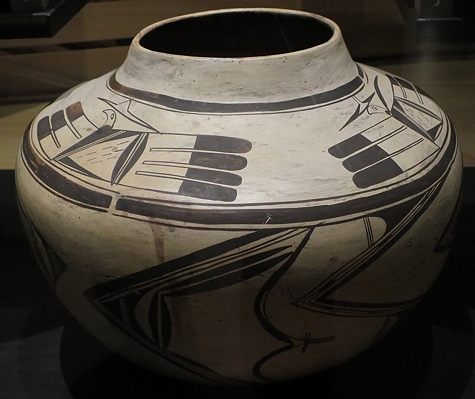
(above: Hopi jar decorated with stylized birds, 1905-1910, Heard Museum. Photo by Wmpearl. Public domain, via Wikimedia Commons**)
Adapting Forms for the Tourist Market
As the Fred Harvey Company's Indian Detours brought more travelers to the mesas, Hopi potters began to adapt the physical forms of their work to accommodate the logistical constraints of rail and automobile travel. While large storage jars and water ollas remained part of the repertoire, there was a significant shift toward the production of smaller, more portable items. Miniature vessels, small bowls, and "seed jars" became increasingly popular as they could be easily packed into luggage.
The water canteen also saw a revival and transformation during this period. Traditionally used by women to carry water from springs to the mesa-top villages, canteens were typically large, flat-backed vessels. For the tourist trade, potters began producing "personal" canteens and miniatures, often decorated with vibrant polychrome designs rather than being left as plain utilitarian ware. The "seed jar" form -- a squat, wide-shouldered vessel with a small opening originally designed to protect seeds from rodents -- was particularly favored by Nampeyo and became one of the most sought-after shapes by collectors.
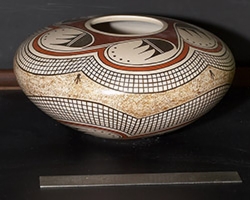
(above: Tyra Naha, Hopi artist, Seed Pot, Bearclaw Design, Photo by Tommears. Public domain, via Wikimedia Commons**)
The Mechanics of the Indian Detour Encounter
The Indian Detours provided the primary mechanism for the direct encounter between the Hopi potters and the international traveling public. Starting in 1926, the Harvey Company operated these tours out of prestigious hotels such as La Fonda in Santa Fe and the Alvarado in Albuquerque. Travelers were whisked away in "Harveycars" through the rugged landscapes of Northern New Mexico and Arizona. The tours were meticulously managed by female couriers who acted as cultural translators, interpreting the "living" culture of the pueblos for their guests.
These couriers were highly trained, often spending months studying Southwestern history and ethnography before leading a tour. They were provided with instructional bulletins that included detailed information about the Hopi mesas and the significance of the pottery traditions. When a "Harveycar" arrived at First Mesa, it was common for the tourists to visit the homes of recognized artists like Nampeyo. These visits created a "celebrity" status for certain potters, which in turn increased the value and demand for their work. This direct-to-consumer model bypassed some of the traditional trading post middlemen and allowed potters to gain a better understanding of the aesthetic preferences of the Anglo-American market.
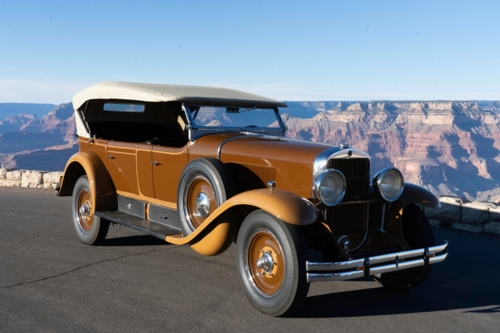
(above: 1929 Cadillac 341-B, the last remaining Harvey Car, on display at the New Mexico History Museum, 2025. Image: Courtesy of the NMHM Photo Archives)
Socioeconomic Impact and Cultural Preservation
The rise of the tourist trade through the Fred Harvey Company had complex socioeconomic implications for the Hopi people. At a time when indigenous economies were being disrupted by the loss of land and the transition to a cash economy, the sale of pottery provided a crucial source of income that allowed families to remain on the mesas. The economic success of Nampeyo and her contemporaries inspired subsequent generations to continue the craft, ensuring that the technical and artistic knowledge was not lost to the forces of assimilation.
However, the pressure to mass-produce for the tourist market also led to periods where the quality of some Hopi arts began to decline. In response, collectors and ethnographers like Mary-Russell Colton established exhibitions such as the Hopi Craftsman Exhibition in 1930 to encourage the maintenance of high standards and traditional methods. These initiatives, coupled with the rigorous standards set by Herman Schweizer at the Harvey Company, helped ensure that Hopi pottery remained a high-art form rather than merely a curio trade.
The collaborative nature of pottery making also became more pronounced as the market grew. In the Nampeyo family, the division of labor became a necessity, particularly as Nampeyo's eyesight failed. Her daughters, Annie, Fannie, and Nellie, and later her granddaughters, often painted the pots that Nampeyo continued to shape by touch. This family-based production model not only met high demand but also reinforced the transmission of the "characteristic style" through lineage, creating a brand identity that was recognizable to collectors worldwide.
Transformation of Identity through Art
By the early twentieth century, Hopi pottery had been transformed from a utilitarian craft into a sophisticated art form that served as a primary point of contact between two cultures. The development of the Sikyatki Revival style allowed potters to reclaim a sense of their own history while simultaneously engaging with the modern world. The materials gathered from the mesa -- the yellow clay, the bee-weed, and the ancestral shards -- became the literal building blocks of a new Hopi identity that was both ancient and commercially viable.
The Fred Harvey Company's marketing of the "Southwest Experience" provided the stage on which this transformation occurred. Through the Indian Detours, travelers were not merely buying a souvenir; they were purchasing a piece of the "romance and mystique" that the Harvey Company had so carefully curated. For the Hopi potters, this relationship was a pragmatic and creative alliance that allowed them to navigate the challenges of the twentieth century while keeping their artistic traditions alive and thriving.
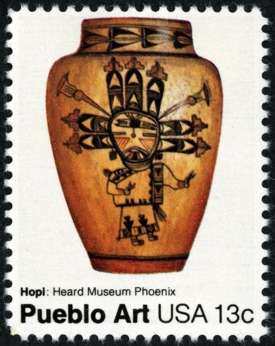
(above: Hopi Pot, American Folk Art Series: Pueblo Pottery, Heard Museum, 13-cent 1977 U.S. stamp. Public domain, via Wikimedia Commons*)
The Enduring Legacy of the First Mesa Potters
The evolution of Hopi pottery during the era of the Fred Harvey Indian Detours represents one of the most successful cultural and artistic revivals in American history. Through the technical mastery of Nampeyo of Hano and the promotional power of the Harvey system, the potters of First Mesa created an aesthetic that remains iconic of the American Southwest. The transition from utilitarian wares to high-art polychrome vessels was driven by a sophisticated understanding of both the archaeological past and the modern commercial landscape. (See Z.S. Liang, Pueblo Street Market in the 1920s, 2006, oil on canvas. The Hilbert Museum of California Art, gift of John Heckenlively, M.D.)
The characteristic style developed during this period -- marked
by thin-walled vessels, vibrant yellow surfaces, and intricate migration
and bird motifs -- continues to influence Hopi potters today. This
legacy is a testament to the resilience and adaptability of the Hopi people,
who successfully harnessed the forces of tourism to preserve and celebrate
their unique cultural heritage. As travelers once embarked on the Indian
Detours to witness the artistry of the mesas, contemporary collectors still
seek out the work of Nampeyo's descendants, honoring a tradition that was
forged at the intersection of the railroad and the mesa-top villages a century
ago.
Prompt:
Research plan:
(1) Research the historical context of the Fred Harvey Company's "Indian Detours" and the Hopi House at the Grand Canyon, focusing on how these programs facilitated the interaction between Euro-American tourists and Hopi potters using .edu and .org sources. (2) Investigate the Sikyatki Revival movement, specifically the work of Nampeyo of Hano, and how her study of ancient archaeological shards at Sikyatki led to the development of the characteristic Polychrome style of the early 1900s. (3) Explore the technical evolution of Hopi pottery materials during this period, including the specific types of local clays used, the transition from utility-focused slips to decorative fine-paste slips, and traditional firing methods. (4) Analyze the development of characteristic motifs such as the eagle tail, migration patterns, and stylized avian forms, examining how these were adapted from ancestral designs to appeal to the aesthetic sensibilities of the "Indian Detours" travelers. (5) Examine the physical evolution of pottery shapes and sizes, specifically looking for evidence on how the need for portability for travelers influenced the creation of smaller bowls, seed jars, and flat-topped canteens. (6) Study the role of the Harvey Company and its buyers in shaping Hopi pottery styles, including how marketing strategies and the demand for "authentic" souvenirs encouraged specific artistic choices among the potters. (7) Look for scholarly articles and museum records on .edu and .org sites that describe the socioeconomic impact of the tourist trade on the Hopi Pueblos and how pottery became a vital link between the traditional economy and the modern market. (8) Synthesize the narratives of individual potters and families from this era to understand the balance they struck between maintaining ancestral cultural identity and innovating for a commercial audience.
We lightly edited this report, added images and provided links to other materials to enhance it. AI is rapidly improving in accuracy, however, the report may contain inaccurate information. This presentation doesn't meet scholarly standards, yet Gemini 3 AI researched and checked it for accuracy. Sources are footnoted in the raw AI report, yet deleted here for a general audience. Please see An Evaluation Of Gemini 3 Deep Research In Replication Of Academic Peer Review, an April, 2026 Gemini 3 Deep Research Report.
 Return to American Pottery Art
Return to Native American Art
*Tag for expired US copyright of object image:

and
**Tag for some rights reserved:

Links to sources of information outside of our web site are provided only as referrals for your further consideration. Please use due diligence in judging the quality of information contained in these and all other web sites. Information from linked sources may be inaccurate or out of date. TFAO neither recommends or endorses these referenced organizations. Although TFAO includes links to other web sites, it takes no responsibility for the content or information contained on those other sites, nor exerts any editorial or other control over them. For more information on evaluating web pages see TFAO's General Resources section in Online Resources for Collectors and Students of Art History.
Copyright 2026 Traditional Fine Arts Organization, Inc. an Arizona nonprofit corporation. All rights reserved.