
Cochiti Pottery in the Early Twentieth Century
a Gemini 3 Deep Research Report
March, 2026
The cultural and artistic evolution of the Cochiti Pueblo during the early twentieth century represents one of the most sophisticated responses to colonialism and the commodification of indigenous identity in the American Southwest. At the heart of this transformation was the interaction between Cochiti potters and the expansive tourism infrastructure developed by the Fred Harvey Company, specifically through the "Indian Detours" program. This period, stretching roughly from the arrival of the railroad in 1880 to the onset of World War II, saw the birth of a unique figurative tradition known as monos, characterized by a blend of traditional materials and radical social commentary. The development of these figures was not merely a commercial endeavor but a complex act of cultural preservation and quiet subversion, as potters utilized the very tourists who purchased their wares as subjects for satirical critique.
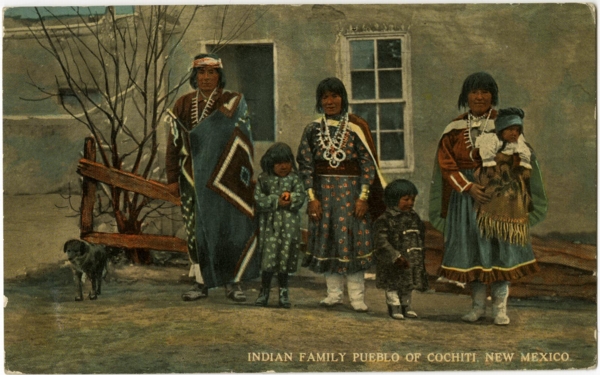
(above: Indian Family, Pueblo of Cochiti, New Mexico, c. 1900s, photographic print, British Museum. Public domain, via Wikimedia Commons*)
Fred Harvey Empire and the Invention of the Southwestern Experience
The rise of the Fred Harvey Company is inextricably linked to the expansion of the Atchison, Topeka & Santa Fe (AT&SF) Railway. Fred Harvey, an English immigrant, founded his first rail-depot lunchroom in Topeka, Kansas, in 1876. His business model, centered on providing high-quality food and professional service in an otherwise rugged Western environment, earned him the moniker "Civilizer of the West". By the time of his death in 1901, the Harvey empire included 45 restaurants and 20 dining cars across twelve states. Following his death, his son Ford Harvey took the helm, navigating a period where train travel was beginning to wane in the face of emerging automobile competition.
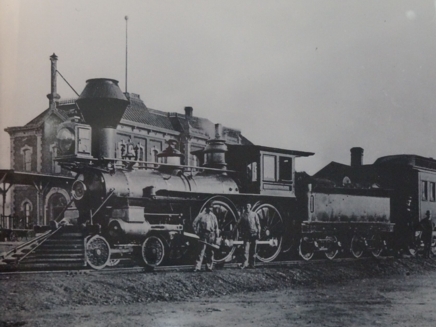
(above: Sherlock locomotive # 5, Topeka, Kansas, c. 1890, Mohave Museum of History and Arts. Public domain, via Wikimedia Commons*)
To revitalize interest in the Southwest, the Harvey Company established an "Indian Department" in 1902, headquartered at the Alvarado Hotel in Albuquerque. Under the direction of Herman Schweizer and J.F. Huckel, this department was tasked with creating an "authentic" tourist experience that marketed the "romance and mystique" of indigenous cultures. The Alvarado's Indian Building became a prototype for the commodification of Native arts, featuring "live exhibits" where Navajo weavers and Pueblo potters worked in staged environments to entice travelers. This institutionalization of the "Indian experience" provided the initial framework for the Cochiti potters to enter the commercial market on a grand scale. (See Z.S. Liang, Pueblo Street Market in the 1920s, 2006, oil on canvas. The Hilbert Museum of California Art, gift of John Heckenlively, M.D.)
Logistics of the Indian Detours: Crossing the Pueblo Frontier
By the mid-1920s, the "Indian Detours" emerged as the Harvey Company's most ambitious attempt to monetize the Northern New Mexico landscape. These tours, lasting one to three days, diverted rail passengers from their transcontinental journeys to explore "wilderness panoramas" and "living pueblos". The tours utilized "Harveycars" -- high-end limousines such as Packards, Franklins, and Cadillacs -- driven by mechanically trained male drivers and accompanied by female "couriers". These couriers were educated young women, often trained by figures like Erna Fergusson, who were required to possess social grace and deep knowledge of the region's history, archaeology, and ethnology.
The interaction between these "detourists" and the Cochiti people was facilitated by the proximity of the Pueblo to the railroad and the detour routes. Cochiti, situated approximately twenty-five miles south of Santa Fe and near the Santo Domingo (Kewa) rail stop, was a frequent destination for these motor coaches. As the cars arrived, tourists were encouraged to observe Pueblo life and purchase handmade crafts. For the Cochiti potters, this influx of visitors represented both a financial opportunity and a cultural intrusion that fundamentally altered their artistic output.
Geological and Botanical Foundations of Cochiti Pottery
The distinctive style developed by Cochiti potters in the early twentieth century was rooted in the specific geology and botany of the Rio Grande Valley. While the subject matter of the pottery evolved to meet tourist demand, the materials remained deeply traditional, emphasizing a continuity of ancestral knowledge. The clay used by Cochiti potters appears reddish-brown when harvested and is formed using hand-coiling methods rather than a potter's wheel.
The aesthetic hallmark of Cochiti pottery is its "black-on-cream" polychrome appearance. To achieve this, a rich cream-colored slip, historically derived from local bentonite (a type of volcanic ash), was applied to the vessel's surface. The black paint was produced through a laborious process of boiling and concentrating the wild bee-plant (Guaco) until it became a dense, carbon-rich pigment. Many historic pieces also featured a wide red band of iron-oxide slip, often sourced from the red cliffs near La Bajada, circling the base.
Genesis of the Mono: Social Commentary in Clay
The most radical innovation of the early twentieth century at Cochiti was the production of monos -- figurative pottery pieces that depicted outsiders. The term mono is the Spanish word for "monkey" or "mimic," a dismissive label often used by contemporary collectors and dealers. However, for the potters, these figures were a form of sophisticated social commentary and a "coping mechanism" for the rapid changes brought by the industrial world.
The monos depicted the very people who were becoming increasingly present in Pueblo life: non-native traders, priests, cowboys, circus performers, and the tourists themselves. These figures often satirized the attire and physical characteristics of the "other," featuring handlebar mustaches, lace-up boots, pinstriped trousers, and elongated bodies. In a subtle act of subversion, Cochiti potters sold these caricatures to the tourists they were mocking, using the newcomers as a "canvas" onto which they projected an indigenous worldview.
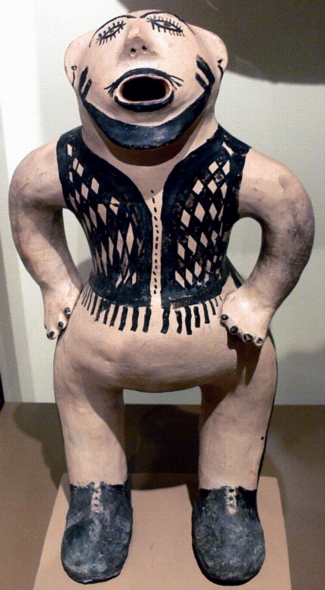
(above: Cochiti Pueblo, Caricature sculpture of a white man, clay, Cochiti Pueblo, New Mexico; North America Department, Ethnological Museum, Berlin, Germany (Bandelier collection, 1883). Public domain, via Wikimedia Commons*)
This figurative tradition also reflected the influence of external entertainment forms that the potters encountered. The arrival of the railroad brought circuses and side-shows, leading potters to create figures of carnival strongmen and "bearded ladies". Despite the modern and sometimes controversial subjects, the construction remained traditional: the figures were built from native clay and pit-fired with the same care as utilitarian jars and bowls.
Language of Symbols: Motifs and Spiritual Signifiers
While the monos captured the social dynamics of the era, Cochiti potters also maintained a rich vocabulary of traditional motifs on more conventional vessels. These designs were not merely decorative but functioned as a visual language conveying prayers for rain, fertility, and survival in an arid environment. Unlike some neighboring Pueblos that prohibited the sale of sacred symbols to outsiders, Cochiti had no such taboo, leading to a proliferation of environmental iconography on commercial pottery.
Common motifs included clouds, rain, and lightning, often rendered in stylized, abstract patterns. A frequent design element was the "sky band," from which long pendulum-like tendrils represented falling sheets of rain.Animals also played a central role; Cochiti became particularly famous for its owl effigies, which symbolized wisdom and the presence of the spiritual world. Other wildlife such as birds, lizards, and raccoons were often painted in isolated, "fussy" patterns that had little connection to one another, a hallmark of the Cochiti Polychrome style.
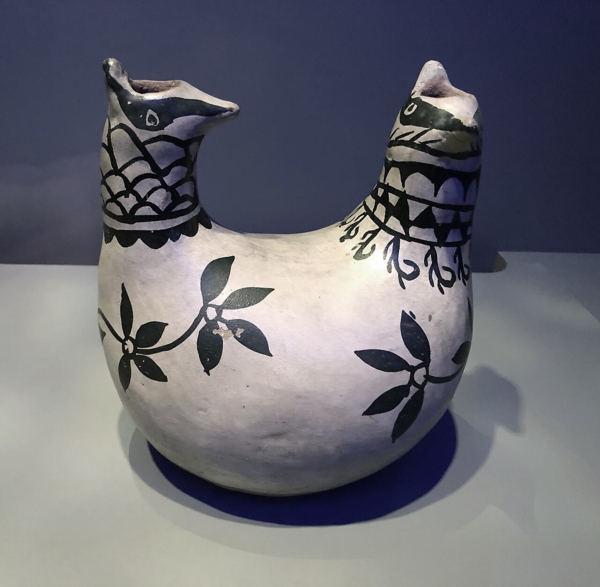
(above: Cochiti Pueblo, effigy storage jar, c. 17901820. Museum label text: Large jars measured grain tribute that the Spanish government imposed on Pueblo households under the econienda, a system of forced Native labor. Photo by Netherzone. Public domain, via Wikimedia Commons**)
A critical feature of any traditional Cochiti vessel was the "spirit break" -- a deliberate gap in the line encircling the top of the pot. This break allowed the spirit of the potter to remain free, ensuring that the act of creation did not capture the artist's essence within the clay. This small detail underscores the fact that even as pottery was being adapted for a global market, it remained grounded in the metaphysical values of the Pueblo.
Economic Necessity and Institutional Conflict
The development of the Cochiti style was driven by profound economic necessity. The late nineteenth and early twentieth centuries were periods of intense hardship for Pueblo communities, as the loss of land and traditional subsistence methods forced a shift toward the cash economy. The Harvey Company's Indian Detours provided a vital source of income, allowing potters to earn money by selling souvenirs to affluent "dudes".
However, this commercial success led to a conflict with institutional gatekeepers of "authentic" Indian art. Organizations like the Indian Arts Fund (IAF), established in 1925, sought to collect traditional Pueblo pottery and set standards for what they considered "pure" art. Scholars and museum directors such as Kenneth Chapman and Edgar Lee Hewitt were often critical of the monos, viewing them as kitsch or "cheap souvenirs".This institutional pressure eventually led to the exclusion of figurative pottery from the inaugural Santa Fe Indian Market in 1922, which caused a decline in the production of large-scale standing figures.
In response to this pressure, Cochiti potters shifted their focus from satirical monos to more conventional human forms, such as the "Singing Mother" or "Madonna" -- seated female figures holding one or two children. Produced between 1920 and 1960, these "Singing Mothers" became the primary figural expression at Cochiti and are now recognized as the direct precursor to the famous "Storyteller" figurines of the late twentieth century.
Identifying the Masters: Genealogies of Cochiti Potters
The artistic shift during the Indian Detours era was led by specific families who passed their knowledge through generations. Because early pottery was largely unsigned, much of this history is reconstructed through the lineages of contemporary masters. Potters like Laurencita Herrera were instrumental in teaching the traditional methods to their children and grandchildren, ensuring that the Cochiti palette and firing techniques remained intact.
These artists navigated a delicate balance between individual creativity and communal tradition. While the monos were often experimental, they utilized a shared vocabulary of designs that identified the work as undeniably Cochiti. The ability of these potters to innovate within the confines of traditional materials allowed them to capture the "curiosity, fear, humor, and trepidation" of their community during a period of radical upheaval.
Architectural and Cultural Stage: The Harvey House as Conduit
The success of Cochiti pottery was inextricably linked to the physical spaces created by the Harvey Company. The Indian Building at the Alvarado Hotel in Albuquerque served as the "headquarters" of this cultural trade.Designed by Mary Colter, the "Architect of the Southwest," these spaces used Pueblo-style architecture and interior design to create a backdrop that made the purchase of indigenous crafts feel like an integral part of the Western adventure.
At the Alvarado and later at La Fonda in Santa Fe, potters would often bring their wares to the hotels or to the rail stations where the Harveycars were parked. Some pieces even entered the Fred Harvey Company's prestigious "Fine Arts Collection," a curated entity separate from their general trading inventory. The provenance of a Cochiti vessel --whether it was sold at the Indian Building in Albuquerque or displayed at La Fond -- added to its value and contributed to the widespread recognition of Cochiti as a center for figurative art. (See Z.S. Liang, Pueblo Street Market in the 1920s, 2006, oil on canvas. The Hilbert Museum of California Art, gift of John Heckenlively, M.D.)
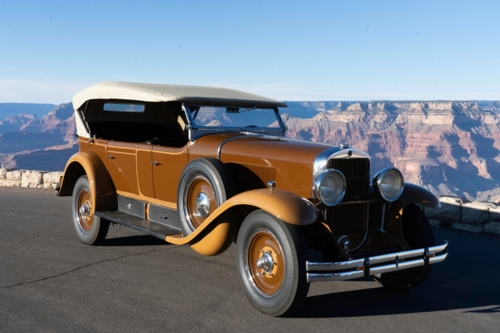
(above: 1929 Cadillac 341-B, the last remaining Harvey Car, on display at the New Mexico History Museum, 2025. Image: Courtesy of the NMHM Photo Archives)
The Indian Detours couriers played a vital role in this marketing process. Trained to speak with "social grace," they interpreted the pottery's motifs for the tourists, often reinforcing the "romance and mystique" that the Harvey Company sought to promote. This mediated interaction meant that the potters were not just selling clay vessels; they were selling a narrative of a "vanishing" yet vibrant culture that was both accessible and exotic.
Legacy of Subversion and Resilience
The development of Cochiti pottery in the early twentieth century stands as a testament to the resilience of Pueblo culture in the face of industrialization and mass tourism. The monos were far more than simple curios; they were a record of a people observing their observers. By using traditional materials-the clay of the earth, the red slip of La Bajada, and the carbon of the bee-plant -- to depict the outsiders brought by the Harveycars, the Cochiti potters asserted their agency and maintained their identity during a period of intense pressure.
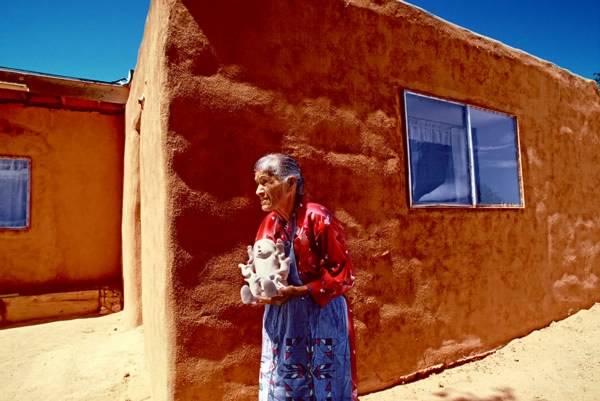
(above: Helen Cordero, 1986, Photo by Tom Pich, a work of the National Endowment for the Arts, taken or made as part of that person's official duties. As a work of the U.S. federal government, the image is in the public domain in the United States.*)
The "Singing Mothers" of the mid-century and
the later "Storyteller" revival by Helen Cordero were built upon
the foundations laid by these early twentieth-century artists. Today, the
revival of the mono tradition by contemporary artists like Virgil Ortiz
ensures that the social commentary of the Harvey era continues to be heard.
The pottery produced for the Indian Detours was a bridge between two worlds,
a sophisticated artistic response that allowed the Cochiti people to navigate
the complexities of the modern world while remaining deeply rooted in the
traditions of their ancestors. Through their art, the Cochiti potters transformed
the intrusion of the railroad into a medium for cultural expression, proving
that even in the most transactional environments, the spirit of the Pueblo
could never be truly commodified.
Prompt:
Research plan:
(1) Research the history of the Fred Harvey Company and the Indian Detours on .edu and .org websites, specifically focusing on the tours established to Cochiti Pueblo in the early twentieth century. (2) Investigate the characteristic materials used by Cochiti potters during this era, including the specific creamy slips and the use of the Guaco (bee plant) for black carbon paint. (3) Explore the development of figurative pottery, particularly the social-commentary figures known as monos, and how tourists and the Harvey Company received them. (4) Analyze the shift from traditional utilitarian pottery to market-driven decorative pieces by examining the economic motivations of the Cochiti potters. (5) Identify common motifs and design elements (such as clouds, rain, and wildlife) that became hallmark features of the Cochiti style during the peak of the Indian Detours. (6) Find scholarly articles or museum archives that discuss how the Fred Harvey Company's marketing and the aesthetic preferences of Eastern travelers influenced Pueblo artistic output. (7) Look for biographical information or specific case studies of early twentieth-century Cochiti potters to provide personal context for the narrative. (8) Synthesize information regarding the cultural interaction between the potters and the travelers to explain how this relationship shaped the unique identity of Cochiti ceramic art.
We lightly edited this report, added images and provided
links to other materials to enhance it. AI is rapidly improving in
accuracy, however, the report may contain inaccurate information. This presentation doesn't meet scholarly standards, yet Gemini
3 AI researched and checked it for accuracy. Sources are footnoted in the
raw AI report, yet deleted here for a general audience. Please
see An Evaluation Of Gemini
3 Deep Research In Replication Of Academic Peer Review, an April, 2026 Gemini
3 Deep Research Report.
 Return to American Pottery Art
Return to Native American Art
*Tag for expired US copyright of object image:

and
**Tag for some rights reserved:

Links to sources of information outside of our web site are provided only as referrals for your further consideration. Please use due diligence in judging the quality of information contained in these and all other web sites. Information from linked sources may be inaccurate or out of date. TFAO neither recommends or endorses these referenced organizations. Although TFAO includes links to other web sites, it takes no responsibility for the content or information contained on those other sites, nor exerts any editorial or other control over them. For more information on evaluating web pages see TFAO's General Resources section in Online Resources for Collectors and Students of Art History.
Copyright 2026 Traditional Fine Arts Organization, Inc. an Arizona nonprofit corporation. All rights reserved.