
Hawaiian Woodcarving
by Grok 4 Expert
April, 2026
When you think about Hawaii in the mid-1800s, it's this wild mix of ancient traditions clashing with a flood of outsiders -- missionaries, whalers, traders, all showing up and shaking things up. Woodcarving, a cornerstone of Hawaiian culture for centuries, was right in the middle of that shift. Back before Captain Cook crashed the party in 1778, native Hawaiians were masters at turning local woods like kou, milo, and kamani into everything from massive temple idols to everyday bowls and tools. They didn't have metal, so they used polished stone adzes, shark-tooth knives, coral rasps, and even sand and water to shape and smooth the wood.
The carvings weren't just pretty; they packed a punch with symbolism, channeling mana -- the spiritual power that ran through everything. Temple images, those big, squat figures of gods like Ku the war god, were grotesque on purpose, with bulging eyes, protruding tongues, and defiant poses to scare anyone approaching the heiau platforms. These weren't delicate artworks; they were meant to evoke fear and awe, guarding sacred spaces and embodying the ferocity of the divine.
By 1850, though, a lot had changed. The kapu system -- the strict religious laws that governed everything, including who could carve what -- had been smashed in 1819 when King Liholiho ditched the old ways after his mom and a French dude convinced him to eat with women at a feast. That led to a massive purge: temples torn down, idols burned or hidden in caves. Woodcarving as a sacred art pretty much screeched to a halt, and what survived was mostly stashed away or collected by curious foreigners. But Hawaii wasn't isolated anymore; the islands were buzzing with Western influences, and woodcarving adapted in sneaky ways.
Missionaries brought Christianity, but they also introduced new tools like metal chisels and saws, which made carving easier and more precise. Whalers and merchants needed furniture and souvenirs, so local craftsmen started blending traditional skills with European styles. Beautiful calabash bowls -- "umeke" in Hawaiian -- originally made from gourds, by the mid-1800s were being carved from wood like kou, which was soft and easy to work with stone tools, but got scarcer as forests were cleared for sugar plantations. These bowls weren't just for poi; they became status symbols, polished to a dark sheen and sometimes incised with geometric patterns that echoed older tapa cloth designs, like zigzags and lozenges dotted for emphasis.
Around this time, immigrant artisans started trickling in, bringing their own flair and filling the gap left by the decline in purely native carving. Take Franz "Frank" Nikolous Otremba, a German born in 1851 who trained in Italy as a woodcarver and cabinetmaker before arriving in Honolulu around 1882. He wasn't Hawaiian, but he dove right into the local scene, partnering with an Italian named Lorenzo Santini to crank out furniture and decorative pieces.

(above: Franz 'Frank' Nikolous Otremba (1851-1910), (after Thomas Ridgeway Gould), Born Germany active Hawai'i, Small Replica of King Kamehameha I, 1903, wood, carved and gilded. Photo courtesy of Hiart, Wikimedia Commons*)
What made Otremba stand out was his knack for capturing Hawaiian icons in wood. In the 1880s, King Kalakaua sought to revive Hawaiian pride with the Kamehameha Statue -- a bronze monument to the islands' great unifier, unveiled in 1883. Otremba saw an opportunity and started making miniature replicas out of local woods like koa and black walnut. His master version was a three-foot-tall stunner, with the king's feather cloak and helmet gilded for that royal pop, standing on a fluted pedestal. He exhibited it in 1885, sold it for $25 to a palace official, and even made smaller ones in plaster or wood for tourists and events, like prizes at shooting matches. These weren't sacred like the old idols, but they kept woodcarving alive as a way to honor Hawaiian history amid all the change. Otremba's work bridged worlds -- European precision meeting Hawaiian symbolism -- and he kept at it until his death in 1910, even carving a fancy koa bed for royalty in 1904.
As the 19th century rolled on, woodcarving got tangled up with Hawaii's economic boom. Sugar and pineapple plantations exploded, bringing in laborers from China, Japan, Portugal, and elsewhere, who added their own woodworking tricks to the mix. Traditional artifacts like kava bowls -- those polished wooden vessels for the ceremonial drink 'awa -- evolved too. They were still carved from hardwoods, but now with iron tools introduced around 1800, allowing for smoother curves and finer details. By the 1870s, lathes became common, mechanizing the process and making bowls more uniform for the growing tourist trade.
Kou wood gave way to koa, that gorgeous, grainy acacia that's now synonymous with Hawaiian crafts, because kou trees were getting wiped out. These bowls had unique aspects: their deep, rounded shapes mimicked gourds but with a wooden durability, often left with tool marks for texture or buffed to a mirror finish. What made them special was how they symbolized hospitality -- the calabash as a shared vessel in Hawaiian culture -- but now they were commodities, sold to visitors as exotic mementos of paradise.
Hawaii became a U.S. territory in 1900 after the controversial annexation in 1898, and that flipped the script even more. Woodcarving shifted from sacred or utilitarian to something more artistic and commercial, influenced by the Arts and Crafts movement sweeping the mainland. Native Hawaiians were reclaiming their heritage amid cultural suppression, but woodcarving wasn't as prominent as hula or music in that revival. Instead, it popped up in hybrid forms. For instance, the Laie Hawaii Temple, built by the Mormon Church in 1919, incorporated local woods like monkeypod -- actually a South American import from the 1800s -- for its interiors, blending Hawaiian motifs with Western architecture. Monkeypod's light color and workability made it perfect for carvings, and it became a staple for tourist items like bowls and ukuleles. The temple's woodwork wasn't traditional idolatry, but it echoed the old reverence for natural materials, with intricate panels and furnishings that nodded to Polynesian patterns.
Enter the early 20th-century artists who made woodcarving their own. Fritz Abplanalp, a Swiss immigrant born in 1907, arrived in Hawaii in the 1920s and became a go-to woodcarver until his death in 1982. He wasn't native, but he immersed himself in Hawaiian themes, carving everything from furniture to sculptures that blended European realism with local legends. His works stood out for their detail -- think flowing lines capturing ocean waves or mythical figures like the pig-god Kamapua'a, but with a polished, modern twist that appealed to collectors.

(above: Fritz Abplanalp, Pikake lei perfume bottle, wood, c. 1935, Honolulu Museum of Art accession 2013-60-01. Photo courtesy of Hiart, Wikimedia Commons*)
What made Abplanalp important was his role in preserving techniques during a time when traditional knowledge was fading; he taught and exhibited, keeping the craft alive as Hawaii modernized. Then there's Marguerite Louis Blasingame, born in Honolulu in 1906 to a Hawaiian mother and French father, who became a sculptor blending wood with stone and bronze. Her pieces from the 1930s and '40s, like bas-reliefs of native figures, had a unique fusion: the organic warmth of wood evoking ancient idols, but with Art Deco influences from her Paris training. Blasingame's work was special because it reclaimed Hawaiian identity through sculpture -- her "fallen male nude" in stone bas-relief echoed the muscular, defiant poses of old temple gods, but in a contemporary voice. She died young in 1947, but her legacy highlighted how woodcarving evolved into fine art, bridging cultural gaps.
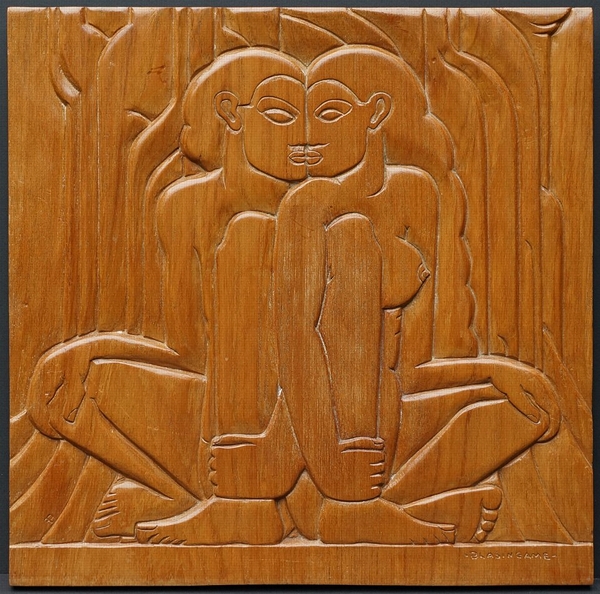
(above: Marguerite Louis Blasingame, The Lovers, c. 1935, carved wood panel. Photo courtesy of Hiart, Wikimedia Commons*)
The 1920s and '30s saw woodcarving tie into tourism. Hotels like the Royal Hawaiian in Honolulu featured "Persian" dining rooms with wooden pillars echoing Hawaiian lanai architecture, but really drawing from global influences via collectors like Doris Duke. Duke's Shangri La estate, started in 1937, incorporated wooden elements inspired by Islamic and Polynesian designs, using local woods for talar-style porches that blended with the islands' open-air vibe. This wasn't pure Hawaiian carving, but it showed how the craft adapted to elite tastes, with intricate woodwork symbolizing exotic escape.
Meanwhile, everyday artifacts like poi pounders and paddles kept traditional forms, but now incised with patterns using shark teeth or metal for tourists. Museums like the Bishop Museum in Honolulu became guardians, housing 19th-century survivors like the upright pole from a Makahiki Lono image -- a ritual staff carved with simple, symbolic faces that represented the fertility god Lono during harvest festivals. These pieces were unique for their portability and ritual role, wrapped in kapa cloth and carried in processions, embodying the spiritual continuity even as Christianity dominated.
World War II shook things up again, with Hawaii as a military hub from 1941. Woodcarving took a hit as resources went to the war effort, but it bounced back in the postwar boom. By the 1950s, as statehood loomed in 1959, artists like Isami Doi (born 1903) were experimenting with woodblock prints influenced by carving techniques, though he focused more on paper. The real gems were the household gods from caves, like the realistic female figures from Kawaihae, polished and lifelike, hidden since the 1819 reforms but rediscovered in the early 1900s. These were special for their naturalism -- unlike the grotesque temple ones -- suggesting they were portraits of ancestors, full of quiet dignity and mana. What made them important was their survival as links to pre-contact life, showing woodcarving's emotional depth beyond the scary gods.

(above: Isami Doi, Untitled (Dog and Bone), 1941, woodcut, Honolulu Museum of Art accession 21081. Photo courtesy of Hiart, Wikimedia Commons*)
Through it all, from 1850 to 1950, Hawaiian woodcarving wasn't static; it morphed from sacred ritual to cultural souvenir to modern art. The unique aspects -- like the deliberate grotesqueness for spiritual power, the shift to tourist bowls with their glossy finishes, and the hybrid works of immigrants like Otremba and Abplanalp -- made it resilient. Artists like Blasingame brought personal stories, infusing wood with Hawaiian soul in a changing world. Sure, a lot was lost, but what endured told a story of adaptation, where wood whispered of gods, kings, and everyday aloha amid the waves of change. It's that blend of ancient ferocity and modern grace that keeps it fascinating, a carved legacy in the heart of the Pacific.
We lightly edited this article based on 87 sources, added images and provided links to other materials to enhance it. AI is rapidly improving in accuracy, yet the article may have inaccurate information.
Prompt:
In about 1,500 to 2,500 words, using an informal writing style with only paragraphs (excluding section headings, bullet points, or tables), write a narrative about the history of Hawaii woodcarving from 1850 through 1950. Explain any unique and special aspects of highly regarded artists and their works that makes them important. Identify. Research only .edu and .org sites.
Follow up inquiry: Feather work in Hawaiian carvings
Hawaiian featherwork is like uncovering this vibrant layer of history where colors pop against the backdrop of ancient rituals and royal power. Featherwork, or n? hulu ali'i in Hawaiian, wasn't just decoration -- it was a profound expression of status, spirituality, and craftsmanship that intertwined with other arts like carving. From the late 18th century onward, explorers like Captain Cook were blown away by these pieces, collecting them as exotic treasures, but for native Hawaiians, they were sacred symbols tied to the gods and chiefs.
The practice dates back centuries, with feathers harvested from endemic birds like the bright red 'i'iwi or the golden-yellow '?'?', which were humanely trapped, plucked, and released to sustain populations. These feathers were then meticulously attached to bases made from plant fibers, creating objects that shimmered with mana, that spiritual essence. What makes it fascinating in the context of carvings is how featherwork often merged with sculpted forms, especially in god images, turning rigid structures into living embodiments of deities.
Think about the akua hulu manu -- these feathered god images that are the ultimate fusion of featherwork and carving-like craftsmanship. They're not your typical wooden statues; instead, they're built on a wicker framework from 'ie'ie vines, twisted and shaped into anthropomorphic heads with gaping mouths, bulging eyes, and crested helmets that echo the mahiole worn by warriors. The base is a rigid basketry form, almost like a carved sculpture in its three-dimensionality, then overlaid with olon? fiber netting -- a tough, native touchardia plant twisted into cords.
Feathers are bundled in tiny groups, tied with fine threads, and stitched onto this net in patterns that create bold contrasts: red for power, yellow for divinity, black accents for features like eyebrows or mouths. What sets them apart is the incorporation of other materials that add a carved quality -- pearl shell for eyes that gleam with otherworldly intensity, dog teeth lining the snarling mouth to evoke ferocity, and sometimes human hair for a beard or topknot. And here's where carving comes in: some akua hulu manu include wooden elements, like internal supports or bases made from 'lii 'au wood, giving them stability and a hidden skeletal structure that's essentially a simple carving.
These weren't mass-produced; each was a unique artifact, often representing K?, the god of war, politics, and prosperity, specifically in his form as K?k?'ilimoku, the "snatcher of islands." Their importance? They served as kino lau -- physical bodies for the god -- carried into battle on poles, placed in luakini heiau temples for rituals, or buried with high chiefs to guide their spirits. Only about 19 survive today, scattered in museums, each one a testament to how featherwork elevated carved forms into divine protectors.
Featherwork didn't exist in isolation; it often complemented or enhanced carvings. Take the mahiole, those crested helmets that chiefs wore into battle or ceremonies. The base is a stiff fiber framework, woven from 'ie'ie or other vines in a basketry technique that's akin to sculpting -- layers built up to create a rounded skull cap with a high ridge running front to back, sometimes extending like a mohawk for dramatic effect. This structure gets covered in olon? netting, then blanketed in feathers: red and yellow dominating, with patterns of triangles, crescents, or stripes that symbolized lineage or achievements.
While not strictly woodcarved, the rigidity and shaping mimic carved helmets from other Polynesian cultures, and in some cases, wooden reinforcements were added for durability. These helmets were paired with 'ahu'ula cloaks, long capes of feathers on netting that draped over the shoulders, providing spiritual armor. Chiefs like Kamehameha I wore them, and replicas or carvings of such figures often depict these feathered elements -- think of wooden statues where the cloak is incised to imitate feather textures, or gilded to capture the shine.
The unique aspect here is the symbolism: feathers represented captured birds' mana, transferring flight and freedom to the wearer, making them untouchable in a way that plain carvings couldn't. Diving deeper into the techniques, the process was labor-intensive, highlighting why these pieces were reserved for ali'i, the elite. Birdcatchers, or po'e k?huli, used sticky sap on poles to snag birds in the forests, plucking only the prime feathers before letting them go -- a sustainable practice that speaks to Hawaiian respect for nature.
Women often handled the bundling: tying five to ten feathers together with olon? thread, then men or specialists attached them to the net in overlapping rows, creating a seamless, velvety surface. For god images like akua hulu manu, the carving element came in shaping the wicker -- twisting vines into a head form up to two feet tall, with exaggerated features to instill awe and fear. The mouth might be framed with dog teeth, carved or filed for fit, and eyes inset with pearl shell disks, sometimes with wooden pegs holding them. One famous example, associated with Kamehameha, stands about 27 inches tall, with a crest like a built-in mahiole, red feathers covering most of the body, yellow at the neck and crest, black for details -- it's a masterpiece that blends soft feathers with hard, carved-like edges.
What makes these special is their role in warfare: carried by priests ahead of armies, they were believed to snatch victory, their feathered forms fluttering like living beings. In temples, they stood alongside wooden carvings of gods, creating a multimedia shrine where featherwork added color and movement to static wood. As Hawaii changed in the 19th century, with missionary influences and the overthrow of the kapu system in 1819, featherwork evolved but retained its ties to carving.
Many sacred items were destroyed or hidden, but royal pieces survived as symbols of heritage. K?hili, those tall feather standards, are another example -- feathers bundled into a cylindrical head, attached to a long wooden pole that's often carved with spirals or inlaid with ivory for grip and beauty. These poles were true carvings, turned on lathes by the mid-1800s thanks to Western tools, blending traditional featherwork with imported techniques. They flanked thrones or were carried in processions, their heigh -- up to 20 feet -- proclaiming royalty.
In exhibitions like the Royal Hawaiian Featherwork at places like the de Young Museum, you see how these items tell stories: a k?hili from the 1800s might have a carved handle depicting ancestral motifs, feathers in royal yellow and red evoking the sun and bloodlines. The cultural significance? They weren't just pretty; they embodied genealogy, with patterns coding family histories that only initiates understood. Artists in collections like those at the Bishop Museum preserved techniques, and modern revivals by folks like Rick San Nicolas recreate capes using pheasant feathers as substitutes for extinct birds, often pairing them with carved wooden displays.
Exploring further, the connection to woodcarving becomes evident in how featherwork influenced sculpted representations. Wooden statues of gods, like those of K? in temples, were sometimes adorned with actual feathers or had surfaces carved to mimic feather patterns -- incised lines for quills and paint for color. In the post-contact era, carvers like Franz Otremba, as mentioned in earlier histories, made miniature Kamehameha statues with gilded feather cloaks, where the "feathers" were carved and painted wood, capturing the essence without real plumes.
This hybrid approach kept traditions alive amid deforestation and bird extinctions. The '?'? bird, key for yellow feathers, went extinct by 1900 due to habitat loss and introduced diseases, forcing adaptations. Yet, the spiritual core remained: featherwork in carvings symbolized elevation, turning earthly materials into divine conduits. In burial contexts, akua hulu manu were placed in caves with the dead, their feathered forms guiding souls, often alongside carved wooden coffins or staffs.
What really makes these pieces important are the artists behind them -- though often anonymous in ancient times, they were specialists, perhaps from guilds tied to the gods. In the 20th century, revivers like contemporary makers draw from museum pieces, like the British Museum's akua hulu manu with its wicker core and dog-tooth grin, to teach techniques.
Unique aspects include the abstract designs: not realistic, but geometric shapes that held esoteric meanings-crescents for the moon god, triangles for strength. Compared to plain woodcarvings, which were grotesque and static, featherwork added dynamism, with colors shifting in light, making gods seem alive. Exhibitions highlight this: the LACMA show in 2016 noted fewer than 300 historic pieces survive, each a rare gem blending artistry and spirituality. By the mid-20th century, as Hawaii approached statehood, featherwork in carvings became more about cultural revival than ritual. Museums repatriated items, like an akua hulu manu from the American Museum of Natural History, recognizing their sacredness.
Modern artists experiment, like Ian Kuali'i with paper-cut
versions inspired by akua hulu manu, or Boris Huang blending Taiwanese and
Hawaiian styles in feather installations. But the core allure remains: how
feathers transform carved bases into something ethereal, bridging human
craft and divine power. It's a narrative of resilience, where amid colonization
and change, these feathered carvings whisper stories of aloha '?ina -- love
for the land -- and the mana that flows through every plume and whittled
vine.
We lightly edited the article, added images and provided
links to other materials to enhance it. AI is rapidly improving in
accuracy, yet the article may have inaccurate information.
 Return to Hawaii Art History
*Tag for expired US copyright of object image:

and
**Tag for some rights reserved:

Links to sources of information outside of our web site are provided only as referrals for your further consideration. Please use due diligence in judging the quality of information contained in these and all other web sites. Information from linked sources may be inaccurate or out of date. TFAO neither recommends or endorses these referenced organizations. Although TFAO includes links to other web sites, it takes no responsibility for the content or information contained on those other sites, nor exerts any editorial or other control over them. For more information on evaluating web pages see TFAO's General Resources section in Online Resources for Collectors and Students of Art History.
Copyright 2026 Traditional Fine Arts Organization, Inc. an Arizona nonprofit corporation. All rights reserved.