
Hawaii Art History: 1850-1945
a Gemini 3 Deep Research Report
April, 2026
The evolution of artistic expression in the Hawaiian Islands between 1850 and 1945 constitutes a distinct chapter in American art history, characterized by a complex interplay between indigenous cultural resilience, the prestige of monarchical patronage, and the transformative influence of Western aesthetic movements. This period witnessed the islands' transition from an independent, internationally recognized kingdom to a United States territory, a socio-political shift mirrored in the mediums, styles, and subjects of the artists working within the archipelago. Unlike the development of art in the continental United States, which often mirrored European trends with a slight delay, Hawaiian art was profoundly shaped by its geographic isolation, the sublime power of its active volcanoes, and the unique racial and cultural synthesis that occurred at this Pacific crossroads.
Royal Legacy and the Foundation of Western Styles (1850-1893)
In the mid-19th century, the Hawaiian monarchy served as the primary engine for artistic production. The ali'i (chiefly class) understood that the visual language of the West. -- Specifically, formal portraiture and neoclassical sculpture were critical tools for asserting sovereignty and diplomatic legitimacy. By commissioning portraits that adhered to European conventions while incorporating traditional Hawaiian regalia, such as the 'ahu 'ula (feather cloak) and k'hili (feather standard), the monarchs presented a sophisticated hybridization of identities that challenged colonial narratives of "primitivism." During the reign of the Kamehameha dynasty, artists such as the French painter Eugénie Le Brun and the English artist Robert Dampier were commissioned to create state portraits that reflected the majesty of the House of Kamehameha. These works were not merely likenesses; they were political manifestos. For instance, portraits of King Kamehameha II and Queen Kam'malu were intended to meet European powers on an equal footing, utilizing the "stipulated conformity" of Western court art to protect Hawaiian interests abroad.

(above: The original statue of King Kamehameha I, in Kapa?au, North Kohala. Sculptor: Thomas Ridgeway. Gould Photo by Karl Magnacca. Public Domain via Wikimedia Commons**)

(above: Franz 'Frank' Nikolous Otremba (1851-1910), (after Thomas Ridgeway Gould), Born Germany active Hawai'i, Small Replica of King Kamehameha I, 1903, wood, carved and gilded. Photo courtesy of Hiart, Wikimedia Commons*)
The arrival of photography in approximately 1845 provided a new, more immediate medium for the ali?i to document their genealogies. King Kamehameha III recognized the democratic potential of this technology and acted as a patron to ensure that photographic services were accessible to his subjects. This period saw a proliferation of portrait photographs that emphasized matrilineal connections and the political power of ali?i wahine (chiefly women), reflecting the traditional Hawaiian emphasis on kinship as the source of authority.
Kal'kaua Renaissance and the Statue of Kamehameha
King David Kal'kaua's reign (1874-1891) is frequently described as the First Hawaiian Renaissance. Kal'kaua was a visionary patron who actively worked to revitalize Hawaiian culture despite decades of missionary suppression. He encouraged the public performance of hula, promoted the 'ukulele -- a hybrid of Portuguese and Hawaiian influences -- and increased funding for the Hawaiian National Museum.
One of the most enduring artistic legacies of this era is the statue of King Kamehameha I, commissioned in 1878 to commemorate the centennial of Captain Cook's arrival. The commission was awarded to the American sculptor Thomas Ridgeway Gould, who worked in Florence, Italy. The statue's history is famously dramatic: the original cast was lost at sea near the Falkland Islands, leading to the commissioning of a second cast. When the original was eventually recovered and brought to Hawai?i, the two statues were placed in different locations -- one in Honolulu and the original in Kohala, the King's birthplace. Gould's work utilized a neoclassical style, potentially modeled after the Augustus of Prima Porta, to frame Kamehameha as a "Pacific Hero," a deliberate attempt to bolster the monarchy's image through a fusion of Hawaiian attributes and Roman heroic imagery.
Volcano School and the Aesthetic of the Sublime
The late 19th century also saw the emergence of a specific movement known as the Volcano School. This group of non-native artists was captivated by the dramatic, intermittent activity of Kilauea and Mauna Loa during the 1880s and 1890s. Unlike the academic landscapes of the continent, the Volcano School focused on the "sublime" -- a Romantic concept emphasizing the awe-inspiring and terrifying power of nature. Jules Tavernier (1844-1889) is arguably the most critical figure in the history of the Volcano School. Born in Paris and trained at the École des Beaux-Arts, Tavernier arrived in Honolulu in 1884 with a reputation as a celebrated painter. His background as a field artist during the Franco-Prussian War and an illustrator for major American publications like Harper's Weekly gave him a unique ability to capture both the technical details and the atmospheric drama of the Hawaiian landscape.

(above: Jules Tavernier, Volcano at Night, c. 1885-89, oil on canvas, 19 x 36 inches, Honolulu Museum of Art 2562.1. Public domain, via Wikimedia Commons*)
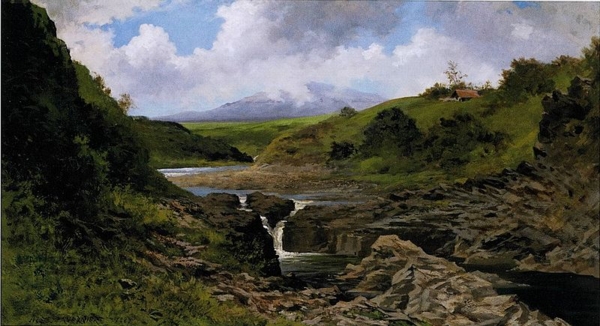
(above: Jules Tavernier, Wailuku Falls, c. 1886, oil on canvas, 18.8 x 36 inches, Honolulu Museum of Art 2563.1. Public domain, via Wikimedia Commons*)
Tavernier's evolution in Hawai'i was marked by a shift from the "indoor landscapes" of his classical training to a more Impressionistic focus on light and color. He became famous for his oil and pastel depictions of the "burning lake" at Kilauea. These nocturnal scenes, often painted with brilliant, swirling hues, captured the incandescent energy of the eruptions. Tavernier's uniqueness lay in his ability to imbue the landscape with a sense of mystery; he often created "studies" of the volcano before he had even seen it, demonstrating his mastery of color and his role as a romantic visionary rather than a mere documentarian. His work remains highly regarded in museum exhibits, such as those at the Bishop Museum and the Honolulu Museum of Art, and he is frequently cited as the premier artist of the 19th-century Hawaiian interior.
Physical Demands of Volcano School Painting
The geography of the islands imposed significant physical constraints on these artists. Reaching the active craters of the Big Island required an arduous two- to three-day journey on horseback. This physical immersion in the wilderness forced artists like Tavernier and the Japanese-born painter Yunosuke Ogura to work quickly, often sketching on-site and finishing larger canvases in their studios. The resulting works were characterized by a raw, atmospheric quality that differentiated them from the more polished, pastoral landscapes common in the eastern United States at the time.
Institutionalization of Art and the Kilohana Art League (1893-1910)
The illegal overthrow of the Hawaiian monarchy in 1893 by a group of businessmen, aided by U.S. forces, created a profound rupture in the islands' artistic patronage system. The focus of art began to shift from royal sovereignty to the cultural ambitions of the new settler-led government and the burgeoning tourism industry. In 1894, one year after the overthrow, a group of white Honolulu residents founded the Kilohana Art League. While the League described itself as a means to foster "truer, higher art culture," its underlying mission was deeply political. The league's logo, which depicted "Hawaiian art" in the guise of a Greek muse, ignored indigenous cultural histories in favor of Euro-American classical roots. The members of the League were often directly or indirectly involved in the movement to join the United States as an annexed territory, and their exhibitions of painting, photography, and wood carving served to formalize settler ambitions to transform Hawai?i into a culturally "American" community. This period saw a marginalized treatment of indigenous visual culture, which was often relegated to "prehistoric" or "folk" categories in early territorial art histories. However, the League did provide a structured environment for artists to exhibit, and it was through this league that the next generation of "giant" figures, such as D. Howard Hitchcock, began to exert their influence. As the 20th century dawned, two artists emerged who would define the visual identity of the Territory of Hawai'i: David Howard Hitchcock and Lionel Walden. Together with Madge Tennent, they are often referred to as the "three giants" of early 20th-century island painting.
D. Howard Hitchcock: The Native Son's Evolution
D. Howard Hitchcock (1861-1943) was born in Hilo, the descendant of a long line of missionary families who arrived in 1832. This native-born status gave him an intimate understanding of the islands' topography and flora that was unique among his contemporaries. Hitchcock studied under Jules Tavernier before traveling to Paris to attend the Académie Julian and the École des Beaux-Arts.

(above: David Howard Hitchcock, Punalu'u, 1913, Honolulu Museum of Art, accession 12789.1. Public domain, via Wikimedia Commons*)
His artistic style evolved from the dramatic, dark-palette influence of the Volcano School to a vibrant, light-filled Impressionism that was perfectly suited to the Hawaiian climate. Hitchcock is particularly noted for his ability to capture the atmospheric haze of the mountains and the unique turquoise of the coastal waters. His 1928 painting "Waikiki Beach, Diamond Head, Oahu" is a masterclass in this style, utilizing loose brushwork and a soft palette to create a sense of tranquil beauty. His importance is reflected in his high level of mention in museum exhibits like "He Makana" and his frequent appearances in appraisals on programs like Antiques Roadshow, where he is cited as arguably the most important early 20th-century Hawaiian artist.
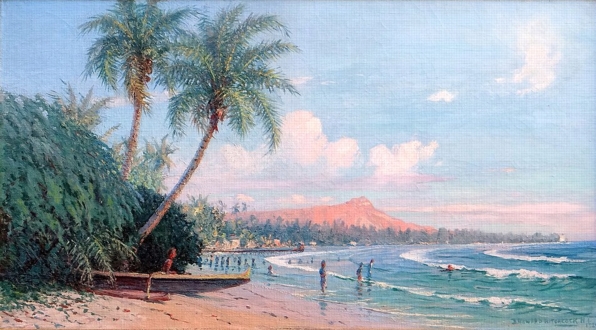
(above: D. Howard Hitchcock, Waikiki Beach, Diamond Head, Oahu, 1898. Private Collection. Public Domain via Wikimedia Commons**)
Lionel Walden: The Master of the Pacific Sea
Lionel Walden (1861-1933) arrived in Hawai?i in 1911 at the invitation of local artist Kimo Wilder. Unlike many of his peers, Walden was already an internationally acclaimed figure, having won medals at the Paris Salon and been inducted into the French Legion of Honor. While Hitchcock focused on the lushness of the land, Walden was the "supreme interpreter of the Hawaiian seas".
Walden was fascinated by the ocean in "all its moods, colors, and actions," specializing in paintings of stormy seas and nocturnal coastal scenes. His technical uniqueness lay in his ability to render the transparency and movement of waves. Works such as "The Torchlight Fishermen, Waikiki" (c. 1920) and " demonstrate a mastery of the interplay between artificial and natural light. Walden's influence was such that he spent half of every year in Hawai?i and the other half in France, effectively bridging the two art worlds. His auction records, which include a sale of over $73,000 for "Breaking Waves," underscore his enduring market and institutional importance.
The Modernist Turn and the Rise of the Human Figure (1920-1941)
In the 1920s, the focus of Hawaiian art began to shift from the landscape to the human figure. This movement, known as Hawaiian Modernism, was characterized by a move away from pastoral Impressionism toward more expressive, rhythmic, and architectonic forms. This era was dominated by a group of women artists who challenged the prevailing tourist tropes of the time. Madge Tennent (1889-1972) is widely considered the most significant individual contributor to 20th-century Hawaiian art. Born in England and trained in France under the academic master William-Adolphe Bouguereau, Tennent arrived in Hawai'i in 1923 after living in South Africa and Samoa. She was immediately entranced by the Hawaiian people, whom she viewed as "living sculpture".
Tennent developed an iconic signature style: enormous, monumental paintings of voluptuous Hawaiian women. Her technique, often called the "Tennent whirl," involved applying thick layers of oil paint with a palette knife in swirling, rhythmic patterns that synthesized brilliant hues into harmonious compositions. Her work was a direct confrontation to the tourism industry's imagery of the time, which depicted Hawaiian women as slender, "Europeanized" figures in grass skirts. Instead, Tennent accentuated the strength, pride, and massive forms of the actual women she saw, often clothing them in the traditional holoku.
Her uniqueness lies in her ability to combine the influences of Van Gogh, Cézanne, and Renoir with a deeply personal obsession with the Polynesian figure. While her work initially shocked the affluent families of Honolulu, she eventually became the most visible presence of Hawaiian art on the global stage, mounting successful solo exhibitions in cities like Paris, London, and New York. Her legacy is preserved at the Isaacs Art Center and the Honolulu Museum of Art, and her importance is reaffirmed by her role as the "greatest interpreter of the Hawaiian figure".
Marguerite Blasingame: Sculpture as Modern Mythology
Marguerite Blasingame (1906-1947), born in Honolulu and educated at Stanford University, brought a sleek Art Deco sensibility to Hawaiian sculpture and painting. She was a co-founder of the Hawaiian Mural Arts Guild in 1934 and became an established sculptor of figural works, many of them bas-reliefs in wood and stone. Blasingame's style was characterized by "sinuous contours and simplified anatomy". During the Great Depression, she worked as a WPA artist, creating architectural panels for public buildings that integrated Hawaiian mythology with modern design. One of her most famous works is the green slate bas-relief "Ka Wai A Ke Akua" (1939) at the Board of Water Supply building, which depicts the gods Kane and Kanaloa in a series of stylized, powerful panels. Blasingame's work was essential in making modern art accessible to the public, and she remains highly regarded for her ability to translate indigenous stories into a sophisticated, modern visual language.
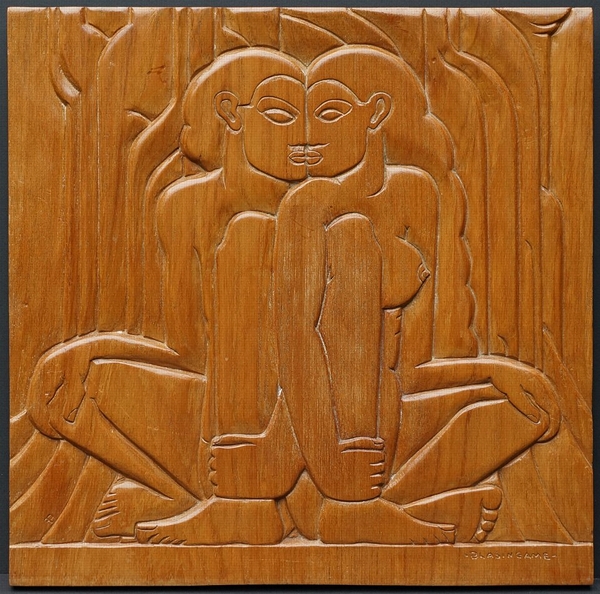
(above: Marguerite Louis Blasingame, The Lovers, c. 1935, carved wood panel. Photo courtesy of Hiart, Wikimedia Commons*)
Art Colonies and the Power of the "Sisterhood"
Between 1850 and 1945, Hawai'i did not host traditional "rural" art colonies like those found in Taos or Carmel. Instead, artistic collaboration centered around city-based coalitions and professional guilds in Honolulu.
John Melville Kelly (1878-1962) and his wife Kate Kelly (1882-1964) arrived in 1923 and stayed for the remainder of their lives, becoming some of the most prolific documentarians of Native Hawaiian life. John Kelly is best known for his color Aquatints -- complex, multi-layered prints that depicted hula dancers, fishermen, and children with "sensitive characterizations." Kate Kelly was an accomplished artist in her own right, working in sculpture, photography, and printmaking. She actually taught John the techniques of printmaking after taking a class with Luquiens. Her bronze sculptures, such as "Hawaiian Head" (1933), are held in the permanent collection of the Honolulu Museum of Art. The Kellys' importance is evaluated through their enduring popularity in the print market and the regular celebratory exhibits of their work, such as the 100th-anniversary exhibit in 2023, which showcased never-before-seen photos by Kate that documented the "bittersweet" reality of Native families selling lei to tourists.
Artistic Shifts During the Conflict Years (1941-1945)
The onset of World War II transformed Hawai?i into a "major Pacific crossroads". The "languid islands" were suddenly engulfed by the turbulent forces of global conflict, which was reflected in a shift toward more functional, immediate, and gritty forms of artistic expression. In the military outposts of the Pacific, art became a tool for morale. Victor Nels Solander, a Seabee stationed at Midway Atoll, painted large murals on the walls of military structures using scrounged military paints. These murals depicted the realities of the war -- submarines loading torpedoes and amphibious invasions -- providing a stark contrast to the romanticized "paradise" paintings of the previous decade.
Simultaneously, Honolulu became a hotspot for tattoo culture. Tattoos during World War II were symbols of pride, patriotism, and sea-faring status. Sailors earned "swallows" for every 5,000 nautical miles traveled, and many enlisted men opted for "Remember Pearl Harbor" designs. This era saw the tattoo industry in Honolulu dominate the local urban scene, reflecting a democratic, "wearable" form of art that recorded the personal experiences of the thousands of servicemen passing through the islands.
Construction of an Island Identity
The history of artistic expression in Hawai?i between 1850 and 1945 reveals a narrative that is far more nuanced than the "touristic fantasy" often portrayed in popular media. From the strategic royal portraiture of the mid-19th century to the monumental Modernism of Madge Tennent, art served as a battlefield for identity. The unique factors of Hawaiian art -- the atmospheric light captured by Hitchcock, the maritime drama of Walden, and the physical presence of the Hawaiian people championed by Tennent and the Kellys -- differentiated it from the art of the mainland. By 1945, the islands had developed a mature, regional style that balanced the influence of European training with a deep, visceral commitment to the Pacific landscape and its people. This legacy continues to inform the contemporary art movement in Hawai'i, which still grapples with the tensions between indigenous agency, colonial nostalgia, and the enduring allure of "paradise".
Prompt:
Research Plan:
(1) Search for comprehensive historical overviews of Hawaiian art from 1850 to 1945 on .org and .edu domains, focusing on how the unique geography, indigenous culture, and political shifts (Kingdom to Territory) influenced artistic styles. (2) Identify and research specific art movements and colonies, such as the Volcano School, active during this era using academic and museum resources. (3) Research 4 to 6 highly regarded artists of this period (e.g., Jules Tavernier, Charles Furneaux, Madge Tennent, Huc-Mazelet Luquiens, or Jean Charlot) on .org and .edu sites to understand their backgrounds and career trajectories. (4) For each selected artist, investigate the evolution of their style and the specific elements that distinguish their work as uniquely Hawaiian or significant within the local context. (5) Find information on the history of sculpture in Hawaii during this period, looking for key figures and public works mentioned on university or museum websites. (6) Evaluate the importance of the selected artists by checking their presence in the permanent collections and special exhibitions of the Honolulu Museum of Art, Bishop Museum, and other educational archives. (7) Look for scholarly articles and digital archives on .edu sites that discuss the impact of Western contact and internal social changes on the themes of Hawaiian paintings and sculptures. (8) Synthesize the gathered information into a long-form, informal narrative that flows continuously without headings or lists, ensuring all historical and biographical details are integrated into the story.
We lightly edited the article, added images and provided
links to other materials to enhance it. AI is rapidly improving in
accuracy, yet the article may have inaccurate information.
 Return to Hawaii Art History
*Tag for expired US copyright of object image:

and
**Tag for some rights reserved:

Links to sources of information outside of our web site are provided only as referrals for your further consideration. Please use due diligence in judging the quality of information contained in these and all other web sites. Information from linked sources may be inaccurate or out of date. TFAO neither recommends or endorses these referenced organizations. Although TFAO includes links to other web sites, it takes no responsibility for the content or information contained on those other sites, nor exerts any editorial or other control over them. For more information on evaluating web pages see TFAO's General Resources section in Online Resources for Collectors and Students of Art History.
Copyright 2026 Traditional Fine Arts Organization, Inc. an Arizona nonprofit corporation. All rights reserved.