
Nevada Art History: 1850-1945
a Gemini 3 Deep Research Report
April, 2026
The story of artistic expression in Nevada between 1850 and 1945 is a profound chronicle of human adaptation to one of North America's most demanding landscapes. Long before expeditionary artists trained in the European tradition crossed the Sierra Nevada, the region's indigenous peoples had established their own rich pictorial traditions, leaving painted designs on cave walls and rock formations that represented animals and figures of deep ceremonial significance. Following the discovery of gold in 1848, the first professionally trained artists arrived in the West, often as argonauts hoping to strike it rich in the foothills.While many centered their activities in San Francisco or the lush valleys of coastal California, Nevada presented drastically different challenges that would ultimately yield a unique aesthetic.
The fundamental factor that differentiated Nevada's art from that of other states was its uncompromising geography and arid ecology. While the Hudson River School painters in the Northeast perceived the advancement of industrial infrastructure as a direct threat to the romantic ideal of untouched wilderness, the artists navigating the vast Great Basin were forced to confront a landscape defined by scarcity and extreme scale. Nevada's persistent natural landscape presented immediate challenges to anyone attempting to maintain a built environment, with water resource management dictating the very flow of human settlement.This stark reality meant that Nevada art rarely indulged in the soft, pastoral agrarian romanticism seen in European art colonies or the lush coastal representations of California. Instead, it demanded a confrontation with blinding light, stark geological forms, and infinite horizons.
The transition from functional craft to high art in Nevada can be observed clearly across multiple mediums, starting with textiles and basketry. In the Great Basin, where mobile subsistence patterns dominated, lightweight and flexible woven fibers were far more practical than heavy ceramic wares. Native weavers, particularly among the Washoe, used local materials like willow found along the Carson River to craft watertight baskets. To generate intricate designs, they relied on bracken fern roots, which had to be dug up and dyed in dark mud to produce a deep black color, and western redbud found in the hillsides of the Sierra Nevada for red accents. These utilitarian objects, traditionally used for holding food or in ceremonial dances, underwent a massive transformation at the turn of the twentieth century. Driven by the national Arts and Crafts Movement and a corresponding basket craze, these objects were elevated from domestic tools to some of the most highly sought-after fine art sculptures in the world.
In contrast to the mobile traditions of basketry, the history of fired pottery in Nevada was heavily localized and tied to the transition toward sedentary living. The most significant historical locus for pottery in the state occurred at Pueblo Grande de Nevada, more commonly known as the Lost City, located near Overton. This complex of villages, inhabited by the Ancestral Puebloans, is recognized as the westernmost extent of their culture. When archaeologists documented the site in 1924 and excavated it in the 1930s before it was partially submerged by Lake Mead, they uncovered intricately painted and textured pottery that displayed clear architectural and decorative connections to the Chaco culture of New Mexico. Beyond the Ancestral Puebloans, pottery in the region was maintained by groups such as the Yuman peoples, who adapted ancestral paddle-and-anvil techniques to produce a variety of forms required by changing dietary customs.Research has shown that as sedentism increased over time, the proportional height of these ceramic vessels also increased, marking a direct link between physical geography, lifestyle, and artistic form.
Traditional sculpture in Nevada during this era was rarely manifested in the monumental bronze casting seen in the Eastern United States. Instead, early Nevada sculpture existed in the highly stylized forms of native baskets and the functional architecture of adobe and stone. However, structured periods for public sculpture arrived during the Great Depression under the auspices of the Federal Arts Project and the Works Progress Administration. Artists were hired to create relief murals and architectural embellishments for civic buildings, heavily drawing upon regional mythologies and Social Realism to portray the physical labor required to tame the desert and the convergence of various ethnic populations that populated the state.
Among the most highly regarded artists who created artworks in the state during this specified time period, the Washoe weaver Dat So La Lee stands as a monumental figure. Born Dabuda or Louisa Keyser around 1835, she fundamentally transformed the medium of native basketry from a functional craft into fine art. Traditionally, Washoe utilitarian baskets, known as degikup, were round and watertight, made to hold acorn mush or pine nut soup. Dat So La Lee's talent for weaving was recognized by Abe and Amy Cohn, owners of a Carson City emporium, who acted as her sponsors and essentially employed her full-time for thirty years. This unusual economic relationship granted her the time to perfect her skills and experiment freely with shapes and design motifs.
Dat So La Lee transformed the shape and design of the degikup into truly aesthetic, sculptured baskets, characterized by large spherical shapes with flat bases and small openings. She utilized standard willow foundation rods and thread but achieved incredible complexity by weaving in dark mud-dyed bracken roots and red branches of western redbud to create repeating hourglass designs and interior bear-paw motifs. Over her career, she produced approximately 120 documented major works that reflect distinct phases of technical brilliance. What makes her artwork so special and important is that it forced the broader American art market to recognize native basketry not merely as a curio or ethnological artifact, but as high art operating on par with any European sculptured form. To evaluate her relative importance today, one need only look at the incredible level of mention she receives across cultural institutions. Her baskets are coveted by collectors, valued at over a million dollars, and featured prominently in top museums including the SSmithsonian American Art Museum, Metropolitan Museum of Art, and the Nevada Historical Society. Furthermore, she is the subject of advanced digital archiving by the University of Nevada, Reno, which utilizes 3D scanning and virtual reality technology to allow visually impaired visitors and online audiences to experience the intricate textures of her world-famous baskets.
Another foundational figure in Nevada's artistic narrative is Lorenzo Palmer Latimer, an American painter and educator who lived from 1857 to 1941. Born in Gold Hill, California, Latimer was educated at the McClure Military Institute and graduated from the San Francisco Art Institute, eventually studying under Virgil Williams at the California School of Design. Latimer first visited Fallen Leaf Lake on the south side of Lake Tahoe in the summer of 1914, where he began to teach annual plein air painting classes. In 1916, he was invited by two students to teach a painting class in Reno, beginning a twenty-year commitment to the region. His artistic style focused heavily on watercolor, emphasizing a soft, poetic approach to landscape that captured atmospheric light without sacrificing structural clarity.
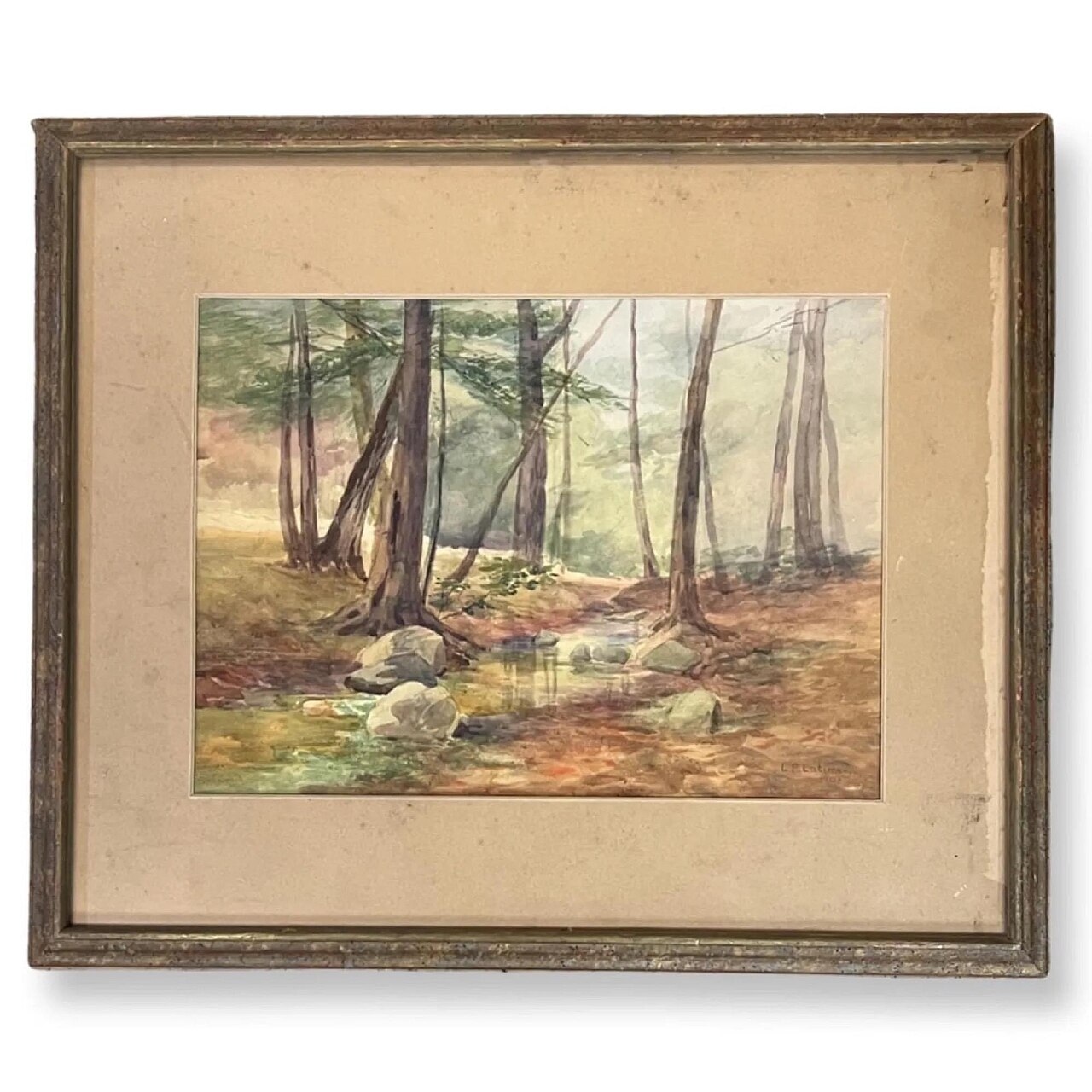
(above: Lorenzo Palmer Latimer (1857-1941), Untitled, watercolor on cream paper, 9.5 x 13 inches, Public domain, via Wikimedia Commons*)
The uniqueness of Latimer's contribution lies less in aggressive stylistic experimentation and more in his massive institutional impact and educational generosity. During the winter months, while Latimer was in California, he would share a painting with his Nevada students to copy, and they would mail the work back to him for detailed critiques. This sustained mentorship of local landscape painters led directly to the formation of the Latimer Art Club in Reno in 1921. Members included local figures such as Minerva Pierce, Hildegard Herz, and Dolores Samuels Young. This organization became the primary volunteer driver that joined together with visionary humanist scholar Dr. James Church to establish the Nevada Art Gallery in 1931, the institution known today as the Nevada Museum of Art. Latimer's relative importance is strongly reflected in the continuous exhibitions dedicated to him at the Nevada Museum of Art and the Robert Louis Stevenson Museum, as well as the active presence of the Latimer Art Club, which still operates as a nonprofit organization today.
Maynard Dixon is widely cited as the most important landscape painter of the American West, and his frequent trips to Nevada between 1901 and 1939 were instrumental in defining his mature artistic voice. Dixon first visited the state on a horseback sketching trip with fellow artist Edward Borein in 1901, and he later received commissions documenting the construction of the Boulder Dam in Las Vegas in 1934. Dixon's style underwent a profound evolution during his time in Nevada, specifically around 1935. Shaken by a painful divorce from photographer Dorothea Lange and the loss of his family, Dixon wandered the desert alone in search of healing. What he observed during this period of intense isolation shifted his art away from standard western genre illustrations toward a powerful, stark modernism. He painted the desolate playa of Lake Lahontan, lone cottonwood trees, and vast mountain vistas under heavy, cloud-filled horizons.
See paintings by Maynard Dixon
The artworks produced during this period, such as The Shores of Lahontan and Elements of Nevada, which accurately depicted Fairview Peak near Middlegate, are unique for their raw emotional minimalism. Space is flattened, and the focus rests entirely on the pure geometry of land and sky. Dixon's ability to strip the landscape of all unnecessary detail to project a feeling of profound silence and space resulted in what commentators still call the iconic Maynard Dixon sky. Evaluating his importance is easily done by looking at his massive presence in cultural media. In 2024, the Nevada Museum of Art hosted a milestone exhibition titled Sagebrush and Solitude: Maynard Dixon in Nevada, which assembled over 160 of his paintings, drawings, and poems. He is heavily represented in books, and online videos produced by groups like PBS Utah detail his quest to find the real, vast West.
Robert Cole Caples also stands out as one of the most important modern painters in the history of Nevada.Born in New York in 1908, Caples moved to Reno at the age of sixteen in 1924 to live with his father and soon began his studies at the Santa Barbara School of the Arts. He received early training at the National Academy of Design and the Art Students League of New York. Caples established his first studio in 1928 at the Masonic Building in Reno, followed by the Clay Peters Building in 1929. His style originally focused on charcoal commission portraiture, but by 1932 he moved on to specialize in charcoal drawings of American Indians, the work for which he was best known. This period in his work was influenced by his frequent trips to Pyramid Lake and his interactions with the local Paiute population.
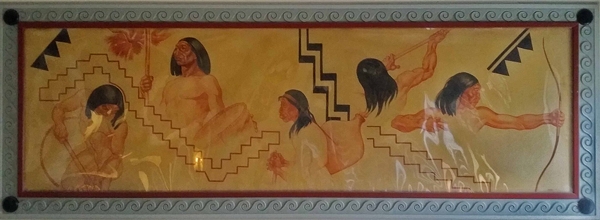
(above: Robert Cole Caples, Creation, c. 1935, mural for the Washoe County Courthouse, Reno, Nevada. Public domain, via Wikimedia Commons*)
He also produced religious paintings like Job's Comforters and The Last Supper, and he used a Washoe Indian legend as the basis for his courthouse mural Creation. Following his time serving in the United States Navy during World War II, Caples moved to Virginia City and came into contact with a broad range of modernist figures forming a thriving artists colony known as the Comstock Bohemians. During the 1940s and 1950s, his style shifted dramatically toward stylized landscapes with haunting and atmospheric effects. Caples was determined to portray not just a specific place, but the absolute essence of landscape itself, with space at once telescoped and expanded infinitely. His relative importance is supported by his portfolios of lithographs published by the University of Nevada Press, dedicated books like Anthony Shafton's The Nevada They Knew, and featured discussions in museum programs and exhibits honoring his legacy. Will James, born Joseph Ernest Nephtali Dufault in Quebec in 1892, created a fictionalized backstory for himself as a native-born American cowboy to market his art and stories.
After drifting across the border around 1910, he changed his name to William Roderick James and worked as a nomadic hand capturing wild horses and breaking broncs across Montana, Idaho, and Nevada. In 1914, he was arrested for cattle rustling and served eighteen months in the Nevada State Prison at Carson City. It was during this period of confinement that he had the time to concentrate on his drawings, receiving encouragement from local press reports like the Ely Record to pursue art professionally. His method of illustration involved precise pen-and-ink and pencil drawings that captured dynamic horse and rodeo action. What makes Will James' artwork special is its raw authenticity.
Unlike non-resident artists who romanticized the West with serene landscapes, James' scenes are almost exclusively focused on the taming of broncs, the roping of feral cattle, and the arduous, often dangerous nature of cowboy life. He eventually settled on a small ranch in Washoe Valley, Nevada, where he wrote and illustrated his masterpiece, Smoky the Cowhorse, which won the 1927 Newbery Medal. James is widely recognized and admired among collectors, contemporary western artists, and singer-songwriters. His relative importance is proven by his presence in numerous museum collections across the country, including the Whitney Western Art Museum and a massive collection at the Yellowstone Art Museum. His life has been the subject of biographical films and books exploring the French Canadian who became the quintessential image of the American cowboy. Hans Meyer-Kassel brought a rigorous European academic discipline to the high desert of Nevada.
Born in Kassel, Germany, in 1872, he studied at the University of Munich before immigrating to the United States. In 1935, he and his wife moved to Reno, and later to Carson City and Genoa, Nevada, where they spent their permanent years. Meyer-Kassel's style originally reflected formal, classically influenced academic methods, including experiments with Cubism and rigorous portraiture. However, upon settling in Nevada, his more formal style mellowed into a painterly perfection that resulted in breathtaking landscape views and delicate studies of Native American dancers. His time in Reno and Genoa saw a wealth of work, from WPA-sponsored portraits of Paiute tribal members to sweeping landscapes of the Carson Valley.
In 1950, his painting of Genoa was selected to serve as the image for the centennial stamp commemorating the first permanent Euro-American settlement in Nevada. Meyer-Kassel is special for his ability to translate classical European training into a highly localized sensitivity for the unique light of the high desert. His relative importance is continually maintained by the Nevada Historical Society, which stewards a complete archive of his life and art, and features him prominently in exhibits and published books outlining his profound romance with the Nevada landscape. To truly evaluate the importance of all these artists, one must look at the collective ways they are remembered in contemporary society.
Dat So La Lee and Maynard Dixon hold dominant positions due to the pure volume of massive institutional exhibits and the extensive digital media revolving around their names. Robert Cole Caples and Will James are heavily favored in regional literature and targeted public exhibits due to their deep narrative connection to the state's culture. Meanwhile, Lorenzo Latimer and Hans Meyer-Kassel remain essential for their structural impact on Nevada's artistic organizations and civic symbols. Together, these creators prove that the history of artistic expression in Nevada was not merely a reaction to external movements, but a brilliant dialogue with the raw, beautiful elements of the Great Basin itself. Together, these creators prove that the history of artistic expression in Nevada was not merely a reaction to external movements, but a brilliant dialogue with the raw, beautiful elements of the Great Basin itself.
We lightly edited the article, added images and provided
links to other materials to enhance it. AI is rapidly improving in
accuracy, yet the article may have inaccurate information.
Prompt:
Research plan:
 Return to Nevada Art History
*Tag for expired US copyright of object image:

and
**Tag for some rights reserved:

Links to sources of information outside of our web site are provided only as referrals for your further consideration. Please use due diligence in judging the quality of information contained in these and all other web sites. Information from linked sources may be inaccurate or out of date. TFAO neither recommends or endorses these referenced organizations. Although TFAO includes links to other web sites, it takes no responsibility for the content or information contained on those other sites, nor exerts any editorial or other control over them. For more information on evaluating web pages see TFAO's General Resources section in Online Resources for Collectors and Students of Art History.
Copyright 2026 Traditional Fine Arts Organization, Inc. an Arizona nonprofit corporation. All rights reserved.