
Oregon Art History: 1850-1945
a Gemini 3 Deep Research Report
April, 2026
The trajectory of artistic expression in Oregon between 1850 and 1945 is a chronicle of a remote frontier evolving into a culturally distinct region capable of synthesizing external modern influences with its own powerful natural aesthetics. While East Coast art circles frequently looked toward European academies for validation, and the neighboring state of California often celebrated a bright, promotional brand of impressionism, Oregon's creative output was intensely grounded in geographic isolation, a mood that often leaned toward the meditative and melancholic, and a fierce dedication to interpreting local ecosystems through evolving modern vocabularies. The artistic evolution across painting, sculpture, pottery, and textiles during this nearly century-long span reveals how creators successfully negotiated the tension between imported traditions and the distinct, grounding realities of the Pacific Northwest.
Geography, Culture, and the Differentiation of Oregon Art
The physical environment of Oregon acted as the primary catalyst for its distinct artistic identity. The state is characterized by dramatic geographic divisions including the rain-drenched coastal forests, the fertile Willamette Valley, the monumental barrier of the Cascade Range, and the vast, arid high desert of the eastern interior. This immense variety meant that Oregon artists were not responding to a singular Western landscape, but rather to a complex matrix of ecosystems, each carrying its own light, color palette, and emotional weight.
In the decades immediately following statehood in 1859, the primary cultural driver was survival and the establishment of basic infrastructure. Early visual records were often topographical or purely illustrative, designed to portray the region's resources to potential immigrants or investors. However, as the nineteenth century gave way to the twentieth, a unique regional consciousness began to emerge. Unlike the highly commercialized art markets of the East Coast or the romanticized, sun-drenched landscapes popularized by the California school, Oregon art frequently embraced a darker, more introspective tone. The gray skies of the coastal winter, the deep greens and purples of the forests, and the stark, sun-bleached isolation of the eastern desert fostered an aesthetic that prioritized mood, memory, and spiritual resonance over literal, decorative depiction.
This cultural introspection was compounded by the state's geographic isolation. Until the expansion of the railroad and highway systems in the early twentieth century, Oregon remained relatively cut off from the major artistic centers of the country. While this isolation delayed the arrival of contemporary European and East Coast movements, it also prevented the premature dilution of local styles. When modernism finally arrived, accelerated by pivotal events like the Portland Art Museum hosting of works from the landmark 1913 New York Armory Show and local artists' exposure to the 1915 Panama-Pacific International Exposition in San Francisco, it was not merely copied. Instead, Oregon artists synthesized these new ideas with their own intimate understanding of the local landscape.
The Great Depression of the 1930s served as another major differentiating factor. The influx of Federal Art Project and Works Progress Administration (WPA) funding did more than just provide employment; it centralized the artistic community and fostered a highly collaborative environment. The crowning achievement of this era was the construction and furnishing of Timberline Lodge on Mount Hood. This project served as a massive, living synthesis of regional architecture, painting, sculpture, textile weaving, and wrought-iron work, establishing a unified Cascadian aesthetic that remains a benchmark of Oregon's cultural heritage.
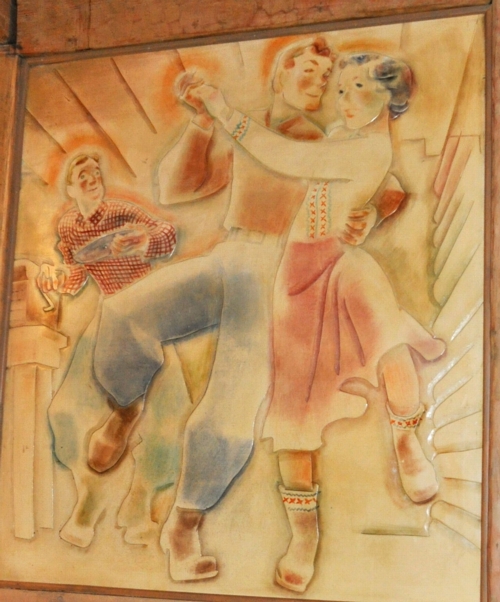
(above: Douglas Lynch, Calendar of Mountain Sports - Timberline Lodge, 1938, linoleum mural panels. Public domain, via Wikimedia Commons*)
Evolution of Painting: From Frontiers to Expressionism
The history of painting in Oregon between 1850 and 1945 is a chronicle of a shifting consciousness, moving from the faithful recording of physical reality to the exploration of the spiritual and psychological dimensions of the land. The earliest professional painters to work in the state were often visitors or short-term residents commissioned to document the expansion of the frontier. For instance, the Scottish-American painter William Keith received a commission from the Oregon Navigation and Railroad Company to paint scenes of the Pacific Northwest, bringing the grand, detailed realism of the Hudson River School to the region. These early works were monumental in scale, utilizing dramatic lighting to convey a sense of the sublime and to celebrate national expansion.
By the turn of the twentieth century, however, a shift toward more intimate and subjective interpretations of nature began. This evolution was heavily supported by the founding of the Portland Art Association in 1892 and the establishment of the Museum Art School in 1909. Under the guidance of influential educators like Harry Wentz, who served as dean of the school from 1910 through 1941, students were actively encouraged to reject academic formulas and instead depict regional subject matter using modern principles of abstraction and expressive color. Wentz himself practiced a style that absorbed the lessons of the Barbizon School, Impressionism and emerging Modernism, passing on a legacy of aesthetic freedom to generations of Oregon painters.
The true maturation of Oregon painting occurred in the 1920s and 1930s, marked by a decisive break from strict realism. Artists began to realize that capturing the essence of the Northwest required painting not just what was visible to the eye, but what was felt through the senses. This led to a distinct form of regional modernism characterized by simplified compositions, flattened planes, and a palette often drawn directly from the damp forests or the high desert. Painting became less about documenting a specific place and more about participating in a broader, continuous rhythm of nature.
Sculpture in the Pacific Northwest
For much of the period between 1850 and 1941, sculpture in Oregon remained a sparse and intermittent practice. The state's early economy and culture were focused on resource extraction and building, leaving little surplus capital or civic demand for fine-art sculpture beyond functional crafts and standard memorial tablets. When large-scale public sculpture was required, commissions were frequently handed to out-of-state artists. A prime example of this dynamic was the creation of the Oregon Pioneer (colloquially known as the "Gold Man"), the massive eight-and-a-half-ton bronze statue with a gold leaf finish that was placed atop the new Oregon State Capitol in Salem in 1938. This iconic symbol of the state's pioneer heritage was designed and cast in New Jersey by the sculptor Ulric Ellerhusen https://en.wikipedia.org/wiki/Ulric_Ellerhusen before being shipped via the Panama Canal and transported by rail to its resting place.
The actual practice of fine art sculpture within the state was fundamentally revived and transformed by the arrival of European emigres fleeing the growing crisis abroad. Chief among these was Frederic Littman, who arrived in Portland in 1941. Before Littman's arrival, active sculptors working in the state were rare, and the discipline lacked the institutional support and community presence enjoyed by painting. Littman, having trained at the prestigious École Nationale des Beaux-Arts in Paris and served as an assistant to Charles Malfray, brought a sophisticated understanding of both classical and modernist sculpture to the region.
Under the influence of artists like Littman, and fueled by the collaborative opportunities presented by the WPA and forward-thinking local architects like Pietro Belluschi, Oregon sculpture entered a highly productive phase in the 1940s. The work moved away from the literal, heroic monuments of the nineteenth century toward more romantic, impressionistic, and figuratively based forms that prioritized the interplay of light and shadow on the material surface. Wood also became a favored medium for many sculptors, drawing directly from the state's abundant timber resources and inspired by the relief carvings of indigenous traditions and the lush surrounding forests. This shift represented a deep internalization of the local environment, transforming raw natural resources into vehicles for modern aesthetic exploration.
Pottery
The late nineteenth century brought a severe crisis to the traditional pottery industry. The widespread introduction and affordability of glass and tin containers rapidly replaced stoneware in Oregon homes. This industrial decline set the stage for the rebirth of pottery as a high art and fine craft form in the twentieth century. A significant catalyst for this shift was the Arts and Crafts Society of Portland, founded in 1907 by Julia Hoffman. Hoffman and her contemporaries advocated for a return to hand-crafted production as a direct response to the perceived soullessness of the Industrial Revolution. They began organizing classes and high-quality exhibitions at the Portland Art Museum to showcase craft work that elevated everyday objects into realms of aesthetic beauty. While full-scale studio pottery as a major artistic movement did not fully mature in Oregon until after the close of World War II, the foundational efforts of the Arts and Crafts Society and the preservation of traditional wheel-turning and glazing techniques laid the groundwork for the state's eventual leadership in modern ceramic arts.
Textiles and Regional Resources: The Flax and Linen Industry
The artistic potential of Oregon's textiles reached its absolute zenith during the construction of Timberline Lodge in the late 1930s. Margery Hoffman Smith, serving as the interior designer for the lodge under the Federal Art Project, developed a total design concept that drew directly from the surrounding environment. Smith understood that to create a truly authentic mountain resort, every element, from the architecture to the smallest piece of fabric, had to feel rooted in the Pacific Northwest.
To achieve this, Smith orchestrated a massive hand-weaving and sewing project that employed dozens of women through the Women's Division of the WPA. The workers wove hundreds of yards of heavy upholstery fabrics and draperies using local wools and linen. Furthermore, they created over a hundred hand-hooked rugs to cover the lodge's floors. In a brilliant display of resourcefulness necessitated by economic hardship, many of these rugs were composed of strips of worn-out blankets and uniforms collected from nearby Civilian Conservation Corps camps and scraps from the state's WPA sewing project. The color schemes for these textiles were taken directly from the surrounding forests and flora. Watercolors of local wildflowers were painted to hang in the guest rooms, dictated the color palette of the hooked rugs, and served as the templates for the stylized, hand-appliquéd floral designs on the window curtains. This holistic approach elevated textiles from mere functional furnishings into a primary medium for expressing a unified regional identity.
Master Artists of the Era: Evolution of Style and Contribution
To understand the full depth of Oregon's artistic evolution between 1850 and 1945, it is necessary to examine the careers of the individual masters who shaped the region's visual landscape. These artists did not merely record the world around them; they developed highly personal, innovative styles that translated the raw energy of the Northwest into enduring works of modern art.
Clayton Sumner (C.S.) Price
Clayton Sumner Price is widely regarded as one of Oregon's most important and influential painters of the twentieth century. Born in Iowa in 1874 and raised on ranches in Wyoming and Alberta, Price was an accomplished carpenter, horseman, and cattle hand before fully committing to art. This intimate connection to the physical labor and vast spaces of the frontier shaped his entire artistic philosophy. His mother encouraged his early efforts, and he famously carried a sketchbook in his saddlebag to draw the men and animals he worked with.
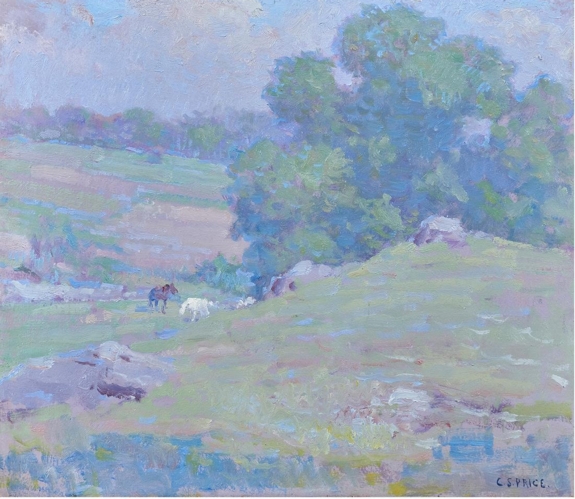
(above: Clayton Sumner Price, Carmel Valley, oil on board, n.d., 17.75 x 21.5 inches. Public domain, via Wikimedia Commons*)
Price's formal training was limited to a single year at the St. Louis School of Fine Arts in 1905. In 1909, he moved to Portland to work as an illustrator of Western stories for The Pacific Monthly magazine. His early paintings and illustrations during this period were highly representational, heavily influenced by the narrative Western art of Charles Marion Russell. However, Price soon grew dissatisfied with the superficial, commercial nature of illustration and left Portland in 1910, spending the next several years wandering and working on ranches in exchange for room, board, and time to paint.
The critical turning point in Price's career occurred at the 1915 Panama-Pacific International Exposition in San Francisco. There, he was exposed to European modernism, including the structural landscapes of Paul Cézanne and the bold compositions of Pablo Picasso. Price realized that his goal was not to paint what he saw literally, but to capture the underlying spirit that connected all living things and the land, a concept he referred to as the one big thing.
He spent the 1920s in the Carmel/Monterey Peninsula Art Colony, where his style evolved into a vivid, colorful post-impressionism that startled local conservatives but inspired younger modernists. Seeking less distraction and a deeper focus, Price returned to Portland in 1929 and lived in Spartan simplicity in a series of small downtown studios. Here, his art underwent its final and most important evolution. He abandoned the bright colors of his Monterey period in favor of a boldly sculptural, heavy-impasto style with muted, serene colors. He would begin a canvas by applying colors in an abstract manner, then scrape the paint back with a palette knife, and repaint, repeating the process five or six times until a rough, scumbled surface emerged that suggested the forms of horses, farmers, or mountains. This labor-intensive, meditative process produced works of immense emotional weight and thick physical texture that bridged the gap between representation and pure abstraction.
Charles Edward Heaney
Charles Edward Heaney was a premier printmaker and painter whose career in Oregon spanned nearly sixty years. Born in Wisconsin in 1897, Heaney moved to Portland with his mother and sister in 1913 following the death of his father. The train journey across the western United States left an indelible impression on the fifteen-year-old, introducing him to the endless highways, abandoned mines, and vast mountains of the interior American West that would dominate his artwork for a lifetime.
To support his family, Heaney did not complete high school but instead took an apprenticeship at the Brandenburg Engraving Company, where he learned to engrave jewelry, flatware, and trophies. This highly precise craft gave him a mastery of line and detail that directly informed his later success as a printmaker. Encouraged by his employer, Heaney enrolled in part-time classes at the Museum Art School, where he became a close friend and student of Harry Wentz.
Heaney's artistic evolution was also deeply shaped by his admiration for C.S. Price. Like Price, Heaney adopted an obsessive dedication to his craft and sought to simplify his compositions to find the emotional core of the landscape. During the Great Depression, he was employed as an easel painter for the Oregon Federal Art Project, completing sixty-four paintings, including his masterpiece The Mountain (1937) for Timberline Lodge.
What makes Heaney's artwork unique is his highly stylized approach to memory and place. He did not paint on-site; instead, he would take sketches, notes, and photographs of the Eastern Oregon high desert and then return to his Portland studio to paint from memory. This process filtered out non-essential details, leaving behind poetic, often melancholic compositions characterized by a warm desert palette, bold geometric shapes, and a profound sense of human scale dwarfed by ancient geological forces. In his later career, Heaney pushed his art even further, creating mixed-media fossils that combined plaster relief, carving, and actual fossil imprints to directly engage with the deep history of the earth.
Amanda Snyder
Amanda Snyder was a highly prolific and fiercely independent artist who produced thousands of drawings, paintings, collages, and woodcuts while maintaining a profoundly private lifestyle. Born in the Blue Ridge Mountains of Tennessee in 1894 to a subsistence farming family, Snyder moved to the small town of Roseburg, Oregon, in 1903. She began showing a strong aptitude for art as early as the third grade.
Following her marriage to Edmund Snyder in 1916, she moved to Portland. Snyder's formal education was incredibly brief; she spent less than two years at the Museum Art School before leaving to care for her infant son. Thus, Snyder was largely a self-taught artist who learned by doing, using a basement studio in her home as a laboratory for continuous aesthetic experimentation.
Snyder's work is extraordinary for its concurrent execution of wildly different styles. While many artists evolve linearly from one style to another, Snyder would frequently paint realist portraits, soft impressionistic still lifes, and highly structured geometric landscapes in the very same period. She met C.S. Price in 1929, and he became a mentor, pointing out the similarities between her textured, emotional work and that of the French artist Georges Rouault.
What makes Snyder's work special is her ability to find immense aesthetic power in the everyday objects that surrounded her home and garden. While she was often dismissed by contemporary male critics as a woman who preferred to paint casual subjects, her paintings of birds, clowns, and flowers possess a remarkable emotional density. She utilized the technique of scumbling, softening edges and building up heavy layers of paint, to give her paintings a rich, almost tactile physical presence. Her landscape work also stood out, applying cubist principles and a dark, rainy palette to create powerful geometric structures that perfectly captured the dense atmosphere of the coastal Northwest.
Harry Wentz
Harry Wentz was an artist and educator who served as one of the most critical structural pillars of the Oregon art community during the first half of the twentieth century. He served as dean of the Museum Art School in Portland from 1910 through 1941, successfully mentoring nearly every major painter who emerged from the region during that span.
Wentz's own artistic style grew up alongside major art movements including the Barbizon School, Impressionism, and emerging Modernism. He utilized these various lenses to champion a highly localized Northwest aesthetic. Wentz encouraged his students to drop academic formulas and paint their immediate regional surroundings with bold, expressive color and abstract framing.
His influence was not restricted simply to his direct pedagogy; Wentz was also a key figure in establishing the architectural ideals of the Northwest Regional style. His 1916 shingled beach cottage at the base of Neahkahnie Mountain, designed in collaboration with architect A.E. Doyle, served as a foundational model for vernacular coastal architecture that emphasized raw wood and seamless integration into the foggy landscape. His paintings and his lifestyle set a persistent example for students like Charles Heaney of how to lead a life dedicated purely to creative regional exploration.
In Summary
The history of artistic expression in Oregon between 1850 and 1945 is a narrative of profound transformation driven by a direct dialogue between the artist and a monumental natural environment. The early period was dominated by utilitarian needs, resulting in heavy functional pottery and resource extraction. However, the arrival of external modern influences, combined with the extreme geographic isolation of the state, forced local painters and sculptors to develop a highly original, moody, and deeply textured regional aesthetic.
The collective efforts of educators like Harry Wentz and
masters like C.S. Price paved the way for Oregon to move away from mere
derivative academic copying and instead become a hotbed of authentic regional
modernism. By capitalizing on specialized regional resources and utilizing
federal initiatives during the Depression to forge a holistic, native design
language, Oregon established a lasting legacy. These efforts ensured that
the creative output of the Pacific Northwest would not be forgotten, but
rather celebrated for its unique ability to fuse the physical facts of the
landscape with the deep, spiritual realities of human experience.
We lightly edited the article, added
images and provided links to other materials to enhance it. AI is
rapidly improving in accuracy, yet the article may have inaccurate information.
Prompt:
Research plan:
(1) Search educational and non-profit websites for overviews
of art history in Oregon between 1850 and 1945, focusing on paintings, sculpture,
pottery, and textiles. (2) Identify geographical, cultural, and historical
factors that shaped Oregon's art during this era and made it distinct from
art in other states. (3) Find four to six of the most highly regarded artists
active in Oregon during the specified timeframe. (4) For the selected artists,
research the evolution of their styles and the unique characteristics of
their work on relevant university and institutional domains. (5) Evaluate
the prominence and importance of these artists by reviewing their mentions
in digital exhibits, academic articles, books, and educational videos referenced
on .edu and .org sites. (6) Synthesize the information to prepare a continuous,
informal narrative that flows without structured headings or lists.
 Return to Oregon Art History
*Tag for expired US copyright of object image:

and
**Tag for some rights reserved:

Links to sources of information outside of our web site are provided only as referrals for your further consideration. Please use due diligence in judging the quality of information contained in these and all other web sites. Information from linked sources may be inaccurate or out of date. TFAO neither recommends or endorses these referenced organizations. Although TFAO includes links to other web sites, it takes no responsibility for the content or information contained on those other sites, nor exerts any editorial or other control over them. For more information on evaluating web pages see TFAO's General Resources section in Online Resources for Collectors and Students of Art History.
Copyright 2026 Traditional Fine Arts Organization, Inc. an Arizona nonprofit corporation. All rights reserved.