
Wyoming Art History: 1850-1945
a Gemini 3 Deep Research Report
April, 2026
The artistic evolution of Wyoming between 1850 and 1945 is not merely a chronicle of aesthetic shifts but a profound visual record of the American West's transition from a perceived "terra incognita" to a culturally codified frontier. During this century, Wyoming served as a crucible for some of the most influential landscape painters and sculptors in American history, whose works did more than reflect the scenery; they actively shaped national policy, fueled the fires of Manifest Destiny, and established a mythology of the cowboy that persists in the global imagination today. The state's unique geography -- characterized by the stark, eroded bluffs of the Green River, the alpine sublimity of the Wind River and Bighorn Ranges, and the geothermal anomalies of Yellowstone -- demanded a new visual vocabulary. This vocabulary combined the rigorous documentation required by government scientific surveys with the emotional resonance of European Romanticism.

(above: Albert Bierstadt, Wind River Country, 1860, oil on canvas; 29 5/8 x 43 3/4 inches, Denver Art Museum, The Charles H. Bayly Collection, 1987.47)
Wyoming's art during this era is differentiated from that of neighboring states like Colorado or Utah by its relative isolation and its deep connection to the "working" landscape. While Colorado's art scene was buoyed by early urban centers like Denver and Utah's by the cohesive cultural identity of the Latter-day Saints, Wyoming art remained largely the province of the lone ranger, the itinerant explorer, and the cowboy-artist. The history of this period is defined by a shift from the "theatrical" West of the mid-19th century -- painted in massive New York studios for an elite audience -- to an indigenous Western realism born in the ranching communities and forest ranger stations of the 20th century. This narrative traces the works of six primary figures -- Albert Bierstadt, Thomas Moran, Bill Gollings, Gertrude Vanderbilt Whitney, Hans Kleiber, and Edward Grigware -- whose contributions have been validated by exhaustive inclusion in museum collections, scholarly publications, and persistent public engagement.

(above: Albert Bierstadt, Snow in the Rockies, oil on paper mounted on board. Public domain, via Wikimedia Commons**)
Foundations of the Wyoming Aesthetic: Geography and Early Recording
The artistic history of Wyoming did not begin with the arrival of the canvas and oil brush. For millennia, the state's geography served as a primary site of spiritual and cultural recording for Indigenous populations. Over 200 known rock art sites, particularly within the Wind River Valley and the Wind River Reservation, provide a prehistoric baseline for the state's visual culture. These early artists utilized two distinct methods: petroglyphs, which were incised or pecked into stone surfaces using bone or harder rock hammers, and pictographs, which were paintings created from minerals like iron oxide and charcoal mixed with animal fat. These works often functioned as "Hunting Magic," intended to communicate with supernatural spirits to ensure the success of the hunt.
By the mid-1800s, this Indigenous tradition encountered the first wave of Euro-American artist-explorers. These individuals faced grueling journeys over rough terrain, carrying minimal supplies like notebooks and watercolors to make plein air studies. These sketches were the raw data for what would become the first major wave of Wyoming landscape art. The arrival of the horse in the region around 1700 had already transformed Indigenous culture, and by the 1850s, the horse and rider had become the central motif of the Western frontier, setting the stage for the monumental works of the following century.
Albert Bierstadt and the Era of the Romantic Sublime
Albert Bierstadt, a German-born artist trained in the Düsseldorf school, was the first to elevate Wyoming's scenery to the level of high art in the national consciousness. His entry into the state was catalyzed by the 1859 government survey expedition led by Frederick W. Lander. This expedition, aimed at mapping a wagon road through the Nebraska Territory toward the Pacific, reached the Wind River Range in what is now western Wyoming by summer. Bierstadt was immediately captivated by the "sublimity" of the peaks, which he found more genuine and grand than any landscape he had previously witnessed.
Bierstadt's artistic evolution was characterized by the transition from scientific sketching to theatrical studio synthesis. While on the Lander expedition, he produced numerous oil sketches and photographs, but his most famous works, such as The Rocky Mountains, Lander's Peak (1863), were painted in his New York studio.What makes Bierstadt's Wyoming work unique is its dual role as both art and propaganda. His paintings presented an "Edenic" vision of the West -- bathed in warm light and pristine beauty -- that served to validate the doctrine of Manifest Destiny. By depicting the landscape as an unspoiled, hospitality-rich frontier destined for White settlement, he systematically downplayed the ongoing conflicts with Indigenous populations, such as the Shoshone, who were often relegated to the foreground as atmospheric elements rather than sovereign inhabitants.
Bierstadt's importance is evidenced by the theatricality of his exhibition style. He would often show his large-scale canvases -- some reaching over ten feet in width -- on a stage with dramatic lighting, charging admission for viewers to look at the work through opera glasses. This level of public engagement, coupled with his frequent mention in modern museum exhibits like those at the Metropolitan Museum of Art and the Buffalo Bill Center of the West underscores his status as the foundational figure of Wyoming's professional art history.
Thomas Moran and the Political Power of the Landscape
While Bierstadt introduced the grandeur of the Rockies, Thomas Moran provided the visual evidence that transformed Wyoming's most unique geography into protected national territory. Moran's involvement with Wyoming began in 1871, when he funded his own trip to join the Hayden Survey of the Yellowstone region.Traveling with photographer William Henry Jackson, Moran produced a series of watercolors and sketches that captured the extraordinary geothermal features of the area -- features that had previously been dismissed as trappers' tall tales.
Moran's significance lies in the causal relationship between his art and the creation of the National Park System. Upon returning to the East Coast, his studies and finished studio paintings were presented to Congress, proving instrumental in the 1872 decision to designate Yellowstone as the country's first National Park. His style, though influenced by the luminosity of British painter J.M.W. Turner, was uniquely adapted to the Wyoming light. He was particularly fascinated by the Green River area, stepping off the railroad in 1871 to find instant inspiration in the eroded cliffs surrounding the town.
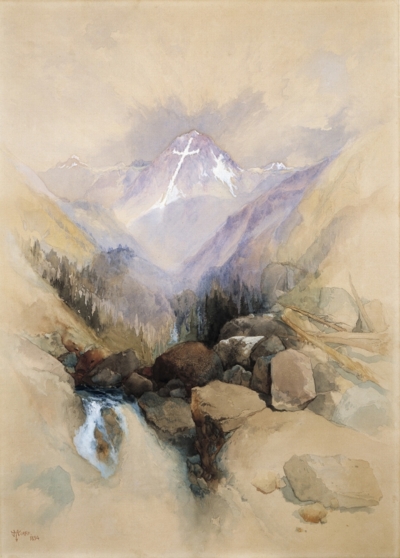
(above: Thomas Moran, Mount
of the Holy Cross, 1894, watercolor on paper, 18 1/2 x 16 1/2
inches, Denver Art Museum, Anonymous Gift, 1981.16)
Moran's importance is measured by the enduring demand for his work and his pervasive mention in contemporary media. He is the subject of numerous YouTube documentaries and specialized museum exhibits, such as "Thomas Moran in Wyoming" at the University of Wyoming Art Museum. His artistic importance is further solidified by the fact that Mount Moran in the Grand Tetons was named in his honor, a rare instance of a landscape artist's legacy being permanently etched into the very geography he painted. Unlike earlier artists who sought only topographical accuracy, Moran's work captured the "spirit" of the West through vivid color and atmospheric contrast, a style that continues to define Western landscape painting.
Rise of the Cowboy Artist: Elling William "Bill" Gollings
As the 19th-century era of the "artist-explorer" faded, it was replaced by a more authentic, localized tradition: the "working" Western artist. No figure embodies this shift more completely than Elling William "Bill" Gollings. Born in Idaho but coming to Wyoming at the age of 20, Gollings was a working ranch hand before he was an artist. His life on the range -- branding cattle, driving stagecoaches, and trapping -- became the primary source material for his artistic career.
Gollings' evolution as an artist was marked by a tension between his self-taught roots and his formal education at the Chicago Academy of Fine Arts. Settling in Sheridan in 1909, he built a studio with a skylight and began to document the "vanishing" American West. What makes Gollings unique is his uncompromising realism. While Bierstadt and Moran painted for a distant Eastern market, Gollings painted for the people who lived the life he depicted. His work is noted for its technical accuracy, particularly in the anatomy and movement of horses, which he signed with a distinctive pony hoof trademark.
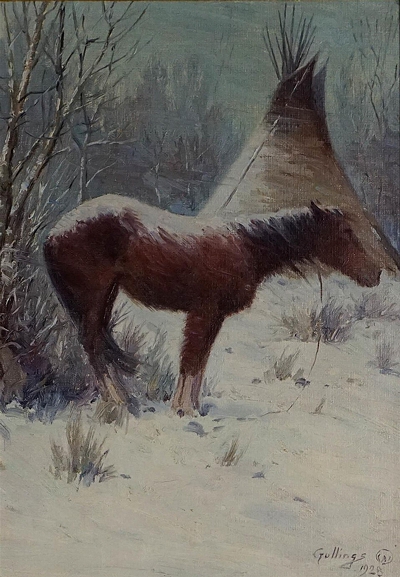
(above: Elling William Gollings, Winter Night, 1928, oil on canvas: 14 x 10 inches. Public domain, via Wikimedia Commons*)
The importance of Gollings is reflected in the specialized educational materials developed by the University of Wyoming and the high value of his work at auction, as seen in appraisals on programs like Antiques Roadshow. He represents a "third wave" of Western art -- one that moved away from the Romantic myths of the frontier toward an insider's view of the arduous, often solitary life of the cowboy. His inclusion alongside figures like Frederic Remington and Charles M. Russell in institutions such as the Gilcrease Museum and the National Museum of Wildlife Art confirms his status as Wyoming's preeminent cowboy artist.
Monumental Legacy of Gertrude Vanderbilt Whitney
In the early 20th century, the focus of Wyoming art expanded from the two-dimensional canvas to the three-dimensional monument. The most significant event in this evolution was the 1924 dedication of the statue Buffalo Bill - The Scout in Cody. The sculptor, Gertrude Vanderbilt Whitney, was a figure of immense social and artistic standing in New York, hailing from the wealthy Vanderbilt family. Her commission to memorialize William F. "Buffalo Bill" Cody was not just a tribute to a man but a foundational event for the town that bore his name.
Whitney's artistic style was rooted in classical training, but the creation of The Scout forced a confrontation with the demands of Western realism. Her initial model faced scrutiny from Cody residents who regarded the horse's pose and tack as too "Eastern". To satisfy the Memorial Association's demand for historical accuracy, a horse named "Smokey" and a local cowboy were shipped from Wyoming to Whitney's New York studio to serve as models. This process of negotiation between the artist's vision and the community's lived experience resulted in a monument that captures Buffalo Bill not as a showman, but as a young army scout.
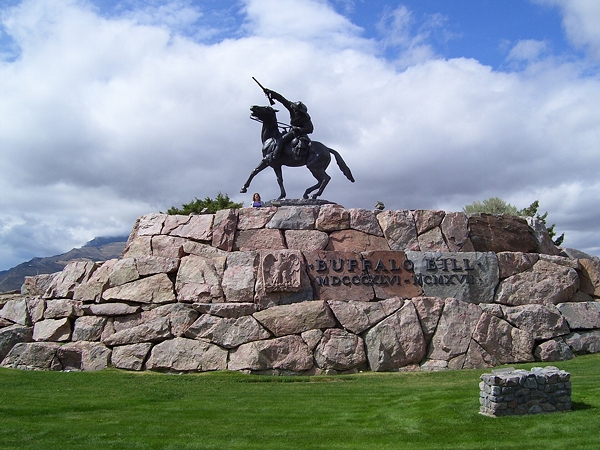
(above: Gertrude Vanderbilt Whitney, Buffalo
Bill - The Scout in Cody, sculpture, Buffalo Bill Center of the
West. Photo by Swampyank. Public domain, via Wikimedia Commons** )
The significance of Whitney to Wyoming art cannot be overstated. Beyond the statue itself, her family's continued patronage led to the founding of the Whitney Gallery of Western Art (now the Whitney Western Art Museum) in 1959. Her role is a rare example of an artist whose influence transitioned from personal creation to institutional philanthropy, effectively making Cody a "leading center of western American art". Her presence in history is documented by her inclusion on the National Register of Historic Places and the widespread recognition of her role in founding the Whitney Museum of American Art in New York.
Cody Art Colony
By the mid-1930s, the dream of establishing Wyoming as a permanent, self-sustaining center for the arts led to the creation of the Cody Art Colony. This initiative was driven by Mary Jester Allen, Cody's niece, who believed that artists could only capture the "spirit of the West" by living in it year-round. Although the ambitious plans for the colony largely failed to materialize due to the onset of World War II, the colony's impact was significant.
Public Art and the New Deal: The Democratization of the Wyoming Image
The final decade of this period, 1935-1945, was dominated by President Franklin D. Roosevelt's New Deal programs, which sought to put artists back to work during the Great Depression. In Wyoming, these programs -- specifically the Works Progress Administration (WPA) and the Federal Art Project -- transformed public buildings into galleries for the common man. Over 12,000 artists were employed nationally, creating thousands of murals and sculptures for nonfederal municipal buildings.
In Wyoming, the WPA art project was directed by E. E. Lowry, head of the University of Wyoming art department. A key figure in this movement was Ernest E. Stevens, who was commissioned in 1935 to paint historical murals for the Torrington High School auditorium. These murals, which depicted Old Fort Laramie and the Pony Express, were created in collaboration with the historian Grace Raymond Hebard to ensure they served as accurate pedagogical tools for the community. The WPA era marked the first time that art in Wyoming was explicitly intended to serve a social and educational function, rather than simply an aesthetic or commercial one.
Wyoming Aesthetic as a National Identity
The history of artistic expression in Wyoming between 1850 and 1945 reveals a consistent effort to reconcile the raw majesty of the landscape with the human experience of inhabiting it. From the Romantic canvases of Bierstadt that fueled expansion to the authentic ranch scenes of Gollings that documented its results, Wyoming's art evolved from a tool of empire to a medium of identity. The state's geography -- the "majestic nature" that Edward Grigware described as having the beauty of "an old face that has lived" -- dictated a style that was inherently different from the "sweet and trivial" landscapes of the East.
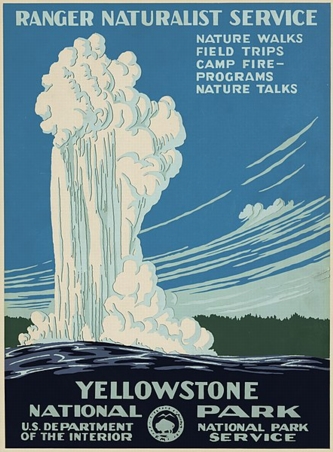
(above: Poster for Yellowstone National Park, Ranger Naturalist Service, c. 1938, Public domain, via Wikimedia Commons*)
The four artists discussed -- Bierstadt, Moran, Gollings and Whitney -- represent the peak of this expression. Their importance is not merely a matter of artistic skill but of cultural impact. Moran saved Yellowstone; Whitney built the foundation of Cody; and Gollings gave the cowboy a voice that was both rugged and refined. The high level of mention these artists receive in modern museum rotations, scholarly articles, and digital media confirms that their work remains the primary lens through which the world views the American West.
By 1945, the artistic infrastructure of the state -- the Cody Art Colony, the WPA mural projects, and the founding of major museum collections -- had firmly established Wyoming as a region where art was not an ornament of civilization, but its cornerstone. The transition from the "theatrical" studio paintings of the 19th century to the "regionalist" public murals of the 1940s reflects a state that had grown into itself, transforming its granite horizons and golden plains into a permanent and respected chapter of American art history.
We lightly edited the article, added
images and provided links to other materials to enhance it. AI is
rapidly improving in accuracy, yet the article may have inaccurate information.
Prompt:
Research plan:
(1) Search .org and .edu domains for a comprehensive history of fine arts in Wyoming from 1850 to 1945, focusing on how the state's unique geography, frontier culture, and specific events like the founding of Yellowstone influenced artistic expression. (2) Identify a list of prominent painters and sculptors active in Wyoming during this era; focus on those frequently cited in university archives, historical societies, and museum collections. (3) For 4 to 6 of the most significant artists, research their personal histories, the progression of their artistic techniques, and the specific qualities of their Wyoming-based works that distinguish them from peers in other regions. (4) Evaluate the relative importance of these artists by checking their presence in digital museum exhibits, educational video repositories, and academic publications hosted on .org or .edu sites. (5) Investigate the development of early art colonies in Wyoming, such as those in Jackson Hole or linked to the University of Wyoming, and determine the motivations for their establishment and their long-term impact on the state's cultural identity. (6) Analyze how the styles of Wyoming art evolved from mid-19th-century Romanticism and landscape documentation to the more modern or regionalist approaches seen through the early 20th century up to 1945. (7) Look for specific instances of cross-cultural influence, such as interactions with Indigenous art forms or the rise of the 'Western' genre, that helped create a distinct Wyoming aesthetic compared to neighboring Western states. (8) Synthesize all gathered information to prepare for a narrative that weaves together geography, artist biographies, and the significance of artistic clusters without the use of structured headings or lists.
 Return to Wyoming Art History
*Tag for expired US copyright of object image:

and
**Tag for some rights reserved:

Links to sources of information outside of our web site are provided only as referrals for your further consideration. Please use due diligence in judging the quality of information contained in these and all other web sites. Information from linked sources may be inaccurate or out of date. TFAO neither recommends or endorses these referenced organizations. Although TFAO includes links to other web sites, it takes no responsibility for the content or information contained on those other sites, nor exerts any editorial or other control over them. For more information on evaluating web pages see TFAO's General Resources section in Online Resources for Collectors and Students of Art History.
Copyright 2026 Traditional Fine Arts Organization, Inc. an Arizona nonprofit corporation. All rights reserved.