
Yellowstone National Park Art History: 1850-1945
a Gemini 3 Deep Research Report
Between the years of 1850 and 1945, the vast volcanic landscape of the Yellowstone region acted as a powerful focus for American expeditionary artists, printmakers, and painters. This high-elevation plateau, occupying over two million acres and straddling the Continental Divide, was largely an unmapped mystery to the general public during the mid-nineteenth century. Documenting this terrain required artists to verify and capture natural anomalies that many Easterners considered to be fabrications. The paintings resulting from these efforts did more than just supply visual proof of the region's active geology; they catalyzed a movement for national land preservation and established a highly lucrative market for private collectors and corporate patrons.
Geographical and Volcanic Context of the Yellowstone Plateau
To understand why artists were drawn to paint the region, the unique geographical and lithological parameters of the park must be evaluated. Approximately 96 percent of the total land area of Yellowstone is located within the state of Wyoming, with three percent in Montana and the remaining one percent in Idaho. The park occupies a roughly square parcel of volcanic complex measuring 63 miles from north to south and 54 miles from west to east. Rivers and lakes cover five percent of the land area, with Yellowstone Lake at 87,040 acres standing as the largest high-elevation lake in North America. The Continental Divide runs diagonally through the southwestern part of the park, separating the Pacific Ocean and Atlantic Ocean water drainages. The plateau is bounded on nearly all sides by mountain ranges of the Middle Rocky Mountains, ranging from 9,000 to 11,000 feet in elevation.
The mountains framing the plateau were the result of the North American and Pacific plates pushing against each other. The geological features that fascinated late nineteenth-century painters were formed when an intense period of volcanism left a 500-mile trail of more than 100 calderas as the North American plate moved in a southwestern direction over a localized hot spot. About 2.1 million years ago, this movement brought the Yellowstone area directly closer to this hot spot, causing magma to sit near the surface.
The region experienced three massive volcanic eruptions that deposited the thick ash and volcanic debris visible to expeditionary artists. The first eruption occurred 2.1 million years ago, covering 5,790 square miles with ash. A second, smaller eruption followed around 1.3 million years ago, and a third took place about 640,000 years ago. This final eruption created the massive Yellowstone Caldera, whose 30-mile by 45-mile wide rim remains visible in parts of the park. Though the last period of lava flow occurred 70,000 years ago, the plateau still sits over the active hot spot. Rain and snowmelt seep down through cracks in the earth's crust and are superheated by the magma, resulting in the spouting geysers, mudpots, and thermal pools that expeditionary artists were tasked with interpreting.
Compulsion to Paint: Verifying the Sublime and Documenting the Frontier
The principal compulsion driving painters to Yellowstone during the nineteenth century was the region's extraordinary, almost implausible natural topography. Prior to formalized scientific expeditions like the 1871 Hayden Survey, the descriptions of the region sounded more like works of science fiction than accurate geographical recording. Reports of boiling water shooting hundreds of feet into the sky and rumblings underfoot were frequently disbelieved by Easterners. This skepticism presented a professional challenge to academic painters who sought to verify these phenomena through empirical visual translation.
This artistic drive was deeply tied to the broader cultural climate of nineteenth-century American Romanticism and Transcendentalism. Thinkers like Ralph Waldo Emerson stated that the era was ocular and that the physical health of the human eye demanded a defined horizon. As industrialization surged on the East Coast, the wilderness moved progressively west, carrying the weight of the nation's future identity. Painters like Albert Bierstadt and Thomas Moran categorized themselves as Frontier Artist-Adventurers, feeling an obligation to document pristine environments before they were irrevocably altered or destroyed by Anglo-American civilization.
Capturing these landscapes was technically challenging. Academic painters and lithographers were pushed to stretch the possibilities of both the written word and standard illustration. The task of interpreting photographically captured geological formations into lines, dots, and dashes required a high degree of translational maneuver. Meticulous crosshatching and stippling were used to evoke the scaly expanses of mud, the pearly luster of conical steam vents, and the dark-brown spongy masses of siliceous sinter surrounding the active craters. Furthermore, the intense color palette of the thermal springs was so extreme that returning expeditionary teams often suspected their own initial field sketches had been exaggerated until repeat visits proved that the intense colors could not be overstated.
Appeal to Collectors and Corporate Patrons: Nationalism and Commercial Tourism
Artworks produced in Yellowstone found a highly receptive audience among American collectors due to a unique convergence of aesthetic appreciation, emerging nationalism, and commercial enterprise. The immense appeal to collectors was heavily facilitated by an alliance of three distinct constituencies: wealthy tourists, railroad developers, and conservation advocates.
Wealthy tourists desired tangible records of their excursions into remote territories. Collectors were heavily drawn to large-scale panoramic paintings that were explicitly designed to approximate the overwhelming physical grandeur of the western landscape for the viewer. These massive canvases were exhibited in major cities across the country and were eagerly viewed by urban audiences who wished to vicariously experience western exploration from a comfortable, controlled setting.
The railroad companies were among the most prominent collectors and patrons during this era. Corporate entities like the Northern Pacific Railroad and the Santa Fe Railroad realized that visual art could be utilized as a potent marketing tool. By commissioning works that idealized the remote landscapes accessible along their rail lines, they could successfully advertise their luxury services to high-paying tourists. For instance, Jay Cooke, the founder of the Northern Pacific Railroad, heavily funded promotional efforts surrounding the region to encourage railroad development and the construction of luxury hotels. Lavishly illustrated guidebooks regularly used landscape art to extol natural wonders alongside these man-made amenities.
Simultaneously, conservation advocates utilized these visual records to lobby for the preservation of pristine environments. Visual art functioned as irrefutable proof of the region's aesthetic value. The circulation of watercolor sketches and photographs through the halls of Congress was the direct mechanism that convinced federal legislators to establish Yellowstone as the world's first national park in 1872. For private collectors, buying a painting of Yellowstone was not merely an acquisition of fine art; it was a physical participation in the validation of national pride and the preservation of American identity.
The mass print market explosion of the 1860s and 1870s further expanded this appeal to less affluent collectors. High-quality, multi-colored chromolithographs were mass-produced using as many as 56 separate lithographic stones to achieve accurate color separation. These portfolios were sold widely, ensuring that the visual myth of Yellowstone penetrated deeply into the American collective imagination.
Focal Geological Features: Canyons, Geysers, and Thermal Pools
While the entire park presented an abundance of visual material, specific geological features were painted with much higher frequency than others. This prioritization was governed by the logistical realities of the early survey expeditions and the specific aesthetic philosophies guiding the artists.
The Grand Canyon of the Yellowstone and the Lower Falls were the most frequently depicted features in the landscape. Measuring 308 feet in height, the Lower Falls provided the exact visual drama required by practitioners of the sublime style of landscape painting. Canyons presented a dynamic vertical scale that was easy to interpret for an audience accustomed to European mountain landscapes. The walls of the canyon featured highly saturated bands of color derived from volcanic mineral deposits. John Muir described the illuminated canyon walls in 1885 as burning in a perfect glory of color, featuring white, yellow, green, blue, and vermilion shades blending indefinitely when struck by the sun.
Geysers, specifically Old Faithful and Castle Geyser, represented the second most frequently painted cluster of geological features. Geysers were the defining symbol of the region's geothermal activity, characterized by massive columns of superheated water and steam ejecting high into the sky. Castle Geyser, named for its towering cone structure, offered a predictable eruption cycle of roughly every 14 hours, emitting water streams reaching up to 75 feet. This predictability allowed artists to systematically study and paint the feature under varying lighting conditions, including the warm, complex colors of a sunset eruption.
Third, the smaller but highly complex thermal springs, mudpots, and fumaroles were painted to capture the detailed abstract qualities of the landscape. Hot springs like the Morning Glory Pool and the Grand Prismatic Spring derive their distinct concentric bands of color from specialized heat-loving microorganisms responding to extreme water temperatures. Blue colors represent the hottest waters, typically registering at 189 F (87 C), while orange and yellow bands characterize the slightly cooler spectrum between 149 F and 165 F (65 C and 74 C). These abstract visual circles and the thick, bubbling clay textures of the mudpots defied the standard linear perspective and compositional arrangements of traditional European painting. They forced painters to move toward a more modern, textural aesthetic heavily focused on localized color and atmospheric haze.
Evaluation of Five Highly Regarded Artists of the Yellowstone Region
An analysis of the artists operating in the park between 1850 and 1945 reveals four individuals who fundamentally shaped the visual understanding of the region. Their stylistic evolutions and unique technical approaches reveal how rendering active geological formations gradually shifted American landscape painting away from strict classicism and toward modernism.
Thomas Moran
Thomas Moran remains the most historically significant artist to have documented the park, and his work directly influenced federal policy regarding land preservation. Joining the 1871 Hayden Expedition at the age of 34, Moran was originally tasked with producing watercolor field studies to support official scientific reports. He funded his own travel to join the expedition and document the tales of geothermal activity that many in the East disbelieved.
His initial style on the trip was characterized by delicate, gem-like watercolors executed rapidly en plein air. These studies prioritized color and general atmospheric impression over minute botanical or lithological accuracy. Moran developed a technique referred to by art historians as artistic compression. Rather than painting a strict topographical map of a specific view, Moran took the signature elements of a place and compressed or expanded the scene within his composition to generate a heightened sensory experience of the location's true atmosphere. Visitors to the actual sites often struggled to achieve the exact views, realizing that Moran had liberally compressed or expanded the scenes.
This stylistic choice proved highly effective when he returned to his eastern studio to paint massive oils like The Grand Canyon of the Yellowstone, a 7-by-12-foot canvas that Congress eventually purchased for $10,000. Moran's technique varied relatively little from his 1871 debut until his death in 1926. While mainstream tastes shifted from the Hudson River School style to modern impressionism, Moran remained highly popular and respected, avoiding the sharp critical decline suffered by his peers like Frederic Church or Albert Bierstadt. He cemented his connection to the region by adopting the signature "TYM" (Thomas "Yellowstone" Moran), tying his professional identity permanently to the landscape.
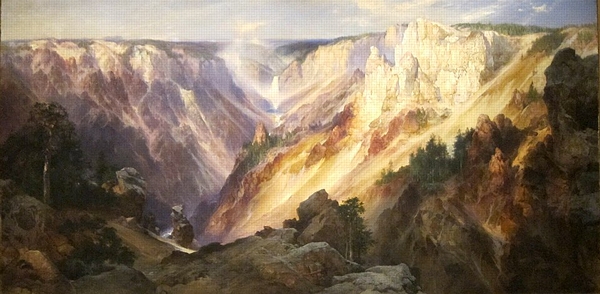
(above: Thomas Moran, Grand Canyon of the Yellowstone, 1904, oil on canvas, Honolulu Museum of Art. Public domain, via Wikimedia Commons*)
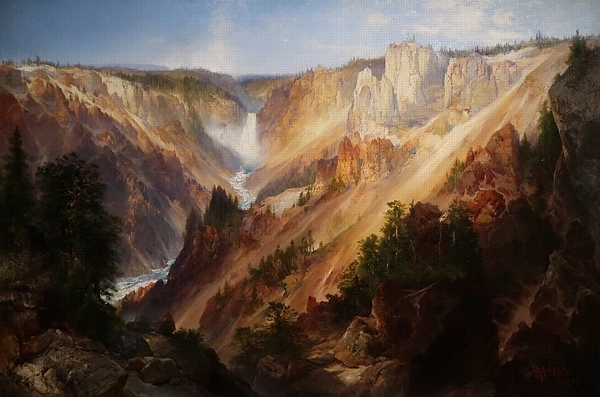
(above: Thomas Moran, Lower Falls, Yellowstone Park (Grand Canyon of the Yellowstone), 1893, oil on canvas, Crystal Bridges Museum of American Art. Public domain, via Wikimedia Commons*)
Albert Bierstadt
Albert Bierstadt was an established giant of the Hudson River School who brought his signature theatrical style to the Rocky Mountains and eventually Yellowstone. Born in Germany and heavily trained at the international artists' colony in Düsseldorf, Bierstadt specialized in large-scale, operatic landscapes characterized by dramatic lighting and extreme scale. He first visited Yellowstone in 1880, focusing his energy on the geysers and falls, though he tended to produce medium-sized paintings to avoid direct competition with Moran's massive 1872 masterpiece.
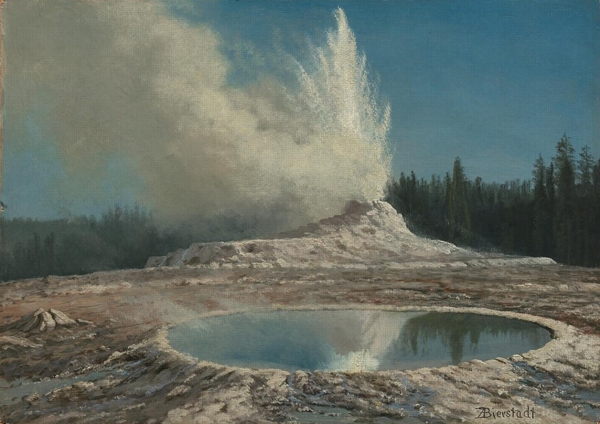
(above: Albert Bierstadt, Geyser, Yellowstone Park, c. 1881, oil and paperboard on paper, 13.8 x 49.5 inches, Museum of Fine Arts, Boston. Public domain, via Wikimedia Commons*)
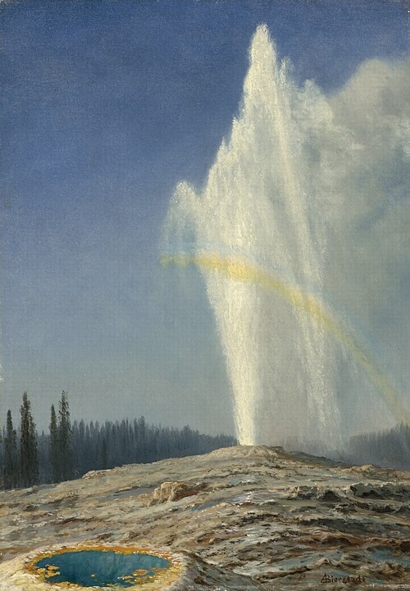
(above: Albert Bierstadt, Old Faithful, c. 1881, oil on paper, 49.5 x 34.9cm. Public domain, via Wikimedia Commons*)
Bierstadt's stylistic evolution was profoundly impacted by the emergence of photography. His brothers were commercial photographers, and Bierstadt frequently utilized stereographs and on-site photographs taken during his surveys to build his studio compositions. This influence is highly evident in his treatment of spatial organization across his works.
John Henry Twachtman
John Henry Twachtman represents a major shift toward modernism in the documentation of the park. As a founding member of the progressive group known as The Ten American Painters, Twachtman was a leading practitioner of American Impressionism. He visited Yellowstone in 1895, relatively late in his life, having been commissioned by a private patron named William Wadsworth to paint a series of the park.
Twachtman's stylistic evolution proceeded from a dark, heavily textured palette absorbed during his studies under Wilhelm Leibl at the Academy of Fine Arts in Munich, to a bright, light-drenched French Impressionist approach. He was famously obsessed with the material structure of snow, slush, and water. Canvases painted between 1889 and 1901 were strikingly white, with passages glistening with varnish and paint built up to high degrees of thickness resembling the snow itself.
Encouraged by friends like William Merritt Chase, Twachtman also began to experiment heavily with pastels, developing a unique tonal approach influenced by James Abbott McNeill Whistler. Like Whistler, Twachtman used the pastel chalk not like a pencil to draw lines, but rather like a brush to paint, emphasizing the textural possibilities he considered key to capturing a sense of place.
At Yellowstone, this focus on texture found a perfect application among the park's thermal features. In his September 1895 visit, it luckily snowed, leaving him with a palette of emerald greens, buttercream yellows, and varied whites. In his depiction of the Edge of the Emerald Pool, Twachtman actively abstracted the specific site. Instead of relying on a standard horizon or standard landscape markers, he turned the canvas into a meditation on pure color and light. His brushwork was deliberately choppy and built up to high degrees of consistency, leading viewers to focus on the tactile qualities of the paint itself rather than purely recognizing the geological formation.
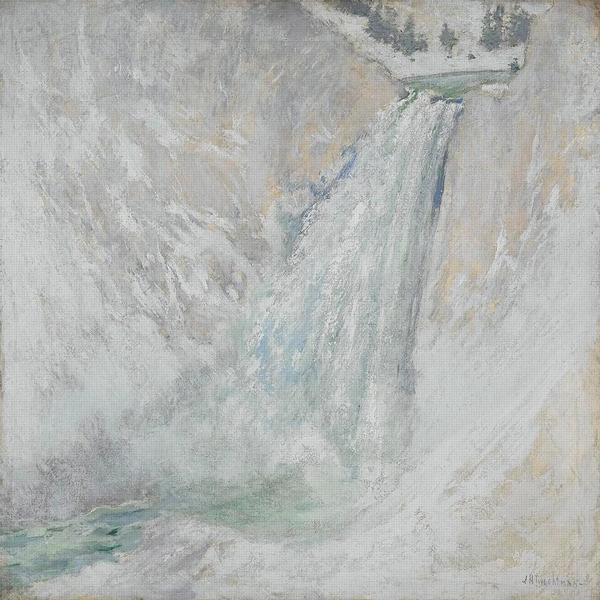
(above: John Henry Twachtman, Lower Falls of the Yellowstone, c. 1895, oil on canvas, 30 x 30 inches, Crystal Bridges Museum of American Art. Public domain, via Wikimedia Commons*)
William Robinson Leigh
William Robinson Leigh, routinely cited as one of the most thoroughly trained painters of the American West, brought a highly disciplined compositional approach to the region. He studied at the Maryland Institute in Baltimore at the age of 14 before leaving for Germany to attend the Royal Academy in Munich. He confirmed his interest in painting uniquely American subjects after meeting Thomas Moran and hearing the artist's appeal for native art rather than imitations of foreign styles.
Leigh's stylistic evolution took him through Tonalism and Impressionism, eventually arriving at a distinctly Modernist aesthetic. His early paintings of the West emphasized mood, deep shadows, and glowing highlights derived from his exposure to the Barbizon school. Leigh was highly technical in his rendering of complex geology, utilizing rich, earthy tones and dynamic lighting to capture scale without relying on human intervention to measure the scene.
By the 1920s, Leigh's paintings exhibited an Impressionist-inspired palette featuring vibrant purples and oranges designed to mimic the southwestern and mountain sunsets. By 1930, his style had evolved further into a Modernist-leaning format characterized by bold, simplified forms. His focus was primarily aimed at capturing the raw geological drama of nature, deliberately leaving human figures out of his canyon and park landscapes. Returning from Europe, Leigh became well-established as a magazine illustrator, earning the nickname America's Sagebrush Rembrandt for his large-scale paintings of western terrains.
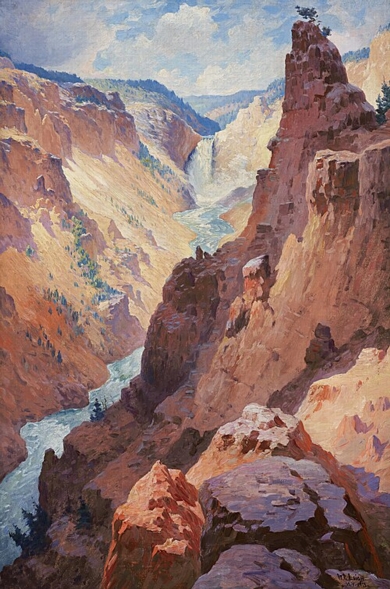
(above: William Robinson Leigh, Grand Canyon of the Yellowstone, 1913, oil on canvas, 33 x 22 inches. Public domain, via Wikimedia Commons*)
Evaluating Relative Importance: Museum Presence and Literary Representation
A critical evaluation of the relative importance of these artists, as demonstrated by their frequency of mention across museum exhibits and formal literary accounts, establishes a clear hierarchy of historical and continuous legacy.
Thomas Moran stands out in the provided records as the preeminent figure regarding the artistic history of the park. He is cited across an array of major institutional exhibitions, including retrospectives organized by the National Gallery of Art, the Gilcrease Museum, the Dallas Museum of Art, and the National Museum of Wildlife Art. His field sketches are maintained as core historical documents at the Yellowstone Heritage and Resource Center in Gardiner, Montana. The continuous stream of publications regarding his work, such as Joni L. Kinsey's Thomas Moran's West, reflects his foundational role in establishing visual structures of national preservation.
Albert Bierstadt retains an equivalent historical stature, although often cited in materials in connection to a broader regional context including Yosemite and the Wind River Range. Academic texts, such as Matthew Biagell's monograph, evaluate his contributions extensively, particularly targeting the way his use of early photography transformed compositional balance in nineteenth-century oil paintings. Institutional collections at the New-York Historical Society, the Seattle Art Museum, and the Brooklyn Museum actively feature his smaller oil studies.
William Robinson Leigh represents a figure with a massive physical archival footprint. The Gilcrease Museum alone owns a collection of approximately 1,300 pieces of his work, including the complete contents of his studio gifted by his widow. His work is frequently presented as on par with figures like Frederic Remington and Charles Russell. His legacy is further established by self-authored publications such as Frontiers of Enchantment and The Western Pony.
John Henry Twachtman represent an artist whose reputation has been re-evaluated and elevated by modern institutional focuses on specific aesthetic movements and historical inclusion. Twachtman's Yellowstone works are framed in galleries like Crystal Bridges and the Whitney Western Art Museum as rare instances where an American Impressionist engaged directly with the raw terrain of the West.
While digital platforms such as YouTube videos are often absent as isolated citation metrics in standard archival indices, online educational initiatives and virtual exhibitions hosted by repositories like the Huntington Library and the Gilcrease Museum serve as the active modern mechanism for disseminating these artists' works to a global audience. This continuous digital presence reflects a modern extension of the mass-market chromolithograph accessibility of the late nineteenth century.
The intense compulsion felt by painters operating in Yellowstone between 1850 and 1945 was rooted in a distinct collision of severe geological anomalies, romantic philosophies regarding pristine nature, and institutional mandates from both scientific surveys and corporate railroad entities. The resulting artworks appealed heavily to collectors as instruments of national pride, vicarious exploration, and capital promotion. Canyons and major falls received top priority due to their dramatic vertical scale, while thermal springs and geyser basins forced artists to abandon strict academic classicism in favor of capturing complex tactile textures and abstract colorations. The specific evolutions of figures like Moran, Bierstadt, Twachtman and Leigh demonstrate a broader arc where active volcanic geology effectively served as a laboratory for developing a uniquely American tradition of landscape painting. These artists ultimately served as the visual bridge between a misunderstood, hostile environment and a celebrated icon of international conservation.
Please click here to view more artworks
We lightly edited the article, added images and provided links to other materials to enhance it. AI is rapidly improving in accuracy, yet the article may contain inaccurate information.
Prompt:
Research Plan:
 Return to Wyoming Art History
*Tag for expired US copyright of object image:

and
**Tag for some rights reserved:

Links to sources of information outside of our web site are provided only as referrals for your further consideration. Please use due diligence in judging the quality of information contained in these and all other web sites. Information from linked sources may be inaccurate or out of date. TFAO neither recommends or endorses these referenced organizations. Although TFAO includes links to other web sites, it takes no responsibility for the content or information contained on those other sites, nor exerts any editorial or other control over them. For more information on evaluating web pages see TFAO's General Resources section in Online Resources for Collectors and Students of Art History.
Copyright 2026 Traditional Fine Arts Organization, Inc. an Arizona nonprofit corporation. All rights reserved.