
Mosaics Depicting Jesus Christ Created in the United States between 1855 and 1955
a 2026 Gemini 3.1 Extended Narrative .
When you think about the great mosaic artworks of the world, your mind probably jumps straight to the ancient, ash-covered ruins of Pompeii or the dazzling, gold-drenched domes of Byzantine churches in Ravenna and Istanbul. It is easy to assume that the art of piecing together tiny bits of glass and stone to create sweeping religious narratives is strictly an old-world phenomenon. However, there is an incredibly rich and somewhat underappreciated chapter of mosaic art that happened right here in the United States between 1855 and 1955. This was a wild, deeply transformative century for the country.
We went from a young nation on the brink of a devastating Civil War to a booming industrial superpower during the Gilded Age, and finally to a global titan navigating the complex aftermath of World War II. Throughout all this rapid cultural and economic change, Americans were building churches, chapels, and cathedrals at an astonishing rate. And to decorate these sacred spaces, they turned to one of the oldest art forms in the world, reinventing it with modern industrial technology and a distinctly American swagger.
During this hundred-year span, the depictions of Jesus Christ created in mosaic were nothing short of breathtaking. They reflect not just the changing theological views of American congregations, but the evolution of American art itself. In the mid-nineteenth century, if a wealthy parish wanted a mosaic, they generally had to import European artisans and rely on strict, centuries-old design templates. But as American art schools developed and glassmaking technology exploded, homegrown artists began to push the boundaries of what a mosaic could be.
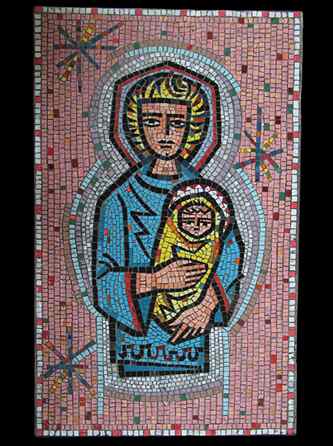
(above: Edward M. Catich (1906-1979), Madonna with Blonde Hair and Christ Child, n.d., glass on concrete mosaic, collection of St. Ambrose University) from Edward M. Catich: Rock, Paper Scissors, Glass -- a Selection of Works from St. Ambrose University
Let's take a stroll through this fascinating era and look at five of the most highly regarded artists who crafted these shimmering visions of Christ, breaking down what made their styles so unique and evaluating why their legacies continue to matter so much today.
You really cannot talk about the history of American glass or mosaic art without immediately bringing up Louis Comfort Tiffany. Born in 1848, he was the son of the famous jewelry company founder, but Louis wanted to make his own distinct mark on the world. By the late 1880s, he had become absolutely obsessed with the visual possibilities of glass. He was not at all satisfied with the traditional European methods of making mosaics, which usually involved taking flat, opaque pieces of glass or stone and setting them rigidly into plaster. Tiffany wanted his mosaics to glow from within, to shift in color as the sun moved across the sky, and to possess a deep, three-dimensional texture. To achieve this, he utilized his famous Favrile glass, which was wildly iridescent and heavily textured, moving mosaic art away from a flat medium into something incredibly dynamic.
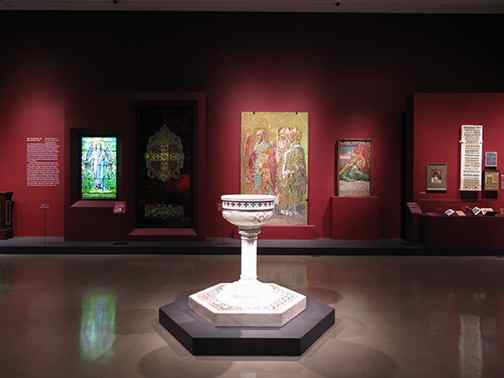
(above: Among the many ecclesiastical objects the Tiffany Studios designed were baptismal fonts, and the one at center, on loan from Christ Church, Pomfret, Connecticut, dates from 1908 and is made of marble and glass mosaic. In the background from left, is I Am the Resurrection and the Life, 1902, from the Richard H. Driehaus Museum, Chicago, Illinois; Antependium Window, ca. 1892-93, on loan from Lillian Nassau LLC, New York; Fathers of the Church, ca. 1892, a glass and plaster mosaic that was exhibited at the 1893 World's Columbian Exposition in Chicago, on loan from The Neustadt Collection of Tiffany Glass, Long Island City, New York; and Head of St. Andrew, ca. 1897, a glass mosaic detail for a Last Supper composition, on loan from Lillian Nassau LLC, New York. Photo credit: Photo by Gina Fuentes Walker, courtesy the Museum of Biblical Art.) from Louis C. Tiffany and the Art of Devotion
In 1889, seeing the massive boom in church construction funded by America's newly minted industrial millionaires, Tiffany opened a dedicated ecclesiastical department. One absolute masterpiece to come out of his studio was a massive three-panel mosaic known as the Te Deum Laudamus. The center panel features a staggering depiction of Christ Seated in Glory. What makes Tiffany's depiction of Jesus so special is the ethereal, almost magical quality of the light. He used over two million pieces of opalescent glass in this triptych alone. Instead of the flat, severe Christ figures of medieval Europe, Tiffany's Christ is bathed in a sublime, naturalistic glow, surrounded by deep crimsons representing love and sacrifice, and vibrant golds typifying divine glory.
When you try to evaluate Tiffany's relative importance today, it is almost impossible to overstate. He is a towering titan of American decorative arts. If you search for American mosaic history on YouTube, his name completely dominates the algorithm, with countless documentaries dedicated to his glassmaking secrets. Major institutions like the Metropolitan Museum of Art and the Corning Museum of Glass have permanent exhibits dedicated entirely to his studio's output, and the books and articles written about his innovations could fill a small library. Critics and art historians still widely agree that his work was nothing short of a "symphony in glass."
But Tiffany did not build his massive aesthetic empire entirely on his own, which brings us to the brilliantly talented Frederick Wilson. Born in Great Britain in 1858, Wilson crossed the pond and eventually became the very first in-house designer for Tiffany's ecclesiastical department. Wilson was an absolute genius when it came to figure drawing, heavily influenced by the Pre-Raphaelite movement back in England, which favored rich colors and deeply emotional, romanticized religious subjects. While Tiffany mastered the glass chemistry and managed the overall business, Wilson was the artist who actually designed many of the most famous religious scenes bearing the studio's name.
One of Wilson's most important mosaic achievements is a colossal, 2,600-pound piece titled Christ the Teacher, which was unveiled in 1906 for the John Raymond Memorial Universalist Church in Scranton, Pennsylvania. The mosaic depicts the biblical scene of the Sermon on the Mount, showing Jesus seated in a beautifully detailed, leafy wooded landscape with figures gathered intently around him. What makes Wilson's artistic style so incredibly unique is his ability to blend traditional, highly expressive figure modeling with the wild, unpredictable nature of Tiffany's opalescent glass.
Wilson had a spectacular knack for using the natural folds, ripples, and color gradients in the foil-backed tesserae to create the heavy drapery of Christ's robes and the intricate textures of the surrounding nature. He gave the figure of Jesus a real sculptural weight and a gentle, deeply human presence that felt incredibly modern. Evaluating Wilson's importance can be a bit trickier because he spent so many decades working under the massive shadow of the Tiffany brand, meaning his name is often left off the casual tourist plaques. However, if you dig into scholarly articles and specialized museum exhibits, his name pops up constantly. Curators know exactly who he was, and his individual design drawings are highly prized in museum archives today.
As the twentieth century rolled on, the artistic tastes of the country began to experience a massive shift. The lush, hyper-detailed, romantic landscapes of the late Victorian era started to feel a bit out of date, especially after the immense global trauma of the First World War.
Enter Hildreth Meiere https://www.hildrethmeiere.org , a trailblazing woman who became one of the most prominent muralists and mosaic designers of the mid-twentieth century. Born in 1892, Meiere developed an artistic style that was a gorgeous, striking blend of the Byzantine revival and sleek, modern Art Deco. She completely stripped away the fussy garden backgrounds and the sentimentality of the previous generation. Instead, her work is characterized by crisp, clean lines, bold geometry, and monumental, static figures that project an incredible sense of architectural authority and deep peace.
During the height of the Second World War in 1943, she designed a brilliant glass mosaic altarpiece depicting Christ Pantocrator for the crypt chapel at the Seminary of the Immaculate Conception in Huntington, New York. A few years later, she designed a breathtaking Resurrection apse mosaic for the Washington National Cathedral, showing Jesus standing triumphant over death. Her process was fascinating; she would draw massive, full-scale cartoons and send them to the Ravenna Mosaic Company, carefully overseeing how the craftsmen translated her crisp lines into glass. In the Pantocrator mosaic, she depicted Christ as the supreme judge, seated in majesty with a shattered cathedral, a fallen mitre, and skeletal bones at his feet to symbolize earthly disarray.
What makes Meiere's depictions of Christ so culturally important is how she updated the oldest, most rigid traditions of the Orthodox church for a modern American audience. Her Jesus does not look like a soft Victorian shepherd; he is the ruler of the cosmos, rendered in a stylized, almost architectural way that perfectly fits the streamlined aesthetics of twentieth-century design. In terms of her relative importance, Meiere has experienced a massive critical renaissance in recent years. For a few decades after her death, the widespread craze for mid-century modern minimalism made some of her religious work seem a bit traditional, but today, she is celebrated everywhere.
There is an entire international association dedicated specifically to preserving her legacy. You will find her heavily featured in museum exhibits focusing on women in the arts and Art Deco architecture. Recent books and scholarly articles have finally placed her right at the top of the twentieth-century hierarchy of American muralists, and documentaries about her massive architectural commissions are starting to gain serious traction on educational YouTube channels. Historians now frequently look at her massive output and call it an "absolute triumph of modern American design."
Stepping back slightly into the Gilded Age, we have to talk about the remarkable life and work of David Maitland Armstrong. Born in Newburgh, New York, in 1836, Armstrong had a truly fascinating life trajectory. He actually served as an American diplomat, acting as Consul General in Rome before fully dedicating himself to a career in art. Living in Italy, he fell deeply in love with classical antiquity and the grand Renaissance traditions of tying art directly to the surrounding architecture. When he returned to the United States, he became a central figure in the American Renaissance movement, working alongside heavyweights like Augustus Saint-Gaudens and John La Farge before setting up his own highly successful firm, Maitland Armstrong and Co.
Armstrong was an absolute master of integrating architectural space with decoration. He did not just want to stick a pretty mosaic picture on a wall; he wanted the entire room to feel like a cohesive, spiritually uplifting environment. One of his most spectacular contributions to American mosaic art is the exquisite marble and mosaic reredos he created for the Church of the Ascension in New York City. The piece features beautiful mosaic angels flanking the altar space, perfectly complementing the overall chancel design and drawing the eye toward the central theological focus of the church.
Armstrong's style was characterized by a very grounded, patrician elegance. He did not push the medium into the wild, abstract, glowing iridescence that Tiffany favored. Instead, Armstrong used traditional mosaic techniques to create a sense of enduring, classical stability. His figures have a quiet dignity, reflecting his deep, lifelong appreciation for Italian antiquity. When we evaluate Armstrong's relative importance today, we have to look at the elite circles he ran in and the lasting impact of his public works. He is frequently discussed in thick academic books covering the American Renaissance.
If you visit museum exhibits focused on the diplomatic and artistic exchanges between America and Italy in the nineteenth century, Armstrong is a central, unavoidable figure. His peers recognized his genius, and modern architectural historians still deeply respect his contribution to the American ecclesiastical landscape.
Finally, you absolutely cannot discuss American religious mosaics from this era without bringing up Ella Condie Lamb and the immense legacy of the J&R Lamb Studios. Founded in 1857, Lamb Studios was actually older than Tiffany's operation and proved to be his biggest, most consistent lifelong competitor. Ella Condie Lamb, born in 1862, was a highly acclaimed, award-winning portrait painter who became the star designer for the family business after marrying Charles Lamb. Her artistic style was a profound, fascinating blend of American Art Nouveau https://www.metmuseum.org/essays/art-nouveau grace and incredibly strict, deeply intellectual ecclesiastical symbolism. She did not just design pretty faces to fill up empty wall space; every single color, shape, and object in her mosaics had a highly specific, carefully researched theological meaning.
One of her crowning achievements in mosaic design can be found in the apse of Sage Chapel at Cornell University. While the space is filled with gorgeous angels and trailing vines, it is the deeply symbolic representation of Christ that truly steals the show. She utilized ancient symbols like the Greek letters Chi Rho, which begin the word Christos, along with the Alpha and Omega and the lamb representing the Redeemer, all set brilliantly against a stunning blue firmament of gilded sunbursts and stars.
The Lamb Studios were also responsible for the spectacular Lakewood Memorial Chapel in Minneapolis, which was completed in 1910 and is still widely considered one of the most perfect, authentic Byzantine mosaic interiors in the United States. Under her husband's direction, the studio actually brought over highly skilled artisans from Italy who had just finished working at the Vatican to execute the ten million tiny tesserae made of marble, colored stone, and glass fused with gold and silver.
What makes Ella Condie Lamb's work so incredibly special is her intellectual rigor. She brought a high-minded, classically trained portraitist's eye to the medium, ensuring that the depictions of Christ and his symbols were not just visually stunning, but theologically bulletproof. When evaluating the historical importance of Ella Condie Lamb and the studio she helped run, they hold a totally unique place in American history.
Because J&R Lamb Studios is the oldest continuously running decorative arts firm in the United States, their massive historical archive is actually preserved in the Library of Congress. Scholars frequently praise her ability to merge breathtaking artistic beauty with the "deepest theological truths."
When you look back at the hundred years between 1855 and 1955, the evolution of the American mosaic is truly a spectacular story of cultural ambition. It is the story of a young country trying frantically to find its own artistic voice on the world stage. We started by importing European talent and directly copying ancient Byzantine traditions, but very quickly, American artists began to experiment, innovate, and break all the old rules. They took the figure of Jesus Christ -- arguably the most depicted figure in Western art history -- and continually reimagined him to suit the changing spirit of the nation.
Through the glowing, opalescent innovations of Louis Comfort Tiffany and the highly emotional, Pre-Raphaelite storytelling of Frederick Wilson, Christ became a radiant, deeply naturalistic presence that reflected the lush optimism of the Gilded Age. Through the classical, diplomatic grandeur of David Maitland Armstrong, he became a figure of enduring, patrician stability that grounded a rapidly changing society. Through the intellectual, deeply symbolic designs of Ella Condie Lamb, the spiritual mysteries of the Redeemer were mapped out in millions of tiny glass tiles for university students and grieving families alike to ponder. And finally, through the bold, unapologetic Art Deco geometry of Hildreth Meiere, Christ was transformed into a sleek, monumental ruler of the modern age, perfectly suited to a country that had just survived the horrors of global war and was stepping confidently into the future.
These five artists did not just decorate cold church walls; they created entirely new environments of awe. They pushed the boundaries of what glass, stone, and plaster could do, proving once and for all that American ecclesiastical art could stand toe-to-toe with anything produced in the ancient cathedrals of Europe. Today, whether you are watching a high-definition tour of a historic church on YouTube, flipping through a heavy academic coffee table book, or standing silently in a brightly lit museum exhibit, the legacy of these mosaic masters continues to shine brilliantly. They took the ancient, universal impulse to honor the divine and gave it a uniquely American pulse, leaving behind a shimmering trail of artistic history that we are incredibly lucky to still be able to witness today.
We lightly edited this text and provided links to other materials to enhance it. AI is rapidly improving in accuracy, however, the text may contain inaccurate information. This presentation doesn't meet scholarly standards, yet Gemini AI researched and checked it for accuracy. Sources are footnoted in the raw AI report, yet deleted here for a general audience
Prompt:
 Return to Religious Art
Return to Topics in American Representational Art
*Tag for expired US copyright of object image:

TFAO Museum of American Art is proudly sponsored by Traditional Fine Arts Organization, Inc., an Arizona nonprofit corporation. All rights reserved. © 2024
Links to sources of information outside of this website are provided only as referrals for your further consideration. Please use due diligence in judging the quality of information contained in these and all other web sites. Information from linked sources may be inaccurate or out of date. TFAO neither recommends or endorses these referenced organizations. Although TFAO includes links to other web sites, it takes no responsibility for the content or information contained on those other sites, nor exerts any editorial or other control over them. For more information on evaluating web pages see TFAO's General Resources section in Online Resources for Collectors and Students of Art History.
 Search Resource Library
Copyright 2026 Traditional Fine Arts Organization, Inc., an Arizona nonprofit corporation. All rights reserved.