
Bald Eagles in American Sculpture
a 2026 Gemini Pro Deep Research Project
The bald eagle is not simply a biological specimen of North America; it has evolved into the feathered embodiment of the nation's most deeply cherished ideals. It is remarkably easy to see why the bird commands such attention and why Americans have cultivated an enduring fascination with sculptures depicting this magnificent raptor. In the wild, the bald eagle is a creature defined by its rugged independence and overwhelming physical power. With a sweeping wingspan that can stretch over seven feet, it effortlessly rides the thermal currents high above the mountains and coastlines, acting as an apex predator of the skies.
People are inherently drawn to the striking visual contrast of the eagle's brilliant white head against its dark, muscular body, a natural design that practically begs to be immortalized in art. Furthermore,the eagle's piercing yellow eyes suggest a state of unwavering, stoic vigilance, while its razor-sharp talons serve as a lethal reminder of its capability for overwhelming force. But beyond its aggressive hunting traits, the bald eagle is also deeply revered for its intense parental protectiveness, fiercely guarding its massive nests perched high in the wilderness canopy. To the American public, these organic, natural attributes perfectly mirror the idealized national character: autonomous, capable of fierce self-defense, breathtakingly beautiful,and fundamentally protective of its home. When people look at a bald eagle sculpture, they are not just looking at a bird; they are looking at a romanticized reflection of the American spirit itself.

(above: Wilhelm Schimmel (1817-1890), Eagle, c. 1870-1890, wood and paint. Collection of the Brandywine River Museum. Gift in honor of Harry G. Haskell by his family, 1993. Declared the national emblem by the Continental Congress in 1782, the eagle was a favorite theme of carvers. The eagle was the signature form of Wilhelm Schimmel, one of the foremost folk carvers of the 19th century.) Source: Animal Sculpture in the Folk Tradition (5/20/05)
Because these symbolic associations are so exceptionally potent, American governments at the federal, state,and local levels have relentlessly integrated bald eagle sculptures into their public artworks, architectural commissions, and numismatic designs. For a rapidly expanding republic looking to establish a sense of indisputable legitimacy and permanence on the global stage, the bald eagle functioned as the ultimate visual tool of statecraft. By adopting the eagle as the centerpiece of the Great Seal and plastering it across public spaces, governmental authorities intentionally drew a direct, unbroken lineage back to the Roman Republic and its conquering aquilas.
This architectural choice effectively whispered to everyday citizens and foreign dignitaries alike that the United States was the rightful, modern heir to classical democratic glory. Governments placed brooding stone eagles over the entrances of custom houses, federal reserve buildings, post offices and military monuments because the raptor instantly communicates federal authority, the unquestionable rule of law, and a solemn promise of national defense. A massive granite eagle glaring down from a courthouse roof visually assures the public that the state is eternally watchful and institutionally robust. On coinage, the government utilized the eagle to transform everyday currency into pocket-sized medallions of civic pride,allowing the state to place a tangible symbol of sovereign wealth and stability directly into the hands of its people.
For the immensely talented American sculptors working between the mid-nineteenth and mid-twentieth centuries -- a dynamic era frequently referred to as the American Renaissance -- the bald eagle represented a dream subject. These artists were inspired to depict the eagle not only out of a sense of patriotic civic duty but because the bird presented a supreme technical and aesthetic challenge.
Many of these sculptors were rigorously trained in the academic traditions of the École des Beaux-Arts in Paris, a school of thought that demanded supreme, lifelike naturalism fused with grand allegorical meaning. The incredibly complex anatomy of the eagle allowed these sculptors to thoroughly flex their technical muscles. They faced the daunting task of translating the soft, downy feathers of the bird's breast, the stiff, aerodynamic primary feathers of its massive wings, and the tense, prehistoric musculature of its talons into rigid bronze or unforgiving marble.
Furthermore,the eagle provided an unparalleled opportunity to experiment with kinetic energy and dramatic silhouettes, allowing artists to capture the bird with wings thrust aggressively upward in ascent, or folded tightly in dignified,watchful repose. For sculptors actively seeking to define a uniquely American artistic vocabulary that could step out of Europe's shadow, the bald eagle was the ultimate muse. It allowed them to weave their own personal patriotism, and very often their deep gratitude as immigrants, into the very architectural fabric of the rapidly expanding nation.

(above: Eagle from the cupola of Lynn Academy, 1804, Carved by Samuel McIntire, Lynn, Massachusetts, painted pine, Courtesy of Lynn Museum and Historical Society, Photograph by Dennis Helmar) Source: Samuel McIntire: Carving an American Style (11/1/07)
No artist better exemplifies the brilliance of this era than Augustus Saint-Gaudens, a man widely considered the titan of American Renaissance sculpture. Born in Dublin, Ireland, to a French father and an Irish mother, Saint-Gaudens immigrated to the United States as an infant and was raised in the bustling, diverse neighborhoods of New York City. His personal motivation for sculpting iconic American symbols like the bald eagle was deeply rooted in his fervent, highly romanticized love for his adopted homeland, viewing his art as a way to repay the country that had nurtured his immense talent. Saint-Gaudens was on a personal crusade to rid the nation of the stiff, lifeless neo-classicism that had dominated early American art. He wanted to replace it with a vital, pulsing, and deeply naturalistic aesthetic, proving once and for all that American public art could stand shoulder-to-shoulder with the finest masterpieces of the Old World. His deep, frequent collaboration with the legendary architect Stanford White led to some of the most iconic and beloved civic art of the Gilded Age.
In 1890, Stanford White commissioned Saint-Gaudens on behalf of the New York Life Insurance Company to design a crowning, monumental sculpture for the company's new frontier expansion buildings in growing western cities like Kansas City, Omaha, and Saint Paul. Augustus sketched the masterful conceptual form for what would become the magnificent New York Life Eagle, which was subsequently carved in marble by his brother Louis. This specific sculpture possesses a wonderfully unique nature; rather than portraying the eagle merely as a static, aggressive conqueror of the skies, Saint-Gaudens designed it as a brilliant, complex allegory of protection. The majestic bird is poised dynamically on a rugged ledge of rock, its massive wings spread wide to create a safe, sheltering canopy over a vulnerable nest of eaglets, while its sharp talons firmly and violently grasp a writhing, threatening serpent. People admire this sculpture immensely today because it beautifully and effectively humanizes institutional power. It presents strength not as a tool for unchecked tyranny or blind military conquest, but as a deeply necessary, vigilant shield for the innocent. By framing the eagle as a fierce parent desperately defending its young, Saint-Gaudens created a relatable, highly emotional narrative of civic and familial defense that continues to captivate observers who view the restored piece overlooking the Mississippi River valley.
Working quietly but brilliantly alongside Augustus was his brother, Louis Saint-Gaudens, who was responsible for physically carving the marble editions of the New York Life Eagle from his brother's conceptual sketches. While Louis often operated in the immense shadow of his famous sibling, he was an absolute master sculptor in his own right, possessing a profound, intuitive understanding of how large-scale sculpture must harmonize with monumental architecture. Louis's personal reason for sculpting the American eagle stemmed from his passionate belief in the nobility of industry and the critical importance of bringing high, allegorical art out of the museums and into the everyday transit spaces where the American public actually congregated. He wanted to elevate places of transit and commerce into literal temples of modern progress, using the eagle as a stamp of national achievement.
This specific motivation is spectacularly evident in the colossal eagles Louis Saint-Gaudens crafted to flank the center sculptures of The Progress of Railroading, completed in 1908 at the monumental Union Station in Washington, D.C.. These particular eagles are incredibly unique because they are integrated directly into a celebration of industrial might and engineering prowess rather than a commemoration of military victory. They stand as impossibly robust, heavily grounded guardians flanking classical figures that celebrate human ingenuity, mechanics, and the conquering of a vast, untamed continent by the steam locomotive. Admirers are captivated by their heavy, intensely watchful presence; these eagles do not appear ready to fly, but rather they stand resolutely, visually grounding the soaring, cavernous architecture of the massive station. These eagles represent the absolute perfect marriage of classical artistic ideals with the roaring, muscular reality of twentieth-century American infrastructure, and they remain deeply admired as silent, unflinching sentinels watching over the millions of modern travelers passing through the nation's capital.
The powerful theme of immigrant gratitude driving patriotic artistic expression finds another profound voice in the prolific work of Adolph Alexander Weinman. Born in the small village of Durmersheim, Germany, in 1870, Weinman immigrated to the United States as a young teenager and eventually studied his craft at the Art Students League under none other than Augustus Saint-Gaudens, fully absorbing the master's lifelong dedication to naturalism and civic grandeur. Weinman's personal motivation for dedicating so much of his long career to depicting American eagles was deeply, inextricably rooted in the overwhelming appreciation he felt for the boundless opportunities his new country had afforded him and his family. Weinman viewed architectural sculpture not just as a job, but as a paramount civic duty, passionately believing that public buildings should serve as permanent canvases for heroic, nationalistic storytelling that would inspire future generations of Americans.
When the renowned architectural firm McKim, Mead & White designed the original Pennsylvania Station in New York City -- a breathtaking Beaux-Arts masterpiece famously modeled after the ancient Baths of Caracalla-Weinman was commissioned in 1904 to design its architectural guardians. The spectacular result was his legendary series of Pennsylvania Station Eagles. Carved meticulously from beautiful Milford pink granite sourced from Massachusetts, each of these fourteen massive eagles weighed an astonishing 5,500 pounds and measured five feet in height with a formidable six-foot width. Their unique nature lies entirely in their severe, brooding geometry, seamlessly blending the organic realism of the bird with the heavy, unyielding, blocky lines of early architectural modernism. They were designed to be viewed from far below by passengers rushing to their trains, requiring a robust, almost exaggerated scale that emphasized their broad shoulders and severe, downward gaze. When the magnificent Penn Station was tragically demolished in the 1960s -- a heartbreaking act of architectural vandalism that actually catalyzed the modern historic preservation movement -- these resilient eagles were salvaged from the rubble of the terminal. Today, they are deeply admired not merely for their sheer aesthetic brilliance, but as melancholic, surviving trophies of a lost golden age of American rail travel. Observers flock to see the surviving eagles standing guard at the Market Street Bridge in Philadelphia and at the National Zoo in Washington, D.C., viewing them as stoic, physical memories of a once-great temple of transportation.
Weinman's absolute mastery of the eagle was not limited to colossal stone; he was equally adept at channeling the bird's inherent majesty into incredibly intimate, numismatic scales. His personal drive to celebrate American milestones is beautifully captured in his design for the reverse side of the Louisiana Purchase Exposition Silver Medal, designed in 1904 to commemorate the centennial of the acquisition of the vast western territories. The reverse side of this unique, square-shaped bronze medal features a finely detailed eagle with proudly outspread wings, confidently gripping oak and laurel leaves in its talons, elegantly flanked by two dolphins and an inverted scallop shell. This artwork is widely admired for Weinman's breathtaking medallic genius. He demonstrates an extraordinary ability to maintain the bird's raw, majestic power within a tiny, heavily constrained framework, proving definitively that the eagle's symbolic weight is entirely independent of its physical dimensions. Collectors and art historians cherish this piece as a stunning testament to the era's unshakeable belief in manifest destiny and the remarkable artistic refinement of the American Renaissance.
Another highly regarded sculptor of this transformative era was Charles Keck, who also spent time honing his craft as an apprentice in the bustling, prestigious studios of Augustus Saint-Gaudens. Keck's personal reasons for sculpting eagles were deeply intertwined with themes of localized memory, romantic legacy, and civic pride, offering a stark contrast to the nationalistic fervor of his contemporaries. While many sculptors viewed the eagle primarily as a rigid emblem of the distant federal government, Keck understood the bird as a living spirit animal that belonged intimately to the diverse communities, personal histories, and local ecologies of the American people. He strongly believed in art as an expression of enduring emotional memory, viewing sculpture as a vital way to anchor fleeting human stories and acts of kindness into permanent, enduring materials.
This localized, highly emotional connection to the bald eagle is perfectly embodied in a touching 1929 monument simply known as The Eagle, located at a dramatic viewing area atop Roscoe Conkling Park in Utica, New York. This particular sculpture boasts an incredibly unique and poignant origin story that sets it completely apart from typical military or governmental commissions. The monument was commissioned by a local woman named Maria Watson Williams Proctor to serve as a lasting memorial to her beloved husband, Thomas Proctor. Years earlier, on a festive Fourth of July, Thomas had been gifted a captive bald eagle. However, recognizing the inherent, profound tragedy of caging a creature that so deeply symbolized the nation's liberty, he made the noble decision to liberate the bird, allowing it to fly back into the wild. Tragically, Thomas Proctor later passed away on July 4, 1920. His grieving wife, Maria, considered a monumental eagle to be the absolute most fitting tribute to her husband, celebrating both his profound love of nature and his deeply patriotic spirit. Keck designed the sculpture specifically to honor that single, poignant act of animal liberation, rendering the bird in a state of proud, unchained glory. Placed atop a plateau intentionally designed by the famous Olmsted landscape architecture firm to offer sweeping, dramatic vistas of the Mohawk Valley, the sculpture is fiercely beloved by the local public. It is widely admired because it strips away all the heavy bombast of warfare, politics, and federal authority, presenting the eagle instead as a deeply personal symbol of ecological respect, personal freedom, and enduring conjugal love. It stands forever as a romantic, windswept monument to an eagle that was allowed to fly free, rendered immortal in bronze and stone against the beautiful backdrop of the American landscape.
The emotional resonance of the bald eagle as a symbol of peace and refuge, rather than just martial strength, is powerfully captured in the work of the renowned medallic artist Anthony de Francisci. Much like Weinman and Saint-Gaudens, de Francisci was an immigrant whose artistic output was heavily influenced by a profound, overwhelming sense of gratitude toward his adopted nation. Born in Italy, he arrived in the United States seeking the kind of opportunity and artistic freedom that was scarce in Europe. His daughter later recounted how deeply he appreciated the warm welcome and the immense success he ultimately found in America, driving him to pour that intense appreciation directly into his artwork. His personal motivation for depicting the American eagle was to capture what he saw as the true, underlying essence of the nation-not just its terrible capacity for war and industry, but its profound compassion, natural grace, and cerebral ideals. He desperately wanted his art to reflect the safety and sanctuary that America had provided for his own family and for millions of other immigrants fleeing hardship.
A renowned specialist in medals and numismatic design, de Francisci famously won the highly competitive commission to design the iconic United States Peace Dollar in the immediate aftermath of the devastating First World War. His personal ambition for this specific eagle was to completely redefine the bird for a modern, deeply war-weary generation; he sought to move away from the aggressively postured, arrow-clutching, screaming eagles of past centuries, aiming instead to present a bird that embodied victorious, unshakeable tranquility. This serene vision is beautifully documented in a sculptural bas-relief sketch that would define his medallic legacy, depicting an Eagle on a Rocky Crag. The absolute unique nature of this artwork lies entirely in its wonderfully relaxed, confident posture. The eagle is depicted as proud, upright, and highly alert, but its massive wings are firmly and calmly folded at its sides, showing no intention of taking flight for battle. It perches calmly on a jagged rocky peak, at the base of which de Francisci purposefully and prominently inscribed the word "peace". This artwork is deeply admired by numismatists, historians, and art lovers alike because it masterfully captures a fleeting, collective moment of national sighing. It represents an eagle that has fought the grueling fight, emerged victorious, and now rests upon the high ground, remaining forever vigilant but no longer needing to resort to violence. It resonates powerfully with observers who recognize that true national strength is found not in endless, aggressive conflict, but in the enduring capacity to secure, maintain, and cherish a lasting peace.
Through the chisels, clay tools, and visionary minds of these five remarkable artists -- Augustus and Louis Saint-Gaudens, Adolph Alexander Weinman, Charles Keck, and Anthony de Francisci -- the American bald eagle was radically transformed from a mere biological specimen into a robust, multi-dimensional symbol of the national spirit. Whether they were born on American soil or arrived upon its shores as hopeful, striving immigrants, these sculptors brilliantly utilized the physical form of the eagle to translate their deep awe, their endless gratitude, and their towering architectural ambitions into lasting monuments of bronze, marble, and granite. They universally recognized that the bald eagle, with its fierce eyes, lethal talons, and protective,sheltering wings, provided the absolute perfect canvas upon which to project the fascinating complexities of the American experiment. The sculpted eagles that continue to gaze down from our historic bridges, guard our tranquil parklands, and rest safely within our museums are not just beautiful depictions of a native bird; they are the frozen, enduring dreams of a remarkable artistic era that believed wholeheartedly in the monumental,beautiful destiny of the United States.
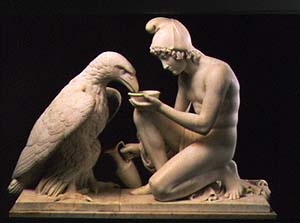
(above: Bertel Thorwaldsen, Ganymede and the Eagle, 1817, 32 3/8 x 41 3/4 inches) Source: The Ricau Collection of American Sculpture (2/1/98)
We lightly edited this text and provided links to other materials to enhance it. AI is rapidly improving in accuracy, however, the text may contain inaccurate information. This presentation doesn't meet scholarly standards, yet Gemini AI researched and checked it for accuracy. Sources are footnoted in the raw AI report, yet deleted here for a general audience
Prompt:
 Return to Birds
Return to Sculpture: 19-20th Century
Links to sources of information outside of our web site are provided only as referrals for your further consideration. Please use due diligence in judging the quality of information contained in these and all other web sites. Information from linked sources may be inaccurate or out of date. TFAO neither recommends or endorses these referenced organizations. Although TFAO includes links to other web sites, it takes no responsibility for the content or information contained on those other sites, nor exerts any editorial or other control over them. For more information on evaluating web pages see TFAO's General Resources section in Online Resources for Collectors and Students of Art History. Individual pages in this catalogue will be amended as TFAO adds content, corrects errors and reorganizes sections for improved readability. Refreshing or reloading pages enables readers to view the latest updates.
 Search Resource Library for everything about American
art.
Search Resource Library for everything about American
art.
Copyright 2026 Traditional Fine Arts Organization, Inc., an Arizona nonprofit corporation. All rights reserved.
