
Bald Eagles in American Painting
a 2026 Gemini Pro Deep Research Narrative
The history of American art is deeply and inextricably entwined with the imagery of the bald eagle. For centuries, this striking bird has captured the collective imagination of the continent, serving as a soaring canvas upon which the United States has projected its highest ideals, its deepest anxieties, and its evolving identity. But what is it about this specific creature that has caused people to admire and be fascinated by paintings depicting them throughout the history of the country? The answer lies in the bird's unique combination of physical grandeur and behavioral ferocity, attributes that naturally lend themselves to mythmaking and iconography.
With a massive wingspan that can reach up to eight feet and a body weight approaching fourteen pounds, the bald eagle is a true master of the skies, capable of soaring effortlessly on thermal currents and projecting an undeniable aura of absolute dominance. Observers and artists alike have long been fascinated by its sharp, piercing eyes set deep beneath beetled brows, a feature that, when combined with a sharply hooked yellow beak, gives the bird a pugnacious, fierce, and intensely focused appearance.
Perhaps most striking is the adult bird's unmistakable plumage. By the time the eagle is five and a half years old, it develops a stark, brilliant white head and tail that contrast dramatically with a deep, dark brown body. This stunning visual juxtaposition makes the creature recognizable even from great distances, projecting a natural majesty that seems almost designed for the painter's palette.
(see our Artists for Nature in the Copper River Delta featuring Vadim Gorbatov, Bald Eagle over the Copper River Delta, 1997, watercolor, 18 x 20 inches)
Long before European settlers arrived on the continent, Native American cultures revered the bald eagle for these very attributes. For many indigenous tribes, the bird was considered a highly sacred entity, embodying swiftness, unparalleled strength, and a profound spirituality. Its soaring flight was viewed as a direct connection to the Creator, and its tail feathers, which change from white to jetty black at the extremities, were prized as rays of the sun, representing courage and honor.
(see our Those Who Came Before Us: The Indian Murals of H. D. Bugbee featuring The Eagle Dancer, an Indian Mural by H. D. Bugbee)
When the fledgling United States was forming its own political identity, the Continental Congress sought a symbol that was unique to North America and capable of projecting the autonomy and strength of the new republic. In 1782, despite some debate over the bird's character, the bald eagle was officially adopted as the central motif for the Great Seal of the United States cementing its status as the nation's premier emblem. From that moment on, painters throughout American history have been endlessly inspired to depict these eagles, though their overall reasons have shifted dramatically over the centuries. In the early days of the republic, the inspiration was deeply tied to patriotism and the Enlightenment era's thirst for scientific discovery. Early artists wanted to meticulously document the unique flora and fauna of their new homeland to prove that the American wilderness was just as magnificent as the landscapes of Europe, using the eagle to represent infinite frontier freedom and scientific curiosity. As the nation grew into a global power, the eagle became an omnipresent decorative and political motif, a favored image of artists in the fledgling nation who painted it on everything from folk art carvings to grand, sweeping canvases. However, by the late twentieth century, the inspiration shifted dramatically.
One of the earliest and most highly regarded American artists to capture the bald eagle on canvas was Alexander Wilson. A Scottish immigrant who is widely celebrated today as the founding father of American ornithology, Wilson found profound inspiration in the birds of his adopted country, wandering the untamed landscapes to catalog its avian life. His motivation for painting the bald eagle was deeply rooted in the scientific method and a desire to elevate American natural history. He wanted to provide accurate, empirical evidence of the continent's species, traveling extensively on foot to create the first definitive scientific record of American birdlife, predating other famous naturalists by over a decade. Furthermore, he explicitly recognized the bird's vital cultural importance, noting in his writings that the bald eagle, as the adopted emblem of the country, was entitled to particular notice and study. Wilson's tireless dedication culminated in his celebrated mixed-media engraving and painting titled White-headed Eagle which was published in the fourth volume of his monumental work, American Ornithology, in 1811. Pages 89 through 100 describe the bird at length. They can be read online on the Biodiversity Heritage Library website. The image of the bird is also found immediately before page 89.
The literature written about this specific artwork reveals the fascinating and sometimes pragmatic methods of early naturalists working in a frontier society. Historians and ornithological scholars note that Wilson likely modeled this specific painting after a stuffed, taxidermied mount housed in a famous Philadelphia museum.
Because he was working from a mounted specimen rather than a live bird in flight, critics observe that Wilson strove for absolute anatomical accuracy over dynamic action, resulting in a somewhat static but highly detailed and proportionate representation. In his accompanying writings, which scholars frequently analyze alongside the painting, Wilson expressed a deep skepticism regarding the romanticized folklore surrounding the bird. For instance, he openly doubted the popular myth that the eagle could live for a hundred years, preferring instead to highlight its actual, sometimes unsavory behaviors. He famously documented its notoriously aggressive habit of stealing freshly caught fish from ospreys, or feeding on the putrid flesh of carcasses, painting a picture of a gritty survivor rather than a flawless saint. Today, critics and historians write that this painting represents a foundational moment in American natural history, reflecting a time when art served as a strict, unembellished tool for education and scientific taxonomy, successfully stripping away the mythology of the eagle to present the bird exactly as it existed in nature.
Following closely on Wilson's heels was a man who would become arguably the most famous bird painter in the history of the world: John James Audubon. If Wilson was the rigorous, pragmatic scientist, Audubon was the dramatic, romantic showman. Audubon's primary inspiration for painting the bald eagle was deeply intertwined with his intense, highly competitive desire to outshine Wilson and claim the title of America's premier naturalist for himself. Furthermore, Audubon was driven by a wildly romantic vision of the American frontier. He wanted to paint birds not as stiff, stuffed museum specimens, but as vibrant, life-sized creatures engaged in the desperate, brutal struggle for survival in their natural, untamed habitats. This fierce inspiration is perfectly captured in Audubon's iconic painting White-headed Eagle, commonly known as Plate 31 in his legendary, massive publication The Birds of America .
What has been written about this artwork highlights Audubon's extraordinary flair for drama, narrative, and occasional deception. Art critics and biographers frequently note that the painting depicts the eagle in a moment of visceral, bloody triumph, its powerful talons gripping a freshly caught yellow catfish on a rocky cliff ledge, its beak open as if letting out a terrifying screech of dominance. Scholars have written extensively about the background of this piece, noting that Audubon drew inspiration from his travels in places like Florida and the Mississippi River, where he spent days observing the eagles' hunting habits, flight patterns, and nesting behaviors. Furthermore, literature surrounding Audubon's eagle paintings often delves into his highly controversial ambition. Commentators write extensively about how Audubon invented a mythical species called the "Bird of Washington," painting what was actually just an immature, brown bald eagle, and presenting it to the scientific community as an entirely new, much larger species simply to secure his own legacy and undermine Wilson's previous work. He even claimed this fake species was named in honor of the nation's first president to garner favor and funding. Despite his occasional scientific embellishments and theatrical rivalries, critics uniformly agree that Plate 31 captures the fierce, untamed essence of the bird better than any artwork that preceded it. It has been written that Audubon's depiction perfectly encapsulates the romantic spirit of the American wilderness, elevating the bald eagle from a mere scientific specimen to a timeless symbol of raw, unbridled natural power.
While naturalists like Wilson and Audubon were trekking through forests and swamps to document the eagle in the wild, other highly regarded American artists were utilizing the bald eagle in cultivated, deeply civic settings to make political statements. Charles Willson Peale was a true Renaissance man of the early American republic. As a patriot, soldier, inventor, and artist who had served alongside George Washington during the American Revolution, Peale's inspiration for painting the eagle was rooted in his Enlightenment belief that the young republic desperately needed a distinct cultural and intellectual identity. In 1784, he founded the first successful public museum in the United States in Philadelphia, designing it as a world in miniature where ordinary citizens could come to learn about the natural wonders of their continent and the democratic ideals of their government. Peale wanted to teach Americans to see their cultural identity reflected in both the nation's natural history and its political achievements, and the bald eagle was the perfect bridge between the two.
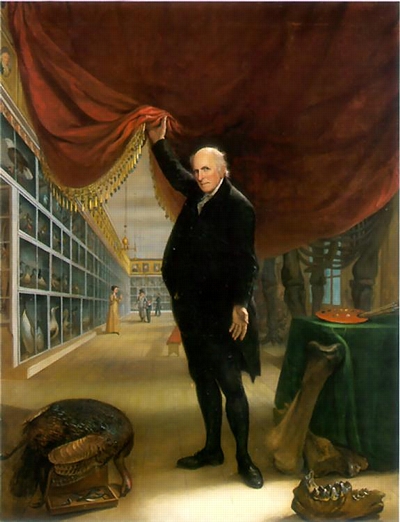
(above: Charles Willson Peale (1741-1827), The Artist in His Museum, 1822, oil on canvas, 103.7 x 79.8 inches. Pennsylvania Academy of the Fine Arts. Public domain, via Wikimedia Commons*)
This profound civic philosophy is beautifully realized in Peale's masterpiece, The Artist in His Museum, painted in 1822 when the artist was eighty-one years old. In this expansive, masterful oil on canvas, Peale lifts a heavy red velvet curtain to invite the viewer into his grand exhibition hall, revealing rows of scientific specimens and portraits of revolutionary heroes. What has been written about this painting is exceptionally rich with symbolic interpretation. Art historians frequently point out that Peale deliberately placed a taxidermied bald eagle in a display case in the immediate foreground of the painting. Critics write that this specific placement was no accident; it was a masterful visual argument linking the unique natural history of North America with the political sovereignty of the United States. The eagle acts as an anchor for the room, drawing a direct line between the continent's rugged wilderness and the founding fathers' refined leadership. The painting is widely discussed in academic literature as a brilliant intersection of art, science, and patriotic propaganda, showcasing the bald eagle not as a wild killer of fish, but as an indispensable fixture of American civic life and enlightenment.
As the centuries progressed, the physical landscape of the United States changed dramatically, and so did the context in which the eagle was viewed. The frontier vanished, the continent was heavily industrialized, and the once-abundant bald eagle found itself pushed to the very brink of extinction. By the late twentieth century, the bird's symbolism had shifted from invincible national might to vulnerable ecological reality, its populations decimated by hunting, habitat destruction, and the thinning of their eggshells caused by pesticides. It was this fragility that inspired the legendary Pop Art pioneer Andy Warhol to paint the bird.
Warhol's resulting artwork, Bald Eagle, created in 1983 as part of his ten-piece Endangered Species portfolio, is a stunning departure from his usual subjects of consumer goods and movie stars. What has been written about this vibrant silkscreen painting focuses on the brilliant paradox of its execution. Warhol affectionately referred to the animals in this series as his "animals in makeup," and art critics have written extensively about his use of highly saturated, unnatural, psychedelic colors to depict the bird. Reviewers note that by rendering the eagle in electric hues with thin strokes of bright yellow and red, Warhol elevated the bird to the status of a stylized Pop icon, effectively treating the animal with the same graphic intensity as a cultural superstar. Moreover, curators and historians have written about the profound conceptual irony embedded in the work. It has been observed that as Warhol layered bright inks over the source photographs of disappearing species, the original photographic image vanished beneath the synthetic colors, much like the animals themselves were vanishing from the earth due to human interference. Yet, because of the reproductive ability of silkscreen printing, critics point out that Warhol symbolically created hundreds of new eagles, successfully merging the aesthetics of commercial mass production with sincere environmental activism. He ultimately donated one hundred portfolios to wildlife conservation organizations to be auctioned, raising significant funds for their causes.
In contemporary times, the bald eagle continues to inspire highly regarded American artists as a dynamic symbol of grassroots community strength and multicultural identity. Ralph D'Oliveira, a prominent California muralist, educator, and community arts organizer, draws his inspiration from a very different source than the early naturalists or the New York Pop artists. With Chumash and Mexican roots, D'Oliveira is inspired by a lifelong desire to build community and make art profoundly accessible to the public, particularly school children and working-class neighborhoods. For D'Oliveira, the bald eagle is a shared symbol of the land that transcends political boundaries, representing a natural, indigenous heritage that unites diverse local populations and instills a sense of pride and stewardship among people who might feel alienated from traditional museums.
D'Oliveira's artwork, Bald Eagle, painted in acrylics in 2017, beautifully showcases this inclusive, community-oriented vision. What has been written about this painting emphasizes its role in public life rather than high-society commerce or elite scientific study. Cultural historians and archivists note that the painting depicts the majestic bird flying low over a river, set against a vibrant backdrop of green foliage, capturing a serene yet immensely powerful moment in nature.
The history of American paintings depicting bald eagles is a sweeping, vibrant narrative that perfectly mirrors the growth, the struggles, and the ever-shifting values of the United States. From the meticulous, scientifically driven engravings of Alexander Wilson to the dramatic, fiercely romantic canvases of John James Audubon, the bald eagle has always served as a mirror for America's complex relationship with its wild frontier. Through the civic-minded brush of Charles Willson Peale, the bird was enshrined in the museum as a fundamental piece of the nation's democratic and intellectual soul, standing guard over the ideals of the founders.
Through the vibrant, commercial lens of Andy Warhol, the
eagle became an urgent, neon-colored plea for environmental salvation
and ecological awareness, challenging a modern society to protect its
heritage. And through the community-focused, multicultural art
of Ralph D'Oliveira, the bird continues to fly as a localized symbol
of shared heritage, demonstrating that national icons can be reclaimed
to build unity at the neighborhood level. The eagle's fierce brow, contrasting
colors, and breathtaking speed have never lost their power to fascinate. Its
image has survived the closing of the frontier, the industrial revolution, and
the modern digital age. As long as artists continue to look to the
skies for inspiration, the bald eagle will undoubtedly remain a central, commanding
presence on the American canvas, forever reflecting whatever hopes, fears,and
ideals the nation projects upon its expansive wings.
We lightly edited this text and provided links to other materials to enhance it. AI is rapidly improving in accuracy, however, the text may contain inaccurate information. This presentation doesn't meet scholarly standards, yet Gemini AI researched and checked it for accuracy. Sources are footnoted in the raw AI report, yet deleted here for a general audience
Prompt:
 Return to Birds
Links to sources of information outside of our web site are provided only as referrals for your further consideration. Please use due diligence in judging the quality of information contained in these and all other web sites. Information from linked sources may be inaccurate or out of date. TFAO neither recommends or endorses these referenced organizations. Although TFAO includes links to other web sites, it takes no responsibility for the content or information contained on those other sites, nor exerts any editorial or other control over them. For more information on evaluating web pages see TFAO's General Resources section in Online Resources for Collectors and Students of Art History. Individual pages in this catalogue will be amended as TFAO adds content, corrects errors and reorganizes sections for improved readability. Refreshing or reloading pages enables readers to view the latest updates.
 Search Resource Library for everything about American
art.
Search Resource Library for everything about American
art.
Copyright 2026 Traditional Fine Arts Organization, Inc., an Arizona nonprofit corporation. All rights reserved.