
Alson Skinner Clark
a 2026 composite biogaphy
by SI and us
Alson Skinner Clark (March 25, 1876 - March 23, 1949)
was an American Impressionist painter, muralist, and art educator. Trained
under masters William Merritt Chase and James McNeill Whistler, he achieved
national acclaim for his sun-drenched landscapes and became one of the foremost
figures of the Southern California plein-air movement.
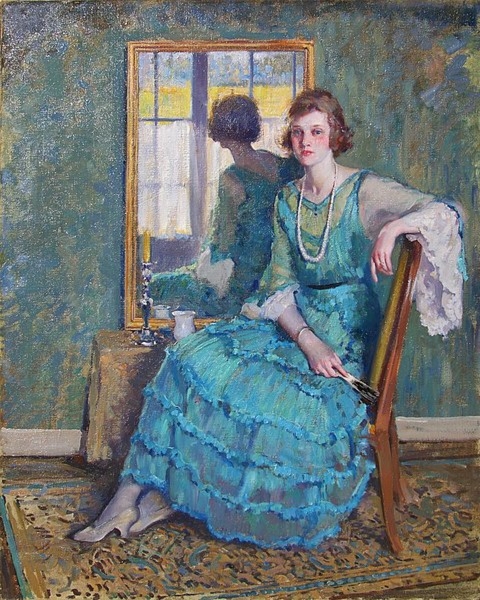
(above: Alson S. Clark (1876-1949), Reflection,
1922. Public domain, via Wikimedia Commons*)
Early Life and Academic Training
Clark was born in Chicago, Illinois, into a prosperous
family. His father, Alson Ellis Clark, was a Union Army Civil War veteran
who built a fortune as a commodities broker at the Chicago Board of Trade.
Showing early artistic talent, Clark began taking weekend classes at the
Art Institute of Chicago at age eleven.
Between 1889 and 1891, his family took him on an extended
two-year tour around the world, introducing him to classical European galleries,
cathedrals, and architecture. After graduating from high school, he enrolled
full-time at the Art Institute of Chicago in 1895. Impatient with the rigid
academic requirement of endlessly drawing from plaster casts before touching
a live model, Clark left the school after a dispute with an instructor.
In 1896, he moved to New York City to enroll at the Art Students League, studying under William
Merritt Chase. Clark followed Chase to his newly established Chase School
of Art and the Shinnecock Summer School
of Art on Long Island. Chase's bravura brushwork and dynamic handling of
light left a permanent impression on Clark's technique.
European Studies, Marriage, and the Panama
Series
Clark sailed for Paris in the autumn of 1898. Finding the
crowded Académie Julian unappealing, he enrolled at James McNeill
Whistler's short-lived Académie Carmen. Under Whistler's mentorship,
Clark developed a refined sense of tonal harmony, subtle color palettes,
and delicate composition. He also studied under Lucien Simon and Charles
Cottet and had work accepted into the prestigious Paris Salon in 1899.
· Return to America and Marriage (1901-1902): Facing
recurring digestive and abdominal ailments, Clark returned to the United
States in 1901 for surgery. While recuperating at his family's summer retreat
in Alexandria Bay and working from a studio in Watertown, New York, he hired
Atta Medora McMullin to pose for him. The two married in 1902; Medora remained
his lifelong companion and frequent model.
· Travels and Recognition (1902-1912): The
couple spent much of the subsequent decade traveling across Europe, Canada,
and New England. Clark established a solid critical reputation, winning
a bronze medal at the 1904 Louisiana Purchase Exposition in St. Louis and
the Martin B. Cahn Prize at the Art Institute of Chicago in 1906 for The
Coffee House.
· The Panama Canal Series (1913): In 1913,
Clark traveled to Central America to record the monumental construction
of the Panama Canal. Working directly outdoors under intense tropical heat,
he produced a celebrated suite of paintings documenting steam shovels, railway
cuts, and massive locks, capturing modern industrial machinery through an
Impressionist lens. The series won a bronze medal at the 1915 Panama-Pacific
International Exposition in San Francisco.
Military Service and Southern California
When the United States entered World War I, Clark enlisted
in the U.S. Army. Leveraging his visual expertise and precision drafting,
he served in France as an aerial photographer.
Following his discharge in 1919, physical strain and lingering
respiratory issues prompted Clark and his wife to relocate to Southern California.
In 1920, they settled in the Arroyo Seco district of Pasadena, immersing
themselves in the regional arts community:
- Stickney Memorial Art School: Clark joined the faculty
in 1921 alongside fellow California Impressionist
Guy Rose and soon became the school's director.
-
- Occidental College: He served as an instructor of
landscape painting in Eagle Rock during the late 1930s.
-
- Regional Subjects: Clark painted extensively throughout
the state, capturing coastal bluffs, the historic missions (notably Mission San Juan Capistrano), and desert terrains
from a second studio he maintained in Palm Springs.
Palette and Value Hierarchy: Dissolving
the Neutral Envelope
Under Whistler at the Académie Carmen in Paris,
Clark was trained to see nature through a unifying, low-key "tonal
envelope." Whistler insisted that a painting's color harmony should
be determined on the palette before a single stroke touched the canvas,
organizing compositions around a dominant neutral keynote-often referred
to as an "arrangement in grey."
- The Tonalist Formula (1898-1912): Clark
built forms using close-valued harmonies, subdued primaries, and heavy
mixtures of umbers, raw siennas, and ivory black. Contrast was achieved
through subtle shifts in value (lightness versus darkness) rather than
color temperature. Atmospheric veil took precedence over raw illumination,
best seen in the muted rose, soot, and steel grays of The Coffee House (1906).
-
- The California Shift (1920-1949): The intense Pacific
light made Whistlerian neutrals obsolete. Clark pushed his palette into
high-key territory, adopting the French Impressionist technique of banishing
black and earth pigments. Shadows were no longer neutralized dark tones;
they became vibrant, chromatic passages of cobalt blue, manganese violet,
and ultramarine, tempered by warm reflected ground light bouncing off sand,
chaparral, and whitewashed adobe.
Brushwork and Material Application: From
Thin Washes to Broken Impasto
Whistler's studio method favored a heavily thinned, flowing
medium -- a liquid turpentine-and-oil wash colloquially known as "sauce."
This medium allowed Whistler and his disciples to rub, wipe, and veil large
areas to create vaporous, seamless transitions.
In Southern California, Clark adapted the vigorous, gestural
bravura he had first learned from William Merritt Chase to meet the tactile
demands of the outdoors:
- Direct Mark-Making (Alla Prima): Rather than
rubbing down pigment to create smooth tonal gradients, Clark used direct,
structural strokes of rich, buttery oil paint applied directly to canvas
or heavy artist board.
-
- Broken Color and Optical Mixing: To convey the vibrating
heat of Palm Springs or the coastal glare of San Juan Capistrano, he set
separate daubs of complementary colors side by side (such as pale ochres
against soft lavender, or chrome orange against turquoise). Up close, the
brushstrokes remain distinct and sculptural; from a distance, they merge
optically to simulate ambient sunlight.
The Panama Canal as the Technical Bridge
(1913)
Clark's transition did not occur overnight when he moved
west; its true laboratory was his 1913 expedition to the Isthmus of Panama.
Faced with equatorial glare, steam plumes, and saturated
red clay cuts, Clark discovered that high atmospheric humidity and blinding
sunlight could coexist. He retained Whistler's atmospheric unity but discarded
the muddy European palette, rendering industrial devastation in pastel mauves,
chalky yellows, and delicate blues. Panama taught Clark that blinding light
could be expressed without harsh, black-and-white tonal contrast -- a realization
that directly prepared him for the sun-drenched canyons of the Arroyo Seco.
Structural Composition: The Enduring Whistlerian
Design
While Clark adopted the palette of California Impressionists
like Guy Rose and William Wendt, his underlying spatial design remained
distinctly Whistlerian. Plein-air painters often worked
with panoramic, open-ended horizontal sweeps of rolling hills. Clark, by
contrast, remained fascinated by Japanese print aesthetics, two-dimensional
decorative design, and deliberate architectural framing:
- Framing Apertures: In works like Mission
Cloisters, San Juan Capistrano, Clark framed brilliant, sun-bleached
courtyard gardens inside darkened Spanish archways-a classic Whistler device
balancing flat decorative silhouettes against deep aerial perspective.
-
- Rhythmic Intervals: He organized tree trunks (especially
coastal live oaks and eucalyptus), ship rigging, and desert rock faces
into measured spatial rhythms across the picture plane, ensuring that even
his most spontaneous outdoor sketches maintained architectural order.
Sidebar: The Panama Canal Series (1913-1914)
In early 1913, as the decade-long American construction
effort reached its peak, Clark traveled to the Isthmus of Panama. Rather
than treating the canal as a clinical engineering subject, he approached
the earthmoving effort through French Impressionist light and Whistlerian
tonal atmosphere.
Working outdoors under tropical heat, humidity, and pervasive
mud, Clark positioned his easel directly along active excavation zones and
lock chambers. He produced dozens of oil canvases -- most notably Culebra
Cut, The
Locks at Panama, and Work
Trains, Miraflores.
Key characteristics of the series include:
- Scale and Human Diminution: Massive steam shovels,
railroad trestles, and monolithic concrete block walls dominate the frame,
with laborers rendered as tiny brushstrokes wandering the valley floors.
-
- Soft, Lyrical Palette: Instead of stark industrial
grays, Clark used pastel mauves, chalky ochres, soft purples, and hazy
blues, integrating plumes of locomotive smoke into the humid atmospheric
haze.
-
- Exhibition Triumph: Eighteen paintings from the
series were awarded their own dedicated gallery room at the 1915 Panama-Pacific
International Exposition in San Francisco, where Clark earned a bronze
medal and national critical acclaim.
Sidebar: Murals in Southern California
When Clark settled in Pasadena in 1920, the regional building
boom provided him an ideal venue to expand into architectural commissions.
While several historic Los Angeles interiors have been lost, key works survive
in original or preserved settings.
1. Pasadena Playhouse (1925)
- The Asbestos Fire Curtain: For
the grand opening of Elmer Grey's Spanish Colonial Revival playhouse on
El Molino Avenue, Clark painted the massive 20?32-foot safety curtain.
-
- Composition: A Spanish galleon under full sail,
rendered with rich golden-hour maritime light to complement the auditorium's
Mediterranean aesthetic.
- Status: The curtain remains intact in the historic
mainstage auditorium.
2. First Trust & Savings Bank, Pasadena (1929)
- Location: 587-595 East Colorado Boulevard (Playhouse
Village).
-
- The Panels: Four monumental arched lunette murals,
each measuring roughly ten feet in height, framed by ceiling ornamentation
designed by decorative artist John B. Smeraldi.
-
- Themes: Clark documented the four economic engines
of early 20th-century Southern California:
-
- 1. Oil Drilling (derricks
and extraction infrastructure)
-
- 2. Citrus Agriculture (orange
groves and harvesting)
-
- 3. Shipping and Harbor Trade (San
Pedro docks and cargo freight)
-
- 4. The Motion Picture Industry (soundstages,
arc lamps, and camera crews)
-
- Status: Preserved in situ within the building's
ground-floor banking hall, which remains accessible during business hours.
-
3. The Lost Carthay Circle Murals (1926)
- Commission: Developer J. Harvey McCarthy commissioned
Clark to produce seven large-scale historical oil murals for the lobby
and mezzanine of the Carthay Circle Theatre.
-
- Subject Matter: Pioneer expeditions and California
history, including scenes of Jedediah Smith reaching Mission San Gabriel
and The Passing of the Pony Express.
-
- Fate: The movie palace was demolished in 1969. Unlike
the building itself, Clark's canvas panels were salvaged and donated to
missionary organizations before eventually dispersing into private collections
and fine art auctions.
Sidebar: Notable Paintings
1. The Coffee House (1906)
- Location: Art Institute
of Chicago
-
- Subject & Style: Clark captures the Dearborn
Street Bridge crossing the icy Chicago River amidst towering warehouses.
Rather than presenting a stark industrial portrait, he applies the tonalist
lessons learned from James McNeill Whistler -- filtering factory smoke
and locomotive steam through a soft, rose-and-ochre winter sky. The painting
earned him the Martin B. Cahn Prize in 1906.
2. Panama Canal Excavation (1913)
- Subject & Style: Part
of Clark's critically acclaimed Panama series, this canvas illustrates
heavy steam shovels carving through the Isthmus. Clark avoids mechanical
sterility by treating the excavation walls as a vibrant mosaic of terracotta,
sulfurous yellow, and violet, with dense plumes of black engine exhaust
softening into the humid tropical atmosphere.
3. Mission Cloisters, San Juan Capistrano (1921)
- Subject & Style: Created
shortly after Clark settled in Southern California, this painting exemplifies
his mastery of plein-air light. The composition frames the Spanish colonial
brick arches and tiled courtyard, playing intense, direct California sunlight
against deep, luminous purple-blue shadows across the brick floor.
4. California
Mountain Landscape (c. 1920s)
- Subject & Style: Reflecting
Clark's Arroyo Seco and Palm Springs excursions, this landscape uses loose,
rapid impressionist brushwork to depict coastal sagebrush and rolling chaparral
foothills rising toward hazy, blue mountain ridges under high desert cloud
cover.
5. Early French Countryside (c. 18991901)
- Subject & Style: Painted
during his postgraduate training in France, this piece demonstrates Clark's
early academic foundation. The deep greens, rich umbers, and structural
stone cottages highlight the influence of French painters Charles Cottet
and Lucien Simon before Clark embraced the lighter, higher-key California
palette.
Alson Skinner Clark's evolution from Whistler tonalism
to California plein air was a systematic recalibration of value, color temperature,
and paint handling under the unforgiving intensity of Western sunlight.
Rather than discarding his early European training, Clark imported James
McNeill Whistler's discipline of structural harmony and decorative arrangement
into the saturated, high-key atmosphere of Southern California.
Sidebar: Painting Focus - Mission
Cloisters, San Juan Capistrano
Painted in 1921 shortly after Alson Skinner Clark settled
in Pasadena, Mission Cloisters, San Juan Capistrano (also
cataloged as San Juan Capistrano Mission [Mission Cloisters])
stands as one of the definitive masterpieces of the California Plein Air
movement. This monumental oil on canvas captures the historic 18th-century
Franciscan mission bathed in radiant Southern California sunlight.
Historical Context: The Revival of the "Jewel of the
Missions"
- Clark first visited Mission San Juan Capistrano briefly
in 1914, but his deep artistic engagement with the site began after he
relocated permanently to California following World War I. During the early
1920s, the mission was undergoing a cultural renaissance under the stewardship
of Father St. John O'Sullivan, who was widely recognized as "the man
who saved the mission."
-
- O'Sullivan welcomed landscape painters, providing studio
space and encouragement to artists who documented the crumbling, romantic
adobe ruins before and during restoration. Capistrano, popularly hailed
as the "Jewel of the Missions," offered Clark an ideal subject:
a marriage of European architectural heritage, weathered organic materials,
and blinding Pacific light.
Composition and Architectural Framing
- The painting exemplifies Clark's ability to merge outdoor
Impressionism with the rigorous spatial design he learned under James McNeill
Whistler:
-
- The Archway as a Framing Device: Rather than executing
a conventional frontal elevation of the chapel, Clark positioned his easel
deep beneath the covered colonnade. The heavy, whitewashed arcade arch
in the immediate foreground acts as a theatrical proscenium,
framing the sun-drenched inner courtyard and the distant bell campanario.
-
- Receding Diagonal Perspective: The heavy timber
ceiling beams and the patterned floor of square terracotta pavers establish
strong orthogonal lines that draw the viewer's eye through the colonnade
into the open courtyard.
-
- Balancing Mass and Void: The dark, solid mass of
the archway creates a silhouette that anchors the left and upper margins,
preventing the high-key glare of the open courtyard from flattening the
composition into two dimensions.
Palette and Chromatic Shadows
- In Mission Cloisters, Clark discarded the
gray, muted tones of his earlier European studio works, deploying the vibrant,
high-key palette of California Impressionism:
-
- No Neutral Darks: Clark abolished black and umber
from his shadow passages. The shaded floor of the arcade and the underside
of the arches are rendered in radiant, optical mixtures of cobalt blue,
manganese violet, and lavender.
-
- Luminous Reflected Light: The cool violet shadows
are counterbalanced by the warm ambient light bouncing upward from the
sun-baked clay tiles, giving the shaded colonnade an open, breathable luminosity.
-
- Warm and Cool Oppositions: The sunlit facade of
the inner courtyard gleams in creamy whites, pale yellows, and soft buff
tones, offset by the deep emerald greens of creeping vines and the turquoise
tints of the distant weeping pepper trees.
Brushwork and Tactile Surface
- Influenced by his New York mentor William Merritt Chase,
Clark treated the weathered mission surfaces
with decisive, textural brushwork:
-
- Faceted Masonry: Clark used wide, flat bristle brushes
to apply thick, buttery strokes of paint (alla prima). Broad, slab-like
marks define the crumbling plaster pillars where time has exposed the underlying
red fired-brick foundation.
-
- Botanical Vibrancy: Creeping bougainvillea and ivy
clambering up the foreground pillar are articulated through rapid, staccato
dabs of pure green and blue pigment. Potted geraniums on the courtyard
floor add sharp flecks of warm terracotta and floral color that animate
the quiet stone architecture.
Sidebar: Comparison of Clark's painting
style and technique to his Pasadena peer Guy Rose
While Alson Skinner Clark and Guy Rose were close contemporaries
who shared leadership of Pasadena's Stickney Memorial Art School, their
work represents two fundamentally different branches of Impressionism adapted
to the American West. Rose was California's purest disciple of French Impressionism
and Claude Monet, whereas Clark arrived at Western light through James McNeill
Whistler's tonal design and William Merritt Chase's direct, athletic paint
handling.
1. Lineage: Monet's Dissolution vs. Whistler's Architecture
- Guy Rose (The Giverny Lineage): Rose lived in Giverny
for over a decade, absorbing Claude Monet's direct mentorship. His primary
objective was l'instantanéité -- capturing
fleeting atmospheric shifts. For Rose, physical objects (coastal bluffs,
cypress trees, tidepools) existed primarily as reflective surfaces that
fractured and scattered ambient light.
-
- Alson Skinner Clark (The Whistlerian / Chase Lineage): Clark's
training under Whistler in Paris and Chase in New York grounded him in
formal composition and structural mass. While Rose allowed form to dissolve
into atmospheric vibration, Clark maintained the underlying geometry and
solid weight of his subjects, organizing his landscapes like architectural
elevations.
2. Light and Color Temperature: Pearly Opalescence vs.
Sun-Baked Saturated Contrast
- Rose's Atmospheric Envelope: Having developed his
eye in the humid, silvery Seine Valley, Rose favored a cool, pearly palette
dominated by muted viridians, soft lilacs, silvery blues, and cream. When
painting coastal California (particularly Point Lobos and Carmel), he sought
out low-contrast, moisture-heavy conditions-morning fog, marine layers,
and filtered coastal haze.
-
- Clark's Solar Glare: Clark embraced the unfiltered,
arid glare of the California interior, the Arroyo Seco, and Palm Springs.
His palette is warmer, higher in key, and more chromatic, featuring saturated
cobalts, glowing ochres, terracotta reds, and deep violet cast shadows.
He used strong temperature shifts (warm light against cool shadows) to
define form, rather than Rose's close-valued tonal harmonies.
3. Surface Texture and Brushwork
- Rose's Broken, Feathery Mark-Making: Rose worked
with dry-brush scumbles, small comma-shaped marks, and multi-directional,
interwoven strokes. The paint surface remains delicate and atmospheric,
allowing underlying tinted grounds to peek through and produce an optical
shimmer.
-
- Clark's Loaded, Sculptural Impasto: Clark laid down
thick, buttery strokes using flat and filbert bristle brushes. His application
was direct (alla prima), leaving decisive, planar facets of paint
that carve out rock walls, mission cloisters, or industrial scaffolding
with physical authority.
4. Subject Matter: Contemplative Nature vs. Human Endeavor
- Rose: Favored pristine, unpopulated landscapes-dramatic
coastal cliffs, solitary sea cypresses, and quiet high-Sierra meadows-or
domestic Giverny-style figural
-
- Clark: Drawn consistently to the interaction between
human labor and the land. He is celebrated for his industrial canvases
(the locks of the Panama Canal, Chicago rail bridges) and his architectural
works (historic missions, movie studio sets, and urban bank interiors),
bringing a muralist's civic scale to outdoor painting.
Death and Collections
On March 23, 1949, Clark suffered a sudden heart attack
and died while painting at his easel in his Pasadena studio at the age of
72. His works are preserved in permanent collections including the Art Institute
of Chicago, the Los Angeles County Museum of Art (LACMA), the San Diego
Museum of Art, and London's Victoria and Albert Museum.
Note: This article was created from various SI models in October,
2026, modified by us and may contain errors.
*Tag for expired US copyright of object
image:

**Tag for some rights reserved:
 Search Resource Library
Copyright 2005-2026 Traditional Fine Arts Organization, Inc., an Arizona nonprofit corporation. All rights
reserved.