
The Alaskan Four
In January, 2025, we asked ChatGPT about the historic "Alaskan Four." Not wanting a bunch of bullet points we asked for a story in narrative form.
The "Alaskan Four" refers to a group of prominent artists -- Sydney Laurence, Eustace Paul Ziegler, Jules Dahlager, and Ted Lambert -- who played pivotal roles in shaping and defining the visual identity of Alaska during the early to mid-20th century. Each of these artists brought their unique perspective to the rugged landscapes and cultural life of the region, creating works that captured the imagination of Alaskans and outsiders alike.
Sydney Laurence, often considered the leader of the group, was renowned for his dramatic and romantic depictions of Alaska's wilderness, particularly Denali. His paintings conveyed a sense of awe and grandeur, showcasing the towering peaks, luminous glaciers, and endless skies that defined the territory. Laurence's work epitomized the rugged beauty of Alaska and set a high standard for landscape painting in the region.
Eustace Paul Ziegler, on the other hand, brought a different focus to his art. As an Episcopal missionary in Cordova, Ziegler was deeply connected to the communities he served. His paintings often depicted the people of Alaska, including Native communities, miners, and fishermen, with a warmth and vitality that celebrated their resilience and way of life. Ziegler's use of bold colors and dynamic compositions reflected both his artistic training and his personal affection for the land and its inhabitants.
Jules Dahlager, based in the remote town of Skagway, contributed to the group's legacy with his detailed and vibrant scenes of Southeast Alaska. Dahlager's work often centered on the maritime culture of the region, capturing ships, harbors, and the coastal landscape. His paintings were both artistic and historical, documenting the daily life of Alaska's communities during a period of significant change and development.
Ted Lambert, the youngest of the four, was an adventurer as much as he was an artist. Known for his affinity for the wilderness, Lambert's work reflected his firsthand experiences of Alaska's interior. His paintings were less romanticized than those of Laurence, focusing instead on the raw, unvarnished beauty of the landscape. Lambert's time living and working in remote cabins lent authenticity to his art, which often featured intimate views of the vast forests, rivers, and mountains he explored.
Together, the "Alaskan Four" created a body of work that not only celebrated Alaska's natural beauty but also preserved its cultural and historical essence. Their art remains a cornerstone of Alaskan heritage, offering a glimpse into a time when the state was still a rugged frontier and capturing the spirit of the people and places that defined it.
See...
The Lure of Alaska: Paintings, Watercolors, and Graphics from the Permanent Collections In addition to works by Ziegler, the installation includes paintings by the acknowledged dean of Alaskan painters, Sydney Laurence (1865-1940), as well as later artists, "Rie" Munoz (b. 1921), "Rusty" Heurlin (1895-1986), Theodore Lambert (1905-1965), and Fred Machetanz (b· 1908). As a complement to the Machetanz paintings, the museum will display for the first time the recently acquired complete set of fifty lithographs created by Machetanz Other artists included in the exhibition are "Jon" van Zyle (b. 1942), Bettina Steinke (b. 1913), and R. T. "Skip" Wallen
Spirit of the North: The Art of Eustace Paul Ziegler Ziegler, who is perhaps best known for his portraits of frontier characters including miners, priests, fishermen and Alaska Natives, came north in 1909 at age 27 to manage the Red Dragon, a community Episcopal mission in Cordova. His missionary work required extensive travel among the territory's mines and construction camps, which gave him grist for his art.
Sydney Laurence Paintings from the Permanent Collection Seven recently donated Laurence paintings are a highlight of this exhibition. The Alaska State Museum acquired five Laurence paintings from Carl Valentine, husband of the late Betty Valentine. She was a niece of former territorial Gov. George A. Parks. Parks, who served from 1925-33, collected a number of pieces of Alaska artwork and gave them to her. She asked her husband to make sure the art collection returned to Alaska, and, after her death, Valentine contacted the Museum from his home in California.
ChatGPT on Laurance and Ziegler...
Eustace Ziegler
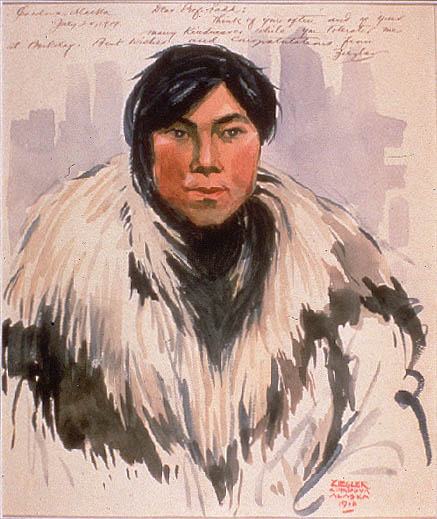
(above: Eustace Paul Ziegler: Cordova Native, 1918, watercolor, 9 1/4 x 8 inches. From Spirit of the North: The Art of Eustace Paul Ziegler)
Eustace Ziegler was a prominent artist whose work captured the rugged beauty and pioneering spirit of Alaska during the early 20th century. Born in Detroit, Michigan, in 1881, Ziegler's early life was shaped by his father's career as a minister, which would later influence his own path. He studied art at the Detroit School of Fine Arts, where he honed his skills in drawing and painting. However, his life took a transformative turn when he decided to venture to Alaska in 1909, drawn by the allure of its untamed wilderness and burgeoning frontier communities.
Upon his arrival, Ziegler took on the role of a missionary for the Episcopal Church in Cordova, a small coastal town surrounded by dramatic landscapes. This position allowed him to immerse himself in the lives of miners, fishermen, and Indigenous peoples, all of whom would become central themes in his art. He quickly gained a reputation not only as a pastor but also as a gifted artist who chronicled the unique character of Alaskan life. His paintings often depicted the rugged individuals who populated the frontier, from stoic miners in remote camps to Indigenous figures engaged in traditional activities.
Ziegler's work was characterized by its vivid use of color and its romantic portrayal of Alaska's landscapes and people. His style combined realism with an almost mythic quality, capturing both the harshness and the majesty of the Alaskan wilderness. He had a particular talent for portraying light, whether in the glow of a miner's lantern or the ethereal hues of an Arctic sunset. His paintings offered viewers a glimpse into a world that was remote and unfamiliar to many outside of Alaska.
As Ziegler's reputation grew, he left his missionary work to focus on his art full-time. He opened a studio in Seattle but continued to travel extensively throughout Alaska, drawing inspiration from its vast, unspoiled terrain and resilient inhabitants. His work gained national attention and was exhibited in galleries across the United States, solidifying his status as one of the most important chroniclers of Alaskan life.
Eustace Ziegler's legacy endures as a vivid record of a pivotal time in Alaska's history. His art not only captures the physical beauty of the region but also conveys the spirit of adventure, resilience, and community that defined its people during the early 20th century. Through his paintings, Ziegler immortalized a landscape and way of life that continue to captivate audiences today.
Sydney Laurence
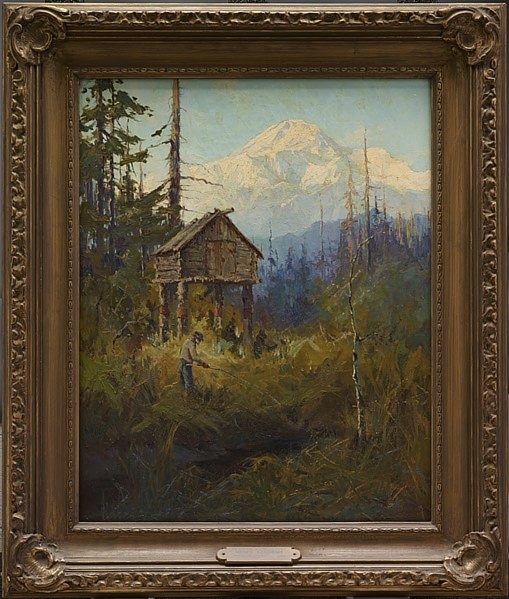
(above: Sydney Lawrence, The Streams Are Full of Them, c. 1915-1923, oil on canvas, 30 x 234 inches, Dallas Museum of Art, 1932.3. Public domain, via Wikimedia Commons*)
Sydney Laurence, one of Alaska's most celebrated artists, is often remembered as a pioneering figure in capturing the state's rugged beauty on canvas. Born in Brooklyn, New York, in 1865, Laurence began his artistic journey studying at the Art Students League and developing a reputation as a talented painter of landscapes in the traditional academic style. His early career flourished in Europe, particularly in England, where he gained recognition for his romantic, atmospheric depictions of nature.
However, Laurence's life took a dramatic turn in the early 1900s. Facing personal and financial difficulties, he left his family and career behind and ventured to Alaska, drawn by the allure of the Klondike Gold Rush. Like many others, he hoped to find fortune in the wilderness. While his success as a prospector was limited, his time in Alaska reignited his artistic passions, and he began to paint the vast, untamed landscapes that surrounded him.
Laurence's work during this period captured the grandeur and mystique of Alaska's natural environment. His paintings often focused on iconic landmarks, most famously Denali (then known as Mount McKinley), which he rendered with a majestic sense of scale and drama. Using a rich palette and expressive brushwork, he conveyed the interplay of light and shadow across glaciers, mountains, and rivers, evoking both the beauty and the harshness of the Alaskan wilderness.
Settling in Anchorage, Laurence became the state's first professional artist, earning widespread acclaim for his ability to translate Alaska's raw power onto canvas. His paintings appealed not only to locals but also to tourists and collectors, who saw in his work an authentic representation of the "Last Frontier." Laurence's success helped establish a market for Alaskan art and inspired other artists to explore the region's unique landscapes.
Despite his fame, Laurence lived modestly, devoting himself
to his craft. He remained in Alaska for the rest of his life, producing
a prolific body of work that continues to define the artistic identity of
the region. Sydney Laurence passed away in 1940, but his legacy endures
as one of the first artists to capture the spirit of Alaska, preserving
its awe-inspiring beauty for generations to come.
 Return to Alaska Art History
Return to Individual States Art History Project
*Tag for expired US copyright of object image:

\
Links to sources of information outside of our web site are provided only as referrals for your further consideration. Please use due diligence in judging the quality of information contained in these and all other web sites. Information from linked sources may be inaccurate or out of date. TFAO neither recommends or endorses these referenced organizations. Although TFAO includes links to other web sites, it takes no responsibility for the content or information contained on those other sites, nor exerts any editorial or other control over them. For more information on evaluating web pages see TFAO's General Resources section in Online Resources for Collectors and Students of Art History.
 Search Resource Library
Copyright 2025 Traditional Fine Arts Organization, Inc., an Arizona nonprofit corporation. All rights reserved.