
Online information about African American Art
from sources other than Resource Library
with an emphasis on representational art
The Story of African-American Art in Brief
by ChatGPT
April 3, 2025
The evolution of Afro-American representational art is a rich and complex narrative, interwoven with themes of resilience, cultural rediscovery, and social commentary. Its history mirrors the African American experience in the United States -- a journey marked by struggle, affirmation, and a persistent quest for self-expression.
In the 19th century, amid a society deeply divided by racial segregation, a few pioneering Black artists began to emerge, laying the groundwork for what would become a profound artistic tradition. Artists such as Henry Ossawa Tanner and Robert Scott Duncanson began to capture the everyday realities and dignified moments of Black life. Tanner's works, notably "The Thankful Poor," displayed not only technical mastery in rendering light and shadow but also conveyed a deep spiritual connection and a quiet strength that resonated with the experiences of his community. Duncanson, though working within a predominantly Eurocentric art framework, subtly wove themes of resilience and dignity into his landscape -- early indicators of an identity that was both part of and apart from mainstream art.
As the nation moved into the early 20th century, the cultural landscape of African America was transformed by the Harlem Renaissance. This period was a vibrant outpouring of art, music, literature, and performance that reimagined what it meant to be Black in America. In this milieu, visual artists like Aaron Douglas emerged as trailblazers. Douglas's work fused modernist aesthetics with African motifs, creating a new visual vocabulary that celebrated African heritage while addressing contemporary social realities. His murals and prints, characterized by bold silhouettes and dynamic compositions, narrated a story of cultural rebirth and defiance against the oppressive forces of the era. His art not only chronicled the past but also envisioned a hopeful future, reflecting the renewed pride and collective spirit of the Harlem community.
Moving into the mid-20th century, the Civil Rights Movement further amplified the role of art as a tool for social commentary and change. During this period, artists adopted social realism as a means to document the Black experience with honesty and urgency. Jacob Lawrence's seminal work, "The Migration Series," powerfully depicted the mass movement of African Americans from the rural South to the urban North in search of better opportunities. With vivid colors and narrative panels, Lawrence transformed historical migration into a visual epic that spoke of struggle, hope, and the quest for dignity. At the same time, Romare Bearden redefined the boundaries of representational art through his innovative collages. By layering images drawn from African American life, jazz culture, and personal memory, Bearden created multifaceted works that invited viewers to explore the intersections of history, identity, and emotion.
Another important narrative emerged through the work of artists like Faith Ringgold. Her story quilts, which combined traditional craft techniques with powerful narratives, offered a unique medium to express the complexities of Black history and experience. Through these quilts, Ringgold chronicled personal and communal stories that addressed issues of race, gender, and social injustice. Her work served as a bridge between the visual and the literary, affirming the importance of storytelling in preserving cultural memory.
By the late 20th century and into the contemporary era, Afro-American representational art continued to evolve. Modern artists have built on this storied legacy, blending classical techniques with contemporary themes such as identity, migration, and global interconnectedness. This ongoing dialogue between tradition and innovation underscores an enduring commitment to truth-telling through art. Today, the rich archives and critical analyses available on resources like tfaoi.org provide valuable insights into this evolution, offering scholars and art enthusiasts alike a deeper understanding of the forces that have shaped Afro-American art.
In essence, the history of Afro-American representational art is a testament to the transformative power of creativity. From its early days of subtle defiance in the 19th century to the bold declarations of identity during the Harlem Renaissance and the impassioned calls for justice of the Civil Rights era, this art form has continuously evolved to reflect the changing realities of Black life in America. Its legacy is not only seen in the works that adorn galleries and museums but also in the ongoing narrative of a people determined to define their own image, one brushstroke at a time.
Also see from our website:
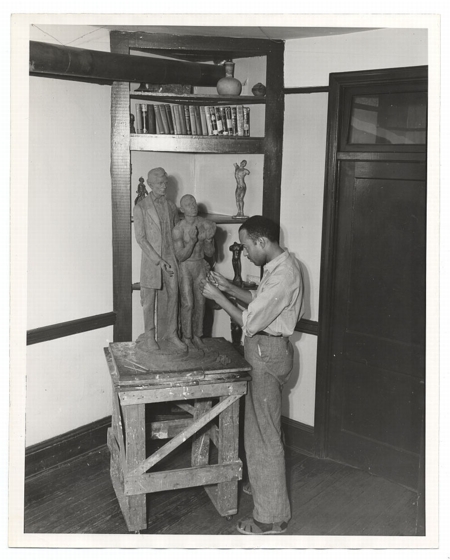
(above: Richmond Barthé, At
work on a sculpture of Lincoln and an African American slave for the New
York City, WPA Art Project. Identification on verso (handwritten
and stamped): New York City W.P.A. Art Project, Photography Division, 110
King Street Neg. No.: 5888-4; Date: 4/4/41; Title: Artist at work studio,
R. Barthe, 285-8th Ave. M.; Photographer: Rose; O.P number: 165-9-00-11. Public
domain, via Wikimedia Commons*)
Additional artworks by Richmond Barthé
Artwork by Robert Scott Duncanson

(above: Jacob Lawrence, Jean Francois was the first black to rebel in Haiti, National Archives at College Park. Public domain, via Wikimedia Commons*)

(above: Henry Ossawa Tanner, The Thankful Poor, 1894, oil on canvas, 35.5 x 44.2 inches, Private collection. Public domain, via Wikimedia Commons*)
Additional paintings by Henry Ossawa Tanner
 Return to African American Art
Return to Topics in American Representational Art
See our Museums Explained to learn about the "inner workings" of art museums and the functions of staff members. In the exhibitions section find out how to get the most out of a museum visit. See definitions for a glossary of museum-related words used in articles.
To help you plan visits to institutions exhibiting American art when traveling see Sources of Articles Indexed by State within the United States.
Unless otherwise noted, all text and image materials relating to the above institutional source were provided by that source. Before reproducing or transmitting text or images please read Resource Library's user agreement.
Our catalogues provide many more useful resources.
American Representational Art has links to dozens of topics.
Distinguished Artists is a national registry of historic artists.
About Resource Library
Resource Library is a free online publication of nonprofit Traditional Fine Arts Organization (TFAO). Since 1997, Resource Library and its predecessor Resource Library Magazine have cumulatively published online 1,300+ articles and essays written by hundreds of identified authors, thousands of other texts not attributable to named authors, plus 24,000+ images, all providing educational and informational content related to American representational art. Texts and related images are provided almost exclusively by nonprofit art museum, gallery and art center sources.
All published materials provide educational and informational content to students, scholars, teachers and others. Most published materials relate to exhibitions. Materials may include whole exhibition gallery guides, brochures or catalogues or texts from them, perviously published magazine or journal articles, wall panels and object labels, audio tour scripts, play scripts, interviews, blogs, checklists and news releases, plus related images.
What you won't find:
User-tracking cookies are not installed on our website. Privacy of users is very important to us. You won't find annoying banners and pop-ups either. Our pages are loaded blazingly fast. Resource Library contains no advertising and is 100% non-commercial. .
Links to sources of information outside our website are provided only as referrals for your further consideration. Please use due diligence in judging the quality of information contained in these and all other websites. Information from linked sources may be inaccurate or out of date. We neither recommend or endorses these referenced organizations. Although we include links to other websites, we take no responsibility for the content or information contained on other sites, nor exert any editorial or other control over them. For more information on evaluating web pages see our General Resources section in Online Resources for Collectors and Students of Art History.
*Tag for expired US copyright of object image:

 Search Resource Library
Copyright 2024 Traditional Fine Arts Organization, Inc., an Arizona nonprofit corporation. All rights reserved.