Oakland Museum of California
Oakland, CA
510-238-2200 or toll free at 888-625-6873
http://www.museumca.org
California Classic: Realist
Paintings by Robert Bechtle
 The work of one of America's founders
of photorealism is highlighted in "California Classic: Realist Paintings
by Robert Bechtle," on view at the Oakland Museum of California May
6 - Oct. 1, 2000. The exhibition includes 18 paintings and drawings by the
Bay Area artist, dating from 1965 to 1997. (left: 20th
Street-Early Sunday Morning, 1997, oil on linen, 36 x 66 inches, Courtesy
of the artist and Gallery Paule Anglim)
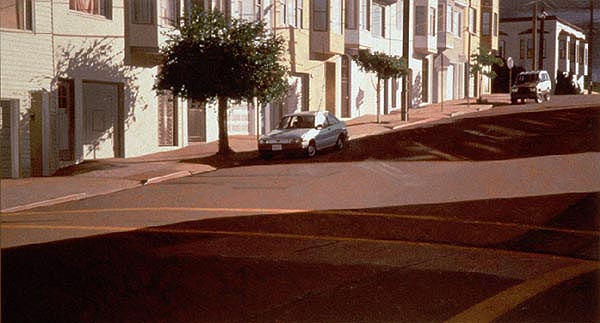
The work of one of America's founders
of photorealism is highlighted in "California Classic: Realist Paintings
by Robert Bechtle," on view at the Oakland Museum of California May
6 - Oct. 1, 2000. The exhibition includes 18 paintings and drawings by the
Bay Area artist, dating from 1965 to 1997. (left: 20th
Street-Early Sunday Morning, 1997, oil on linen, 36 x 66 inches, Courtesy
of the artist and Gallery Paule Anglim)
Bechtle's paintings of San Francisco/Oakland streets and
of cars--the symbol of California culture--are classic American icons that
reflect the California scene. "My subject matter is my immediate world,
objects that I know and care about," Bechtle says in the exhibition
catalog. "They represent the essence of the American experience."
His streetscapes are neutral, objective, often devoid of any human presence.
Bleached by the strong California sun, the scenes reflect a sense of void
and alienation.
The artworks in the exhibition, ranging in size from the
dimensions of a piece of notebook paper to  the eight-foot-long '60 T-Bird, are created
in oils, watercolor, pencil or charcoal. Typically, a Bechtle composition
includes a foreground of asphalt roadway; a midground that contains the
main subject, often a parked car; and in the background, the facade of a
building. Much of the detail in the scene is edited out, resulting in simple,
organized, almost abstract forms. (right: Potrero Crest-19th &
Pennsylvania, 1995, oil on linen, 40 x 48 inches, Courtesy John Berggruen
Gallery, San Francisco)
the eight-foot-long '60 T-Bird, are created
in oils, watercolor, pencil or charcoal. Typically, a Bechtle composition
includes a foreground of asphalt roadway; a midground that contains the
main subject, often a parked car; and in the background, the facade of a
building. Much of the detail in the scene is edited out, resulting in simple,
organized, almost abstract forms. (right: Potrero Crest-19th &
Pennsylvania, 1995, oil on linen, 40 x 48 inches, Courtesy John Berggruen
Gallery, San Francisco)
 The
term photorealism was coined by New York gallery owner Louis K. Meisel in
1968, and was first used in print in the 1970 exhibition Twenty-two Realists
at the Whitney Museum of American Art. Photorealists base their works on
photographs, using such mechanical means as copying onto a grid or projecting
the image onto the canvas to transfer the information. The finished work
is made to appear photographic, with even tones, flattened forms, and apparently
unselective detail. Bechtle defines his own paintings as realist, since
he works from, but is not limited by, photographic detail. (left:
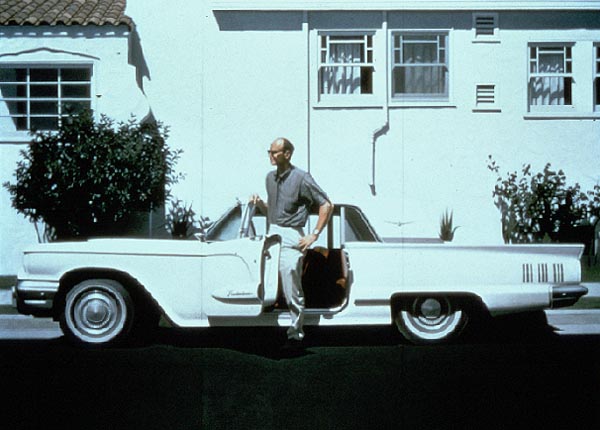
'60 T-Bird, 1967-68, oil on canvas, 73 x 99 3/8 inches, Collection
U. C. Berkeley Art Museum)
The
term photorealism was coined by New York gallery owner Louis K. Meisel in
1968, and was first used in print in the 1970 exhibition Twenty-two Realists
at the Whitney Museum of American Art. Photorealists base their works on
photographs, using such mechanical means as copying onto a grid or projecting
the image onto the canvas to transfer the information. The finished work
is made to appear photographic, with even tones, flattened forms, and apparently
unselective detail. Bechtle defines his own paintings as realist, since
he works from, but is not limited by, photographic detail. (left:
'60 T-Bird, 1967-68, oil on canvas, 73 x 99 3/8 inches, Collection
U. C. Berkeley Art Museum)
He began to use the camera so that he could work on figure
paintings while his model, his wife, wasn't around. After he began painting
cars, he found that he needed the camera to preserve the scene as the light
changed. The camera makes possible the freezing of single moments in time,
recorded with every minute detail. He uses the camera as a sketchbook, then
turns the scenes of American vernacular suburban culture into metaphors
for alienation and loneliness.
 Bechtle
explores issues of light and lack of centrality in composition. He uses
tilted, often empty foregrounds to achieve emotional as well as visual effects.
Chrome bumpers, spindly palm trees, creamy stucco, and patterned fabrics
come alive in his hands. His early work was flat, bland, with minimal shadow.
In the early '80s he began using higher contrast, with dramatic backlighting
and darker shadows that incorporated subliminal colors, reflecting his interest
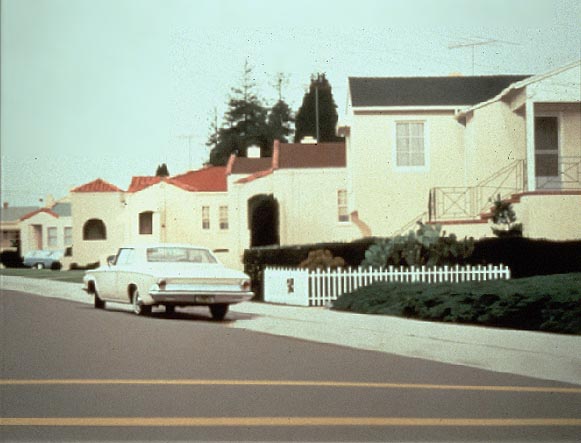
in such Old Masters as Vermeer and Velasquez. (left: '64 Chrysler,
1971, oil on linen, 48 x 60 inches, Collection of Max Palevsky)
Bechtle
explores issues of light and lack of centrality in composition. He uses
tilted, often empty foregrounds to achieve emotional as well as visual effects.
Chrome bumpers, spindly palm trees, creamy stucco, and patterned fabrics
come alive in his hands. His early work was flat, bland, with minimal shadow.
In the early '80s he began using higher contrast, with dramatic backlighting
and darker shadows that incorporated subliminal colors, reflecting his interest
in such Old Masters as Vermeer and Velasquez. (left: '64 Chrysler,
1971, oil on linen, 48 x 60 inches, Collection of Max Palevsky)
Born in 1932 in San Francisco, Bechtle received his B.A
and M.F.A degrees from the California College of Arts and Crafts in Oakland.
He retired in 1999 from a 30-year teaching career at San Francisco State
University. Over the past 40 years he has had numerous solo exhibitions
throughout California and in New York, and has participated in group exhibitions
throughout the United States and Europe as well as in Japan, Australia and
New Zealand.
 Bechtle
is one of three Northern California artists, along with Ralph Goings and
Richard McLean, who originated the West Coast photorealist style. Their
work is distinguished from that of their New York counterparts by use of
the bristle brush rather than airbrush, spontaneous outdoor scenes rather
than the subject matter of studio still lifes and figures, and use of sharp
focus for all depths of the image (unlike the images a camera would produce).
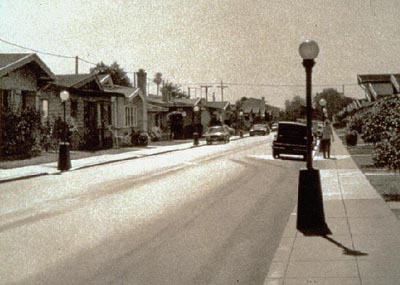
(left: Sterling Avenue, Alameda II, 1991, charcoal on paper, 10 x
14 inches, Courtesy of the artist and Gallery Paule Anglim)
Bechtle
is one of three Northern California artists, along with Ralph Goings and
Richard McLean, who originated the West Coast photorealist style. Their
work is distinguished from that of their New York counterparts by use of
the bristle brush rather than airbrush, spontaneous outdoor scenes rather
than the subject matter of studio still lifes and figures, and use of sharp
focus for all depths of the image (unlike the images a camera would produce).
(left: Sterling Avenue, Alameda II, 1991, charcoal on paper, 10 x
14 inches, Courtesy of the artist and Gallery Paule Anglim)
"California Classic: Realist Paintings by Robert Bechtle"
is organized by the University Art Museum, California State University,
Long Beach with funding from the Richard Florsheim Art Fund, and is curated
by Marina E. Freeman. Supervising curator at the Oakland Museum of California
is Philip Linhares, OMCA Chief Curator of Art.
Read more in Resource Library
about the Oakland Museum of California.
Please click on thumbnail images bordered by a red line
to see enlargements.
rev. 1/29/11
Search Resource
Library for thousands of articles and essays on American art.
Copyright 2011 Traditional Fine Arts Organization, Inc., an Arizona nonprofit corporation. All rights
reserved.
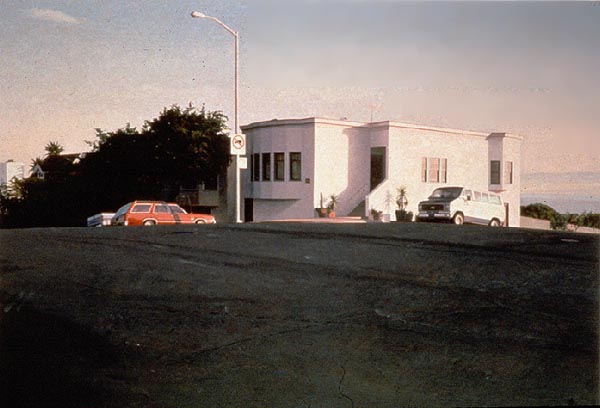
 The work of one of America's founders
of photorealism is highlighted in "California Classic: Realist Paintings
by Robert Bechtle," on view at the Oakland Museum of California May
6 - Oct. 1, 2000. The exhibition includes 18 paintings and drawings by the
Bay Area artist, dating from 1965 to 1997. (left: 20th
Street-Early Sunday Morning, 1997, oil on linen, 36 x 66 inches, Courtesy
of the artist and Gallery Paule Anglim)
The work of one of America's founders
of photorealism is highlighted in "California Classic: Realist Paintings
by Robert Bechtle," on view at the Oakland Museum of California May
6 - Oct. 1, 2000. The exhibition includes 18 paintings and drawings by the
Bay Area artist, dating from 1965 to 1997. (left: 20th
Street-Early Sunday Morning, 1997, oil on linen, 36 x 66 inches, Courtesy
of the artist and Gallery Paule Anglim)