
University Park, PA
814-865-7672
http://www.psu.edu/dept/palmermuseum/
History Past, History Present: The Daguerreotype Portrait in America
January 16-May 20, 2001
Featuring daguerreotypes by Mathew Brady and the partnership of Albert Southworth and Josiah Hawes -- among the finest art daguerreotypists in the nineteenth century -- History Past, History Present: The Daguerreotype Portrait in America explores both the aesthetic qualities of daguerreotype portraits and their social and cultural significance in nineteenth-century America.
The centerpiece of the exhibition is a rare, signed daguerreotype
portrait of Mexican War hero Colonel 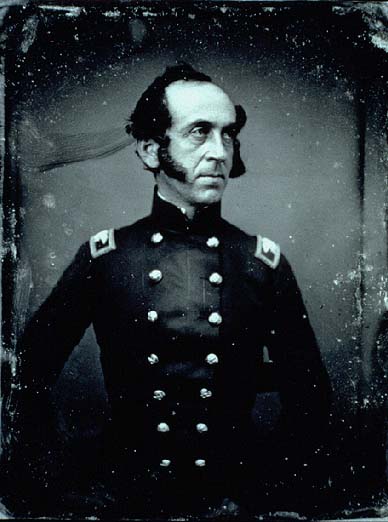 James Duncan by Mathew Brady. The Mexican War was
the first conflict fully documented in prints and photographs. Some of these
early illustrations of the war and of American presidents and statesmen,
including Presidents James Polk and Zachery Taylor, demonstrate the ways
in which, as early as the 1840s, visual documents were used politically
to sway public opinion. History Past, History Present examines this
historical context for the Duncan portrait -- particularly the fame Colonel
Duncan achieved during the war. (left: Mathew Brady (American, c.
1823-1896), Portrait of James Duncan, c. 1848, half-plate daguerreotype,
Collection of the Palmer Museum of Art, Penn State, Photo by Penn State
Image Resource Center)
James Duncan by Mathew Brady. The Mexican War was
the first conflict fully documented in prints and photographs. Some of these
early illustrations of the war and of American presidents and statesmen,
including Presidents James Polk and Zachery Taylor, demonstrate the ways
in which, as early as the 1840s, visual documents were used politically
to sway public opinion. History Past, History Present examines this
historical context for the Duncan portrait -- particularly the fame Colonel
Duncan achieved during the war. (left: Mathew Brady (American, c.
1823-1896), Portrait of James Duncan, c. 1848, half-plate daguerreotype,
Collection of the Palmer Museum of Art, Penn State, Photo by Penn State
Image Resource Center)
Duncan's photographer, Mathew Brady, is best known for
the Civil War photographs that he made between 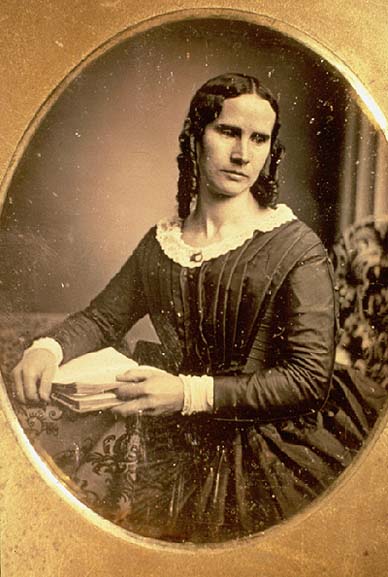 1860 and 1865, however, in the 1840s and 1850s he
was the leading portrait photographer in New York City and the most famous
American photographer of his time. Demonstrating his status, this exhibition
features several Brady photographs and numerous lithographs from his New
York City studio. This exhibition is the first to bring together Brady's
signed daguerreotype with other examples of daguerreotypes signed directly
on the plate by the photographer. (left: Albert Sands Southworth,
(American, 1811-1894) and Josiah Johnson Hawes (American, 1808-1901), Portrait
of a Seated Woman Holding a Book, c. 1850, Quarter-plated daguerreotype,
Collection of Matthew Isenberg, Photo Courtesy of Matthew Isenberg)
1860 and 1865, however, in the 1840s and 1850s he
was the leading portrait photographer in New York City and the most famous
American photographer of his time. Demonstrating his status, this exhibition
features several Brady photographs and numerous lithographs from his New
York City studio. This exhibition is the first to bring together Brady's
signed daguerreotype with other examples of daguerreotypes signed directly
on the plate by the photographer. (left: Albert Sands Southworth,
(American, 1811-1894) and Josiah Johnson Hawes (American, 1808-1901), Portrait
of a Seated Woman Holding a Book, c. 1850, Quarter-plated daguerreotype,
Collection of Matthew Isenberg, Photo Courtesy of Matthew Isenberg)
History Past, History Present also includes examples of other photographic processes used in the nineteenth century so that visitors can see the differences between a daguerreotype, an ambrotype, a tintype, and a paper photograph. There is a daguerreian studio including a camera, studio furniture, and all the equipment necessary to make a daguerreotype.
Read more about the Palmer Museum of Art in Resource Library Magazine.
Search for more articles and essays on American art in Resource Library. See America's Distinguished Artists for biographical information on historic artists.
This page was originally published in 2000 in Resource Library Magazine. Please see Resource Library's Overview section for more information.
Copyright 2012 Traditional Fine Arts Organization, Inc., an Arizona nonprofit corporation. All rights reserved.