
Art in California: 1880 to 1930
by Jean Stern
Impressionism made its debut in Paris in 1874. The new style of painting was greeted with much criticism and derision. In all, the small group of painters, including Claude Monet (1840-1926), Camille Pissarro (1830-1903), Pierre-Auguste Renoir (1841-1919), Edgar Degas (1832-1917), Alfred Sisley (18391899), Georges Seurat, and Paul Cezanne (1839-1906), among others, exhibited together only eight times. Strong disagreements over theory and practice led to the eventual break-up. Mary Cassatt (1844-1926), an American painter living in France, was accepted as a member of the group in 1879 and participated in later exhibitions. Theodore Robinson (1852-1896) lived a great part of his short life in France and was a friend of Claude Monet. Although he did not exhibit with the Impressionists, he nevertheless was one of the first American artists to return to the United States espousing Impressionism.
The first exhibition of French impressionist paintings in America was held in Boston in 1883. The display consisted of works by Monet, Pissarro and Sisley, among others. In 1893, the World's Columbian Exposition in Chicago had a significant art section devoted to American impressionist painters, and in 1898, "The Ten American Painters" was formed in New York. "The Ten" was a group of professional impressionist artists who organized for the purpose of exhibition and sale of their paintings. They were Frank W. Benson (1862-1951), Joseph De Camp (1858-1923), Thomas W. Dewing (1851-1938), Childe Hassam (18591935), Willard L. Metcalf (1853-1925), Robert Reid (1862-1929), E. E. Simmons (1852-1931), Edmund C. Tarbell (1862-1938), John H. Twachtman (1853-1902), J. Alden Weir (1852-1919) and William Merritt Chase (1849-1916), who was invited to join after the death of Twachtman.
Just as the original group of French Impressionists consisted of diverse personalities with disparate aims and philosophical approaches, American Impressionists likewise were practicing different forms of the style and, on occasion, straining the limits of what can be loosely defined as Impressionism. There was no theoretician to lead the movement.
Moreover, Impressionism came to America at least a decade after its riotous debut in France. As such, American painters benefited from the soothing effects of time on a critical art public. Also, they had the luxury of picking and choosing from among a number of techniques and approaches, many of which were developed by artists who had progressed beyond Impressionism. These methods concerned themselves with specific uses of subject, color and line, and related to painting techniques followed by post-impressionist artists such as Paul Gauguin (1848-1903) and Vincent van Gogh (1853-1890).
By 1900, Impressionism, or what may be more properly termed "Impressionistic Realism," was the style of choice among American painters. Stylistically, it was a modified and somewhat tempered variant of the prototype French movement. The significant contributions of French Impressionism to American art were in the use of color and the specialized brushwork. Americans, in general, did not dissolve forms, a common practice with Claude Monet and his followers. The penchant for realistic observation of scenes, long a staple of American painting, survived the Impressionist onslaught. The scientific theories of color as revealed by Chevreul were indeed well received by Americans, even by those who did not consider themselves Impressionists, and the outcome showed in paintings with brilliant and convincing effect of natural light. The loose, choppy brush stroke that characterizes an impressionist work was both the consequence of the quick manner of paint application and the desire to produce a brilliant surface covered with a multitude of small daubs of bright color.
The principal American teacher of Impressionism was William Merritt Chase. At first with the Art Students League in New York and later in his own art school in New York City and at Shinnecock, Long Island, Chase was insistent on imparting to his students the discipline and technique of painting" en plein air." To impress on them the necessity for quickness when painting outdoors, he admonished them, "Take as long as you need to finish the painting, take two hours if necessary."
The plein-air style continued to be popular in California until the end of the 1920s. By that time, many of the key figures that had made the style the vibrant and dynamic phenomenon of earlier years had died or ceased to paint. Moreover, the new generation of California artists who had admired, sought out and trained under the Impressionists had been lured into "new" styles based on tenets and concepts of European Modernism. Indeed, by the start of the Depression the direction of California art was set by an entirely new group of artists, and the California Impressionists were consigned to the past.
This is page 4
Resource Library editor's notes:
The above 1995 essay was written by Jean Stern, Director of The Irvine Museum, for the 128 page illustrated catalogue Romance of the Bells: The California Missions in Art , ISBN 0-9635468-5-6 (cloth). The essay is located in pages 73-83 in the catalogue. The essay is re-keyed and reprinted with permission of The Irvine Museum and without illustrations. If you have questions or comments regarding the essay, or wish to purchase a copy of the catalogue, please contact The Irvine Museum directly through either this phone number or web address: 949-476-2565; http://www.irvinemuseum.org. Readers may enjoy reading a 1997 review of this catalogue from Resource Library's predecessor publication.
Also see these articles and essays: California Art History, California Artists: 19th-21st Century, California Impressionism and California Regionalism and California School of Painters. Read more articles and essays concerning this institutional source by visiting the sub-index page for the The Irvine Museum in Resource Library.
See these essays by Jean Stern in Resource Library:
Art in California: 1880 to 1930 by Jean Stern
Artists in Santa Catalina Island Before 1945 by Jean Stern
The California Missions in Art: 1890 to 1930 by Jean Stern
The Development of Southern California Impressionism by Jean Stern
Franz A. Bischoff, 1864-1929 essay by Jean Stern
Impressionist Style in Perspective by Jean Stern
Impressionism in California, 1890-1930 by Jean Stern
The Irvine Museum in Perspective by Jean Stern
Landscape of Light: Impressionism in California by Jean Stern
Landscape Painting in California by Jean Stern
Marion Kavanagh Wachtel, 1870-1954 by Jean Stern
Masters of Light by Jean Stern
"The Outsiders" -- Modernism in California, 1920-1940 by Jean Stern
The Paintings of Sam Hyde Harris by Jean Stern (2001)
Robert Henri and the 1915 San Diego Exposition by Jean Stern
For further biographical information on artists mentioned in this article please see America's Distinguished Artists, a national registry of historic artists.
Following are examples of representational artworks created by artists, or photographs of artists, referenced in the above article or essay. Images may not be specific to this article or essay and are likely not cited in it. Images were obtained via Wikimedia Commons, which believes the images to be freely available for presentation here. Another source readers may find helpful is Google Images.
(above: Mary Stevenson Cassatt, Children in a Garden (The Nurse), 1878, oil on canvas, 25.7 x 31.8 inches, Museum of Fine Arts, Houston. Public domain, via Wikimedia Commons*)
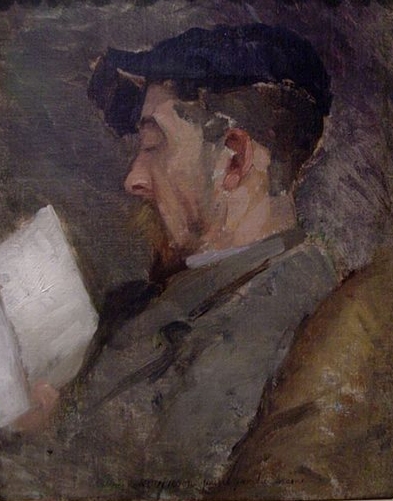
(above: Theodore Robinson, Self-portrait, c. 1884-87, oil on canvas, 13 1/4 x 10 1/4 inches, Metropolitan Museum of Art. Public domain, via Wikimedia Commons*)

(above: Frank Weston Benson, Portrait of Gertrude Russell, 1915, oil on canvas, 54.2 x 42 inches, Christie's. Public domain, via Wikimedia Commons*)

(above: Frederick Childe Hassam, West Indian Girl, 1914, oil on canvas, Harvard Art Museums. Public domain, via Wikimedia Commons*)
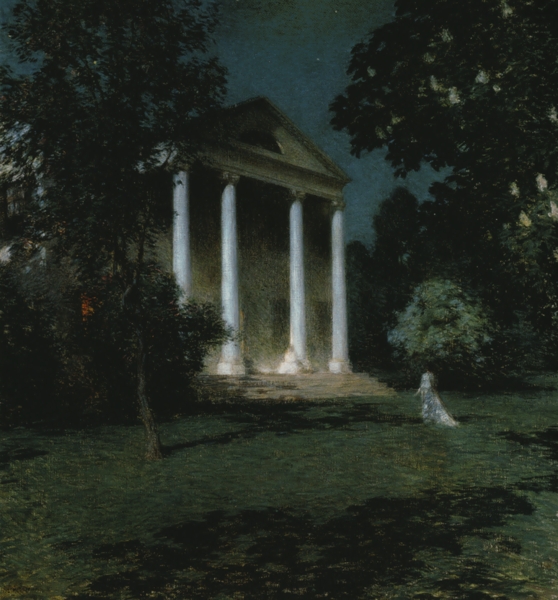
(above: Willard Metcalf, May Night (Florence Griswold House in Old Lyme, Connecticut.), 1906, oil on canvas, 99.5 ? 36.1 inches, National Gallery of Art. Public domain, via Wikimedia Commons*)

(above: William Merritt Chase (American, Williamsburg, Indiana 1849-1916 New York), At the Seaside, c. 1892, Oil on canvas, 20 ? 34 inches. The Metropolitan Museum of Art, Bequest of Miss Adelaide Milton de Groot (1876-1967), 1967. Public domain, via Wikimedia Commons*)
 Return to California Art History
Return to Individual States Art History Project
Links to sources of information outside of our web site are provided only as referrals for your further consideration. Please use due diligence in judging the quality of information contained in these and all other web sites. Information from linked sources may be inaccurate or out of date. TFAO neither recommends or endorses these referenced organizations. Although TFAO includes links to other web sites, it takes no responsibility for the content or information contained on those other sites, nor exerts any editorial or other control over them. For more information on evaluating web pages see TFAO's General Resources section in Online Resources for Collectors and Students of Art History.
*Tag for expired US copyright of object image:

 Search Resource Library
Copyright 2005-2022 Traditional Fine Arts Organization, Inc., an Arizona nonprofit corporation. All rights reserved.