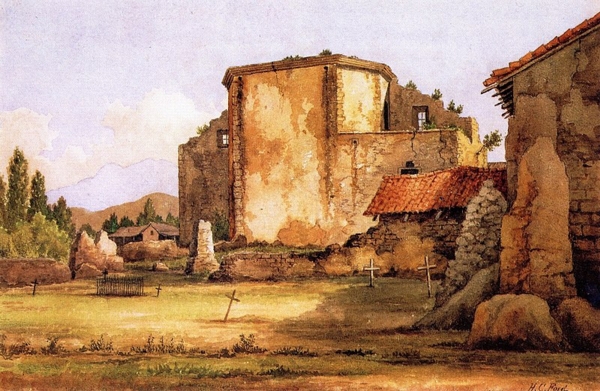
The California Missions in Art - 1786 to 1890
by Norman Neuerburg
Ford's place as the leading artist in Santa Barbara was taken by Alexander Harmer (1856-1925), who had married into an old California family and settled in that city in 1893, shortly before Ford's death. In the late 1880s, however, he had done a number of fine oils of both San Luis Rey and San Juan Capistrano missions. Having been a student of Thomas Eakins in Philadelphia, he was the first professionally trained artist to paint the California missions seriously. These works are straight-forward, accurate renderings of what he saw. After settling in Santa Barbara, he turned to portraying a very romantic view of early California of the sort which had become popular after the publication of Helen Hunt Jackson's novel Ramona.
The 1880s saw the appearance of a number of articles on the missions in national publications and the first books on the subject. As a result, a large number of artists did one or more mission paintings, though few attempted series. We find artists such as William Keith (1838-1911), Thomas Hill (1829-1908), J. Henry Sandham (1842-1912), and a host of other artists of lesser renown doing occasional paintings of missions. Many of these, and others, prepared drawings to be reproduced as illustrations, especially before the reproduction of photographs became widespread. Numerous amateur painters, frequently women, painted missions, and they continued the tradition. Miss Jane Hunt, a niece of the brothers Richard and William Morris Hunt, the noted architect and painter, did a large number of watercolors of the missions during the years 1888 to 1894. Eva Scott Fenyes (1846-1930) also did a very large number of watercolors of the missions and old adobe houses between 1896 and 1926.
After the railroad came to San Juan Capistrano in 1887, painters arrived in large numbers to paint its mission. Over the years possibly no other mission had so many paintings done of it. Some artists even rented space as studios in the unruined parts of the mission buildings. In 1894 Judge Egan commissioned Fred Behre to paint a reconstruction of the San Juan Capistrano mission with a wildly improbable steeple over the entrance of its Great Stone Church. It was incorrectly believed to be the way the church looked before the 1812 earthquake. Excavations in 1938 showed that the steeple placement shown in the painting was impossible. The landscape in the background of this painting was modified by Gutzon Borglum (1861-1941). He began to frequent the mission along with his first wife Elizabeth Collins Borglum (1848-1922), who had actually been his teacher. Charles Arthur Fries (1854-1940) lived in the mission in the late 1890s. His famous painting Too Late, which adorned doctors' waiting rooms across the country, is set in the old dining room of the mission. By that time the mission had become a special and favorite subject for artists of the plein-air school, which came into its own in California in those years.
About the author
The late Dr. Norman Neuerburg was an expert on art of the California missions and historical consultant for several of the mission restoration projects. He was the author of numerous texts concerning the missions including "Painting in the California Missions" American Art Review July 1977 (Volume IV, Number 1) and books including The Decoration of the California Missions (1987), Architecture of Mission La Purisima (1987) and Saints of the California Missions (1989). He received a posthumous Honorary Doctor of Fine Arts from California State University Dominguez Hills in 1998.
In honor of Dr. Neuerburg, in 1999 the California Mission Studies Association created the Norman Neuerburg Award to recognize outstanding contributions towards the study and preservation of California's missions, presidios, and ranchos.
This is page 4
Resource Library editor's note:
The above 1995 essay was written by Norman Neuerburg for the 128 page illustrated catalogue Romance of the Bells: The California Missions in Art , ISBN 0-9635468-5-6 (cloth). The essay is located in pages 85-95 in the catalogue. The essay is re-keyed and reprinted with permission of The Irvine Museum and without illustrations. If you have questions or comments regarding the essay, or wish to purchase a copy of the catalogue, please contact The Irvine Museum directly through either this phone number or web address: 949-476-2565; http://www.irvinemuseum.org
Readers may enjoy reading a 1997 review of this catalogue from Resource Library's predecessor publication and these articles and essays:
For California art history overall see California Art History, California Artists: 19th-21st Century, California Impressionism and California Regionalism and California School of Painters.
For further biographical information on artists mentioned in this article please see America's Distinguished Artists, a national registry of historic artists.
Following are examples of representational artworks created by artists, or photographs of artists, referenced in the above article or essay. Images may not be specific to this article or essay and are likely not cited in it. Images were obtained via Wikimedia Commons, which believes the images to be freely available for presentation here. Another source readers may find helpful is Google Images.
(above: Henry Chapman Ford, Misión San Juan de Capistrano, 1880, oil on canvas. Public domain, via Wikimedia Commons*)
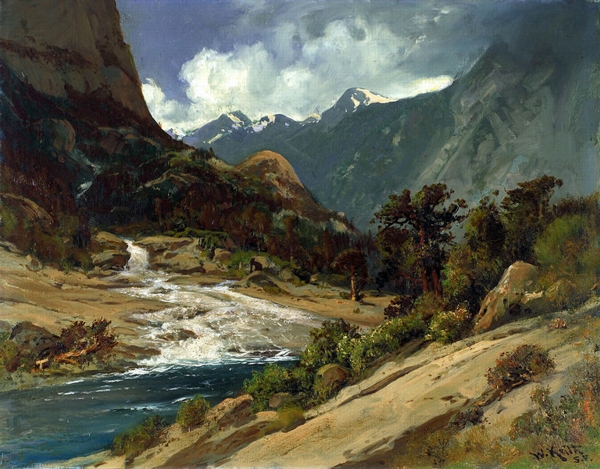
(above: William Keith, Hetch Hetchy Side Canyon, c. 1908, oil on canvas, 22 x 27.9 inches, De Young Museum. Public domain, via Wikimedia Commons*)
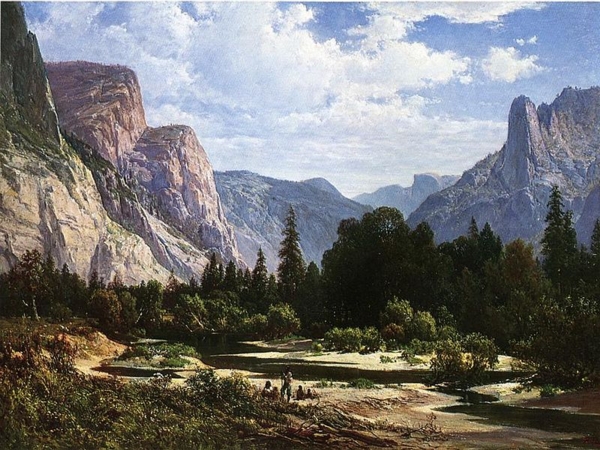
(above: Thomas Hill, Resting by a Stream, 1866, oil on canvas, 24 x 32 inches, Private collection. Public domain, via Wikimedia Commons*)

(above: Gutzon Borglum and Lincoln Borglum, Mount Rushmore National Memorial, 1927 to 1941. Photo courtesy of National Park Service Image Gallery)
Read more articles and essays concerning this institutional source by visiting the sub-index page for the The Irvine Museum in Resource Library.
 Return to California Art History
Return to Individual States Art History Project
Links to sources of information outside of our web site are provided only as referrals for your further consideration. Please use due diligence in judging the quality of information contained in these and all other web sites. Information from linked sources may be inaccurate or out of date. TFAO neither recommends or endorses these referenced organizations. Although TFAO includes links to other web sites, it takes no responsibility for the content or information contained on those other sites, nor exerts any editorial or other control over them. For more information on evaluating web pages see TFAO's General Resources section in Online Resources for Collectors and Students of Art History.
*Tag for expired US copyright of object image:

 Search Resource Library
Copyright 2022 Traditional Fine Arts Organization, Inc., an Arizona nonprofit corporation. All rights reserved.