
Illustrated Audio Opportunities
(above: George Hetzel, Farm at Scalp Level, c. 1860, oil on canvas, 22 x 33 inches, Private collection. Public domain, via Wikimedia Commons*)
Gallery tours
The illustrated audio concept may be adapted to the creation of virtual gallery tours. Web gallery tours can:
Each tour's web page can contain links to pages containing individual illustrated audio clips. There can be orientation pages starting with an introduction page with a clip identifying the tour followed by a page introducing the presenting person(s). A floor plan map page identifying the galleries in the subject floor can be next in the orientation sequence.
A QuickTime floor plan panoramic example (without audio) is:
Other static floor plan examples include
After the orientation pages there are links to pages containing clips that show and interpret specific objects in the gallery room(s). The illustrated audio page interpreting the painting Right and Left from the National Gallery of Art is an example. A gallery room map image, with a dot or other marker identifying the location of a specific object in the room, can be used on the page with the illustrated audio clip describing that object.
Admission departments of colleges and universities effectively employ illustrated audio tours. Campus maps are used to orient viewers. Here are creative examples using interactive maps:
As suggested above for accession interpretations, the gallery tour segments should be brief.
In the November 22, 2004 issue of Business Week, there is an article on the refurbished Modern Art Museum in New York City. The article quotes Steve Peltzman, MOMA's chief information officer and says that "Ultimately, art watchers should be able to log onto MOMA's Web site and customize their tours, which will be downloaded to a handheld when they arrive." The article suggests that visitors will be able to choose from tour options online and then use a Toshiba Pocket PC to guide them on their physical tour. While the use of onsite handhelds is a creative use of technology, the viewing of an online customized tour before arriving at a museum will serve to make the visitor's onsite experience more enriching. The visitor will be able to better plan the use of his or her time at the museum and be pre-informed on the objects to be seen one-by-one and in a larger context. A museum can conserve scarce docent resources through the use of self-directed tours.
The West Bend Art Museum placed on a web page samples of an audio tour. The page may be likened to a page containing a guide to an online illustrated audio discussion of objects by a curator or docent. The West Bend page contains audio-only segments, not illustrated audio segments.
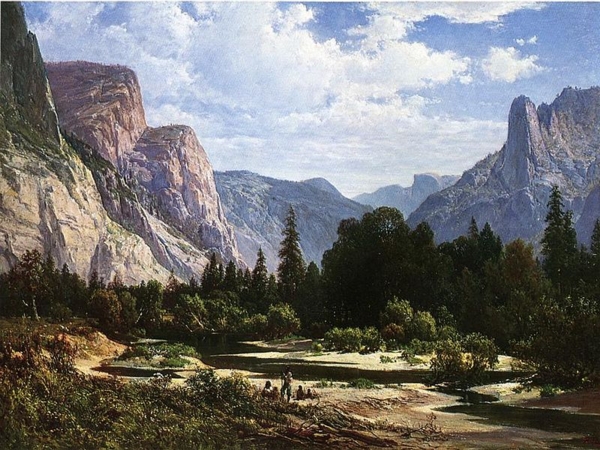
(above: Thomas Hill, Resting by a Stream, 1866, oil on canvas, 24 x 32 inches, Private collection. Public domain, via Wikimedia Commons*)
go back to Illustrated Audio Opportunities
*Tag for expired US copyright of object image:

Links to sources of information outside of our web site are provided only as referrals for your further consideration. Please use due diligence in judging the quality of information contained in these and all other web sites. Information from linked sources may be inaccurate or out of date. TFAO neither recommends or endorses these referenced organizations. Although TFAO includes links to other web sites, it takes no responsibility for the content or information contained on those other sites, nor exerts any editorial or other control over them. For more information on evaluating web pages see TFAO's General Resources section in Online Resources for Collectors and Students of Art History.
 Search Resource Library
Copyright 2022 Traditional Fine Arts Organization, Inc., an Arizona nonprofit corporation. All rights reserved.